




EY refers to the global organization, and may refer to one or more, of the member firms of Ernst & Young Global Limited, each of which is a separate legal entity. Ernst & Young Global Limited, a UK company limited by guarantee, does not provide services to clients.
Recent Searches
Trending
-
Advancing Canada’s defence innovation
09 Apr 2026 -
Canadian Insurance Outlook 2026: navigating uncertainty, unlocking opportunity
13 Mar 2026 Financial services -
From bottleneck to accelerator: the strategic role of digital identity controls for industrials and energy companies
18 Feb 2026 Energy and resources

Authors:
Christopher Burgh, EY Canada Partner, Health care Transformation Leader
Maureen Palmer, EY Canada Senior Manager, Health care Consulting
Health care systems across Canada face rising costs and demand, driving urgent action for innovation and efficiency to ensure sustainability.
In brief
- Health care costs and demand are growing rapidly, pressuring sustainability and requiring efficiency improvements.
- System transformations including care delivery innovation and digital investment are key to navigating resource constraints.
- Implementing financial and operational improvements grounded in strong assessments and accountability is essential to achieving sustainable health care.
Health care systems across Canada are under increasing strain from growing demand for services and rising costs. This pressure is challenging the system’s financial sustainability, creating a sense of urgency to act by seizing opportunities to innovate and challenge the status quo.
Governments — both provincial and federal — have increased spending on health care in recent years to address fiscal challenges, but demand is outpacing governments’ ability to continue to invest at the same rate. There is recognition that future spending increases must be combined with efficiency gains to drive long-term sustainability and increased value to the health care system.
These efficiency gains will be achieved through a combination of operational improvements and more structural system changes:
- Structural changes to health care systems across the country are required to better align health care system capacity to population health needs to provide timely care to people in the most appropriate care setting.
- Health care operations must become models of efficiency through the reinvention of service delivery models. Adopting new models of care and deploying emerging innovations in care delivery will both drive down the cost of delivering services and increase the system’s capacity to manage growing demand.
Across Canada, health care leaders are rising to the challenge and seizing the opportunity to build a more sustainable health care system by undertaking transformations at all levels. Such transformations include bolstering primary, home and community care; developing and scaling innovation; and investing in technology and workforce transformation.
At the same time, we are seeing a heightened focus on optimizing how resources — both financial and human — are managed and deployed to maximize the value delivered by the system for every dollar invested.
This starts with assessing where and how funds are being spent and seeking opportunities to optimize where and how resources are deployed. But it’s also critical to actively implement operational improvements at pace and enforce this progress through enhanced accountability mechanisms and capabilities.
The goal is to enable the strategic investment of scarce resources to unlock operational efficiencies and capacity to manage growing demand with resource constraints.
The urgency to tackle financial sustainability in health care
Demographic shifts are driving increasing demand for health care services in Canada and a corresponding increase in health care costs. Canada’s population has increased by 16% over the past decade, while those aged 65 and older have surged by 40%, now representing nearly 1 in 5 Canadians (19%) as of July 1, 2024.1 This age group is a significant driver of health care demand and costs, accounting for more than 40% of health expenditures.2 These demographic shifts present a significant challenge to health care sustainability that will intensify as the population continues to grow and age.
Further, inflationary pressures on both labour and supply costs have increased the cost of delivering services over the last several years. These impacts are seen in the accelerated growth of annual health care spending in Canada — from 1.7% growth in 2022 to an expected 5.7% in 2024.3 Since 2013, provincial government spending on health care has increased by 60%, federal spending by 86%.4
It is acknowledged that this rate of spending growth is unsustainable, constrained by the financial realities of federal and provincial/territorial government budgets. From 2019/20 to 2023/24, the accumulated debt of the federal and provincial governments grew by 24.3%, to approximately $425 billion.5
How health care systems are responding to the financial sustainability challenges
Across Canada, we are seeing accelerated large-scale changes to health care systems to meet this moment. These include:
- Transforming Canada’s primary care system in support of better long-term health outcomes
- Bolstering home and community care to provide convenient and connected care in the home and community setting
- Investing in digital health, including making health data accessible and meaningful
- Innovation development and scaling, including the use of AI to speed health care transformation
These transformations must be paired with a strong focus on improving how resources are managed, facilitating decision-making on how and where scarce resources are deployed to maximize the value delivered by the system for every dollar invested.
Effective resource management strategies span three key types of activities, which work together to drive iterative improvements in financial sustainability:
EY’s perspective on approaches to financial and operational sustainability
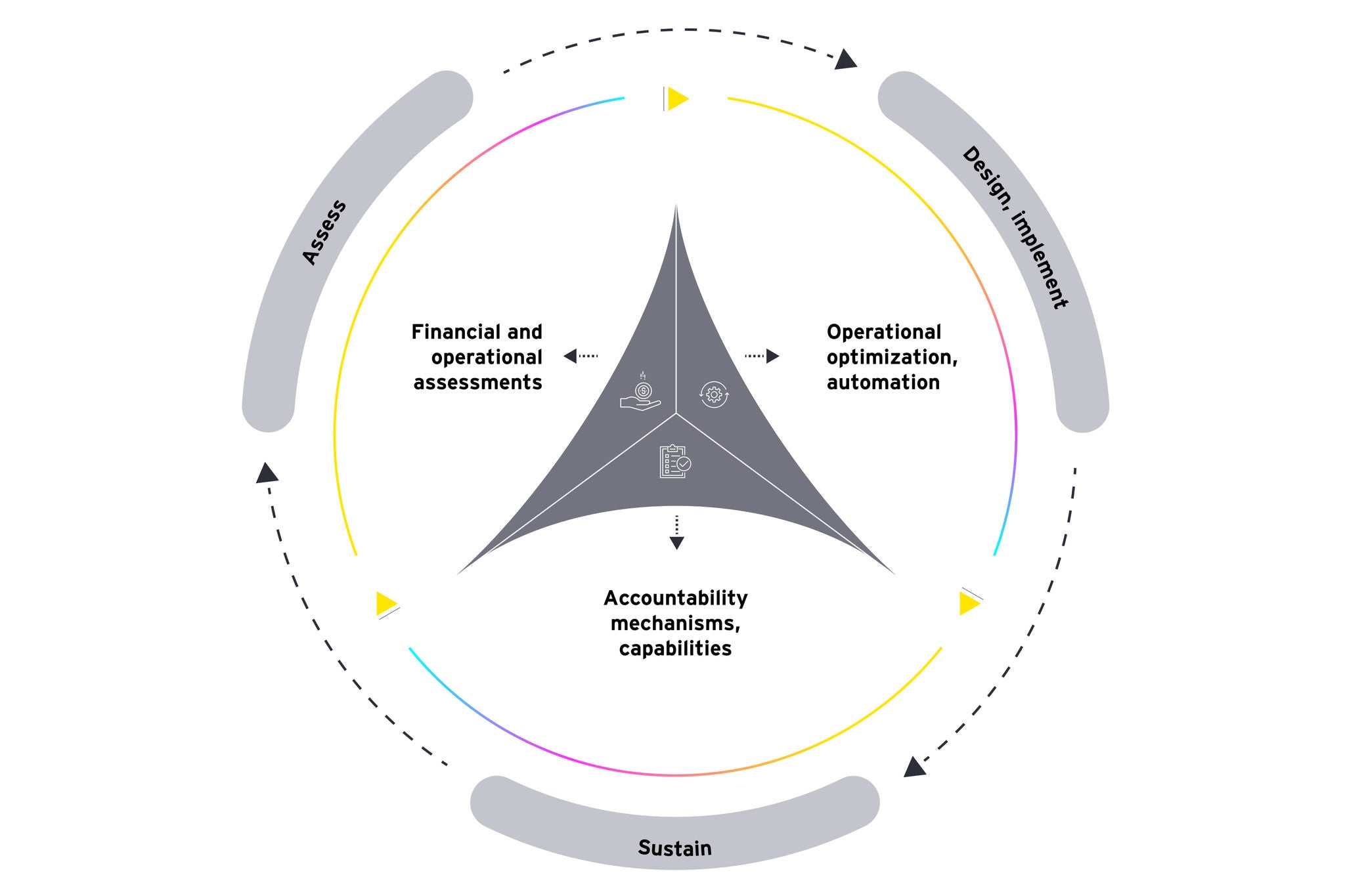
Important to note: while assessing opportunity areas through financial and operational assessments is key to identifying areas of focus, benefits are only realized through the implementation and sustainment of initiatives to unlock value.
Financial and operational assessments: Assessments seek to understand where and how funds are being invested across systems, sectors and/or service providers, and to identify where there may be opportunities to achieve greater efficiency and better align resources to meet population health needs. Accurate and detailed assessments of opportunities enable a focus on improving those areas with the greatest potential for return to the system.
Operational improvements, including through automation: Putting the findings from the assessments into action, optimizing operations often requires implementing complex changes to operating models. These changes may include changes to people, processes and technology through organizational and process redesign and automation of manual processes.
Successfully implementing complex change requires thoughtful design and adept implementation to achieve the desired improvements. Consideration must be given to the organization’s readiness for change, as well as change and project management, including the resourcing required to implement effectively and at pace.
Accountability mechanisms and capabilities: The successes achieved through these improvements are reinforced through strong accountability mechanisms. It’s essential to strengthen an organization’s or system’s ability to drive accountability. This not only helps to monitor progress against the process’s objectives, but also to sustain changes and continuously refine how resources are allocated and used.
To do this effectively, there are three foundational accountability mechanisms:
- Performance management: Establish outcome-oriented performance measures and capture timely operational and financial data to enable the tracking of progress and identification of gaps and inform evidence-based decisions. Robust reporting and analytics turn data into actionable insights.
- Funding models: Design funding models to incentivize the required behaviours to drive transformation goals, including integrated care delivery, prevention and innovation.
- Budgeting and forecasting capabilities: Strengthen these capabilities to help align resources to meet population health needs. This can be adjusted in a timely manner as needs evolve.
Coordinating these three mechanisms and prioritizing implementation supports incremental improvements in financial and operational sustainability. Together, they enable the identification of opportunities to unlock operational efficiencies and advance the ability to make strategic investments of scarce resources to manage growing demand within resource constraints.
Moreover, they lay the foundation for a resilient health care system that can adapt to current and future pressures. With decisive action and strategic investment, health care leaders can create a financially sustainable and operationally resilient system ready for the future.
Summary
Health care systems in Canada face significant financial pressures from demographic changes and cost inflation. Through a combination of structural changes, operational improvements and strong accountability mechanisms, health care leaders can foster sustainable systems that deliver value and adapt to future demands.
Related content
Transform care models to deliver better mental health for all
New EY research reveals four key areas for health organizations to enhance mental health access, experience and outcomes. Discover actionable insights today.
Assessing digital maturity in home and community care
Explore EY's Digital Maturity Model for assessing capabilities in home and community-based care in Canada, enabling efficient and connected care delivery.