






EY Americas Metals & Mining Forum

Metals and minerals: a sector in transition, a decade of transformation

This year’s Americas Metals and Mining Forum (AMMF) convened top industry voices sharing perspectives on key topics in a rapidly evolving future.


In brief:

  • Featuring the theme “Driving innovation: the essential role of metals and minerals in shaping a sustainable future,” AMMF built on last year’s findings. 
  • Driven by demand for critical minerals in a technological world, topics ranged from decarbonization and capital allocation to innovation and transformation. 
  • Audience insights reinforced the need for resilience as the sector reimagines its future, reshapes operating models and redefines expectations for long-term value.

As the world continues to evolve, the metals and minerals (M&M) sector finds itself at a critical crossroads. Tasked with addressing pressing challenges, each year brings a greater need to push boundaries to fully seize opportunities and create long-term value.

From sharing a vision for the future of critical minerals and a sneak peek of the UN Climate Change Conference (COP30) in Brazil to integrating sustainability into mine design, speakers delved into the near-term imperatives facing the sector.

Insights and strategies for balancing capital, growth and energy demands engaged the 516 participants in attendance, who fed into the discussion through a series of polling questions on transformation, decarbonization, future pressures and priorities as companies navigate the complexities of a market influenced by geopolitical uncertainty.

The result? It became abundantly clear that change would continue to be the new normal in the sector’s coming decade. And long-term leaders would be the ones committed to — and confident in — transformation and agility to stay ahead of change.

Conveyor belt transporting rocks in industrial quarry
1

Chapter 1

Transformation and adaptation: strategically evolving to reflect changing dynamics

EY Post-event POV graphics 1

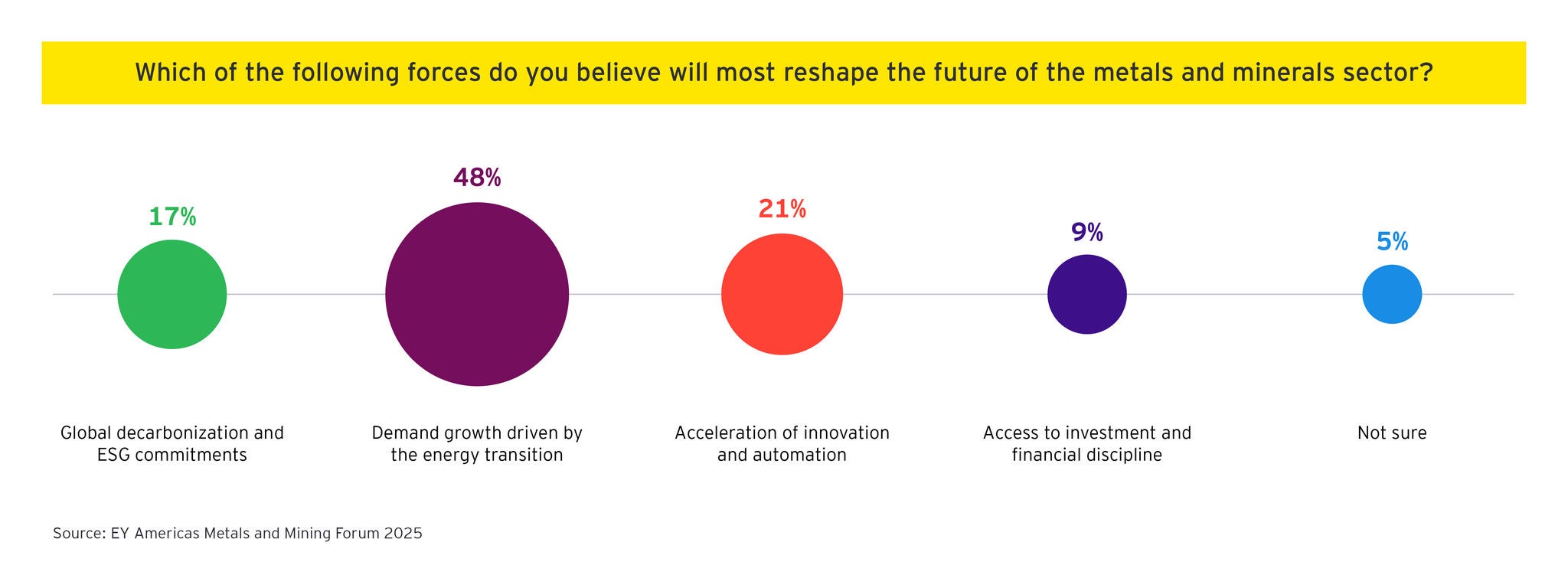
The metals and minerals sector continues its renaissance. Driven by growth and demand in an increasingly technologically dependant world, it’s no surprise that almost half of those polled at the event listed energy transition-driven growth as a leading force shaping the sector in the years to come.
 

The adoption of renewable technologies will require vast amounts of metals and minerals. With demand expected to quadruple by 20401,  significant growth will be necessary, with pressure on producers only mounting. Innovation and automation was selected by one in five respondents, with speakers reinforcing that while progress over the years has been slow, innovation leading to efficiencies continues to be steady across the sector.
 

But with the power of artificial intelligence (AI) continuing to infiltrate different aspects of the business, from predictive maintenance, health and safety to environmental monitoring and the continued adoption of autonomous equipment, innovation is sure to have an impact on mining’s future. It is therefore not a surprise that very recently, our annual Top 10 Business Report in the sector confirmed digital and innovation as part the top opportunities.
 

Rounding out the final quarter of responses, 17% of those polled expect environmental, social and governance (ESG) commitments to play a role, despite being deprioritized in the fallout of geopolitical shifts. Access to investment and financial discipline garnered the remaining 9% of votes, reinforcing findings from the EY Top 10 business risks and opportunities for mining and metals in 2026 report, which identified rising costs and capital among the top three opportunities.
 

Injections of funding, reliable partnerships that help diversify risk and strong trade relations may be the rewire needed to tip the scales and reshape one of the most challenging and complex periods in mining’s history into one of its most exciting, as the sector looks to the future.

Not without challenges

EY Post-event POV graphics 2

With so much on the line, defining the future the sector wants to see cannot be underestimated. Likened to a “tale of two cities” by one presenter, who compared Western ecosystems and supply chains to those in China and other “step-ahead” jurisdictions around the world, the ability to attract capital and investment will be critical to upping mining’s game.

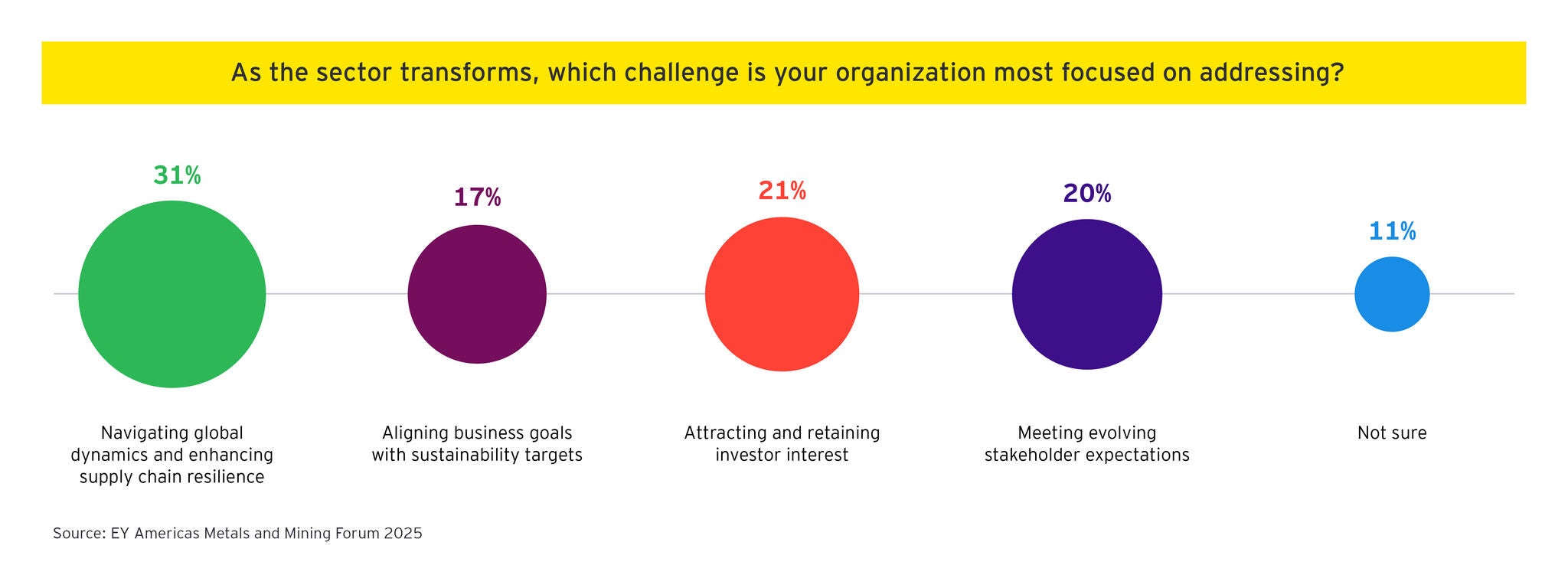
Securing 21% of polling responses, attracting and retaining investor interest and delivering on stakeholder expectations (20%) came neck and neck, second and third to unprecedented global dynamics and supply chain uncertainties, at 31%.

According to AMMF speakers, resilience and collaboration will be key to navigating global dynamics and optimizing supply and value chains. But laying the groundwork for a future that meets stakeholder expectations is unlikely to be quick. Or simple. And certainly not a lever that can easily be turned alone.

Where, historically, success was defined as “chasing geology” - regardless of where deposits were found - models have fundamentally changed. Exploration can no longer turn a blind eye to policy. Government and industry must work together to influence smart tax policy aimed at reducing permit approval and licensing timelines to deliver supply with greater efficiency.

Federal loans, tax credits or incentives - such as the U.S. Department of Energy Mine of the Future initiatives,2 Brazil’s supportive taxation regime3 or the Critical Mineral Exploration 30% tax credit aimed at unlocking mining investment in Canada4 - can encourage responsible investment and reward high environmental standards. Inviting joint ventures, co-ownership models and critical partnerships with Indigenous communities, for example, can bring like-minded groups together to partner on decision-making and share in potential stakes.

From the inside out

EY Post-event POV graphics 3

Labor shortages. Advancing technology. Capital risks. Geopolitical pressures. While predicting what’s pending in coming decades can be tricky, one thing is certain - inaction will not be an option.

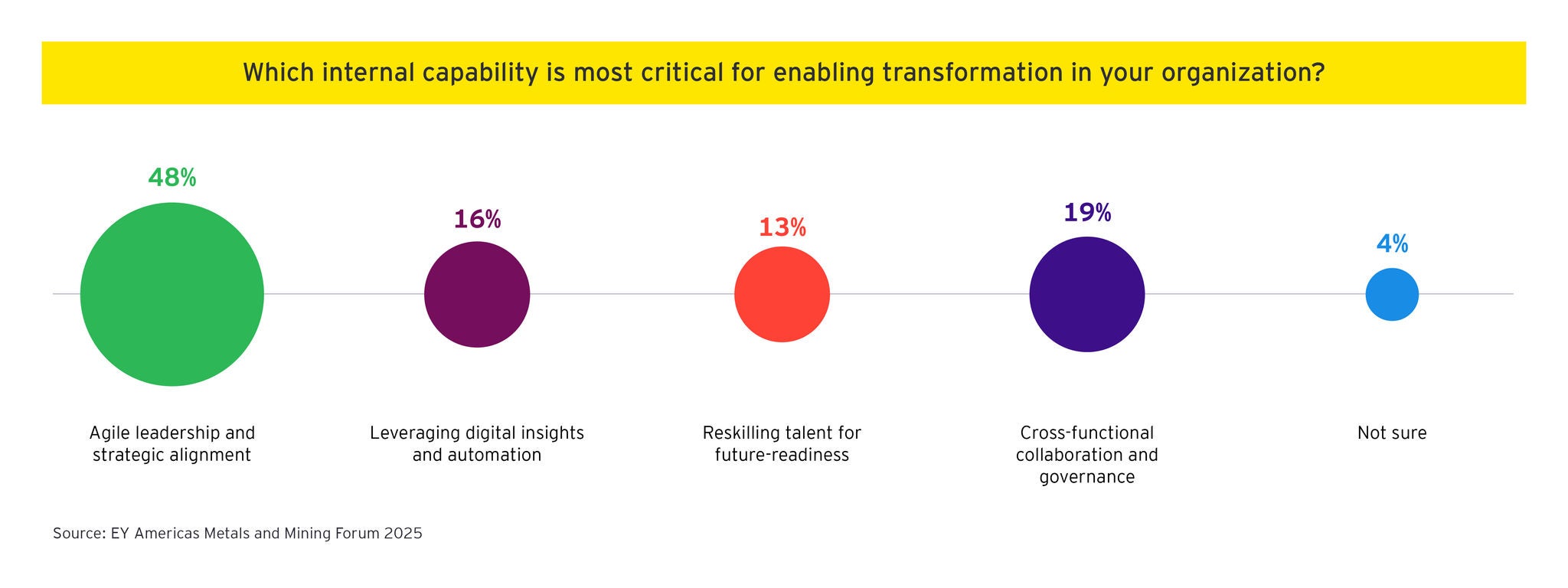
Navigating the landslide of evolving change will take stamina and agility, as echoed by almost half of respondents (48%) who voted leadership and strategic alignment as key capabilities enabling transformation. In an ecosystem a speaker described as having atrophied in recent years, mining is often seen as an industry firmly planted in the past.

Overdue transformation may demand back-to-basics tactics - taking a closer look at organizations’ existing portfolios and capital allocation and considering best-case scenarios that allow assets to achieve their full potential down the road.

With more than 60% of mining supply chains affected by geopolitical tensions,5 collaboration with government and key stakeholders will be table stakes, according to 19% of poll participants. While complex, reducing bureaucratic hurdles - around permitting, environmental standards or how we engage with Indigenous communities, for example - can help get to decisions quickly and be time well spent, like Ontario’s One Project, One Process initiative, which is striving to reduce approval times for new mining projects by half,6 or Chile’s recently approved legislation that is expected to slash permitting by 30% to 70%.7 Similarly, supporting like-minded governments in establishing coalitions - rather than battling trade barriers - could focus action on positive change.

And with 13% of respondents prioritizing talent, insights and automation, tapping governments for scholarships to help train the next generation to enable mines of the future can spin opportunity from unemployment, inviting highly skilled youth to respond to the sector’s impending age of AI.

A breathtaking aerial perspective of the Amazon Rainforest, Brazil, showcasing its lush canopy and winding rivers
2

Chapter 2

Accelerating decarbonization: the push and pull of low carbon

EY Post-event POV graphics 4

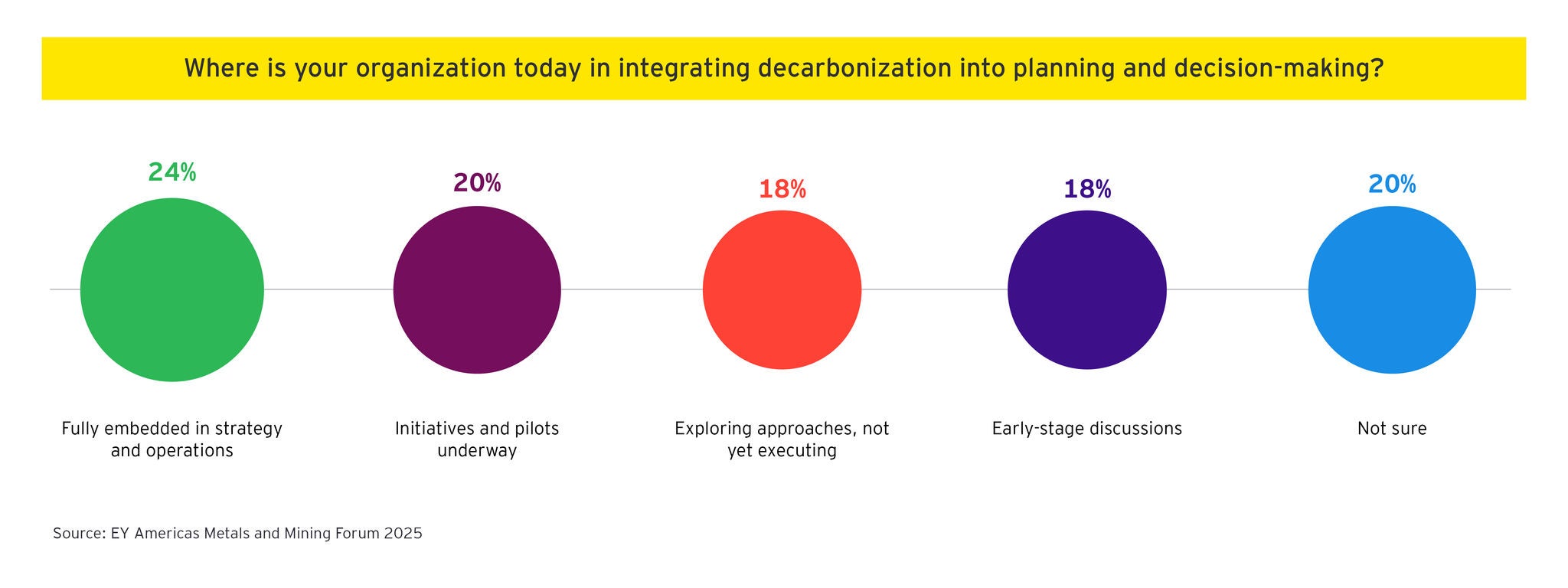
Energy transition pressures are mounting in jurisdictions around the world. Yet despite the clock ticking down to net zero, AMMF polling showed that one in five participants aren’t certain of their decarbonization plans, and almost 40% combined are involved in either exploratory approaches or early-stage discussions.

With less than a quarter of participants (24%) indicating that planning and decision-making are fully embedded in strategic objectives, there is opportunity as the sector looks to advance on decarbonizing commitments. While not without significant challenges - from conquering the remoteness of mining locations to the investment required for infrastructure and the capital needed to implement and support newer technologies - clear opportunities exist. And as one speaker indicated, given the trajectory of climate impacts, resulting action will be just the change the world needs.

But how to get there? Over the coming years, continuing to push energy transition efforts forward will be critical, whether evolving carbon market regulations, unlocking the potential of biofuels or exploring emerging energy sources, such as “green” hydrogen - all subjects that are likely to be discussed at COP30, along with the need for investment as leading mining organizations build out sustainable plans for the future. 

According to one AMMF presenter, showcasing how far the sector has come will be essential if investors are expected to walk the journey with M&M organizations and reward those showing leadership when it comes to decarbonization, sustainability and ESG progress.

Greater than the destination

EY Post-event POV graphics 5

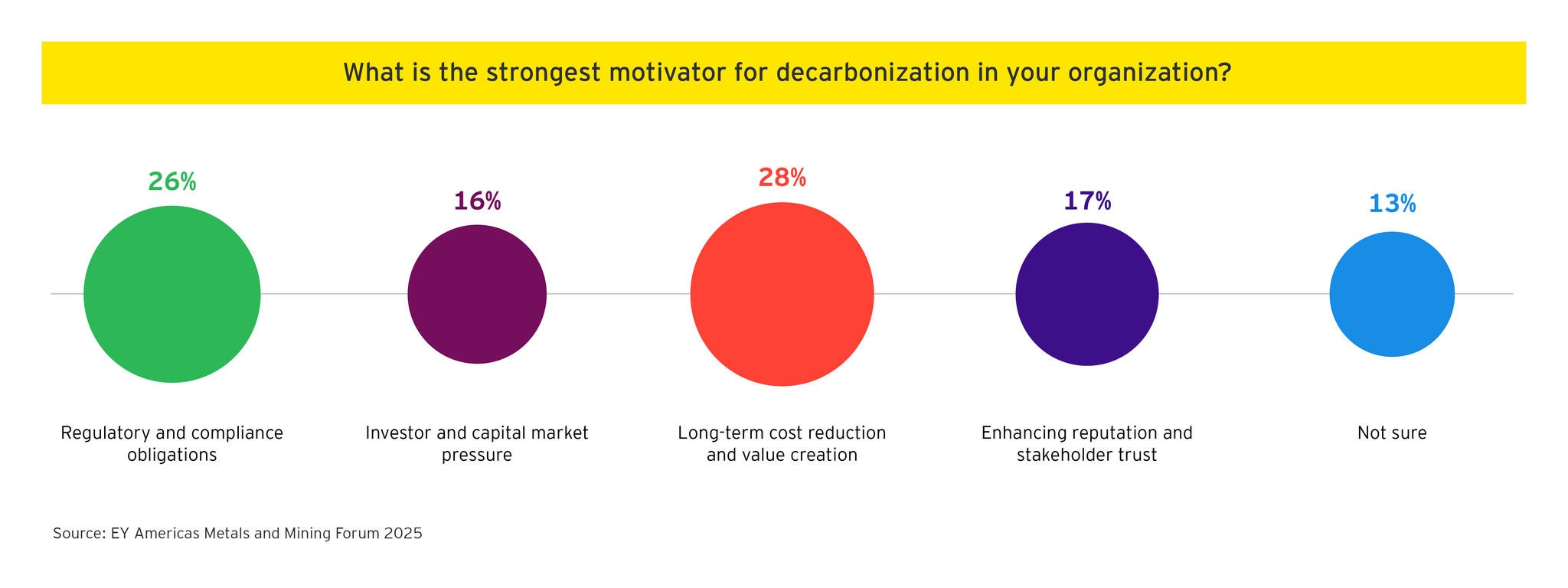
While the road to a better future seems fraught, it was clear from the discussion that the ends will not only justify the means but also far outweigh them. Polling results showed the group was tellingly split on key motivators driving decarbonization. 

Almost a third (28%) indicated that minimizing costs and maximizing value topped their agendas. A quarter of respondents are looking to step up to meet regulatory requirements. And a single percentage separated runner-up categories focused on building trust with stakeholders (17%) and appeasing investor and capital market pressures (16%).  

Session speakers mirrored these sentiments, sharing that companies that moved early and fast to meet sustainability and ESG targets are already experiencing payoffs. And while ESG finds itself at a polarized crossroads, with pressure to meet stringent environmental standards easing, speakers warned that now is not time to slide back. 

Companies that continue their efforts will find themselves ahead of competition as the environmental pendulum swings back — with force — and will likely be the ones to attract capital investments for more sustainable and transparent builds as ESG rebalances. It will be important to move forward with other aspects of deglobalization in mind, however, including supply chain certainty and the sector’s ability to attract and retain an engaged and qualified workforce.

EY navigating the challenges: balancing availability, growth and sustainability
3

Chapter 3

Navigating the challenges: balancing availability, growth and sustainability

EY Post-event POV graphics 6

High risk, long timelines and unpredictable returns have traditionally influenced the sector’s ability to attract capital. Add heavy regulation and lengthy permitting processes, and investment challenges only intensify. 

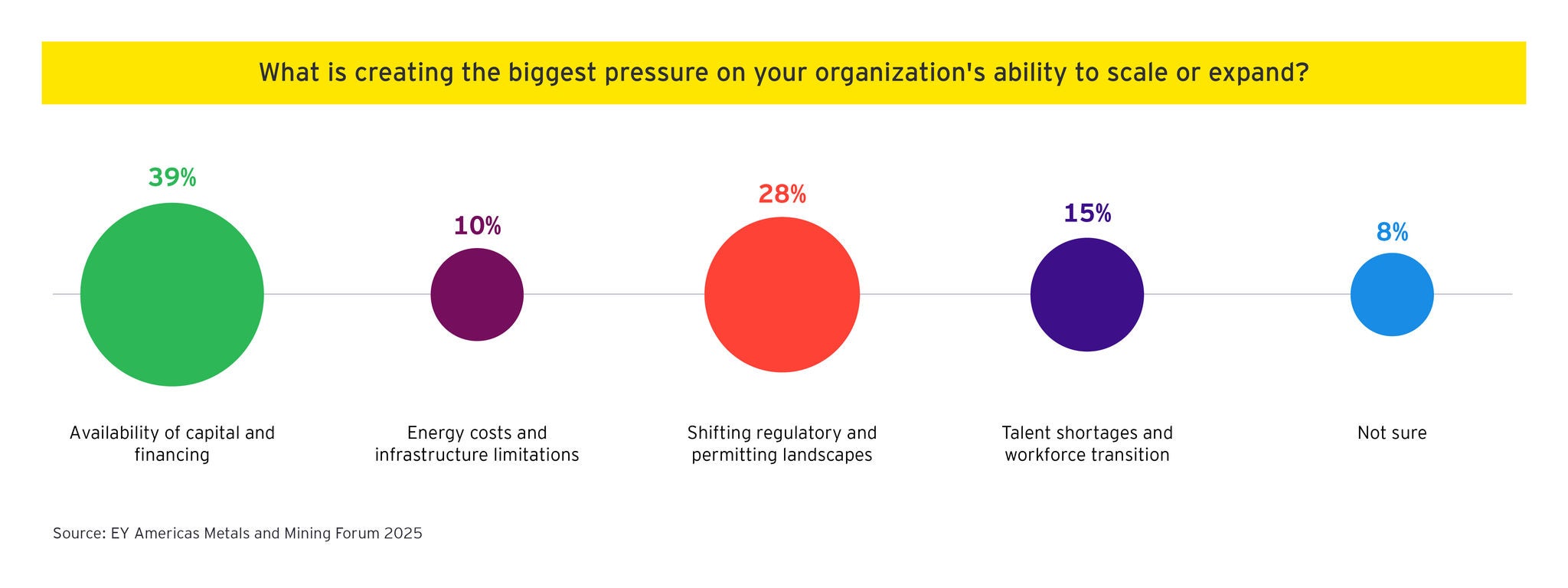
Reflecting that, almost 40% of attendees polled listed capital and financing as their biggest concern, followed by a limiting landscape (28%) - topics that went together for one presenter who shared that a copper mine built in 2000 priced around $5,000 per tonne could easily tally up to $45,000 per tonne of copper today, a build that most mining companies would consider themselves lucky to even have completed a quarter of a century later, despite the demand driven by today’s renewable energies that require five times the copper of traditional power generation. 

Today’s executives are not only challenged by where to focus their strategies going forward but also how to allocate capital among competing priorities. The future will continue to depend on effectively balancing short-term costs with long-term gains. 

And - once a mine operation is up and running - operational issues can often hamper both viability and progress, all challenges that must be resolved if organizations are to gain momentum so future scaling and expansion can take place. That explains why operational  complexity topped our EY Top 10 business risks and opportunities for mining and metals in 2026 report.

Supply down, costs up

EY Post-event POV graphics 7

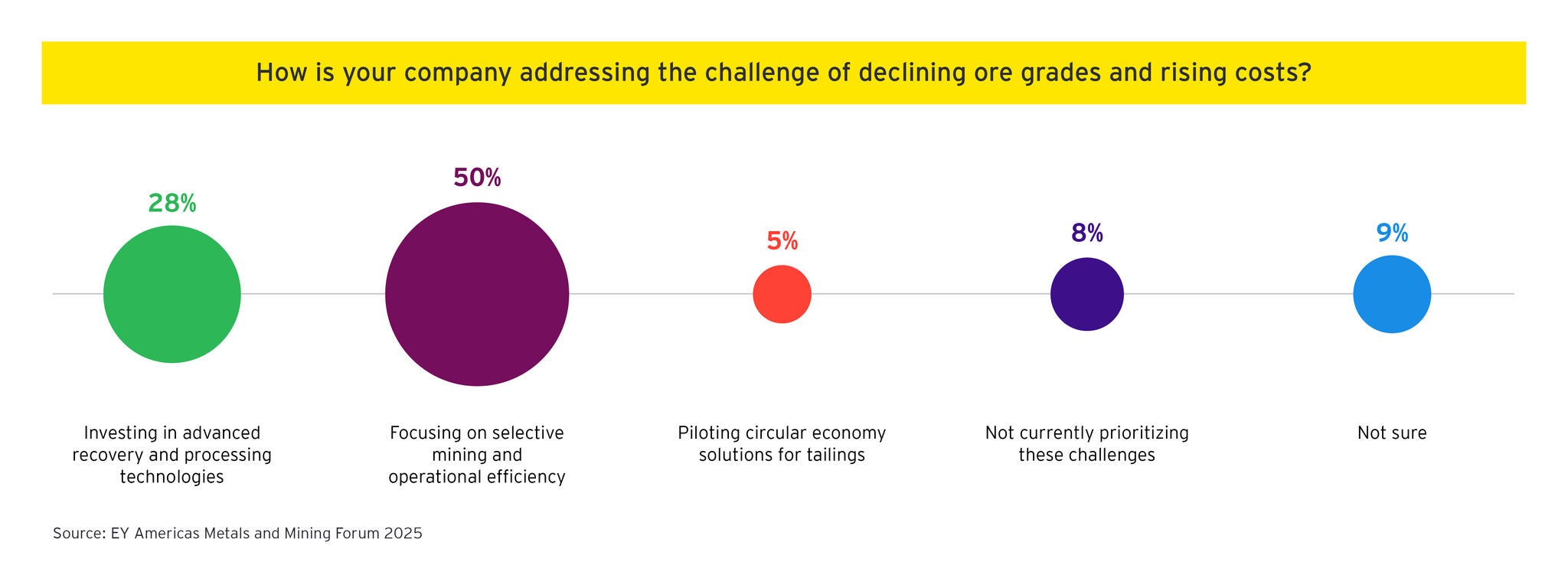
With grade decreasing, but demand and costs continuing to climb, competing metals and minerals organizations are turning to rewriting mining’s rulebook to focus on innovation. Half of poll respondents shared that efficiencies will be key to meeting global demand for raw materials as high-grade deposits become harder to come by.

Given that the repetitive nature of the mining, processing and refining processes, advanced technologies can generate efficiencies impacting the bottom line. From reshaping exploration to accelerate the discovery of viable ore bodies to transforming development by reducing energy, water and material intensity across operations, opportunities abound.

Smart technologies will be an enabler to get more out of existing mines as extraction costs climb - such as automation or AI, a market expected to grow to $8.5 billion in the next decade.  AI is increasingly being applied to optimize fleet dispatching, predict equipment failures and improve ore-grade control. While integration costs and data security risks have meant the uptake on such technologies has been slow, adoption of these technologies has continued.

But such change doesn’t have to be dramatic to have impact. As one presenter shared, even “in-the-margins” innovations implemented across the mining process and supply chain can help lower costs, like those suggested by employees, who while closer to day-to-day production, are a resource that often goes untapped. Offering incentives for ideas that promote innovation, homegrown solutions can add up to untold efficiencies. 

Additional total cost options - as in considering mine closures as part of the initial design - and more modern approaches, such as using dry stack tailings in reclamation or to backfill pits, should also be factored in early. With only 5% of respondents piloting circular economy solutions, and a combined 17% of respondents either not prioritizing or unsure of how they’re managing declining grades in business planning, it’s possible that under-explored strategies are being left on the table.

Jumping at opportunity

EY Post-event POV graphics 8

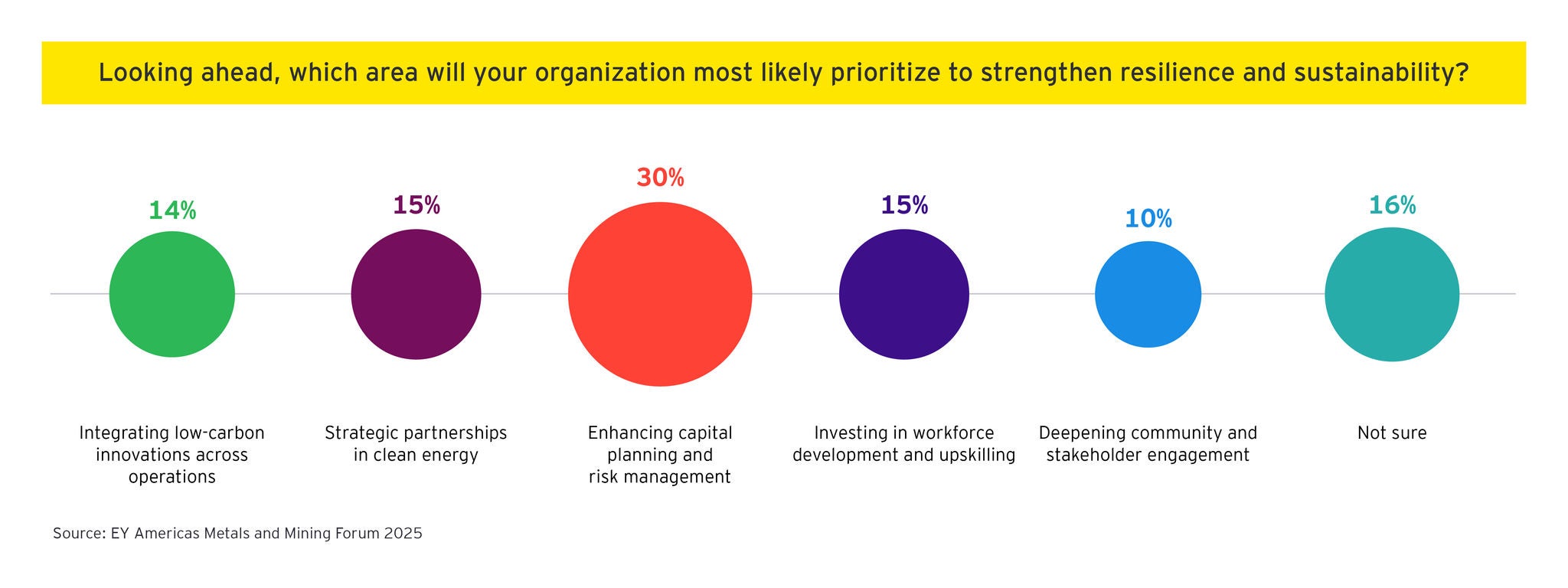
When it comes to building for the future, work being done to strengthen resilience and sustainability is evenly spread among respondents, with one clear and present standout: enhancing capital planning and risk management. 

Equally interesting, remaining levers - from innovation (14%) and partnerships (15%) to workplace upskilling (15%) and stakeholder engagement (10%) - shared almost equal billing, indicating that metals and minerals organizations are covering all bases as they move toward their future.

Hailed as a kingpin of progress, innovation can push a business forward, but not when it doesn’t work or businesses find themselves on the bleeding - rather than cutting - edge of change. Whether innovating as a pioneer or fast follower, organizations need to be positioned to pivot. Determining how to best engage teams in improving productivity, reducing costs and risks, and preserving resources, innovation can come from within. Or it can come from the outside, in collaboration with the ecosystem of suppliers, stakeholders, investors, communities and customers. Disclosing and reporting value or communicating to local communities transparently can have significant impact. 

Being lauded by investors and other stakeholders as an organization that does the right thing can strengthen relationships and brand, providing new opportunities to reimagine resilience, and attract top talent, as the sector moves into the future. As one speaker said, in a world where all mines and mills are capital constrained, how an organization engages with stakeholders can be its key differentiator - particularly when things go wrong.


Summary

The demand for metals and minerals will continue to grow as the global population modernizes and new energy transition efforts get underway. Dedicated leadership, fresh thinking and a willingness to collaborate will make a difference for the sector.

About this article

Authors

Related articles

Top 10 business risks and opportunities for mining and metals in 2026

Unpredictable output and tariff tensions mean companies face a new era of operational risk. It’s time to reimagine mining.

A mining makeover: inspiring the next generation

The mining sector is evolving as it embraces technology, attracts young talent, and prepares for a major workforce shift to support a sustainable future.

Unlocking value in mining capital projects: the role of digital

Explore how digital technologies like AWP, BIM, GIS, and digital twin optimize mining capital projects, improving efficiency, safety, and timely delivery.