EY better land strategy

You don’t need more land – you need a better strategy for the land you have

Unlock the potential of public land with strategic planning to address Canada's housing crisis and create efficient mixed-use communities.


In brief:

  • Public land is underused and can address Canada's housing crisis with strategic planning.
  • Governments need a cohesive land strategy to unlock the potential of their real estate portfolios.
  • Effective land management aligns with housing, social equity, and environmental goals.

Public land is Canada’s most underused housing solution. How can governments fix that?

The land fallacy

The default narrative is simple: we need more land to build more housing. It’s a politically popular proposition, but it’s often wrong.

Across Canada, governments at every level collectively own thousands of acres of urban land. But much of it sits underused, tied up by internal silos, political caution or inertia. This is land that could, and should, help governments meet their most urgent priorities, including housing delivery, an improved built form and more efficient mixed-use communities.

The real constraint isn’t land scarcity. It’s strategic paralysis.

The scope of the opportunity: what governments already own

Governments hold vast real estate portfolios across municipal, provincial and federal agencies — from school boards to hospitals to transit authorities. Much of this land sits in prime locations in our most productive communities: near transit, jobs and services, exactly where new housing is needed most. The assets vary from surface parking lots, aging facilities, old works yards, properties with excess land, but they share a common story: underutilized and disconnected from broader housing strategies.

Without a strategic approach, these sites represent missed opportunities to tackle Canada’s housing crisis at scale.

Why most public land strategies fall short
 

Even governments that recognize the potential of public land often struggle to unlock it. Common reasons include:

  • No integrated inventory: Property data is siloed across departments and agencies, with no clear, shared view of the portfolio.
  • No decision-making framework: Valuable sites are held “just in case” or sold off without evaluating their housing potential.
  • No alignment between land and housing mandates: Real estate teams are tasked with cost recovery, not strategic housing delivery.
  • Reactive decision-making: Action happens only when a developer knocks or a facility upgrade triggers it, not through proactive planning.
  • Over-politicization: Without a clear framework, elected officials face political risks for bold moves, leading to inaction.

Result: high-value land remains locked up and underutilized, while housing needs grow more urgent.

What happens without a strategy

A well-defined land strategy is essential for improving land use. Without such a strategy in place, various detrimental outcomes can occur, undermining the potential for effective land management and housing solutions. The consequences of lacking a cohesive land strategy include:

  • Missed housing opportunities: High-value land sits as surface parking or is left for low-value uses.
  • Fragmented, political decisions: Inconsistent rules lead to ad hoc outcomes and public distrust.
  • Suboptimal financial returns: Poor land management limits governments’ ability to capture long-term value.
  • Weak alignment with broader policy goals: Housing affordability, social equity and environmental targets fall short.
  • Greater public skepticism and scrutiny: When land decisions appear arbitrary, governments lose credibility and community trust.

What a strong public land strategy looks like

While every strategy must be tailored to local conditions, successful public land strategies share five essential components:

1. Portfolio-wide inventory and classification

  • Develop a live, centralized inventory of all public land holdings, including site statistics, current use, zoning, servicing and redevelopment potential.
  • Classify sites into broad categories: retain, transform, dispose or partner based on strategic value and feasibility

2. Scoring framework for site evaluation to enable classification

  • Create a multi-criteria scoring tool that evaluates each site on location — such astransit access or amenities — market potential, fit with housing or strategic objectives, social or operational value, and redevelopment feasibility.
  • Use objective scoring to inform and justify site classifications, ensuring consistency and transparency.

3. Focused prioritization of objectives

  • Clearly define priority goals and how to get there. If housing is the priority, the strategy will need to consider how to get the most housing built in the most economical way, in the shortest amount of time.
  • Embed clear prioritization mechanisms, such as focusing on high-need sites or underserved areas.

4. Governance and decision-making processes

  • Define clear roles and responsibilities across departments — such ashousing, planning, real estate, finance — to coordinate the action.
  • Establish streamlined decision pathways, including thresholds for council approvals versus delegated authority.
  • Require public reporting and transparent dashboards to track land decisions and outcomes.

5. Delivery pathways and partnerships

  • Equip governments with a flexible toolkit of delivery models: land leases, joint ventures, phased developments, or disposition with conditions.
  • Develop a pool of prequalified development partners to expedite project delivery and reduce procurement friction.
  • Standardize template agreements to streamline negotiation and protect public interests.

What Canadian jurisdictions are doing

Across Canada, governments are increasingly recognizing that unlocking the value of public land requires more than good intentions: it demands structured, strategic frameworks. At EY Canada, we’ve developed a balanced framework approach to help public sector clients shift from ad hoc decisions to proactive, portfolio-wide strategies.

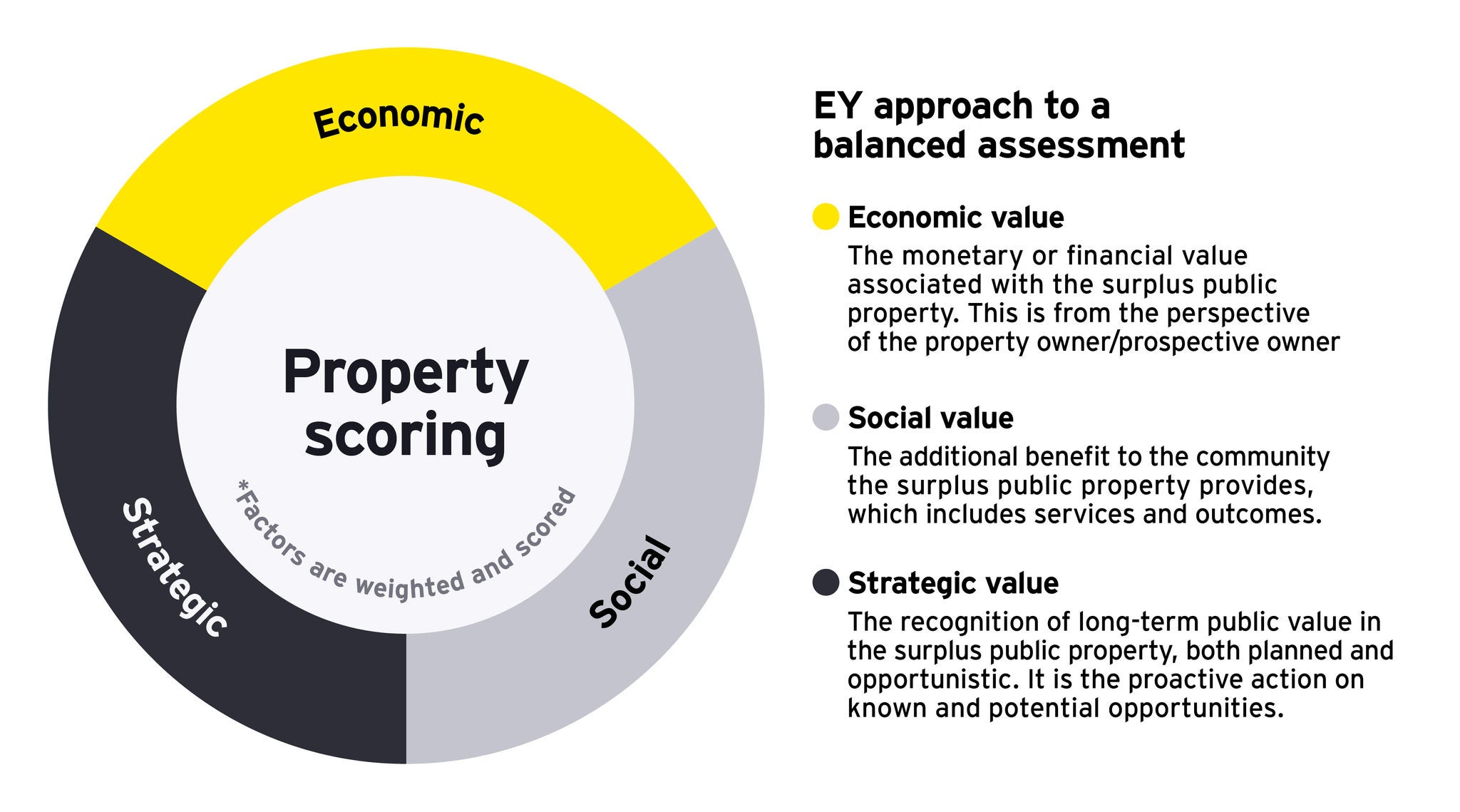
This balanced framework considers not only economic indicators but also strategic and social priorities. While goals may vary, a structured approach enables the achievement of specific, desired outcomes.

For example, York Region used this framework to develop a tool that evaluates the highest and best use of public properties based on user-defined priorities, including economic, social and strategic value. The tool supports both acquisition and disposition decisions, identifies sites with potential for value enhancement, and prioritizes opportunities for municipal or private sector partnerships.

The same framework was applied at York University to create a land development prioritization tool. This tool enhanced the university’s ability to make strategic decisions about land development, housing options and partnership opportunities with private developers.

These examples demonstrate that public land strategies don’t have to remain theoretical. With the right tools and governance, jurisdictions can make faster, smarter decisions that align land use with broader policy goals such as housing, sustainability and fiscal responsibility.


EY Approach to a Balanced Assessment_Web Graphics

Where to start: a practical roadmap

Governments don’t need to wait years or spend millions of dollars to build a better land use strategy. Small wins build momentum and political will for larger actions.

Immediate steps include:

  • Conduct a land portfolio scan to establish a baseline.
  • Craft and pilot an evaluation framework on a subset of 10 to 15 sites to classify. The EY Balanced Framework approach can be a helpful a guide.
  • Engage departments early to align real estate management needs with strategic objectives for housing.
  • Build a business case for investment in internal capacity, both funding and people.
  • Prioritize 1 or 2 demonstration projects to show visible progress.

Conclusion: the land is already there

Canada’s public sector possesses a significant yet underutilized asset in the land it already owns. To unlock this potential, we must move beyond the traditional approaches of expropriation, rezoning battles and lengthy planning processes. Instead, a bold transformation is needed: we must begin to view land as a strategic resource rather than a passive holding.

Implementing a cohesive, action-oriented public land strategy goes beyond mere management: it’s about fostering faster, smarter and more equitable housing outcomes. This shift is essential for addressing the pressing housing challenges we face today. The future of housing in Canada hinges on our ability to transition from mere land ownership to proactive land leadership, harnessing the full potential of existing resources for the benefit of all communities.

York Region is committed to maximizing the public value of our land portfolio through thoughtful and evidence-based planning. Our work with EY has enabled us to take a more strategic approach to land asset management, using prioritization tools to assess the highest and best uses of our holdings. This work not only supports more informed decision-making, it also aligns our land use strategies with long-term growth, fiscal responsibility and community needs. As a steward of public assets, York is proud to employ innovative practices to deliver responsible and impactful land development across the region.

Summary

Canada's public land is underused and holds the potential to address the housing crisis. Governments need a cohesive strategy to unlock the value of their real estate portfolios, aligning land use with housing, social equity, and environmental goals. Effective land management can transform underutilized sites into efficient mixed-use communities, providing housing solutions and meeting broader policy objectives.

Building a land strategy is only the first step. The real challenge and opportunity lie in how governments turn that strategy into action: choosing the right partners, structuring deals that balance public value with private investment, and creating systems that make housing delivery financially sustainable over time. In the coming months, we’ll explore how governments can move from strategy to execution using partnerships, financing models and new delivery vehicles to unlock the full potential of public land.


About this article

Authors