


EY refers to the global organization, and may refer to one or more, of the member firms of Ernst & Young Global Limited, each of which is a separate legal entity. Ernst & Young Global Limited, a UK company limited by guarantee, does not provide services to clients.
Recent Searches
Trending
-
Advancing Canada’s defence innovation
09 Apr 2026 -
Canadian Insurance Outlook 2026: navigating uncertainty, unlocking opportunity
13 Mar 2026 Financial services -
From bottleneck to accelerator: the strategic role of digital identity controls for industrials and energy companies
18 Feb 2026 Energy and resources

Co author: Padraic O Maille, Manager, Operational Risk & Resilience
Explore how commercial real estate firms can thrive in the face of disruption by building enterprise resilience.
In brief
- In a rapidly evolving and unpredictable market, commercial real estate firms face unique challenges that underscore the need for a robust enterprise resilience strategy.
- A holistic understanding of resilience vulnerabilities business-wide is critical to thrive today and tomorrow.
- The current environment offers a multitude of opportunities for real estate firms to enhance their physical, digital, financial and workforce resilience.
The commercial real estate sector is undergoing transformative changes, reshaped by market and socioeconomic dynamics, technological advancements and unprecedented global challenges.
The industry is grappling with heightened demand for affordable housing, sending shockwaves across the sector. This challenge is further intensified by an aging workforce of Canada’s skilled building tradespeople nearing retirement, leading to a nationwide talent shortage.
Moreover, environmental sustainability has become a pivotal concern. As stakeholders increasingly prioritize green initiatives, real estate firms are compelled to navigate a new regulatory landscape and shifting market expectations. Integrating sustainable practices into core operations has become essential for driving long-term value and resilience.
The pandemic also left an indelible mark on the sector, altering the demand for office and retail spaces as businesses pivot towards hybrid work models. This shift necessitates a reevaluation of location strategies, workplace designs and the optimal use of space to accommodate a new reality.
Real estate firms must reconcile these significant trends with broader macroeconomic forces — such as interest rate volatility, inflationary pressures, rising capital costs, lower asset value, accelerated asset dispositions and slowed transaction activity — and still find a way to grow profitably and sustainably.
At EY, we recommend embracing an overarching approach to enterprise resilience rather than tackling these issues in isolation. This integrated approach should be underpinned by fundamental cultural shifts within the organization, which include embracing change management, fostering a culture of critical thinking and cultivating adaptability. By focusing on four foundational pillars in concert, Canada’s commercial real estate companies can fortify operations and support sustainable success, even in unpredictable environments.
We define those areas through four critical pillars.
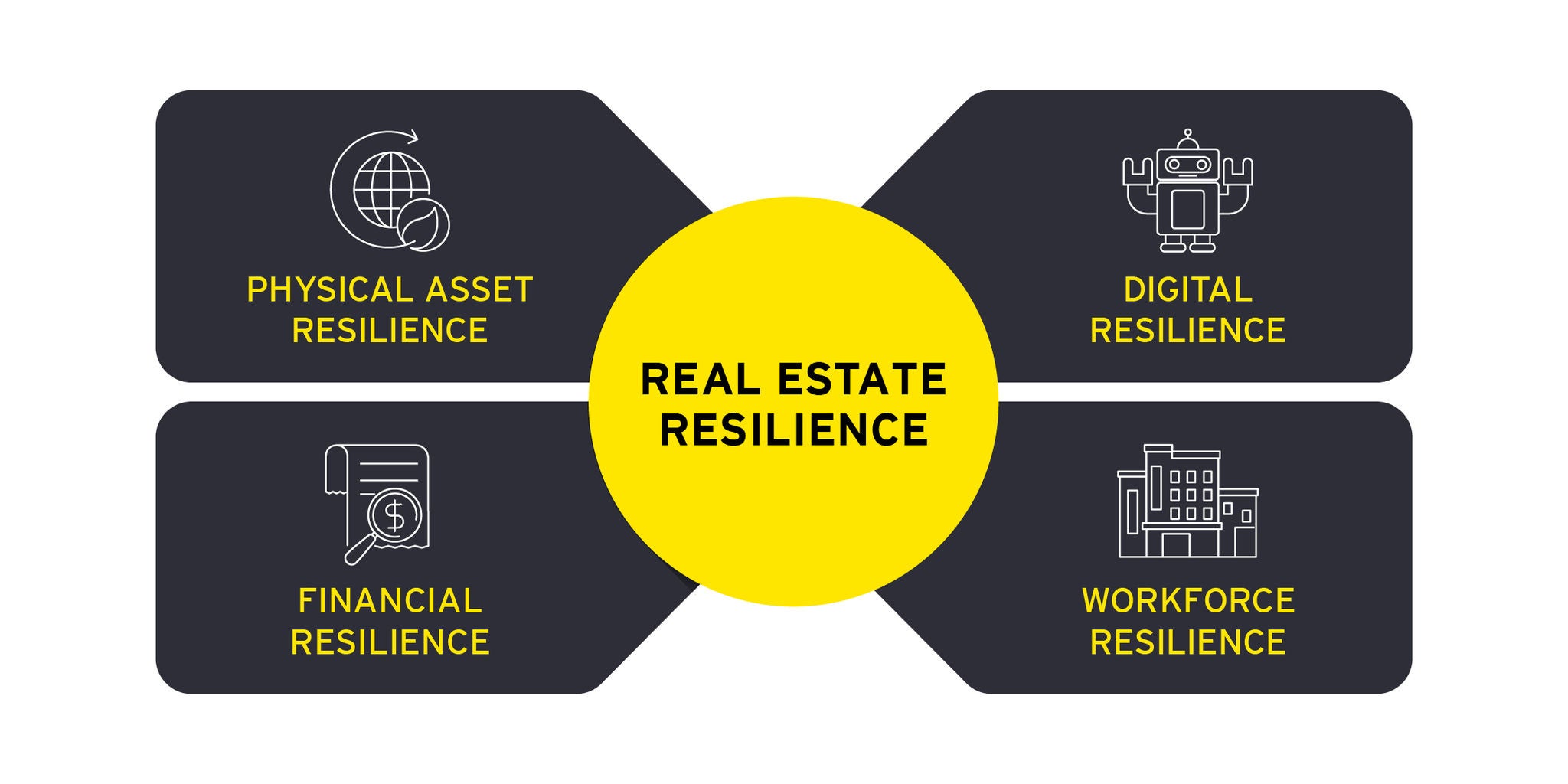
Pillar 1: Physical asset resilience
Real estate significantly impacts the environment. Lloyd’s forecasts that global economic losses from extreme weather events could reach US$5 trillion over the next five years, with a 5% to 7% annual increase in losses due to natural disasters and extreme weather events.⁵ ⁶
Increasing regulatory, capital markets and stakeholder demands are driving commercial real estate firms to reduce greenhouse gas (GHG) emissions, demonstrate transition plans and more. Navigating this shift gives commercial real estate companies a lot to consider.
A few cases in point:
The International Sustainability Standards Board (ISSB) rules give Canada the authority to set mandatory compliance requirements. The European Union Corporate Sustainability Reporting Directive rules take effect in 2024. SEC sustainability disclosure rules take effect in 2025 and will require limited assurance for large and accelerated filers. For commercial real estate firms, this means gearing up for greater rigour in sustainability processes, systems and climate disclosures.
Far from being mere compliance exercises, these initiatives can serve as catalysts for competitive advantage, driving innovation and operational excellence. Strategies such as adopting cleantech solutions, investing in green building practices, implementing energy efficiency measures, conducting climate risk scenario analysis and developing robust plans for asset adaptation not only mitigate risks but also drive cost efficiencies, enhance asset attractiveness and create market differentiation. By capitalizing on these opportunities, firms can lead the way in sustainable development, setting new industry benchmarks and reaping the benefits of a forward-thinking, resilient approach to real estate management.
How to implement?
- Embed sustainability at the centre of your corporate strategy, purpose and value creation.
- Transform your organization and value chain to accelerate the transition, optimizing business value and sustainable impact.
- Manage and measure the change needed to embed sustainability across the business through climate stress-testing and adaptation planning.
- Communicate ambitions and achievements transparently with stakeholders to build trust.
- Consider sustainable reporting and assurance procedures early, testing controls and building a transformation plan.
Pillar 2: Digital resilience
Driven by cost-reduction directives and sustainability priorities, as well as the need for better user experiences and data-backed decisions, many real estate organizations find themselves in the midst of a digital transformation.
The world is changing quickly, and organizations are trying to learn in real time. That includes assessing how and when to use property technology (PropTech) to effectively manage properties, maintenance and tenant communications. It’s also shining the spotlight on the ways digital twins, generative artificial intelligence (gen AI) and machine learning (ML) can, and should, play a part in operational efficiency.
As the built environment evolves, new developments in building technologies, from smart buildings to digital twins, are unlocking digitization to build resilience by centralizing data to drive decisions and reduce costs. But they require real estate organizations to choose tools carefully based on the specific challenge they’re intended to address.
Understanding specific needs is critical to selecting and deploying the right tool, maximizing its benefits and achieving an optimal return on investment. If building systems are siloed, it is difficult for real estate companies to make informed, real-time, data-driven decisions to drive cost savings.
Bringing together the right mix of technology solutions can transform real estate assets into intelligent, efficient and sustainable spaces.
As real estate assets become more interconnected and increasingly reliant on digital infrastructure, the risk of cyber-attacks escalates, making cybersecurity a critical component of digital resilience. With the threat landscape in constant flux, cyber threats pose significant risks to the integrity and reliability of real estate operations. It is, therefore, imperative for real estate companies to adopt a “resilience by design” approach to their digital transformation initiatives. This proactive strategy involves integrating cybersecurity considerations into the planning and implementation phases of technology projects, ensuring that protective measures are a fundamental part of the system architecture, rather than retroactive additions.
How to implement?
- Develop a comprehensive digital roadmap that optimizes data integration, improves operational efficiency and enhances occupant experience.
- Employ advanced data analytics to gain insights into market trends, tenant behaviours and operational efficiencies. This can inform strategic decisions and uncover new opportunities for growth and optimization.
- Embed cybersecurity and leading practice standards for privacy as foundational elements of your digital transformation.
Pillar 3: Financial resilience
Macro-economic conditions and the lingering effects of the pandemic have presented the real estate sector with significant financial challenges. Studies indicate that fluctuations in interest rates can lead to increased volatility and impact property values in the short term, while also posing medium- to-long-term market, liquidity and credit risks for real estate companies. Although current trends suggest a stabilization of interest rates in Canada, proactively building financial resilience remains a critical undertaking for real estate firms.
How to implement?
- Develop models to detect and respond to interest rate volatility.
- Implement robust strategies to optimize cash flow and enhance financial agility.
- Adopt a strategic approach to sustainable financing and tax planning, opening doors to new opportunities and efficiencies.
- Explore asset transaction options that align with your strategic goals.
- Strengthen capital structures, improve access to capital markets and forge strategic partnerships. Additionally, consider financial restructuring to unlock capital and improve liquidity.
- Identify potential acquisition targets or business partners that could yield synergies and enhance financial resilience.
Pillar 4: Workforce resilience
The EY Future Workplace Index shows offices remain essential, with 99% of survey respondents indicating employees are required or encouraged to work in the office at least two days a week. Even so, this permanent hybrid approach is driving a rebalancing across the real estate sector.
Office utilization rates now hover at around 50% of pre-pandemic levels.¹ Since companies don’t need as much physical space these days, they’re downsizing their real estate portfolios.
Many top companies are also evaluating hub strategies, locating in new cities to attract future talent or exiting high-cost markets. They’re using space differently, with 57% of employers using design principles to reallocate space in support of new ways of working.²
As the operating environment continues to evolve, these workforce changes will impact those employed in the real estate industry, too. The continued evolution of AI, technology and automation mean employees will require a deeper understanding of these areas to support adoption, integration and management. Making the most of tech’s possibilities means professionals working in real estate must be able to employ data and predictive analytics when driving information-backed decisions.
As businesses rethink workplace strategies to deliver business results, real estate organizations can enhance workforce resilience.
How to implement?
- Prioritize upskilling and reskilling programs to equip your workforce with the latest skills in AI, technology and automation so they are prepared for the digital future.
- Integrate data from real estate systems, productivity suites and HR systems to inform workplace strategy decisions.
- Use data analytics to optimize real estate portfolios for hybrid work models, making efficient use of space while aligning with employee needs and wellbeing.
- Apply design principles that support collaboration and engagement, integrating technology to create spaces that are responsive to the evolving ways of working.
Where to start your resilience journey
Understanding enterprise resilience starts by unveiling resilience gaps across the business. EY Risk Consulting can help your organization assess resilience gaps and build your roadmap to enable a resilient future.
Contact us to learn more.
Summary
Enterprise resilience doesn’t come down to any one thing. Instead, it’s about your ability to connect and address four core pillars in concert. Moving deliberately through a risk assessment that addresses physical asset, digital, financial and workforce resilience can help commercial real estate companies survive and thrive in the long term.