




EY refers to the global organization, and may refer to one or more, of the member firms of Ernst & Young Global Limited, each of which is a separate legal entity. Ernst & Young Global Limited, a UK company limited by guarantee, does not provide services to clients.
Recent Searches
Trending
-
Beyond compliance: elevating safety standards in underground mining
12 Dec 2025 Mining & Metals -
Reinforce loyalty program safeguards, stay ahead of cyber threats
08 Dec 2025 Consumer Products -
What makes today’s climate leaders tomorrow’s business leaders?
06 Nov 2025 Climate change and sustainability services

As the Canadian economy shows signs of strength and CEOs express a renewed sense of confidence, the business landscape presents both opportunities and challenges. Leaders are now tasked with navigating this environment, using positive market signals and strategic insights to drive growth. With a focus on M&A, portfolio optimization and regulatory adaptation, the path forward requires a careful balance of ambition and prudence. This is a critical juncture for Canadian businesses to solidify their positions both domestically and on the global stage, making strategic choices that will define their future success.
1. Canada leads in business confidence
EY’s newly launched CEO Confidence Index finds Canadian CEOs reporting high degrees of optimism as they look to the future. As Canadian leaders leave behind fears of a recession, they have continued to indicate improving expectations for the global outlook. This may in part be supported by the economy showing more resilience than expected in recent quarters. EY’s survey finds leaders of large enterprises in Canada to be more bullish than the broader business landscape represented in the OECD Business Confidence Index and Bank of Canada Business Outlook Survey.1,2This is likely driven by experienced executives who have previously navigated similar periods of uncertainty.
Overall, while Canadian business sentiments appear to still be marked by caution and relative conservatism, CEOs of large enterprises in Canada hold a positive outlook of the future
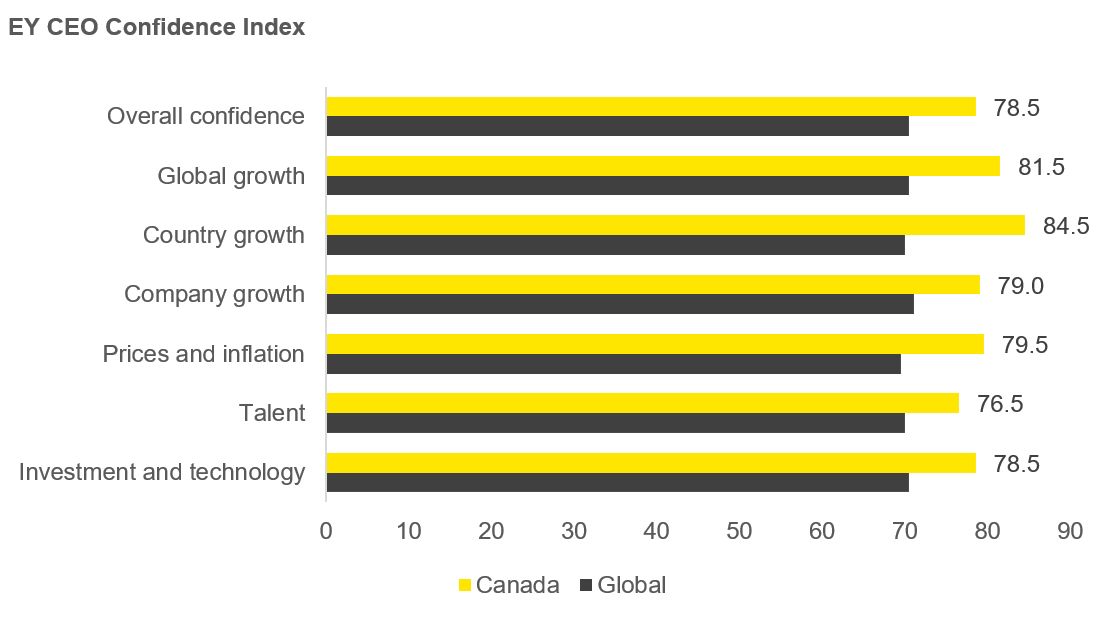
Further, compared to confidence levels among global leaders observed in EY’s Confidence Index, Canadian leaders also indicate a greater appetite for growth and relative optimism. This may be supported by Canada’s prompt monetary policy action in light of stabilizing inflation rates in 2024.
In June 2024, Canada became the first G7 country to announce a relaxation in monetary policy measures, providing a positive market signal that supported business sentiments and consumer confidence. Since then, two further rate cuts were announced, arriving at 4.25% in September, down from a steady 5% since July 2023.
From the sector perspective, oil and gas, mining, and wealth and asset management showcase the highest levels of confidence in Canada. This is consistent with the global outlook, where wealth and asset management, and metals and mining are among the most optimistic sectors in the CEO Confidence Index.
2. Recovering capital markets are supporting bold transaction strategies
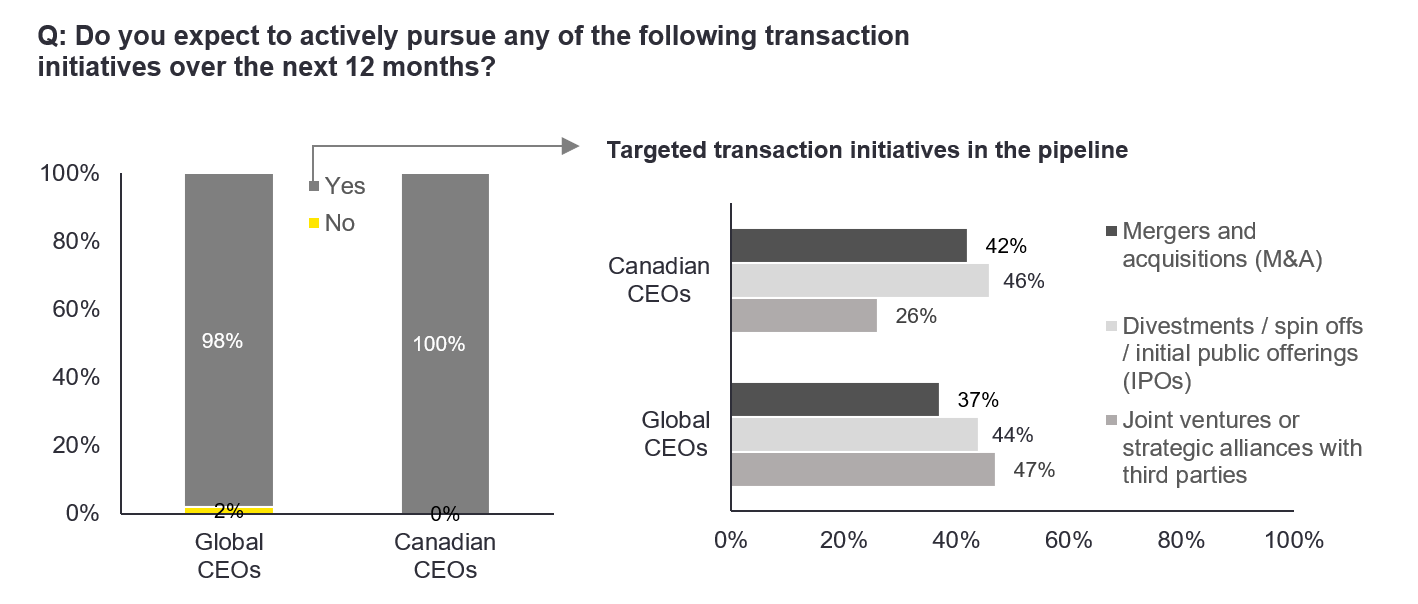
As macroeconomic conditions stabilize, leaders are increasingly bullish in their transaction strategies. In the broader Canadian market, M&A activity has shown signs of recovery since the slowdown in 2023, with deal volumes picking up in the first half of 2024. This is reflected in our CEO survey, where 42% of Canadian leaders expressed an interest in pursuing M&A transactions, higher than the global average of 37%.
Among Canadian leaders, interest in organic measures of growth such as joint ventures, divestments or IPOs is lower than previous quarters. Specifically, a little over a quarter (26%) of CEOs expressed an interest in joint ventures, compared to 42% in the last quarter, and 46% expressed an interest in divestments or IPOs, compared to 60% in the last quarter.
The shifting preference towards M&A may also illustrate a change in business strategy among Canadian leaders. Specifically, while it comes with its own unique risks, M&A has benefits of providing quick entry into new markets and capturing larger market share. This shift in strategic priorities may also be supported by the high degree of confidence indicated by Canadian CEOs in the outlook in investment and technology, in which Canadian CEOs score at 78.5, compared to the global average of 70.5
When it comes to their approach to portfolio reviews, Canadian leaders are more confident than their global counterparts in their approach to regularly reviewing their strategies and making swift decisions to adapt to changing conditions. Two thirds (66%) of Canadian leaders indicate they assess their portfolio against their core strategy on a quarterly basis, whereas fewer than half (45%) of global leaders adopt the same frequency in reviews.
3. Disruption continues to shape business strategy
Positive tailwinds from an improving economic outlook are boosting confidence among CEOs in their approach to navigating disruption. While just over a third (38%) of global leaders consider themselves to be leading in navigating disruption, Canadian respondents are more confident in their ability, as over half (56%) share this sentiment. However, while the Canadian economic landscape improves, a range of disruptive forces is still at play in the domestic and global economies. As such, CEOs must adopt a flexible approach to navigating disruption. According to respondents, the top disruptive force in Canada is new or potential regulatory pressures, which was also a key priority for CEOs in the previous quarter. At the same time, a range of disruptive forces is considered “first priority” by Canadian CEOs, including changing customer needs, elevated cost of capital and emerging technologies.
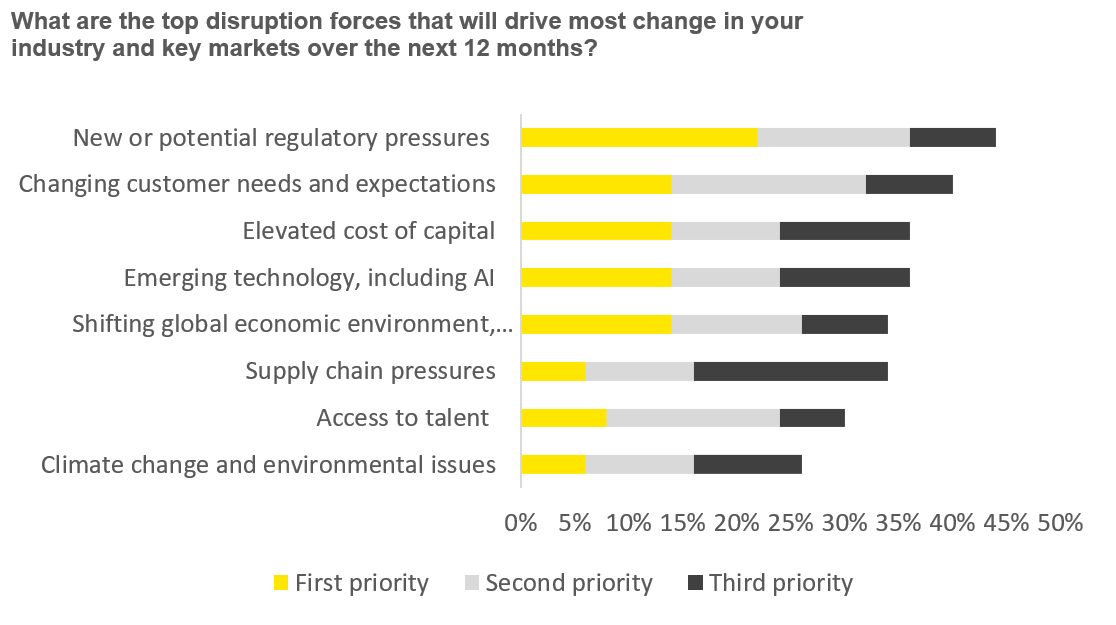
For instance, as technology continues to emerge as a key disruptive force, Canadian leaders are increasingly employing this element in creating new opportunities for their own businesses. More than a third of Canadian leaders (36%) indicate their first priority is to use emerging technologies to build an innovative edge and drive new ways of working for their business. Additionally, 85% of Canadian CEOs believe they are highly proficient in delivering against this strategic aim, more so than global leaders.
Key actions for leaders
Amid an optimistic business environment, Canadian CEOs must navigate growth, manage portfolios with foresight and engage with regulatory changes to maintain a competitive edge.
1. Exercise prudent judgment in M&A ventures: While the positive business sentiment among Canadian CEOs suggests a favourable environment for M&A activity, leaders should proceed with caution. Thorough due diligence and risk assessments should be key before committing to M&A deals. This helps acquisitions align with long-term strategic goals and avoid overextending the company's resources.
2. Balance portfolio agility with strategic consistency: While embracing the agility offered by regular portfolio reviews, leaders must cautiously ensure that strategic changes are deliberate and aligned with their long-term vision to avoid destabilizing the organization.
3. Navigate regulatory landscapes with informed caution: Regulatory changes present both challenges and opportunities for innovation. However, leaders should approach these changes with informed caution. It's important to stay ahead of regulatory trends and prepare for their implementation, but also to recognize that regulations can evolve, especially when it comes to disruptive technologies and innovation. Flexibility in strategies will be essential to allow for adaptation to regulatory shifts without compromising core business operations
Discover EY’s Q3 2024 Canadian Economic Outlook
Related articles
Business confidence picks up amidst an economic recovery
Business confidence picks up amidst an economic recovery. Learn more.