





Eco architecture. Green tree and glass office building. The harmony of nature and modernity. Reflection of modern commercial building on glass with sunlight.

ESRS 2024 reporting: key findings & 2025 priorities


ESMA review of ESRS reports flagged generic materiality disclosures. For 2025, regulators expect entity-specific, comprehensive ESG reporting.


In brief

  • Early ESRS reporters showed strong engagement but many presented generic information with insufficient entity-specific insight.
  • ESMA’s 2025 enforcement priorities focus on double-materiality and reporting scope and structure to ensure transparent, comparable ESRS disclosures.
  • Whilst ESMA priorities are not directly enforceable to Swiss companies, many insights from ESMA’s reports can be leveraged by Swiss companies to improve it Sustainability Reporting and help companies to enhance credibility and build stakeholder trust.

A new chapter in sustainability reporting began with the 2024 reporting cycle published in 2025. With the European Union’s Corporate Sustainability Reporting Directive (CSRD) now in force, large listed wave 1 companies are required to publish sustainability statements for the financial year 2024 in accordance with the European Sustainability Reporting Standards (ESRS).

The European Securities and Markets Authority (ESMA) reviewed 91 reports from companies across 23 EU countries, of which about one-third were prepared in accordance with ESRS on a voluntary basis. The findings informed the annual European Common Enforcement Priorities (ECEP) for 2025 annual reports. ESMA’s enforcement priorities cover not only financial reporting, but also sustainability reporting, focusing on two areas: materiality considerations in ESRS reporting and scope and structure of the sustainability statement.

Beyond ESMA’s guidance and recommendations, companies should take the opportunity to embed sustainability reporting into corporate strategy. In our experience, strong data quality, cross-functional collaboration and regulatory vigilance can boost ESG credibility, streamline reporting and unlock long-term business value.

Overview of ESMA’s findings on 2024 ESRS Set 1 reporting

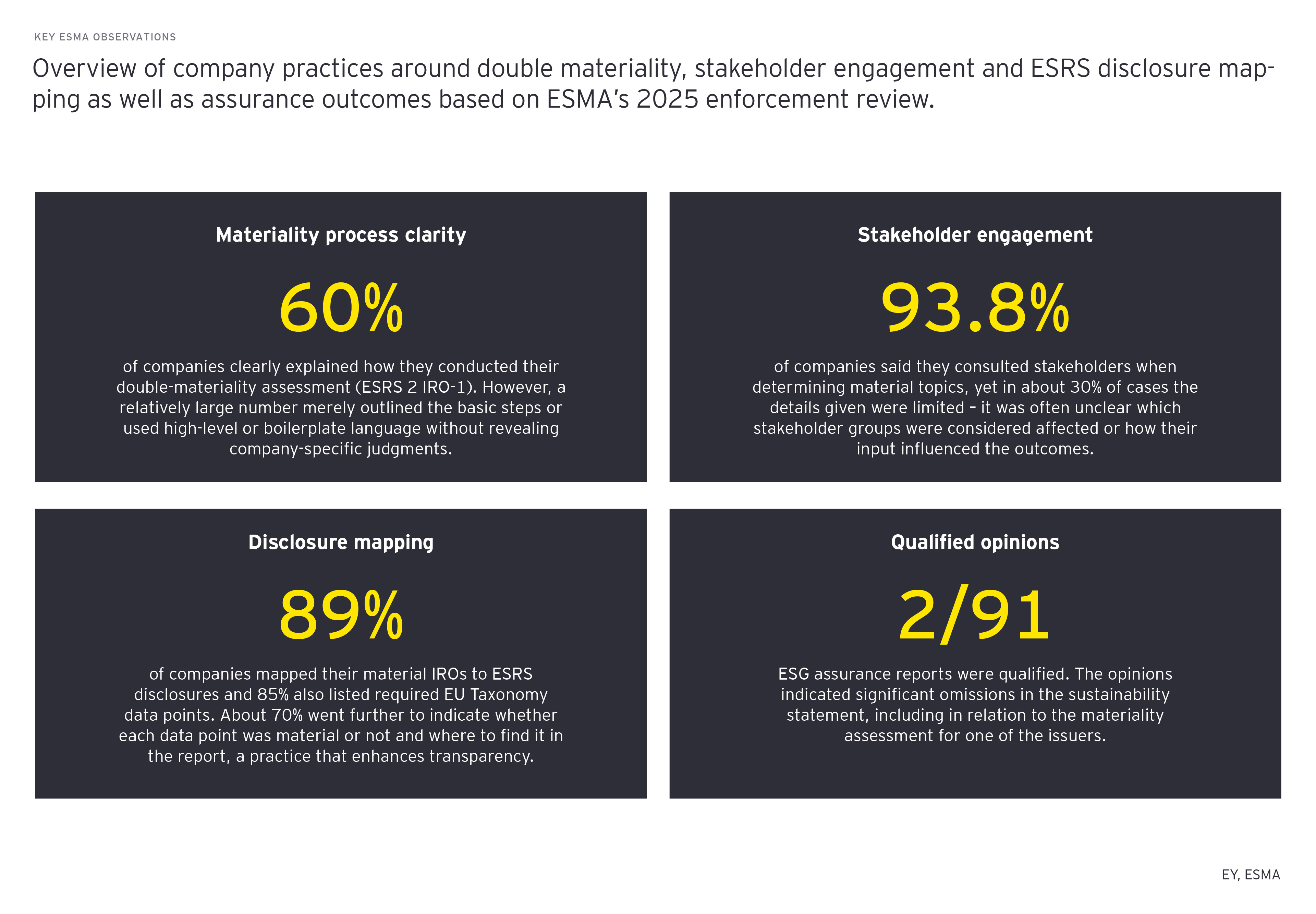
ESMA’s review focused on how companies applied double materiality – the principle used to determine which topics to report on – and whether they met the related disclosure requirements. Its main findings referred to how companies described their materiality assessment process (ESRS 2 IRO-1); impacts, risks and opportunities (IROs) in accordance with ESRS 2 SBM-3; and whether they reported the information required for both material and non-material topics. The chart below highlights key observations from ESMA’s report.

Key ESMA Observations

In addition to the above key observations, ESMA noted a number of commendable practices and common shortcomings:

Overall, the findings show that while reporting companies generally engaged constructively with the new ESRS requirements, some need to take another look at overly generic disclosures and revise them in the next reporting cycle. Future reports should clarify how materiality judgments were made in practice.

On a positive note, most companies mapped their requirements clearly, provided the necessary data points and appropriately recognized climate change and other major issues as material. ESMA’s findings are now shaping regulatory guidance – both future standard-setting, including possible simplification of some requirements, and enforcement priorities aimed at improving reporting practices. 

ESMA’s recommendations to issuers include making specific improvements in their next sustainability reports as outlined in the following:

  • Be entity-specific: Don’t simply restate definitions. Explain how your organization conducted its materiality assessment. What factors did you consider? What internal thresholds or scoring did you apply? This gives readers more meaningful insight.
  • Use ESRS categories and terminology: Whenever possible, map your organization’s material topics to the standard ESRS topics and use official terminology. This helps stakeholders draw comparison across companies. Clearly mark topics outside ESRS as entity-specific so readers know they’re bespoke.
  • Disclose policies, actions and targets for each material topic – or state if you have none: Don’t leave the reader guessing how you’re managing a topic. If an ESG topic is material for your organization, you need to say what you’re doing about it – whether through existing policies, action plans or targets. If no target has been set, say so. Transparency about gaps is more credible than silence.
  • Ensure clarity and connectivity: Ultimately, the goal of sustainability reporting is to explain what your material sustainability matters are and how they’re being managed. Use cross-references or summary tables to link topics, metrics and related policies. This improves readability, usability and completeness. 

ESMA’s 2025 enforcement priorities: focus on materiality and report structure

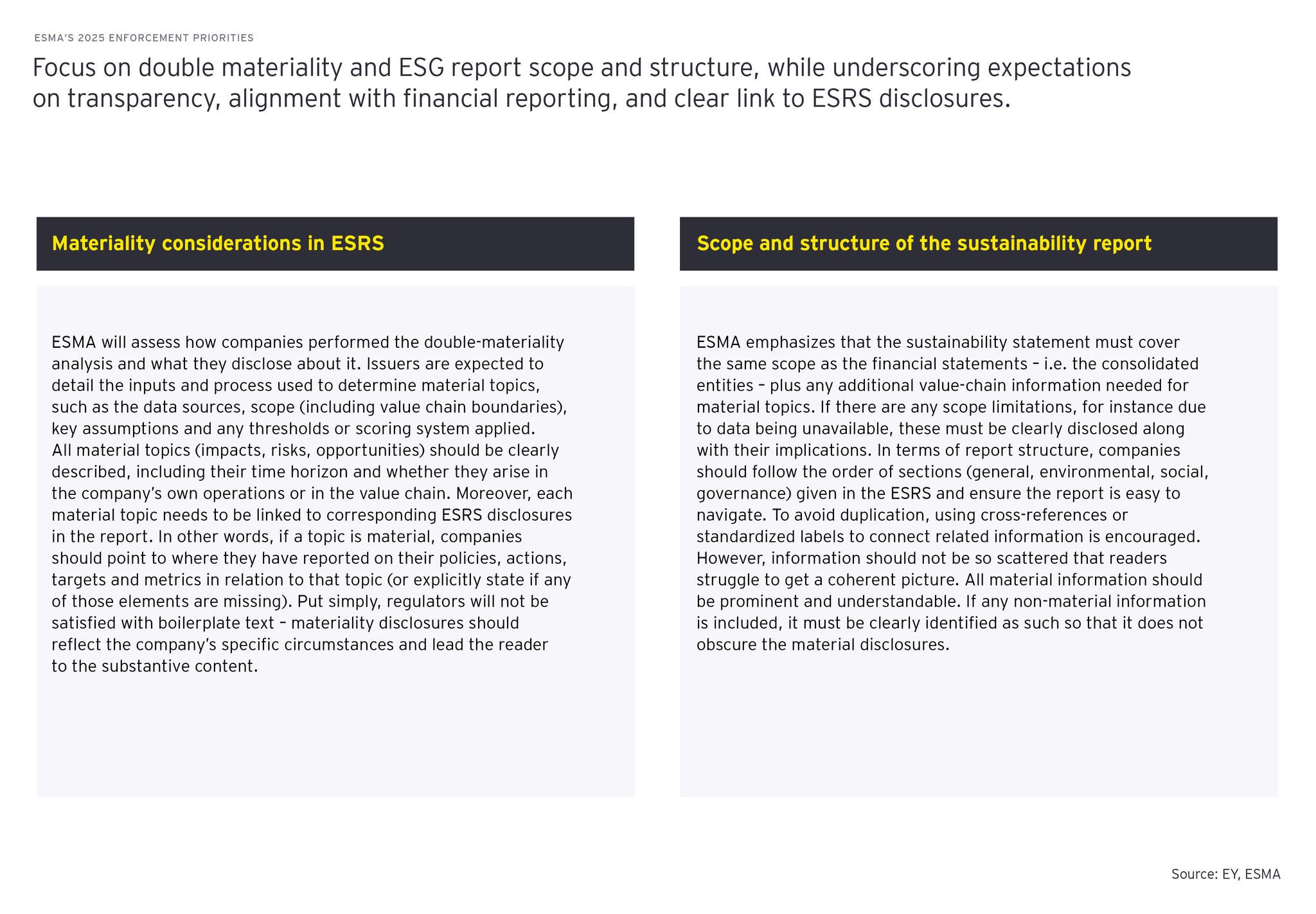
For 2025 annual reports, ESMA has set priority areas that European enforcers will pay close attention to when reviewing companies’ sustainability reporting. The focus is on how companies apply materiality and on the scope and presentation of the sustainability statements. This is not surprising considering the importance of these elements for producing meaningful and comparable disclosures. Moreover, the 2024 fact-finding study showed clear room for improvement in both areas.

The chart below summarizes two sustainability-related enforcement priorities (2.1 and 2.2) set out in ESMA’s ECEP statement):

two sustainability-related enforcement priorities

It’s worth noting that ESMA has carried over these priorities from the prior year (2024 ECEP) because they remain critical. In addition, there was concern that companies might lose focus on them as a result of ongoing regulatory changes (e.g. CSRD Omnibus amendments). While acknowledging that some detailed requirements might change with the forthcoming ESRS revisions, ESMA considers proper application of the double materiality principle and the report scope and structure to be two fundamental areas on which it expects reporting organizations to make progress.

Referring to the European Commission’s Omnibus legislation proposed in early 2025, ESMA advises wave 1 companies to continue applying the current ESRS standards for 2025 reports, as the new exposure drafts and proposals are not yet in force. However, a “quick-fix” delegated act has extended some phase-in options, such as allowing more time or flexibility for specific data points.

Companies should monitor these regulatory developments, but the expected reporting scope for 2025 remains unchanged from 2024. In the meantime, organizations should refer to ESMA’s priorities on materiality and report structure for guidance on where to focus their efforts to improve disclosure.

What the findings mean in practice

From our perspective, ESMA’s findings and enforcement priorities have clear implications for companies as well as their auditors and advisors. In the following we outline how management can refine their sustainability reporting and how audit and assurance teams can adapt their focus ahead of the upcoming reporting cycle.

For companies preparing reports (management):

For audit committees and auditors:

In conclusion, companies should see ESMA’s focus areas not as compliance hurdles, but as guidance to enhance the credibility and clarity of their ESG reporting. Companies that proactively improve the specificity of their disclosures and ensure alignment across their reporting will encounter less turbulence navigating the 2025 reporting cycle. More importantly, they will provide investors and stakeholders a clearer view of how they manage sustainability challenges and opportunities. 


For practical, no-regret actions companies can take to prepare – relevant regardless of the final outcome of the Omnibus legislative process – also see our article on the EU Omnibus package.

Our roadmap for moving forward with confidence

Mandatory sustainability reporting marks a major milestone. Done right, we believe it can lead to better reporting and better-run companies. However, it is critical that the process of selecting and managing sustainability data with strategic planning and risk management. From our perspective, the following considerations can help organizations navigate the coming reporting cycle with confidence:

  • Use materiality as a strategic tool: The double-materiality assessment is more than a compliance exercise. It can be a unique opportunity to engage leadership in discussing the company’s priorities and long-term direction. By deeply embedding the materiality process into the your company’s context – and reflecting that in your report – you help focus sustainability efforts on what truly matters.
  • Leverage cross-functional expertise: Compliant and meaningful sustainability reporting requires collaboration across departments, including risk management, operations, HR, legal and finance. Both sustainability and financial reporting teams should review the sustainability data and narrative to identify any inconsistencies (such as mismatched carbon data and energy costs) and improve overall quality.
  • Invest in data systems and controls: Data quality for ESG metrics was a common weakness in the first reporting cycle, with companies relying on spreadsheets and manual data collection. To reduce errors and prepare for future digital ESG reporting, invest in reliable reporting systems that can handle sustainability data with robust controls and audit trails. This not only improves accuracy but frees up time for analysis and value-adding activities. Audit committees and senior management should oversee sustainability reporting processes with the same rigor applied to financial reporting controls.
  • Stay flexible, but vigilant, with respect to regulatory changes: CSRD and ESRS requirements will continue to evolve over the coming years. Keep compliance for the current year and perform an annual gap assessment comparing your report to both the standards and ESMA’s enforcement priorities. ESMA priorities are directly relevant for Wave 1 filers – European public companies. While Wave 2 companies are not yet affected, they are encouraged to consider these priorities to strengthen processes and set a benchmark for quality reporting.
  • Consider external pre-assurance or advisory reviews: Consider getting an advisory review of your draft sustainability report before finalizing – either by your internal audit department or your external assurance team. We often find that an outside-in perspective can identify ambiguities or unclear disclosures, and help refine key sections, such as materiality narratives. These pre-assurance reviews often lead to stronger, more transparent final reports.

In this way, companies can adopt an approach that builds on credible reporting today to set the foundation for trust and stronger business performance tomorrow.

Summary

ESMA’s review found the first-time ESRS reports to be sufficient but at the same time of overly generic nature. For 2025, companies should provide more entity-specific insights on how material topics were determined; ensure each material issue is fully addressed by policies, actions and targets; and structure sustainability reports with the same rigor as financial statements. In addition, the companies should ensure data quality, use ESRS terminology and continuously monitor the evolving regulatory landscape. Meeting these expectations not only enhances compliance but also builds stakeholder trust and improves the usefulness of sustainability information for decision-making.

Acknowledgement

Many thanks to Rafael Barayón for his valuable contribution to this article.


FAQs


Related articles

Navigating the EU Omnibus Simplification Package: CSRD

Explore the key aspects of CSRD and the EU Omnibus Simplification Package. Learn about the new reporting requirements, the phased implementation, and the proposed amendments aimed at simplifying sustainability reporting.

EU adopts Quick Fix to extend ESRS phase-in reliefs in 2025–2026

Wave 1 undertakings gain flexibility on sustainability disclosures. Learn more.

    Explore Climate change & sustainability services

    Our multidisciplinary teams can help companies understand the risks and opportunities arising from climate change and sustainability issues.

    Brazil town from sky

    About this article

    Authors

    Request for proposal (RFP) - exclusively for Switzerland

    |

    Submit your request now!