






EY refers to the global organization, and may refer to one or more, of the member firms of Ernst & Young Global Limited, each of which is a separate legal entity. Ernst & Young Global Limited, a UK company limited by guarantee, does not provide services to clients.
Recent Searches

AI is gaining ground in Ireland, with confidence, safeguards and transparency defining what comes next.
In brief
- There’s strong uptake in low-risk uses while higher-stakes adoption lags. 41% use AI for customer support and 28% for navigation.
- 73% want human oversight and 80% back stronger rules, signalling what’s needed to unlock wider adoption.
- 69% use AI in customer interactions, yet only 8% would trust an AI agent to buy a product on their behalf.
Artificial intelligence (AI) has come in from the margins and is now firmly part of the mainstream for Irish consumers. It has become an integral part of how people access information, make decisions and engage with organisations in their daily lives. What was once experimental is now embedded, shaping behaviours in subtle but meaningful ways.
However, widespread use does not yet translate into full confidence. As AI becomes more embedded, expectations around transparency, accountability and control are rising. People are increasingly discerning in how they engage with the technology. They are comfortable in some contexts, more cautious in others.
This dynamic is shaping the next phase of adoption. Progress will now depend on the ability of organisations to build trust and provide clear reassurance around how AI operates. Consumers want to be assured that it is being deployed responsibly, that there is human oversight to prevent misuse, and that strong regulatory safeguards are in place before trusting it to make decisions autonomously or use it for perceived higher risk applications.
It also manifests itself in the ways in which Irish consumers are using the technology. They are far more comfortable with what might be termed low-risk scenarios like product recommendations and route planning and much less so with the use of autonomous AI which makes decisions on their behalf without their intervention.
Adoption is strong, trust is catching up
How Ireland compares globally and where AI is being used
AI use and trust dynamics across sectors
Implications for business leaders

1
Chapter 1
Adoption is strong, trust is catching up
Trust in AI remains measured as consumers call for stronger safeguards amidst heightened concerns around transparency and control.
The 2026 EY Ireland AI Sentiment Survey reveals that 84% of respondents have consciously used AI in the past six months, underlining how quickly the technology has moved into the mainstream.
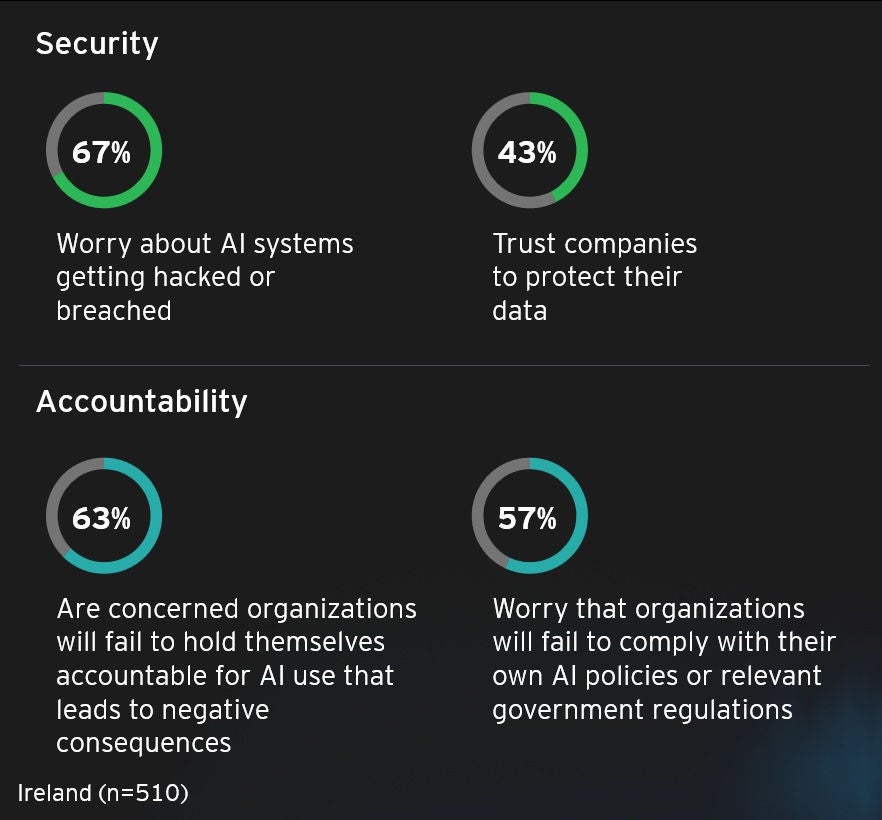
However, trust in AI remains measured with many consumers expressing a desire for clearer safeguards. Two‑thirds of respondents (67%) are concerned about AI systems getting hacked or breached. Trust levels in organisations and public institutions are broadly similar, with less than half (43%) of respondents saying they trust companies to protect their data. 42% trust the government to protect their data.
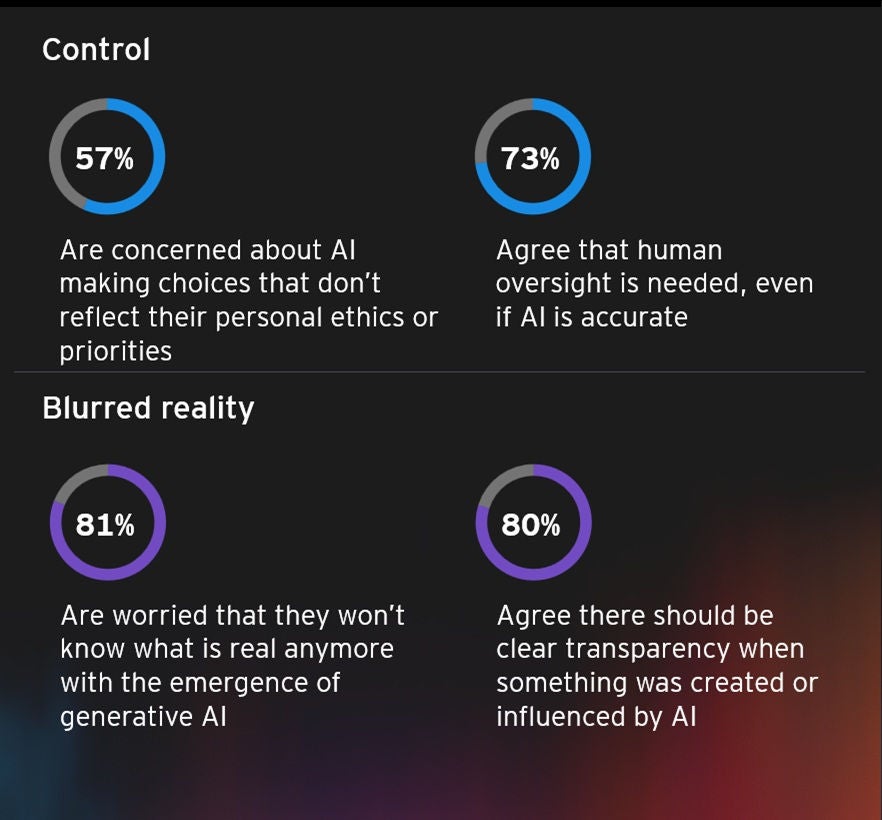
People remain concerned about security, control, accountability and authenticity
The more cautious mindset is also evident when it comes to advanced applications of AI. It is therefore not altogether surprising to find that just 14% of the Irish consumers surveyed claim to have used autonomous AI in the last six months. It is also no surprise to find that willingness to use autonomous AI is strongest in low-risk areas like loyalty offer redemption and lowest for high-risk areas like financial decisions where trust is most important. The same applies to potential future AI use.
Concerns around transparency and control are shaping attitudes. 73% believe that human oversight is needed even when AI is accurate. 80% say that Ireland should have stronger rules for how organisations use AI.
Overall, the findings suggest that while AI adoption is well established, the next phase of growth will depend on strengthening trust. Organisations that can demonstrate transparency, accountability and clear value will be best placed to support broader and more confident use of AI.
AI usage among consumers in Ireland is ahead of that of the US, the UK, Germany, Italy, France and many other developed economies. However, it trails that of India, China, Hong Kong and other markets identified as “Pioneers” in the 2026 EY AI Sentiment Survey.
The gap between AI usage in Ireland and the most advanced markets is relatively narrow. In Ireland, 84% of consumers report using AI in the past six months compared to 94% in Pioneer markets. This highlights strong adoption but also room to grow.
The survey found that, globally, people have embedded AI into how they plan, decide and act. A growing minority is already delegating decisions to AI, while many more are building confidence through everyday low‑risk, assistive use.
Irish people are considerably behind Pioneer markets when it comes to delegating decisions to AI. Just 14% of Irish consumers report using autonomous AI, compared to 24% across advanced markets. The main uses of autonomous AI for Irish consumers were auto-refilling online shopping carts or making purchases on their behalf (12%) and managing finances (11%).
Another notable finding relates to training. While 36% of people in Pioneer markets claimed to have received significant AI training or education, just 17% of Irish people said they had. The reluctance to entrust decisions to the technology may be linked to this comparatively low level of training and education.
In day-to-day use, Irish consumers are most comfortable with assistive, low-risk applications.
These patterns closely mirror global trends.
There are also emerging signals in more sensitive areas. Around 13% of respondents report using AI for conversations related to mental health. This reinforces the importance of rigorous AI regulation and governance, particularly where outcomes are more personal or complex.
When asked what benefits they expect to be delivered by organisations’ use of AI, lower prices or better value for money topped the list with 59% of Irish respondents citing it. The result for Pioneer markets was 54%. Next for Irish respondents was faster service and quicker responses (53%) behind Pioneer markets at 59%.
However, expectations around innovation or improved reliability remain more muted with fewer than one-third anticipating more transformative outcomes, well behind Pioneer markets.
These findings suggest that Irish people are essentially expecting the same but better from AI and are not anticipating anything novel or revolutionary. They are advancing on the AI journey, but the pace of adoption is highest for low risk uses.
AI usage across different sectors tends to reflect the amount of risk involved and hence the degree of trust required. Energy and mobility usages including route planning and electricity consumption monitoring top the list while higher risk financial activities come in at the bottom.
Energy and mobility: 77% of Irish consumers have used AI for energy and mobility in the past six months, led by route planning (28%) and travel planning (23%). In the home, usage is lower but consistent. Around 13% use AI to track electricity usage, receive personalised recommendations for improving home energy efficiency, and to control lighting and heating via voice assistants. A further 10% use it to manage home-based renewable energy.
This likely reflects adoption among households with smart meters connected to AI-enabled applications, although active integration remains limited. Overall, people have a positive view of AI’s helpfulness in use cases like improving navigation and home energy consumption management with a third or more of survey respondents rating it extremely or very helpful.
Customer experience: 69% of respondents have consciously used AI as part of the customer experience in the last six months. The main usage areas are accessing customer support (41%) and getting brand or product recommendations. Usage declines where greater trust is required. Only 12% use it for auto-refilling online shopping carts and making purchases on their behalf. Only 8% would use an AI agent to buy a product on their behalf.
Consumers are generally positive about AI-enabled security features, such as in-store cameras and sensors. However, sentiment is more mixed for chatbots, dynamic pricing and targeted advertising, with around one in five expressing unfavourable views. This reflects ongoing privacy concerns and a preference for human interaction. Security and safety override these concerns with only 7% unfavourable to that usage.
Technology and entertainment experience: 62% of Irish consumers report using AI in technology and entertainment in the past six months.
These results were to be expected given the use of AI by streaming services, the ubiquity of smart home devices, and the growing use of the technology in social media. Consumers see clear value in areas such as content moderation, with 35% rating it as highly helpful. However, views on personalised advertising are more mixed with some ambivalence reflecting a general tolerance rather than strong engagement.
Health and wellness: 57% of Irish respondents said they had knowingly employed AI for health and wellness purposes in the past six months with usage tracking the trust spectrum. A quarter used it to describe symptoms and access quick health information, while 20% relied on wearables to monitor health and support lifestyle choices. Adoption drops for higher-stakes use cases — 10% used AI for medication management and 8% for treating conditions — indicated lower trust.
When it comes to helpfulness in predicting health issues before they become serious, using genetic data to predict health conditions, and remote patient monitoring, the results were overwhelmingly positive. However, some slight concerns relating to privacy were evident but were far outweighed by the potential benefits on offer.
Government services: 50% of Irish respondents have used AI in their interactions with government services, mainly for research and accessing services such as eligibility checks, identifying the right agency and applying for benefits. Overall, usage was quite low with the highest being 16% for eligibility checking suggesting an opportunity to further promote its use.
People are enthusiastic about AI use in areas like law enforcement, emergency response and health and wellbeing support; less so when it comes to uses where privacy and civil liberties concerns arise such as tax returns and passport control. There is also a marked preference for maintaining human oversight in interactions with government services and for policy and legislation formation. Public trust in and respect for human politicians may not be that high in the current volatile geopolitical environment, but people still want them to do their jobs and not to be replaced by machines.
Financial activities: 42% of Irish consumers use AI for financial activities compared with 84% overall usage, reflecting caution in higher-risk areas. Top use cases remain limited. 16% use it for product recommendations and the same share for budgeting, largely for research purposes.
Only 11% rely on AI to manage finances on their behalf. This indicates low trust in autonomous decision-making. Irish consumers are very enthusiastic about AI being used for fraud and crime prevention but less so when it comes to sharing data or having machines make decisions about or for them.
AI adoption in Ireland is now near universal, and the use of autonomous AI is beginning to grow. However, its continued adoption will depend on organisations demonstrating clear value and, more importantly, earning trust through robust guardrails and consistent application.
Responsible AI is central to this. Clear disclosures, strong data protections, the inclusion of humans‑in‑the‑loop, and transparent accountability are not optional anymore. They are prerequisites for scaling autonomous AI and realising its full potential.
Trust will also be built through experience. Organisations should prioritise AI applications that deliver clear, everyday value, while giving users the ability to review, override or opt out. Adoption will remain limited without a clear value proposition. Equally, any perception of imposition risks undermining uptake.
Design will play a critical role as AI is applied to higher-stakes decisions. Simplicity, ease of use and transparency will be as important as performance.
Organisations must ensure they move in step with their customers. Products designed for experienced users in Pioneer markets are unlikely to be successful in other segments. That does not mean that progress should be dictated by the slowest adopters, merely that businesses must be able to offer a range of options to customers to meet their technology comfort levels.
Summary
AI adoption in Ireland is set to deepen as consumers grow more confident in its everyday benefits. While usage is already widespread, the next phase will be shaped by stronger trust, clearer safeguards and more transparent use. AI will move beyond assistive roles as organisations demonstrate value and responsibility. This creates a clear opportunity to unlock more advanced applications and drive meaningful impact across sectors and everyday life.
About the Survey/Methodology
The AI Sentiment Study is based on research created by the global EY organisation to better understand the ways people around the world use AI and how they think about its future. To inform the study, EY Studio+ conducted a survey of 18,152 respondents across 23 markets: Australia, Brazil, Canada, Chinese mainland, Denmark, Finland, France, Germany, Hong Kong SAR, India, Ireland, Italy, Japan, the Kingdom of Saudi Arabia, Mexico, New Zealand, Norway, Singapore, South Korea, Sweden, the United Arab Emirates, the UK and the US.
To ensure results were representative of each market, a random stratified sampling approach was used, with quotas applied for age (18+), gender and location based on local census data. All results were statistically weighted. The Ireland sample comprises 510 respondents.
Related articles
Word power: How AI can open new frontiers for the Irish language
How Údarás na Gaeltachta and EY are advancing Irish-language AI, driving public sector innovation, compliance and everyday language use.
Why responsible AI is critical for trust and bottom-line performance
Responsible AI unlocks quantifiable business value. EY survey shows responsible AI converts risk into resilience and revenue growth. Find out how.