






An aerial photograph of a modern eco city

How client transition assessments can unlock opportunity

Understanding how clients' climate transition plans can help banks manage their own progress, mitigate risks and drive sustainable growth.


In brief

  • Banks lack sufficient insight into clients’ climate progress, which may hinder their own net zero targets and transition finance efforts.

  • Bespoke client transition assessments (CTAs), integrated into business decision-making, can open up new ways to create value. 

  • Opportunities to expand the scope, scale and frequency of CTAs using latest technologies can in turn inform focussed client engagement.


Client transition assessments (CTAs), also known as carbon assessment frameworks, credible transition plans or net zero alignment assessments, are a common way to evaluate clients’ emission reduction and transition efforts, providing a consistent, comprehensive and data-driven approach. CTAs are typically used for data collection as part of broader environmental, social and governance (ESG) assessments of clients’ net zero targets and sustainability performance. They can also inform financed emissions projections, which boosts banks’ understanding of their own expected decarbonisation trajectory.

However, CTA processes are often relatively immature, with gaps in data quality and coverage. Additionally, many banks have not yet fully operationalised CTAs, especially when it comes to aligning net zero targets and strategy with portfolio finance.

With the launch of the Science Based Targets Initiative (SBTi) Financial Institution Net Zero2 Standard, financial institutions are now encouraged to set portfolio climate-aligned targets.3 This calls for a deeper understanding of counterparties’ transition progress – and of how financing activities are supporting the transition, further highlighting the need for high-quality CTAs.  

In this article, we draw on insights from an EY survey of large global banks, information gathered during a sustainability in finance roundtable and our ongoing interactions and conversations with clients. We explore their methodologies for assessing CTAs, and the influence of CTAs on sustainability-related business decisions.

We have identified three key questions banks should consider to gain greater value from CTAs, as well as ways CTAs can be optimised to drive strategy and improve decision-making.  


1. How should you prioritise your clients for CTAs? 


Our analysis shows that banks prioritise CTAs for their most material clients, mainly in carbon-intensive industries like oil and gas, power and utilities, as well as automotive and aviation. Fewer banks carry out comprehensive CTAs on clients from shipping, mining, industrials, steel and agriculture, despite these sectors’ high emissions and their intrinsic value as transition enablers (e.g., the mining sector provides essential materials for expanding renewable power generation and electrifying final energy demand via batteries and other technologies). Financial Institutions (FIs) will benefit by not only prioritising high-emitting sectors and counterparties for CTA analysis, but also key counterparties in sectors with high “transition enabling” potential that may be in need of financing to unlock potential in other sectors.  


CTAs are currently managed by business or sustainability teams and tend to require significant resources. If banks want to extend CTAs to all sectors and clients, they may lack the resources to carry out a full assessment of every company. What is needed is a streamlined prioritisation process that helps determine the appropriate depth of each CTA, taking into consideration the:   


  • Bank’s financial exposure to that client and sector 
  • Client’s and sector’s carbon intensity and emissions materiality  
  • Green and transition financing opportunity  


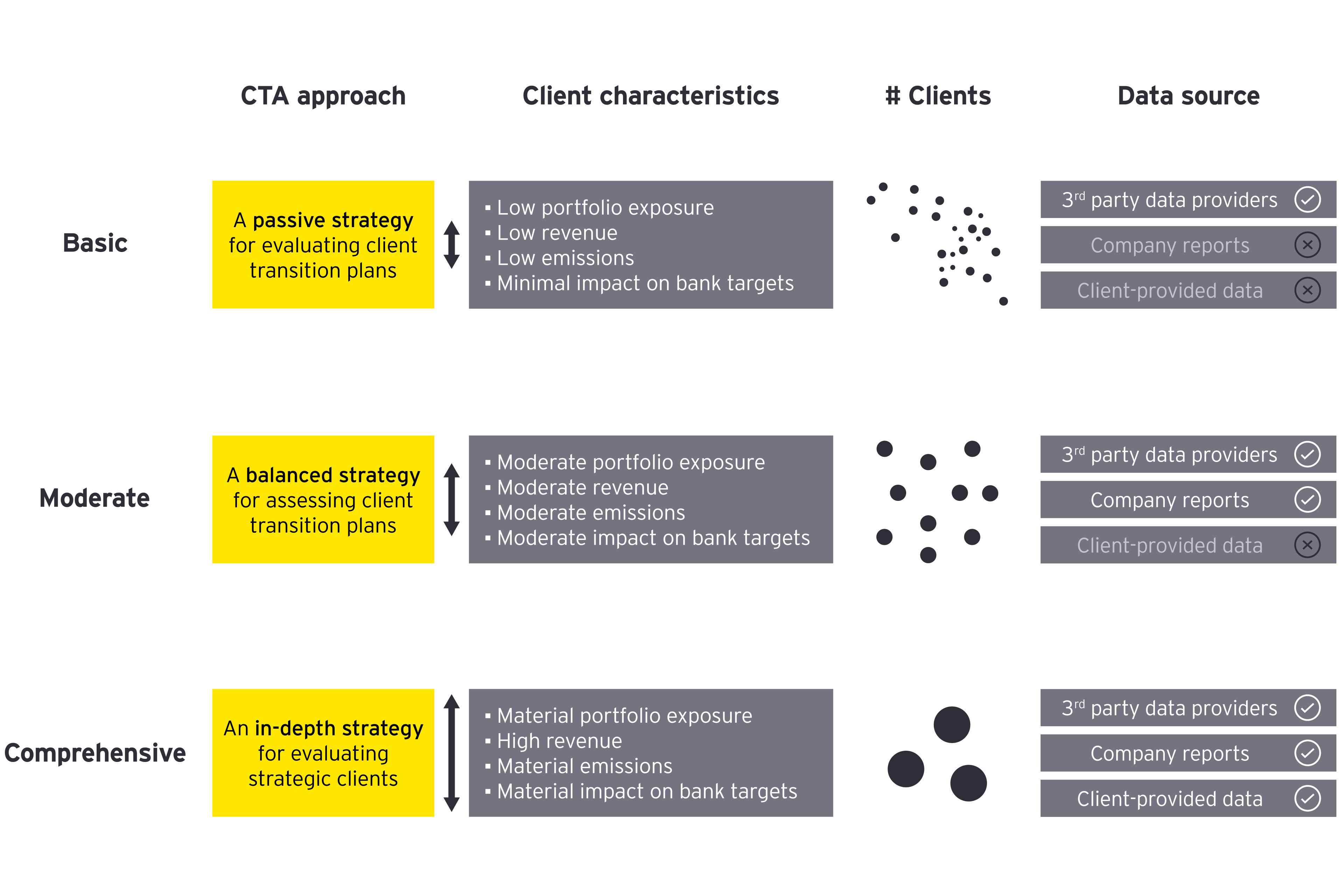
Figure 1 is a conceptual prioritisation framework that sorts clients into three levels of CTA: basic, moderate and comprehensive. Clients with high financial exposure to carbon emissions, substantial revenue and strategic alignment with the bank’s net zero targets, may require a comprehensive CTA involving detailed data gathering and analysis. In contrast, clients with low emissions, minimal revenue and lack of strategic alignment may only need a basic CTA using third-party data. 


Figure 1 Illustrative CTA prioritisation framework

A diagram outlining basic, moderate and comprehensive Client Transition Assessment frameworks.

2. What are your client transition assessment criteria and data sources? 

Banks tend to use standardised, qualitative and quantitative questions to run CTAs. The EY survey revealed a range of 13-81 questions per client, with an average completion time of 5-10 hours. Each answer generates a score that can be weighted and aggregated into a single unified score or ‘red, amber, and green (RAG) rating’. Those banks with more sophisticated CTA approaches categorise clients into distinct groups based on their level of transition alignment, such as ‘non-aligned,’ ‘partially aligned’ and ‘fully aligned’ with the United Nations Paris Agreement.4 In the more advanced cases, banks produce a dashboard displaying CTA results per client, which is accessible to their relationship managers.  

Several frameworks and tools, notably Climate Action 100+5 and the Transition Pathway Initiative,6  not only provide data, but also offer banks valuable guidance and a curated list of questions to facilitate CTA questionnaire design. This enables banks to select the questions and criteria that suit their specific needs. Many banks depend on third-party data vendors such as Moody’s Net Zero Assessments,7 and Sustainable Fitch Transition Assessments,8 which offer comprehensive data sets for evaluating company transitions. However, the third-party score methodology frequently differs from the banks’ CTA criteria, making comparisons challenging. In some instances, relationship managers engage with clients, to retrieve data that is not readily available from third-party providers or sustainability reports. Whilst this approach can be helpful, it also necessitates upskilling personnel and is very resource-intensive; organisations should question whether the value gained is proportional to the investment. 

In the UK, several banks have adopted the 'ambition, action, and accountability' framework from the UK’s Transition Plan Taskforce (TPT) to inform their own CTA framework.9 Table 1 provides a sector-neutral criteria framework to evaluate clients’ climate transition plans based on TPT categories, including sources of free guidelines and data.  

Banks need to form a rounded view of clients’ progress based on all three A’s. However, some A’s are more challenging than others, for example, action, specifically on level of capital expenditure (CapEx) for transition in in oil and gas companies, or sustainable fuel adoption in an aviation company. The thresholds for such CapEx often depend on what is considered an ‘appropriate’ transition spending level for the client's sector and geography; but banks often lack reliable data to assess these levels in an objective manner.  

Table 1 – Key CTA illustrative assessment criteria and free data sources

Note: Climate action 100+ (CA100+), Greenhouse Gas Protocol (GHG Protocol), Science Based Targets initiative (SBTi), Voluntary Carbon Markets Integrity Initiative (VCM-I), Integrity Council for the Voluntary Carbon Market (IC-VCM), Climate Change Committee (UK) (CCC), Transition Pathway Initiative (TPI), Transition Plan Taskforce (TPT), Task Force on Climate-related Financial Disclosures (TCFD), Institutional Investors Group on Climate Change Oil & Gas Net Zero Standard (IIGCC O&G Net Zero Standard), Transition Arc

A few banks are also starting to use artificial intelligence (AI) to support CTA data collection, to reduce the need for manual data collection, namely when assessing a large group of clients (see Box 1).

3. Do you use CTAs to drive strategy? 

As CTA process becomes more robust, the associated insights are increasingly valuable for portfolio management. This is particularly important when evaluating financial risks and opportunities and addressing clients’ capital needs. At present, however, CTA insights are not fully embedded into strategy and financial planning across many banks.  

Drawing on our research we believe CTAs can be enhanced in several ways, to drive strategy and achieve internal buy-in to integrate assessments into multiple decision processes:  

  • A source for identifying new finance opportunities and risks: CTAs should encompass all relevant sectors, especially those that have been underrepresented, to bridge gaps in transition strategies and product offerings, and capture new or unknown transition opportunities and risks. 
  • Deepen client engagement: Use CTAs as a basis for meaningful client discussions, giving relationship managers the knowledge and tools to translate CTA findings into strategic advice that helps clients address transition challenges.   
  • Agile analysis: Embrace AI and other technologies to streamline and scale the CTA process. Despite current limitations, ongoing advancements are likely to improve the efficiency and accuracy of assessments, leading to more nuanced and informed decision-making. 
  • Governance and controls: Help ensure CTAs are integrated across all business functions, rather than siloed within sustainability departments, to embed climate considerations into all financial decision-making. 
  • Monitor and adapt: As climate science and policy evolve, CTAs should also be updated regularly to reflect the latest developments of sustainability in finance, keeping institutions at the forefront of climate technology and transition finance. 

By implementing these improvements, banks can transform their CTAs beyond simple data collection into a strategic tool that could enhance decision-making and identify opportunities for decarbonisation.


With thanks to contributors Pablo Carvajal, Director, UK&I Financial Services, Net Zero UK Banking, Ernst & Young LLP and Adam Nordstrom, Manager, UK&I Financial Services, Climate Change and Sustainability Services, Ernst & Young LLP.

Summary

Client transition assessments (CTAs) are not yet fully embedded into strategy, planning, and financial decision-making, limiting their potential to inform climate-related risks and opportunities. However, by integrating CTA insights across business functions, banks can support decarbonisation and identify new financing opportunities that benefit both clients and portfolios.

Get the latest on sustainability in financial services

Be the first to learn about our latest articles, events and webinars related to sustainability for financial services.

Related articles

How to accelerate transition finance for net zero

Learn why FIs need to operate iteratively to effect transition finance at pace and scale in a complex ecosystem.

Why should financial institutions be on a mission to reduce emissions?

Accelerating decarbonization is urgent. Learn why private sector institutions must play a key role in addressing the current shortfalls in climate finance.

    About this article