




EY refers to the global organization, and may refer to one or more, of the member firms of Ernst & Young Global Limited, each of which is a separate legal entity. Ernst & Young Global Limited, a UK company limited by guarantee, does not provide services to clients.
Recent Searches
Press release
26 Jan 2026
|
London, United Kingdom
Gender pay gap narrows on UK financial services boards
Gender pay gap on UK financial services boards has narrowed from 40% to 29% since 2020, but remains wider than in the US (4%), Canada (9%), Germany (21%) and France (22%)
This equates to an average pay difference of more than $100,000 per year between male and female non-executive directors on UK financial services boards
The gender pay gap has contributed to a 4% decline in overall non-executive pay in the UK since 2020, while global peers recorded increases
The UK is the only major financial services market across Europe and North America to have narrowed its gender pay gap for non-executive directors since 2020. However, the difference in earnings between men and women on UK financial services boards is still considerably wider than that seen across global peers, according to the latest EY Global Financial Services Boardroom Monitor.
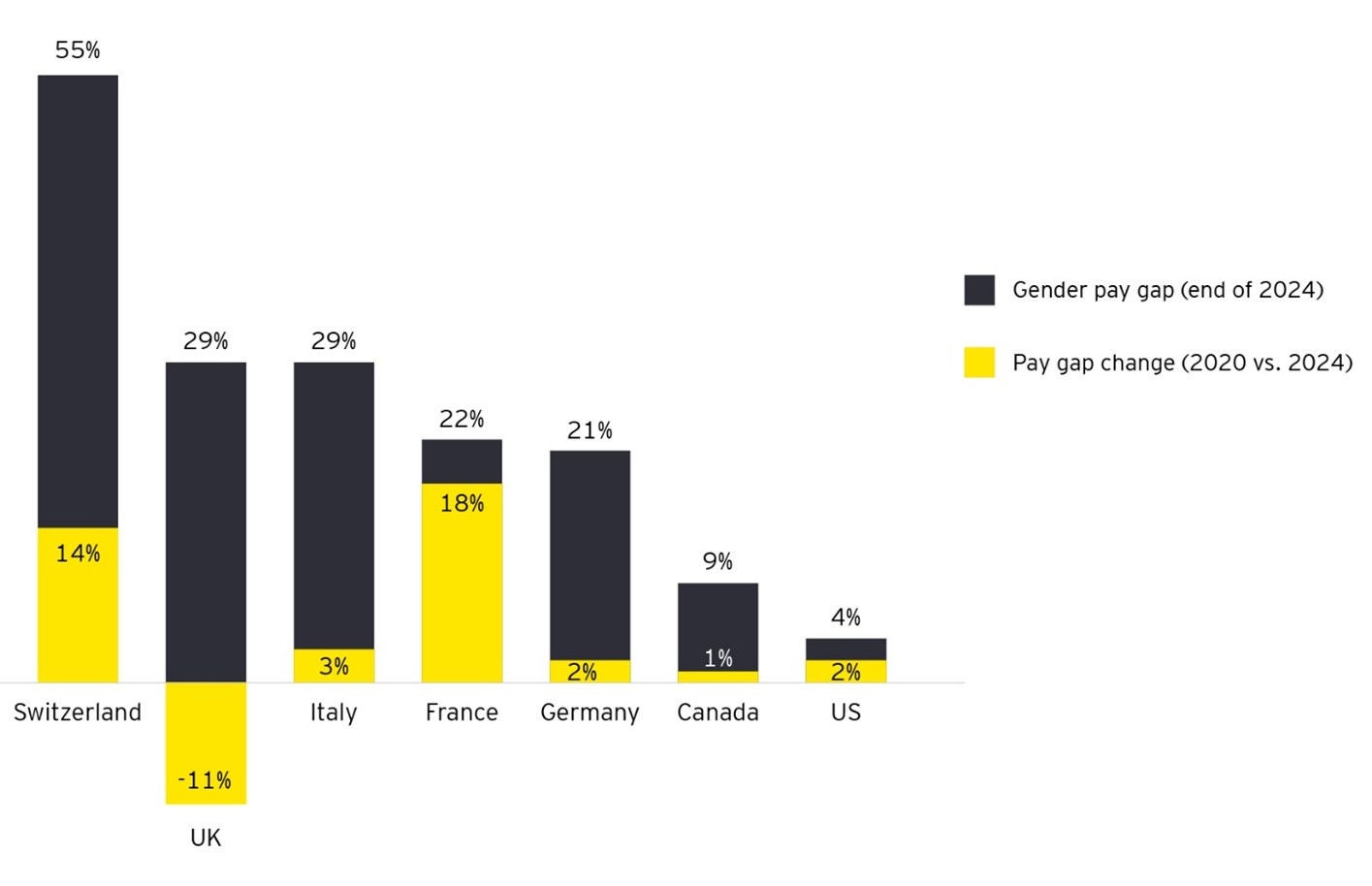
The gender pay gap on UK financial services boards narrowed by 11 percentage points from 40% to 29% between 2020 and 2024 (the latest available five-year period). In contrast, over the same period, on US and German financial services boards, the pay gap widened by two percentage points (from 2% to 4% in the US, and from 19% to 21% in Germany), and in Italy it widened by three percentage points (from 26% to 29%). In Switzerland and France, the gender pay gap grew most markedly, widening by 14 and 18 percentage points respectively (from 41% to 55% in Switzerland and from 4% to 22% in France).
Despite progress however, the UK still has one of the highest board level gender pay gaps in the transatlantic financial services market. At 29%, the gap is equivalent to $102,000 per year on average, much larger than that of the US (4%, or $13,000), Canada (9%, or $22,000), Germany (21%, or $57,000) and France (22%, or $31,000), and in line with Italy in percentage terms (29%, or $77,000). The only comparator country with a larger gender pay gap is Switzerland, where it stands at 55%, equivalent to $478,000.
Gender pay gap on financial services boards (at end of 2024) and the percentage shift
Banking sector drives the UK’s board-level gender pay gap
The UK’s financial services board-level gender pay gap is driven primarily by the banking sector, where it stands at 45%, up 11 percentage points from 34% in 2020. In contrast, the gap is narrowing in other sectors. In insurance, the gender pay gap fell to just 3% in 2024, down 25 percentage points from 28% in 2020. In wealth and asset management, the gender pay gap declined by 31 percentage points from 52% in 2020 to 21% in 2024.
Martina Keane, EY UK & Ireland Financial Services Leader, commented: “It is encouraging to see UK financial services firms move faster than their transatlantic peers to narrow the board-level gender pay gap, particularly when many comparable markets are moving in the opposite direction. But this progress should not obscure the scale of the challenge that remains.
“The progress made in asset management and the near parity achieved in insurance show what is possible. Concerted, proactive efforts are needed to sustain and build on the progress that’s been made, but the pace must pick up. Faster progress to gender pay equality in financial services will better ensure the best global talent is attracted, retained and leveraged to promote industry and economic growth.”
Gender pay gap may be holding UK back in global race for talent
The data suggests that the relatively high gender pay gap on UK financial services boards is contributing to a decline in overall non-executive pay. As UK financial services boards have appointed more women (representation rose from 41% in 2020 to 48% in 2024), persistently lower pay for female directors has placed greater downward pressure on overall non-executive remuneration.
Partly because of this, the UK was the only major financial services market across North America and Europe to see its average level of non-executive pay fall between 2020 and 2024 – declining by 4%. In contrast, non-executive pay rose significantly in the US (up 13%), Italy (up 12%), Canada (up 11%) and Switzerland (up 16%).
While many global peers also recorded increases in female board representation, narrower gender pay gaps in those markets meant it did not affect overall pay levels to the same extent.
Martina Keane concluded: “UK financial services firms have made strides to improve female representation in the boardroom, but an unintended consequence has emerged. As more women join finance boards in the UK, overall pay for non-executive directors is falling – even amid inflation – unlike the upward compensation trend seen in competitor markets.
“Financial services chairs should look to review representation and renumeration policies in tandem to ensure they are equitable, fair, and globally competitive.”
Women lead UK senior tech appointments, but pay gap persists
Technology expertise is an increasing priority for UK financial services boards, and the number of non-executive directors appointed with this skillset increased by 66% between 2020 and 2024, of which 47% were women. However, average pay for tech-specialist non-executives fell by 15% over the same period. Across Europe more broadly, average pay for non-executive directors with technology expertise declined by 12%, alongside a 60% increase in the number of board members with this skillset.
Looking through a gender lens, female directors with technology expertise earn on average 33% less than male peers in the UK. While this gap has narrowed by four percentage points since 2020 – a larger reduction than in all other major European financial services markets bar Italy – it remains significant.
Notes to editors:
- This is the first launch of the EY Global Financial Services Boardroom Monitor, following seven launches of the EY European Global Finance Services monitor since 2022.
- Remuneration data reflects the latest reporting period (to 31st December 2024) and only covers non-executive directors.
- Remuneration data of board members analysed across parameters including region, sector, age, gender and size of entity across global financial services firms is current as at 31st December 2024.
- A total of 213 firms were tracked, including 104 in North America, 91 in Europe (including 18 in the UK), and 18 in Asia Pacific.
- The EY Global Financial Services Boardroom Monitor does not track the race and ethnicity of board members, as there is no standardized format for directors to disclose against.
About the EY Global Boardroom Monitor
- The EY Global Financial Services Boardroom Monitor tracks the renumeration, age, gender, and skillsets of board members across a defined universe of financial services firms to create a broad picture of the gaps in pay and possible pressure points within the listed global financial services markets.
- The EY Global Financial Services Boardroom Monitor is comprised of disclosable, publicly available data on board appointments at listed banks, wealth and asset managers, FinTechs and insurers across the Europe, North America and Asia Pacific.
- For Europe, entities in the MSCI European Financials Index comprise the core universe. For North America, all entities tracked are North American-headquartered and included in the MSCI World Financials Index. For Asia-Pacific, all firms tracked are Asia-Pacific-headquartered entities in developed markets only from the MSCI World Financials Index.