




EY refers to the global organization, and may refer to one or more, of the member firms of Ernst & Young Global Limited, each of which is a separate legal entity. Ernst & Young Global Limited, a UK company limited by guarantee, does not provide services to clients.
Recent Searches
Press release
01 Oct 2026
|
London, United Kingdom
UK bank lending growth to hit three-year low in 2027 as economic pressures weaken borrowing demand
- UK bank lending growth is forecast to slow from 3.6% in 2025 to 2.9% this year and then 2.2% in 2027, amid higher energy costs and economic pressures
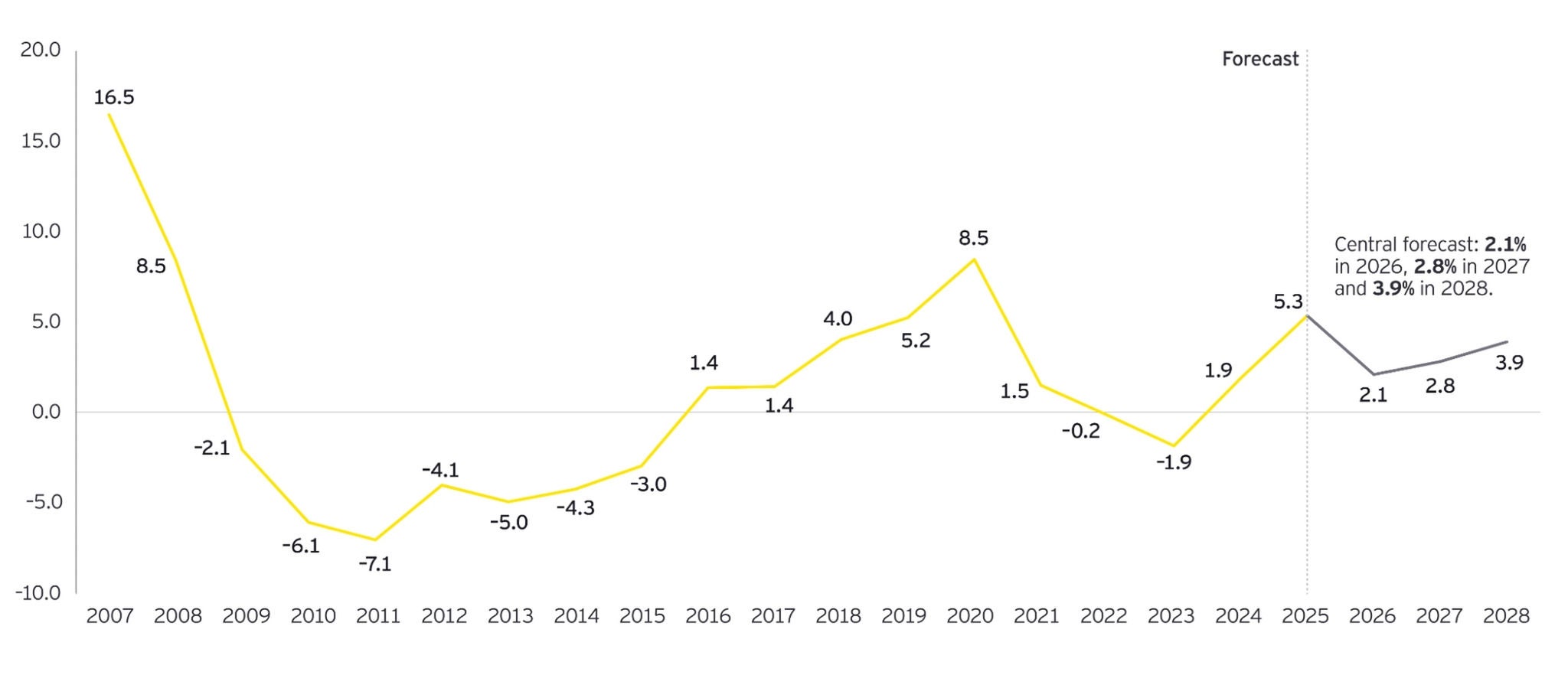
- Corporate lending growth is expected to more than halve from 5.3% in 2025 to 2.1% this year, before a modest rise to 2.8% in 2027
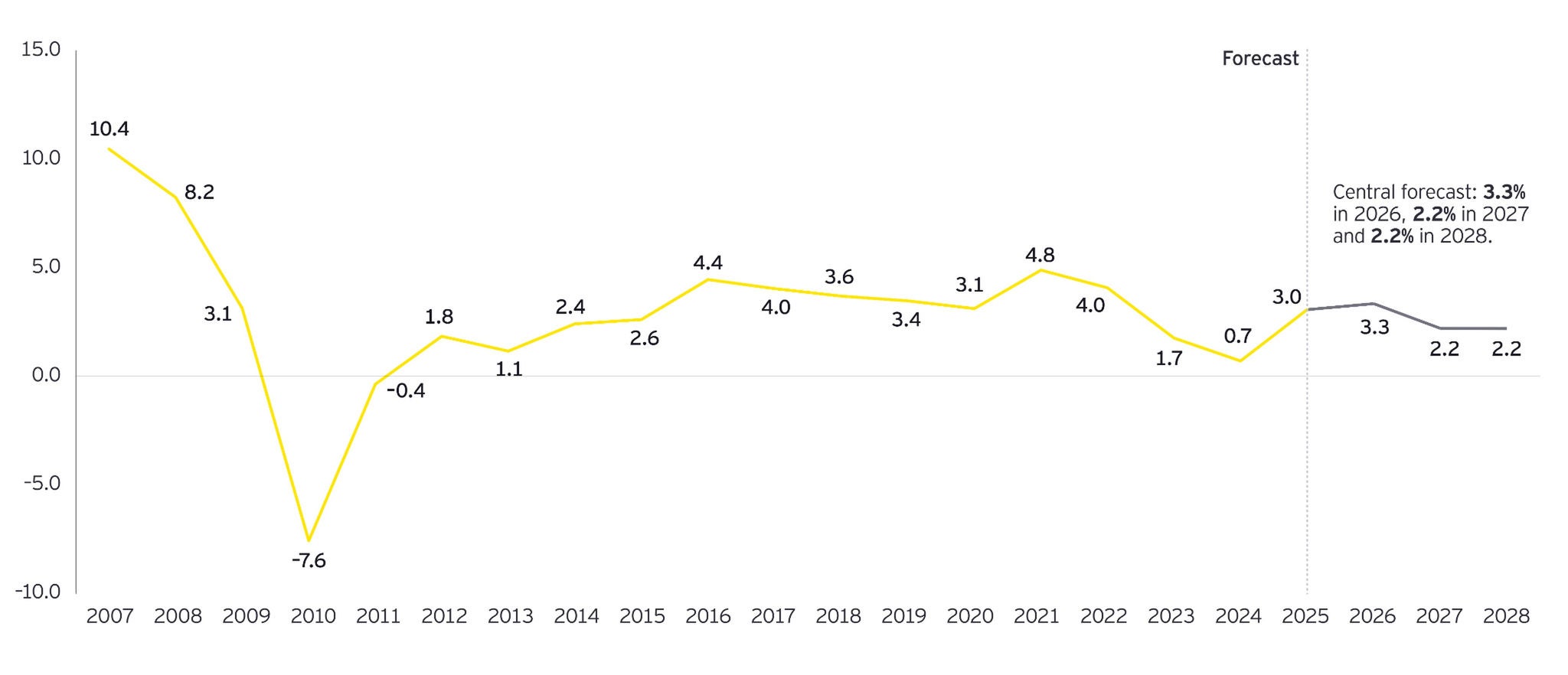
- Mortgage lending growth is the only category expected to see a rise in 2026, from 3.0% to 3.3%, as lower interest rates support demand, before slowing in 2027 to 2.2%
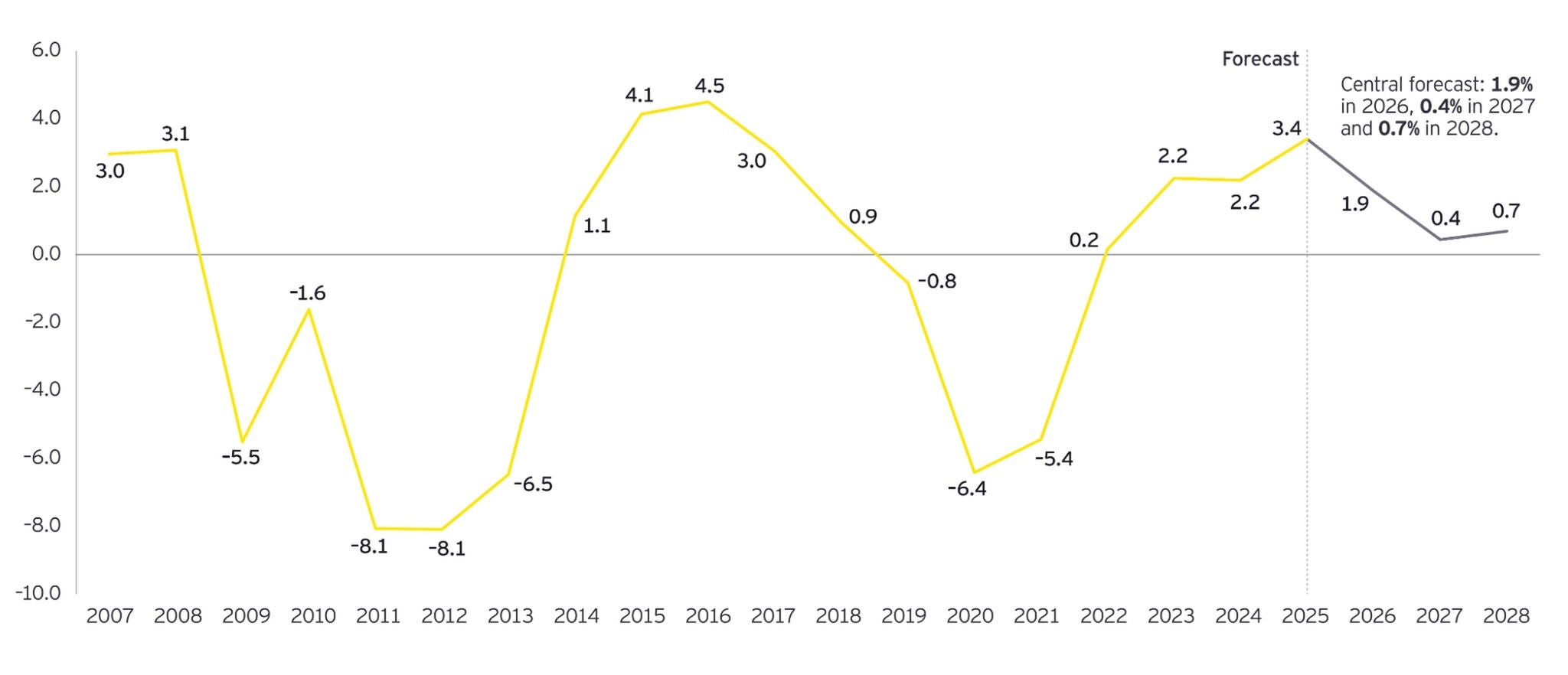
- Consumer credit growth is forecast to fall from 3.4% in 2025 to 1.9% this year and 0.4% in 2027, as banks exercise greater caution amid affordability pressures
Growth in UK bank lending to households and businesses is forecast to slow markedly over the next two years, from 3.6% in 2025 to 2.9% this year, and to a three-year low of 2.2% in 2027, according to the new EY UK Bank Lending Outlook. The forecast comes amid renewed tensions in the Middle East, and with higher energy costs and weaker economic activity weighing on demand.
Corporate borrowing is likely to be most impacted, with lending growth expected to more than halve this year – from 5.3% in 2025 to 2.1% – as firms take a more cautious approach to investment. However, renewed spending on strategic projects should support an uplift from next year, with the forecast rising to 2.8% in 2027 and 3.9% in 2028.
Mortgage lending remains comparatively resilient, after interest rates and inflation fell back last year, with growth expected to rise marginally from 3.0% in 2025 to 3.3% in 2026. However, rising unemployment, slower income growth and interest rates remaining higher for longer are then forecast to reduce growth to 2.2% in 2027.
Martina Keane, EY UK & Ireland Financial Services Leader, comments:
“Ongoing geopolitical tensions continue to create uncertainty for businesses in the UK. While the bank lending forecast reflects the impact of global economic challenges, it is important to keep this in perspective, with growth still set to continue across all major categories. The UK banking sector remains resilient and well-positioned to navigate this period of slower activity and banking leaders should remain focused on the longer-term picture, while being ready to adapt quickly should conditions change.
“At the same time, prolonged economic uncertainty means changing customer needs – households may look for greater financial flexibility, while businesses often take a more targeted approach to investment. As banks support customers through these near-term pressures, those who continue to invest in AI, emerging technology and broader transformation programmes to tailor their services will be best positioned to capitalise on future opportunities as the economy strengthens.”
UK corporate lending growth to slow sharply, before a modest uplift from 2027
Following growth of 5.3% in 2025, bank lending to businesses is forecast to more than halve to 2.1% this year as higher costs and economic uncertainty weigh on investment demand. From 2027, stronger spending on AI and wider digital technology is expected to support an uptick in corporate lending growth to 2.8%, before rising again to 3.9% in 2028.
Corporate borrowing has remained subdued since its historical peak in 2008, reflecting a long-term shift in the lending market since the global financial crisis. Despite a significant slowdown this year, the central forecast expects an average growth rate of 2% - 4% over the next five years, above the average over the previous decade (2015-2025), as continued business investment appetite keeps credit demand healthy.
Non-financial corporate debt, annual growth % 2007-2028
Corporate write-off rates are expected to remain low, reflecting the relatively low-risk nature of recent lending, and are forecast to fall from 0.18% in 2025 to 0.17% in 2026, 0.16% in 2027 and 0.14% in 2028.
UK mortgage lending growth to rise this year, but ease from 2027, as housing demand weakens
Mortgage lending growth is forecast to increase slightly from 3.0% in 2025 to 3.3% this year, making it the only major lending segment with expected growth acceleration in 2026. This reflects the easing in interest rates in the second half of 2025. However, higher unemployment and slower income growth are expected to weaken housing demand thereafter, with mortgage lending growth forecast to dip to 2.2% in both 2027 and 2028.
Household mortgage debt, annual growth % 2007-2028
Mortgage write-off rates have risen steadily since 2022 as households have moved from lower-rate fixed deals to higher monthly repayments. With much of this refinancing adjustment now complete, rates are forecast to increase only marginally, from 0.008% in 2025 to 0.010% in 2026 and 0.011% in 2027, before easing to 0.010% in 2028, remaining low by historical standards.
UK consumer credit growth to slow as household finances come under pressure
UK unsecured consumer credit growth, which has been rising since 2022 as households borrowed to meet higher living costs, is now forecast to moderate to just 1.9% in 2026, down from 3.4% in 2025. Rising unemployment and slower income growth are expected to make households more cautious about taking on debt, while lenders are also likely to become more selective as affordability pressures increase. This subdued credit demand is expected to persist, with consumer credit growth forecast to slow further to 0.4% in 2027, before rising slightly to 0.7% in 2028.
Consumer credit, annual growth % 2007-2028
Consumer credit write-off rates are expected to remain contained, rising only slightly from 0.82% in 2025 to 0.88% in both 2026 and 2027, driven by increased unemployment, before falling back to 0.82% in 2028.
Dan Cooper, EY UK & Ireland Head of Banking and Capital Markets, concludes:
“The moderation in lending activity is broad-based, as households and businesses become more cautious in response to economic uncertainty and higher costs. Business investment, housing activity and consumer borrowing are all anticipated to remain subdued in the near term. Importantly though, write-off rates are expected to remain low and stable across all categories, suggesting slower demand rather than a deterioration in credit quality.
“The UK’s banks enter this period from a position of strength, having built robust capital positions, greater resilience, and disciplined risk management. This means they are well-placed to support customers while continuing to invest for the future, so they are ready to meet demand as the economy stabilises and borrowing appetite returns.”
Notes to editors:
- The central forecast is based on the latest EY UK Economic Outlook.
- If conflict in the Middle East escalates further and no ceasefire agreement is possible until early 2027, higher oil prices and inflation could push the UK economy into recession in late 2026 and early 2027.
- Bank lending growth would then be expected to rise temporarily this year, as households and businesses borrow to manage higher costs, before falling to potentially as low as -0.4% in 2028, as affordability pressures, and weaker confidence reduce investment and demand.
About EY Bank Lending Outlook
The EY UK Bank Lending Outlook is produced using the National Institute Global Econometric Model (NiGEM) software and is conditioned on the economic forecasts contained within the Summer 2026 EY UK Economic Outlook. The NiGEM economic model is the property of the National Institute of Economic and Social Research (NIESR) and NiGEM is a Trademark of the Institute https://www.niesr.ac.uk.
The EY UK Bank Lending Outlook forecasts UK bank lending to households and non-financial corporates. It covers UK-regulated institutions that take deposits and includes central and adverse economic scenarios.