Oil platform yellow color in the sea

From bottleneck to accelerator: the strategic role of digital identity controls for industrials and energy companies

Co-authored by: Vansh Narula, EY Canada Industrials & Energy Digital Identity Leader.

Strong digital identity is now essential in I&E, driving secure operations, managing IT/OT risk, and enabling resilient digital transformation.


In brief
  • Digital identity is now foundational to cybersecurity in Industrials & Energy, with IT/OT convergence making unified governance essential.
  • Expanding machine and third‑party access increases risk, making strong digital identity controls critical to protecting operations.
  • Strengthening digital identity capabilities enables safe modernization, supports compliance, and reduces operational and regulatory exposure.

In a world where data breaches are a continuous threat, harnessing digital identity controls can help fuel innovation, enhance security and build confidence in industrials and energy.

A fundamental shift is occurring in how digital identity is perceived at the executive level. It’s evolving from a mere compliance checkbox to a strategic capability. For two decades, identity management in industrials and energy (I&E) followed a predictable pattern: implement controls to satisfy auditors, refresh them when regulations changed and treat the function as a cost centre managed by IT.

That model is now obsolete.

In this article, we examine what the regulatory and threat landscape now demands, why the I&E sector faces unique challenges and how leading organizations are building identity capabilities that enable rather than constrain the business.

The organizations gaining ground aren’t the ones with the biggest identity and access management (IAM) budgets. They’re the ones that solved the information technology/operational technology (IT/OT) identity governance problem first.

1

Chapter 1

Why the industrials and energy sector is different

Every sector claims its identity challenges are unique. In I&E, that claim happens to be true, and the distinctions matter for how you build your roadmap.

The IT/OT convergence reality

Most industries manage information technology and operational technology as separate domains with occasional integration points. In I&E, the boundary is dissolving. SCADA systems that controlled physical processes in isolation now feed data to cloud analytics platforms. Control room operators need unified access across environments that were never designed to interoperate.

Traditional IAM platforms assume IT-centric models: active directory/Entra ID/IdP integration, SAML federation, cloud identity providers. OT environments run on industrial protocols with authentication models designed decades ago. Bridging these worlds requires more than technical integration; it requires a unified governance framework that most organizations haven’t built.

The operational resilience implications are significant. Energy, mining and pipeline operations rely on complex ecosystems of third-party systems and vendors. Unauthorized access or stale credentials can disrupt flow and safety. Canadian critical infrastructure has already been targeted: attackers are pivoting from IT systems into OT environments. Industry reporting shows a surge in OT cyber incidents across utilities. IAM is the kill switch for insider risk and contractor misuse, but only if controls extend across the IT/OT boundary.

Recent breaches illustrate the stakes. Attackers maintained access to utility systems for months before detection, ultimately impacting numerous customers. Post-incident analysis pointed to identity governance gaps at the IT/OT boundary — exactly where most I&E organizations remain weakest.

The machine identity explosion

In a typical I&E environment, machine identities now outnumber human identities by 10 to 1 or more. Service accounts, API keys, certificates, IoT device credentials, robotic process automation bots: each represents an access point that needs governance. Most organizations have mature processes for managing human identities. Far fewer have equivalent rigour for machines.


As AI deployments scale, this gap becomes acute. A single predictive maintenance deployment might require dozens of service accounts with access to OT data streams. Strategic initiatives — workforce transformation, ERP migrations, multi-cloud adoption, DLP programs — each multiplies identity challenges. If digital identity initiatives are deferred, each new project adds technical debt and expands the attack surface. Retrofitting identity governance after a breach is the most expensive path.


Leading organizations are treating machine identity governance as a first-class concern, building automation that can provision and deprovision at speed and implementing monitoring that detects anomalous machine behaviour before it becomes a breach. Digital identity investments now enable digital transformation securely, avoiding “retrofit taxes” and making identity an enabler rather than a blocker.
 

The supply chain identity problem

I&E supply chains are complex, interconnected and increasingly digital. Contractors need access to production systems. Vendors need access to maintenance data. Joint venture partners need shared access to operational environments. Each relationship creates identity federation challenges that compound organizational risk.


Modern digital identity capabilities — including just-in-time vendor access, session recording and passwordless authentication for SCADA systems — protect uptime, reduce mean-time-to-respond in incidents and prevent disruptions that cascade across Canada’s energy supply chain. Organizations that haven’t implemented rigorous third-party identity governance face both compliance exposure and operational risk, often simultaneously.

2

Chapter 2

The regulatory landscape

Regulators now require ongoing, real-time proof of effective digital identity controls, making continuous compliance essential to avoid penalties and disruptions.

The regulatory environment for digital identity in I&E is undergoing its most significant transformation in decades. North American Electric Reliability Corporation Critical Infrastructure Protection (NERC CIP), TSA pipeline directives, the Critical Cyber Systems Protection Act (CCSPA) and Canadian privacy acts all demand verifiable identity governance. But the nature of regulatory expectation has fundamentally shifted. Regulators increasingly expect real-time evidence of least privilege and privileged session oversight — not annual attestations, but continuous demonstration that controls operate effectively.

Recent breaches in the Canadian energy sector are accelerating enforcement. Organizations waiting to act may find themselves caught in the next wave of compliance crackdowns. The business case for staying ahead is straightforward: continuous compliance lowers audit costs, reduces fines and protects an organization’s ability to operate without interruption.

Bill C-8: The Critical Cyber Systems Protection Act

Bill C-8 represents a fundamental shift in how Canada regulates cybersecurity for critical infrastructure. The CCSPA establishes mandatory cybersecurity obligations for designated operators in telecommunications, finance, energy and transportation. For I&E organizations, this isn’t a distant concern: it’s an imminent compliance obligation with substantial enforcement provisions.

The CCSPA requires designated operators to establish cybersecurity programs that include identity and access management controls. Organizations must implement measures to protect critical cyber systems from unauthorized access, directly implicating identity governance, authentication mechanisms and access control policies. Supply chain security is explicitly addressed: organizations must mitigate cybersecurity risks from third-party products and services, extending identity governance beyond organizational boundaries.

Incident reporting requirements create additional identity implications. Organizations must report cybersecurity incidents within prescribed timelines, which requires comprehensive logging of authentication events, access activities and identity changes. Those without mature identity monitoring will struggle to meet reporting obligations.

The penalty structure commands attention: administrative monetary penalties can reach $15 million per organization per day for continuing violations. Beyond fines, noncompliance can result in compliance orders, court injunctions and criminal prosecution.

NERC CIP standards

For electricity sector participants, NERC Critical Infrastructure Protection standards have long-established baseline identity requirements. CIP-004 addresses personnel risk assessment and access management. CIP-005 governs electronic access controls for critical cyber assets. CIP-007 covers system security controls, including authentication and logging.

What’s changed is auditor expectations. Recent trends show increased scrutiny on access authorization processes, access revocation timeliness and principle of least privilege enforcement. Organizations that implemented “just enough” controls to pass prior audits are finding that bar has moved. Auditors are increasingly using identity evidence as a proxy for organizational resilience, treating mature identity governance as a bellwether for overall security maturity.

TSA pipeline security directives

Following a recent pipeline attack, the US Transportation Security Administration issued security directives specifically addressing pipeline cybersecurity. While US-focused, these directives influence Canadian operators with cross-border operations and signal regulatory direction that Canadian regulators may follow. The directives require access control mechanisms, continuous monitoring and incident response capabilities — all of which are foundational to identity governance.

Privacy legislation

PIPEDA requires organizations to implement security safeguards appropriate to information sensitivity: translating to specific identity obligations around access limitation, authentication mechanisms and audit trails. Québec’s Law 25 goes further, requiring privacy impact assessments for identity systems and privacy-by-default settings. Organizations operating across provinces must navigate a patchwork of requirements that will only grow more complex.

International frameworks

In the US, the National Institute of Standards and Technology (NIST) Cybersecurity Framework 2.0 elevates identity management to a top-level outcome within the Protect function. ISO 27001:2022 restructured controls with new identity-specific requirements. SOX creates identity obligations through internal control requirements for financial systems. For organizations operating internationally or serving customers with security requirements, alignment with these frameworks is often a business necessity.

The Digital Identity and Authentication Council of Canada’s (DIACC’s) Pan-Canadian Trust Framework (PCTF) represents where identity standards are heading. While currently voluntary, the PCTF establishes conformance criteria across identity proofing, authentication, consent and credential management. DIACC estimates the value of trusted digital identity to the Canadian economy at $15 billion annually. Organizations building roadmaps should consider PCTF alignment as strategic positioning for emerging requirements.

Where enforcement is heading

Several regulatory trends are clear. Identity evidence is becoming a primary measure of organizational resilience. Machine identity governance is entering regulatory scope. Continuous compliance is replacing point-in-time attestation. Cross-border data flows face increasing scrutiny. Organizations that anticipate these trends will be positioned for compliance; those that wait will face retrofit costs.

Bill C-8 penalties can reach $15 million per day. But the real exposure isn’t the fine — it’s the 6 to 18 months of operational constraint organizations face while remediating.


3

Chapter 3

The risk financing dimension

Identity maturity is now crucial for securing insurance, investment and lower premiums.

Beyond regulatory compliance, identity maturity increasingly determines access to capital and insurance markets. Insurers and ESG auditors have discovered what security professionals have long known: identity maturity is a reliable proxy for cyber resilience.

Strong privileged access management (PAM), continuous monitoring, decentralized identity and identity verification all lower the perceived cyber risk and increasingly determine whether coverage is available at all. The numbers are stark. Breach costs in Canada are averaging nearly $7m per incident. Insurance firms are raising premiums or denying coverage outright if identity controls aren’t demonstrable.

ESG investors expect utilities to show strong protection of communities and critical data and they’re asking specific questions about identity governance. Digital identity maturity lowers insurance premiums, avoids costly exclusions and enhances investor confidence by embedding identity into ESG reporting. For CFOs evaluating security investments, the ROI case has never been clearer.

4

Chapter 4

The maturity gap

Through our work with I&E organizations across Canada, we’ve observed a widening gap between organizations treating identity as a strategic capability and those managing it as a compliance obligation.

What leaders do differently

Leading organizations solve governance before technology. They establish IAM steering committees, policy frameworks and operating models before making platform decisions. They unify IT and OT identity governance — not necessarily on a single platform, but under a single governance framework with clear accountability for the boundary between environments.

They build for machine identities from the start, treating machine identity governance as a first-class concern rather than retrofitting human-centric processes. They invest in identity analytics that detect anomalous patterns and surface governance gaps before auditors do. And they map controls to multiple frameworks simultaneously, designing processes that satisfy SOX, NERC CIP and ISO 27001 requirements in a single pass.

Common pitfalls

The most frequent mistake is leapfrogging into technology selection without establishing a baseline. Organizations skip the foundational work of understanding what identities exist, what access they have and what gaps need addressing — creating expensive rework when implementation reveals assumptions that don’t hold.

A second pattern is treating identity as an IT project rather than an enterprise initiative. Identity touches HR, legal, operations, procurement and finance. Organizations staffing identity programs solely from IT consistently underestimate the change management required.

Third, organizations often focus effort on the wrong phases paying excessive attention to initial deployment while underinvesting in later phases around automated assurance and adaptive governance. It’s these later phases that separate organizations with mature capabilities from those with expensive but underutilized platforms.

5

Chapter 5

EY’s strategic digital identity roadmap for industrials and energy companies

The path forward isn’t the same for every organization. Where you start depends on where you are.

At EY, our team has developed a strategic framework specifically for I&E organizations that provides a structured approach to building identity capabilities over time.


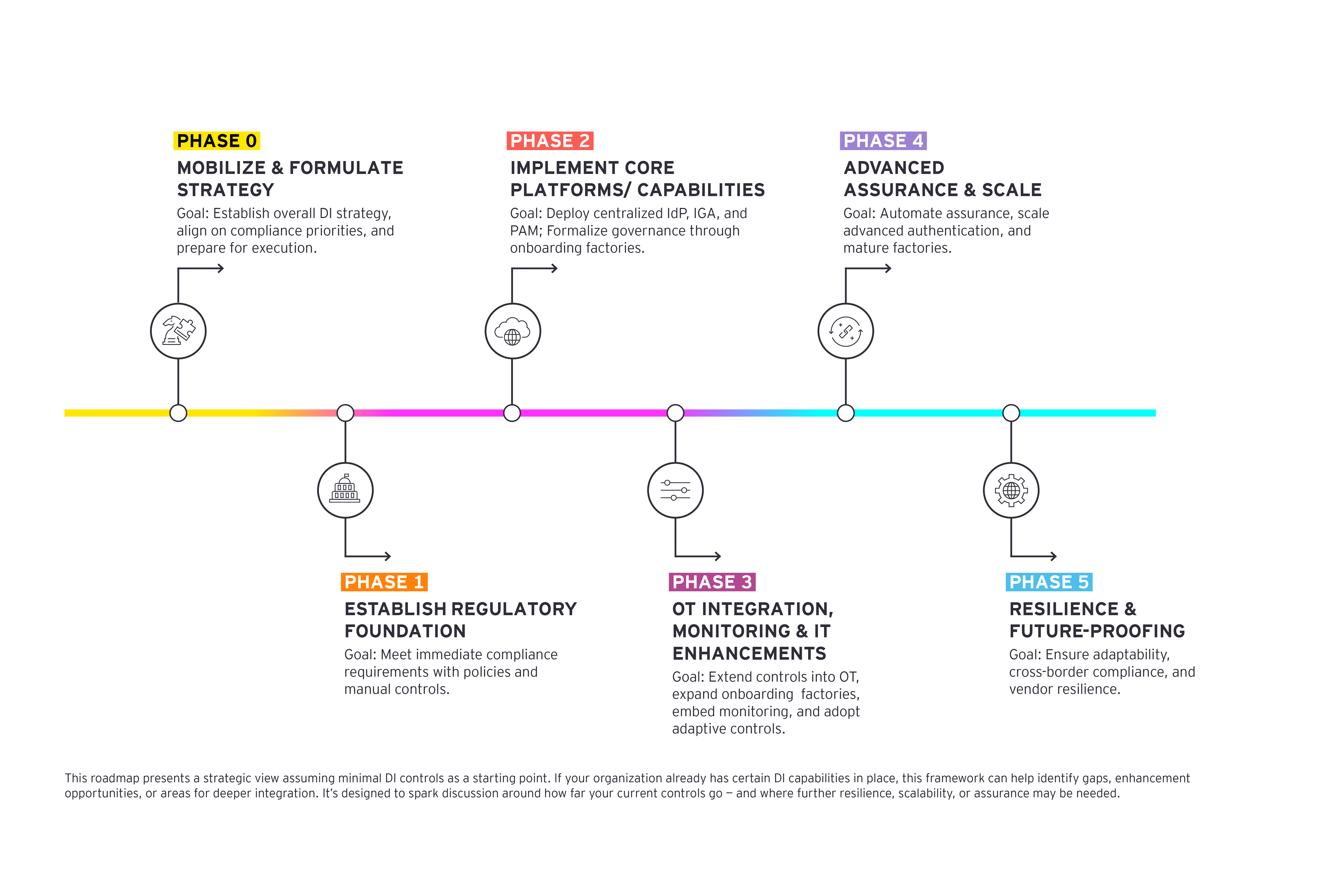
This roadmap presents a strategic view assuming minimal digital identity controls as a starting point. If your organization already has certain capabilities in place, this framework can help identify gaps, enhancement opportunities or areas for deeper integration. It’s designed to spark discussion around how far your current controls go — and where further resilience, scalability or assurance may be needed.


Phase 0: Mobilize and formulate strategy
 

Goal: Establish overall digital identity strategy, align on compliance priorities and prepare for execution.
 

Before platform decisions or implementation work begins, organizations need strategic clarity. This phase establishes the foundation: detailed current-state assessment, target-state vision aligned with business strategy and governance structures that guide decision-making. Critical activities include mapping existing identities across IT and OT, identifying applicable regulatory requirements, establishing an IAM steering committee and building the business case that translates identity capabilities into outcomes that resonate with executives.


Phase 1: Establish regulatory foundation
 

Goal: Meet immediate compliance requirements with policies and manual controls.
 

With strategy in place, this phase implements policies, procedures and manual controls needed to meet immediate compliance obligations. Activities include documenting access control policies that satisfy NERC CIP, Bill C-8 and other frameworks; implementing manual access review processes; establishing provisioning and deprovisioning procedures; and creating audit trails. While manual controls aren’t the end state, they provide the compliance foundation while more automated capabilities are built.


Phase 2: Implement core platforms/capabilities
 

Goal: Deploy centralized identity provider (IdP), identity governance and administration) (IGA and privilged access management (PAM); formalize governance through onboarding factories.
 

This phase implements these core technology platforms: IdP for centralized authentication, IGA for lifecycle management and access certification, and PAM for securing high-risk accounts. Beyond technology, this phase establishes “onboarding factories” — standardized processes for integrating applications that create repeatable patterns and establish consistent governance.

Graphic Title: Strategic Digital Identity roadmap framework

Phase 3: OT integration, monitoring and IT enhancements

Goal: Extend controls into OT, expand onboarding factories, embed monitoring and adopt adaptive controls.

This phase addresses the critical IT/OT boundary — often the most complex and highest-value work for I&E organizations. Activities include implementing identity-aware access controls for SCADA and industrial control systems, establishing monitoring that spans IT and OT environments, deploying adaptive authentication and expanding onboarding factories for OT-specific requirements. This phase moves beyond point-in-time compliance to continuous assurance.

Phase 4: Advanced assurance and scale

Goal: Automate assurance, scale advanced authentication and mature factories.

With core capabilities and OT integration in place, this phase advances maturity — automating compliance monitoring, deploying advanced authentication (e.g., passwordless, risk-based, biometric) at scale, maturing identity analytics and optimizing onboarding factories. This phase transforms identity from a compliance burden into an operational capability that enables the business.

Phase 5: Resilience and futureproofing

Goal: Achieve adaptability, cross-border compliance and vendor resilience.

Identity is not a project with an end date. This phase establishes the operating model and architectural foundations for continuous evolution — adapting to changing requirements, emerging threats and evolving business needs. It addresses cross-border compliance complexity and vendor resilience, reducing dependence on single providers. Organizations reaching this phase have transformed identity into a strategic capability that enables digital transformation and positions them for whatever comes next.

6

Chapter 6

How EY can support you on your journey

Our approach to digital identity in the I&E sector is built on one premise.

Identity strategy should derive from business strategy, not the other way around. We’ve developed frameworks and methodologies specifically for I&E contexts — purpose-built approaches that address IT/OT convergence, machine identity proliferation and sector-specific regulatory requirements.

Our teams include professionals who’ve worked in I&E operations and understand the practical constraints of implementing identity controls where uptime is non-negotiable and safety is paramount. That operational perspective shapes how we design solutions — not just technically correct, but operationally viable.

We bring deep regulatory knowledge to every engagement. Our teams understand Bill C-8 compliance, NERC CIP audit expectations, TSA pipeline directives, provincial privacy requirements and international frameworks. We can help you build control frameworks that satisfy multiple requirements efficiently through integrated design rather than separate compliance workstreams.

We work with you across the maturity spectrum. If you’re just starting your journey, we can establish foundations — assessments, governance frameworks and roadmaps. If you’re further along, we focus on advanced capabilities such as identity analytics, AI enablement and continuous assurance. If you’re facing immediate compliance pressures, we provide targeted support while building toward longer-term maturity.

Summary 

How you balance compliance investment against building strategic capabilities depends on your risk profile, regulatory exposure and business strategy. How you approach IT/OT convergence depends on your operational architecture. How you prioritize machine identity governance depends on your AI ambitions.

What’s clear is that these questions demand attention now. The regulatory trajectory is set. The threat landscape continues to evolve. Organizations that wait for clarity will find themselves rushing to respond under pressure and unrealistic deadlines.

Canada ranked 7th in digital competitiveness by the World Economic Forum, yet our privacy and identity regulations lag other G20 nations. That gap will close. The only question is whether your organization will be ahead of the curve or scrambling to catch up.


Related articles

How can cybersecurity go beyond value protection to value creation?

The 2025 EY Global Cybersecurity Leadership Insights Study found that CISOs account for US$36m of each strategic initiative they are involved in. Read more.

Cybersecurity threat outlook 2025 | EY Canada

EY Canada’s cybersecurity threat outlook report offers a comprehensive analysis of the cyberthreat landscape in 2025 and shares actionable insights for cybersecurity leaders. Read more.


    About this article