ceo-servey-2025-hero

Navigating the Future: Canadian CEOs' Perspectives on 2025

CEO survey - business leaders are navigating a complex environment with cautious optimism


In brief:

  • Canadian CEOs' confidence falls, due in part to political uncertainty, trade disruptions, and economic conditions. 
  • Despite global optimism, Canadian CEOs are adjusting expectations due to domestic challenges.
  • Leaders show increased interest in M&A, joint ventures, divestments, and IPOs, reflecting positive sentiment towards capital and financial markets.

As we step into the new year, the business landscape for Canadian leaders is characterized by a mix of optimism and caution. The latest EY survey reveals that while there is a general sense of optimism about the global outlook, Canadian CEOs are adjusting their expectations in response to various domestic and international challenges.

For instance, the January survey highlights a slight decline in confidence among Canadian leaders compared to the previous quarter, influenced by factors such as political uncertainty, potential trade disruptions with the US, revised immigration targets and a sluggish economic environment.

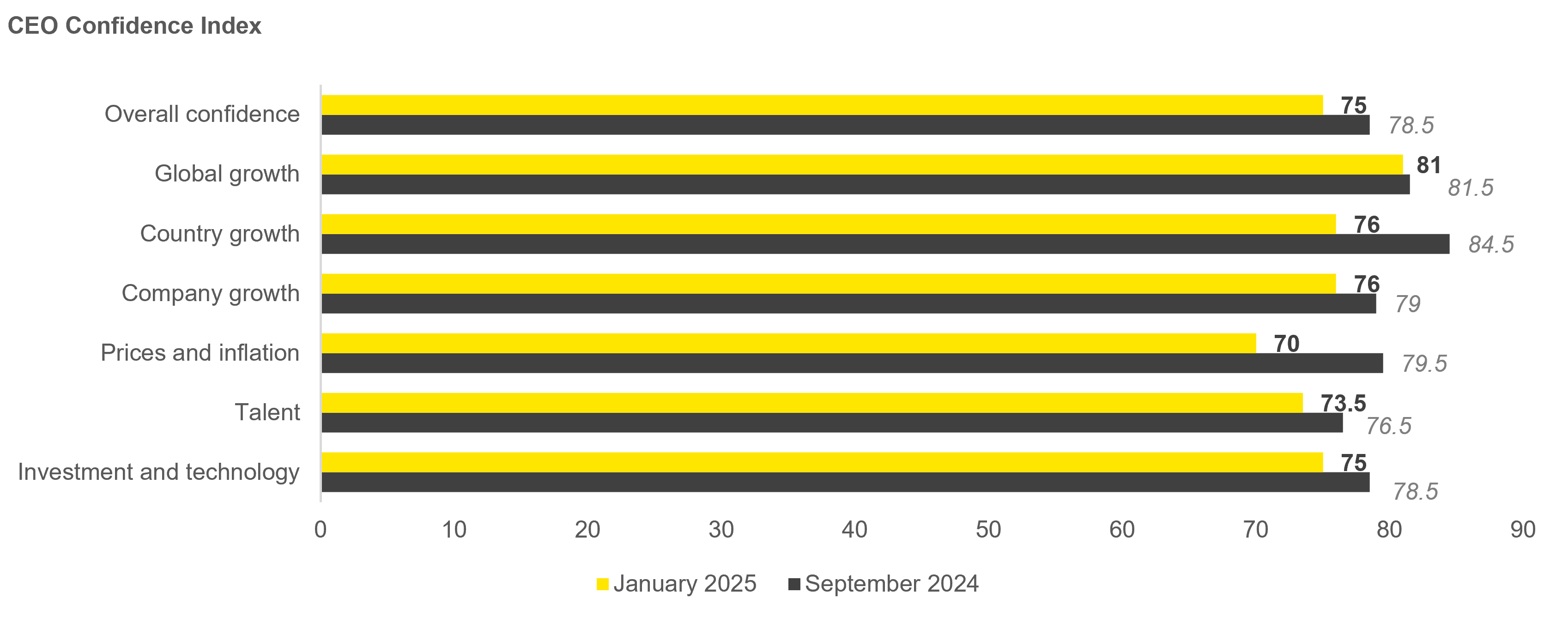
The EY CEO Confidence Index shows a decline across all categories in Canada, with notable decreases in expectations for the country’s growth and inflation. This adjustment reflects the ongoing concerns about high prices and lingering inflationary pressures in certain sectors while economic market uncertainty persists.

In summary, Canadian business leaders are navigating a complex environment with cautious optimism. The focus remains on capitalizing on technological disruption, enhancing digital adoption, and pursuing strategic transactions to drive growth and innovation. As they adapt to the evolving landscape, maintaining a competitive edge and fostering resilience will be key to CEOs’ success in 2025 and beyond.

1. CEO confidence is decreasing in an uncertain environment

Contrasting the high levels of optimism Canadian leaders reported in the previous quarter, a relative adjustment in expectations can be observed in our January survey.

Globally, 80% of CEOs feel optimistic about the global outlook, up from 69% in the previous quarter. And while 84% of Canadian CEOs share this sentiment, it represents a decrease from 88% in the previous survey.

This reflects an adjustment of their expectations, potentially due to several factors such as ongoing political uncertainty, looming threats to Canada-US trade in the form of higher tariffs, Canada’s revised immigration targets and an overall slower economic environment.

EY’s CEO Confidence Index experienced a decline in Canada across all categories, dropping from a score of 78.5 to 75 between September 2024 and January 2025. Particularly when it comes to “country growth,” the score has fallen considerably from 84.5 to 76, showcasing a sizeable adjustment in future expectations for the domestic outlook.

The same is seen for the outlook on prices and inflation – while the September 2024 score was 79.5, it dropped to 70, lowest among all categories in Canada. This may be due to the fact that while inflationary pressures improved in 2024, sentiments among businesses in Canada are relatively subdued due to stickier high prices, soft domestic demand, and lingering inflationary pressures in certain categories such as shelter, transportation and food.1


graph 1

Note: CEOs rated their outlook on 15 statements using a 5-point scale ranging from "very pessimistic" (0) to "very optimistic" (100). These responses were categorized into five thematic groups: sector growth, prices and inflation, company growth, talent, and investment and technology. Higher Index values indicate a more positive sentiment regarding the future state of the economy and their businesses. An index of 100 is fully optimistic, 50 is neutral, and 0 is fully pessimistic.

2. Tech disruption takes centre stage in the Canadian transformation agenda

Canada’s business environment is increasingly affected by the increasing speed and scale of technological disruption and adoption. Under the backdrop of growing macroeconomic and policy uncertainty, the high cost of digital transformation creates a difficult environment to demonstrate an attractive return on investment in advanced technologies and systems.

At the same time, labour market constraints will be top of mind, especially under Canada’s revised immigration targets and notable talent and capability gaps in emerging technologies.2

Despite clear economic and business-related challenges, Canadian leaders are leaning into disruptive forces and looking to increase digital adoption through business transformation.

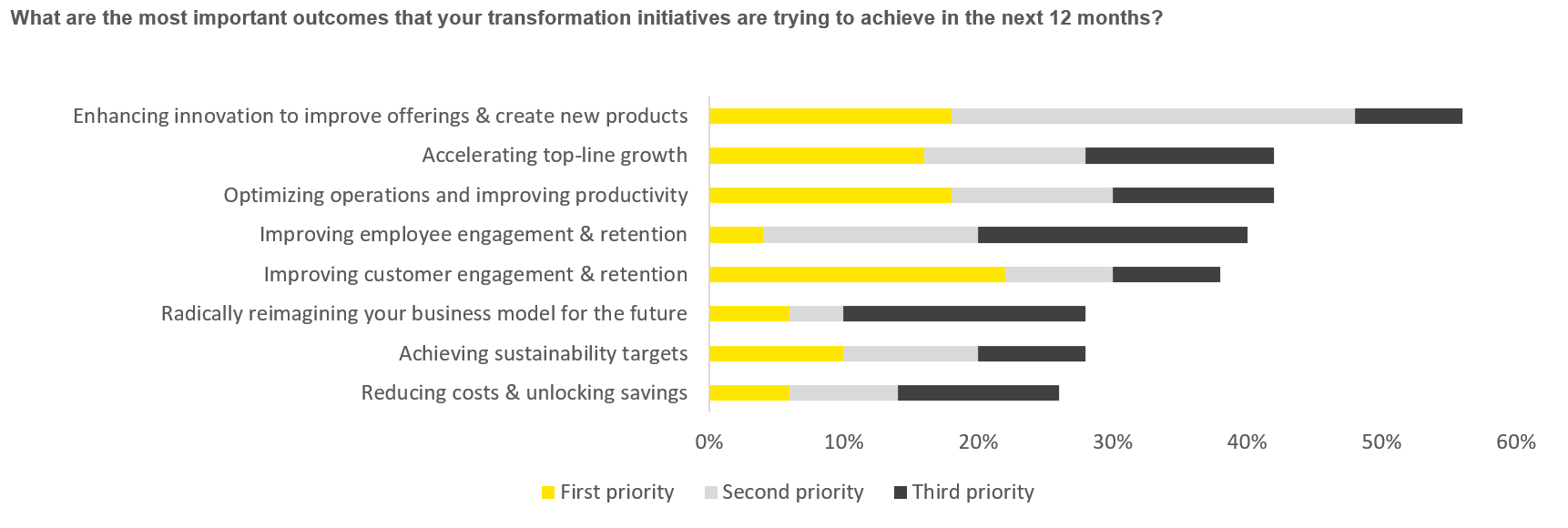
The top three priority areas for leaders are enhancing product and process innovation to improve current offerings and create new products and services, increasing digitization efforts and optimizing operations, and accelerating top-line growth.

This is markedly different from the global sentiment, where top priorities instead include improving employee and customer engagement and retention.

graph 2

3. Strong capital markets are expected to support the transformation agenda

Throughout 2024, M&A activity in Canada was stable, a trend that is expected to continue into 2025.

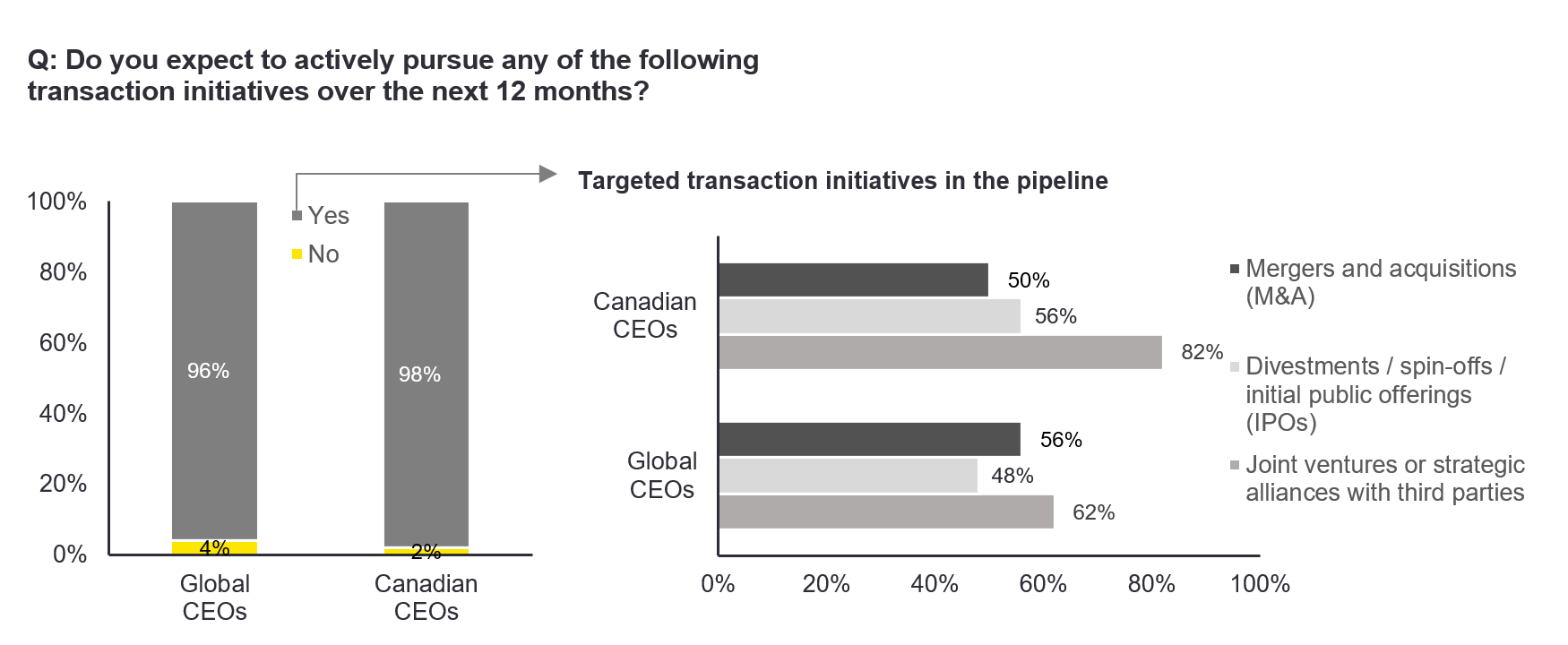
The EY survey of leaders supports this expectation, where 50% of Canadian leaders expressed an interest in pursuing M&A transactions, up from 42% in September 2024. However, this increase is more measured compared to the global average, which stands at 56% in January, a higher increase (from 37%) than that observed in Canada.

Interest among Canadian leaders in all types of transactions is up, notably in joint ventures (JVs), divestments and initial public offerings (IPOs).

As of our January survey, a notable 82% of CEOs intend to pursue JVs, divestments or IPOs. This follows a short slump in September 2024, when only 26% of leaders shared this sentiment, signaling overall optimism in capital market performance in the coming year.

This outlook may be supported by aggressive interest rate cuts in Canada and across the world, which have likely resulted in improved sentiments regarding financial market activity.

In Canada, 86% of leaders are optimistic about overall market conditions and their ability to raise capital, up from 76% in September 2024. The same trend is observed globally, where 75% of leaders hold this view, an increase from 69% in the previous survey.

Leaders intend to enter into major transaction initiatives to improve product and process innovation, accelerate top-line growth, and support customer engagement and retention in an increasingly competitive environment.

Strong transformation activity is expected to help leaders maintain a competitive edge and emerge as winners from what is being characterized as a modest year for the Canadian economy.

graph 3

Key actions for leaders

As Canadian CEOs prepare for the year ahead, they must strategically navigate the challenges and opportunities that lie ahead. Our January survey highlights the importance of being proactive and adaptable in a dynamic business environment. By focusing on M&A opportunities, digital transformation and strategic growth initiatives, leaders can drive growth and maintain competitiveness.

Key actions for leaders to consider:

1.       Conduct thorough due diligence in transaction initiatives
With an increased preference for major transactions, CEOs should ensure any potential deals are closely evaluated. This includes assessing the strategic fit, financial health and potential risks associated with the acquisition to alignment with the organization’s long-term objectives.
At the same time, leaders must keep a close eye on the domestic and global political environments, as well as the Canada-US trade relationship.

2.       Capitalize on technological disruption
Embracing digital transformation and adopting advanced technologies can drive innovation and operational efficiency. CEOs should prioritize investments in technology that enhance product and process innovation, optimize operations and accelerate growth. 

3.       Focus on talent acquisition and retention
With labour market constraints and talent gaps in emerging technologies, leaders should prioritize attracting and retaining skilled employees to succeed in their digital transformations. Investing in talent development will be key to building and maintaining a resilient and innovative workforce.


About this article