





How GenAI adoption transforms team performance

EY research reveals how GenAI boosts team performance. Learn the five traits that separate high-impact adopters from those stuck in pilot mode.

In brief
  • Of the surveyed UK professionals 85% now use GenAI weekly – saving six hours per week through search and summarisation. But deeper use unlocks far more.
  • Top performing users, the “AI Transformers”, save 11 hours weekly by embedding GenAI into workflows and using it collaboratively.
  • Performance improves when leaders model GenAI use, teams share their learnings and culture rewards experimentation – not just efficiency.

GenAI is increasingly embedded in the daily workflows of millions of professionals worldwide. But whilst the headlines focus on automation, efficiency gains and delayed return on investment (ROI), the real story is unfolding inside teams.

The EY Lane4 research team spent 18 months studying how GenAI is reshaping performance — not just for individuals, but for teams and organisations. Our research reveals a powerful truth: the performance differential isn’t about access — it’s about mindset, leadership and integration. Success is not about avoiding mistakes, but about learning fast, experimenting safely and aligning GenAI with strategic goals.

Download whitepaper

Performance Reimagined: How GenAI is transforming team performance at scale  

GenAI creates a new performance frontier but adoption remains uneven

GenAI users report wide-ranging benefits. The median UK professional now reports saving six hours per week with GenAI. Seventy-two percent report improved performance, 70% say it enhances the quality of their work and over half (65%) report improved wellbeing. The bad news: these benefits are not evenly distributed and GenAI risks widening existing inequalities if adoption is uneven. Sector, function and level of responsibility are already shaping GenAI access, usage and outcomes. 

EY Lane4 GenAI User Perception Survey
of UK GenAI users agree that GenAI improves their performance.

Demographic disparities mean whilst some organisations are transforming, others have stalled in what we call the “adoption-value gap”, where GenAI pilots are launched, but the promised benefits remain elusive. Through interviews with senior leaders and a survey of UK professionals, we identified four distinct segments of organisations, each displaying differential rates of adoption and performance outcomes, separated by the level of workflow integration they achieve:

  • AI Sceptics: Low use, low benefit, low belief
  • AI Explorers: Curious users, but inconsistent adoption
  • AI Scalers: Confident users seeing performance gains
  • AI Transformers: High-intensity, high-impact users who embed GenAI deeply into workflows

The difference is stark. Those in AI Transformer organisations save nearly three times more time per week than AI Sceptics, are three times more likely to report significant workflow redesign and 98% say GenAI has improved their productivity and performance.

The cost of standing still

Whilst GenAI offers transformative potential, the risks of delayed or superficial adoption are mounting. Organisations that fail to embed GenAI into workflows face widening performance gaps, not just in productivity but in innovation, agility and employee engagement.

  • Structural barriers, such as limited licenses, slow approval processes and poor data readiness continue to stall adoption.
  • Emotional resistance, including fear of job loss, scepticism and disappointment in early AI outputs  can freeze progress for months.
  • Cultural inertia and leadership misalignment are particularly damaging. In organisations where leaders are cautious or disconnected, GenAI is often perceived as a threat rather than a partner.

The result? Teams remain stalled in pilot phase, unable to scale or realise ROI. In contrast, AI Transformers are already redesigning work, saving time and outperforming competitors. The longer the delay, the harder it becomes to catch up.


The emotional journey matters

AI adoption isn't just technical; it's psychological. This research demonstrates that the emotional journey from scepticism to delight is not linear, nor is it inevitable. GenAI adoption follows four distinct emotional arcs that, once set, are difficult to unfreeze. In the first few weeks, AI Transformers often experience excitement and curiosity and they typically sustain this four to six month into the transformation programme, fuelled by individual curiosity and collective experimentation. They don’t just use GenAI, they feel differently about it, they trust it, experiment with it, see it as a thought partner and use it together as teams.


By contrast, without the right messaging and support, AI Sceptics start their AI journeys exhibiting neutral or negative emotions and do not shift out of this emotional state across a four-to-six-month timeline. The emotional journeys of Explorers and Scalers indicate that with timely interventions and strong leadership support, AI users can progress to and sustain confidence, satisfaction and delight from a neutral or negative starting point.

Five drivers of effective GenAI adoption

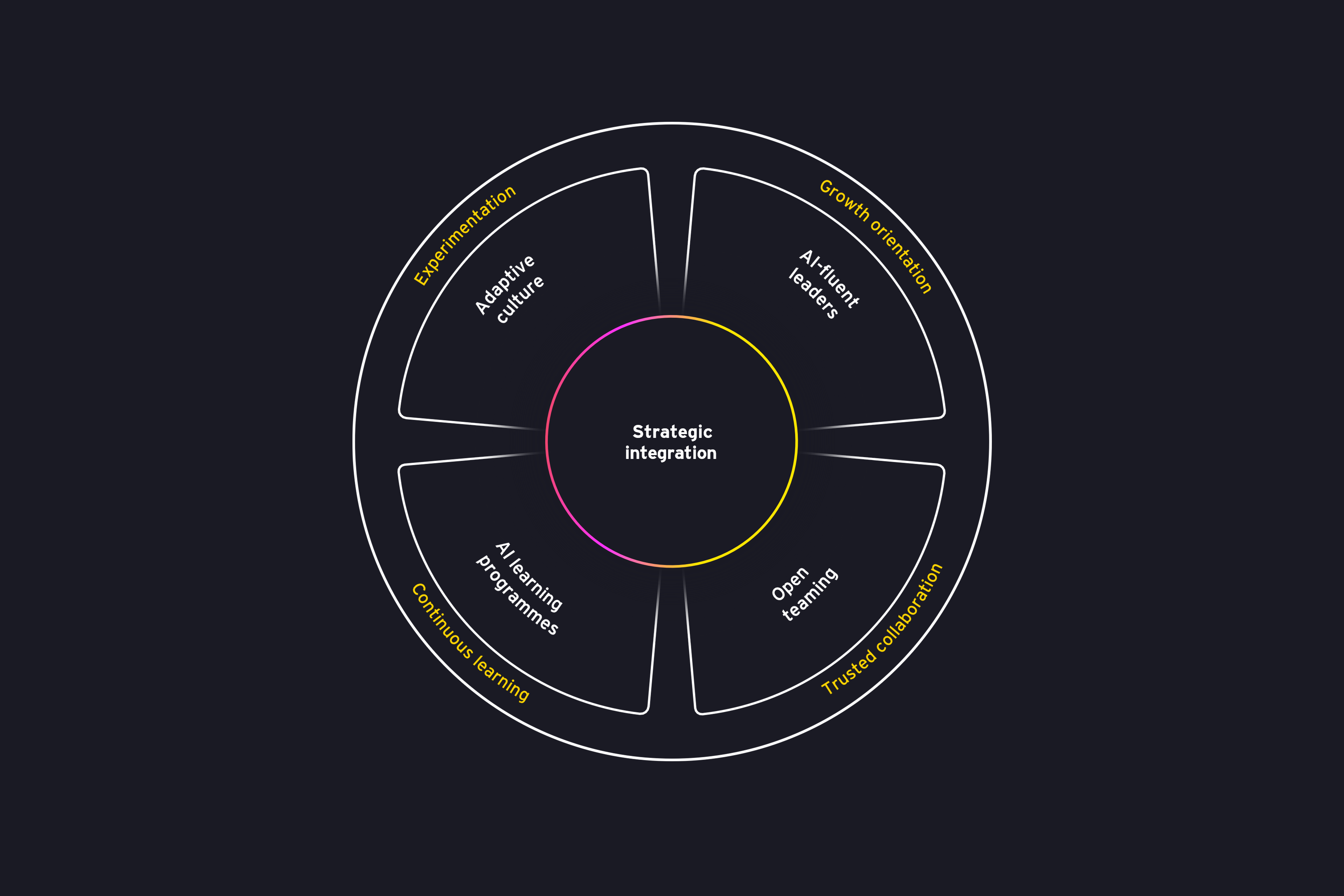
What separates those at the forefront of GenAI adoption from those still struggling to make progress? Our research highlights five organisational capabilities that consistently increase GenAI adoption  and are defining traits of AI Transformers.

Visual representing the five drivers of effective AI adoption in a wheel, with a description of each driver.

1. AI-fluent leadership

In AI Transformers, leaders do more than support GenAI use, they lead by example. They visibly use GenAI, champion its potential, and model best practices, while helping their teams navigate the emotional journey. Line managers play a critical role too, reinforcing behaviours, and translating strategy into team-level actions.


2. Open teams

GenAI is a team sport. Teams in AI Transformers use it together, sharing prompts, reviewing outputs, and integrating it into their workflows. They build rituals around GenAI use, collaborate across boundaries and bring external expertise into the flow of work. This open boundary is the most important way to increase AI confidence - 80% of those working with partners are confident with GenAI, vs 43% who do not work with external partners. This increase in confidence and capability means AI Transformers are almost two times more likely to see GenAI as a thought partner (34%) or collaborator (30%).

A leader within an AI Transformer organisation described how their team works with external partners to redesign workflows:

We hold regular sessions with [ecosystem partner], in the flow of work, to learn from live projects and understand the most effective prompting approaches as we create new content.

3. Continuous learning

Generic training doesn’t resonate. AI Transformers invest in role-specific, engaging learning that challenges users’ capabilities and deepens their understanding of GenAI. They use gamified platforms, tiered learning pathways and external partners to scale capability quickly. Learning effectiveness and outcomes multiply when the learning experience is optimised: 95% of learners in Transformers say their training is effective, vs. 12% of Sceptics; 71% of employees in AI Transformer organisations agree with all AI literacy statements, vs. 11% of Sceptics.

At one life sciences company, a global AI accreditation programme links learning directly to business outcomes. Employees progress through increasingly challenging content before designing and delivering their own GenAI upskilling and business case. This programme was available to all employees, placing inclusion at the core.

It is our belief that to use GenAI effectively and realise the full value of the solution, people need to know how to use it in the right way. Not just targeted at a group of employees but all employees, irrespective of role or function.

4. Adaptive culture

Culture is a force multiplier for AI adoption. In our survey, 99% of AI Transformers described their culture as innovative, compared to just 32% of Sceptics. AI Transformers foster cultures of curiosity, experimentation and sharing. Employees normalise GenAI use and share what they learn widely. AI Transformer organisations reward risk-taking, embrace failure as learning and trust their teams to use AI responsibly. 

We have quite entrepreneurial people at the country level who naturally embrace new things, which lends itself to AI adoption. Colleagues’ agility makes it easier for them to adopt AI technologies. However, financial pressures and the need to demonstrate ROI on new technologies also shape how our culture supports or constrains AI integration.

5. Strategic integration

GenAI must be embedded, not bolted on. AI Transformers align GenAI with business strategy, operating models and KPIs. They target workflows with the most potential, measure impact closely, and use GenAI as a lever for growth and efficiency. Directors in AI Transformer organisations are at least twice as likely (66%) to report that GenAI is exceeding or significantly exceeding benefit expectations in their organisation. An adoption-value gap is visible across all other segments.


In one consumer goods company, GenAI was used to reduce agency spend whilst increasing marketing output, a classic “do more with less” scenario. The result? Faster adoption, deeper integration, and measurable value.

The GenAI adoption gap is not just a performance issue it’s a competitive risk. 

Organisations that fail to embed GenAI into their workflows risk falling behind faster-moving competitors who are already redesigning how work gets done. The data is clear: AI Transformers save nearly three times more time, report higher performance and productivity and are measurably outpacing peers in innovation and efficiency. Inaction isn’t neutral it’s a strategic liability.

Executives must act now. Treat GenAI not as a tech upgrade but as a transformation imperative. Mobilise leadership, rewire teams and embed GenAI into the operating model. The organisations that move first will define the new performance frontier. The rest will be left catching up.

What this means for leaders

Whether you're leading a transformation or navigating early adoption, this research offers a clear roadmap:

  • If you're just starting out: You need visible leadership engagement and permission for experimentation. Executive immersion labs and pilot programs can build momentum.

  • If you're experimenting: Shift from individual to team-based learning. Establish GenAI rituals, such as weekly prompt swaps or agent showcases and bring in external partners to accelerate capability build.

  • If you're scaling: Focus on redesigning workflows, not just increasing usage. Upskill managers and measure ROI to close the adoption-value gap.

  • If you're leading: Reimagine performance systems and operating models. Build hybrid mentorship structures and continuously iterate.

GenAI is not just a tool it’s a new way of working. The question is no longer if you adopt, but how deeply and how fast. Your competitive edge depends on it.

Summary

GenAI is reshaping how teams work unlocking time, boosting productivity and elevating wellbeing. But the gains aren’t universal. AI Transformers succeed by moving far beyond the technical, guiding teams through an emotional, cultural and human journey. Deep integration separates these high performers from the rest.

Related articles

How a license to lead can transform human potential in an AI world

Learn more about the EY AI Sentiment Index Study and unlock key insights to lead in the AI era.

How responsible AI can unlock your competitive edge

Discover how closing the AI confidence gap can boost adoption and create competitive edge. Explore three key actions for responsible AI leadership.

How leaders can embrace five paradoxical mindsets to become future-fit

Discover how leaders can embrace five paradoxical mindsets to become future-fit. Read now, and download the full report.

    About this article

    Authors