




Smiling man in a light-colored shirt standing beside flowing golden light trails on a dark background.

Innovating at Lightspeed: How Canada Scales Breakthroughs Globally

Related topics

Move from pilots to products by combining speed with governance, talent and partnerships to scale impact.


In brief
  • Rapid innovation succeeds when teams link discovery to delivery with clear value cases, product guardrails and a path from pilot to scale.
  • Organizations that invest in talent architecture data foundations and responsible AI practices can more quickly convert experimentation into repeatable outcomes.
  • Partnerships with customers, suppliers and channels can accelerate adoption while operating model changes lock in speed and resilience.

When Canada talks about digital sovereignty, Telesat is redefining the conversation. One of the world’s largest and most successful global satellite operators, they also happen to be one of Canada’s most strategically important tech companies. For more than five decades, Telesat’s built the infrastructure that underpins secure communications across Canada and the globe. Established by Parliament in 1969, the company cemented itself as an innovation leader early on, launching the world’s first commercial domestic communications satellite into geostationary earth orbit (GEO) in the 1970s.

It’s a company undeniably built for this moment.

As geopolitical tensions intensify — particularly in the Arctic, where secure, sovereign communications have become a national priority — the Government of Canada has turned to Telesat as a strategic partner in strengthening continental defence and sovereignty through the Enhanced Satellite Communications Project – Polar (ESCP-P). The program reflects Canada’s broader push to modernize NORAD capabilities and expand secure, resilient northern communications.

Dan Goldberg’s leadership has shaped this positioning. As CEO since 2006, he’s helped Telesat transition from a legacy GEO operator to a forward-looking, innovation-driven company, accelerating its move into lower earth orbit (LEO) through Telesat Lightspeed — one of the most advanced enterprise-class LEO constellations in development.

Since listing on the Nasdaq and Toronto Stock Exchange in 2021, the innovation has just kept on coming. From its partnership with MDA Space to manufacturing Telesat Lightspeed to an expanding role in building sovereign digital infrastructure for Canada: as digital sovereignty, Arctic security and global competitiveness converge, Telesat is emerging as a national asset with global effect.


Telesat CEO Dan Goldberg leads the Canadian tech business forging a new kind of national sovereignty

I love this country. Sometimes we can be a little too parochial or not as ambitious as we should be. But now it feels like the stars are aligning. The network we’re building could be a great calling card. I’d love to see Canada have more global companies with global reach

Against that backdrop, we sat down with Goldberg to explore how the organization is reinventing itself, what he thinks of Canada’s evolving digital sovereignty agenda and what it means to build the next generation of national telecommunications infrastructure right here at home.

Brian Peterson (EY Partner) Telesat Lightspeed has been heralded as the largest space program in Canadian history, positioning us as a strategic partner in global communications that supports those working in defence, northern Arctic operations, enterprise networks and allied government infrastructure.

Getting there saw Telesat evolve from GEOs into LEOs. That’s the kind of agility we have typically seen with much smaller tech companies.

How did you maintain Telesat’s culture as you grew and how important has mindset been in driving the next wave of Telesat’s growth?

Dan Goldberg When people call Telesat the oldest startup in Canada, I think that’s right. We’ve been around for decades, but we’ve had to reinvent ourselves again and again. This industry doesn’t change all at once — it shifts over years — so you either anticipate where it’s going or you get left behind.

When we leaned into LEO, there was a lot of skepticism, but we had a strong conviction that customers needed faster, more resilient, low-latency connectivity. That meant pushing a challenger mindset into a very disciplined, engineering-driven culture. We had to move with urgency, rethink our plans more than once and stay focused on execution, especially through things like supply chain disruptions and COVID.

What’s helped us is a combination of experience and healthy paranoia. We’ve always been innovators and intensely customer focused. That’s how Telesat has succeeded for 50 years and it’s how we’re approaching this next chapter: seeing the opportunity early and executing with discipline.

Warren Tomlin (EY Partner) I think many people tend to see space programs as focused on tomorrow. But Telesat has this rich history going back so many years. How do you balance the past and the future as you reinvent and relaunch?

DG It’s a very methodical industry. It’s very risk averse. But then competitors come along with a sort of ‘move fast and break things’ kind of mentality. We had to inject that sense of urgency without unmooring ourselves from the past and our DNA.

On one hand, we benefit from maturity and longstanding customer relationships. On the other, our industry is being disrupted. We’ve had to rechart a new path.

ey-spectrum-gradients-diagram.jpg

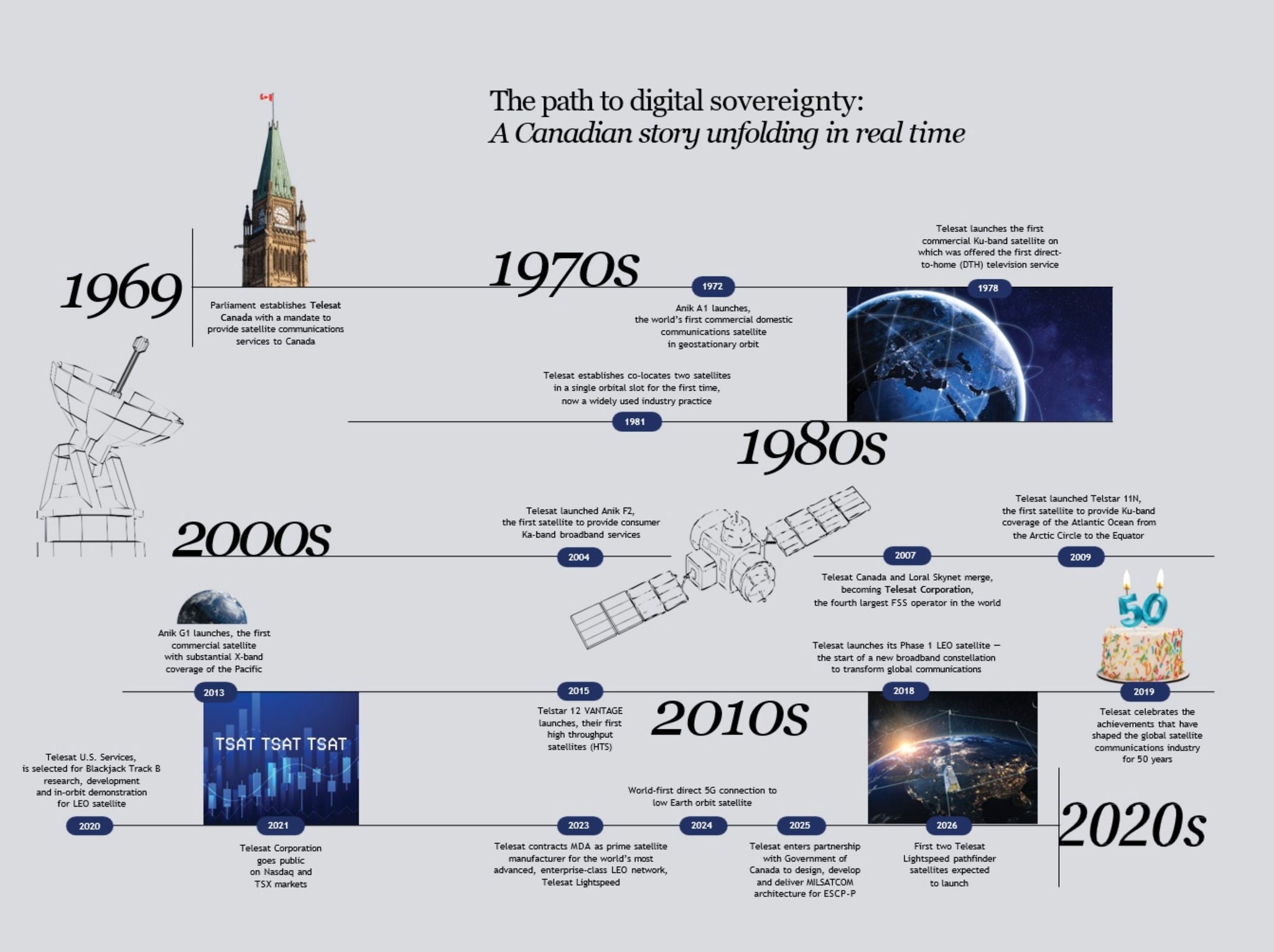
1978 - Telesat launches the first commercial Ku-band satellite on which was offered the first direct-to-home (DTH) television service

1981 - Telesat establishes co-locates two satellites in a single orbital slot for the first time, now a widely used industry practice

2004 - Telesat launched Anik F2, the first satellite to provide consumer Ka-band broadband services

2007 - Telesat Canada and Loral Skynet merge, becoming Telesat Corporation, the fourth largest FSS operator in the world

2009 - Telesat launched Telstar 11N, the first satellite to provide Ku-band coverage of the Atlantic Ocean from

the Arctic Circle to the Equator

2013 - Anik G1 launches, the first commercial satellite with substantial X-band coverage of the Pacific

2015 - Telstar 12 VANTAGE launches, their first high throughput satellites (HTS)

2018 - Telesat launches its Phase 1 LEO satellite — the start of a new broadband constellation to transform global communications

2019 - Telesat celebrates the achievements that have shaped the global satellite communications industry for 50 years

2020 - Telesat U.S. Services, is selected for Blackjack Track B research, development and in-orbit demonstration for LEO satellite 2020

2021 - Telesat Corporation goes public on Nasdaq and TSX markets

2023 - Telesat contracts MDA as prime satellite manufacturer for the world’s most advanced, enterprise-class LEO network, Telesat Lightspeed

2024 - World-first direct 5G connection to low Earth orbit satellite

2025 - Telesat enters partnership with Government of Canada to design, develop and deliver MILSATCOM architecture for ESCP-P

2026 - First two Telesat Lightspeed pathfinder satellites expected to launch

We’ve always had deep engineering roots in this country and a lot of the innovation we’re known for globally was born here.

BP Telesat Lightspeed comprises 198 state-of-the-art LEO satellites. Aimed at large commercial and institutional users, we know it’s already attracting interest from customers ahead of the upcoming launch. How do you bring something so big and game-changing to fruition?
 

DG Telesat’s history is full of industry firsts, and that legacy matters because it shows we’ve always adapted ahead of the market. But you can’t rely on what you did decades ago in an industry that shifts every year.
 

What I’ve said before is that this next chapter is both a continuation of who we’ve always been and a willingness to break from past models when the market changes. Moving from GEO to LEO is the best example — it meant challenging our own assumptions, rethinking long-held designs and putting urgency into a very disciplined engineering culture.
 

The balance is simple: we use our history as a foundation, but we don’t let it slow us down. We honour what got us here, but we stay focused on where customers and technology are going, not where they’ve been.
 

WT It’s exciting to see you innovating right here at home, both by partnering with MDA Space and also investing. Telesat’s new $25-million campus in Gatineau, Quebec will create new intellectual property (IP) and jobs right here in Canada. What does that Canadian presence mean to you?
 

DG What matters most to me about building here in Canada is that it reflects who we are as a company. We’ve always had deep engineering roots in this country, and a lot of the innovation we’re known for globally was born here. So, when we made

the decision to expand our footprint — whether through Telesat Lightspeed or the Gatineau campus — it wasn’t just about facilities. It was about anchoring the next generation of intellectual property in Canada and creating the kind of high-value jobs that keep that expertise here.
 

I’ve said before that projects like Telesat Lightspeed only work when you have the right talent, the right partners and the right ecosystem around you. Canada has all of that. Our partnership with MDA is a great example. They’ve been involved in some of the most advanced space programs in the world. Collaborating with them strengthens the entire domestic space sector.
 

The Canadian presence isn’t symbolic. It’s strategic. It ensures that as we build out capabilities that will support governments, enterprises and critical national infrastructure, we’re doing it with Canadian technology, Canadian talent and Canadian leadership. That’s something I’m incredibly proud of.
 

BP Looking ahead, Canada might represent only a portion of Telesat’s revenue. Do you foresee considerable interest from aerospace, the public sector and other industries?

DG Canada will always be core to who we are, but the demand for Telesat Lightspeed is truly global. I’ve said before that our customer base has long been international and B2B, including telcos, mobility, aviation, maritime and governments, and those sectors are expanding as LEO becomes real.

We’re also seeing stronger than expected interest from allied governments and enterprise networks that need secure, high-performance connectivity. So yes, over time, international markets will represent a much larger share of our revenue.

That’s exactly why we built Telesat Lightspeed to meet enterprise and government-grade requirements anywhere in the world, not just in Canada.

WT Alright, one final question. Digital sovereignty is core to nation-building in 2026. What does that mean for Telesat and other innovators?

DG I love this country. Sometimes we can be a little too parochial or not as ambitious as we should be. But now it feels like the stars are aligning. The network we’re building could be a great calling card. I’d love to see Canada have more global companies with global reach.


Summary 

Speed creates value when discovery is linked to delivery. Put clear guardrails in place, invest in data foundations and make sure teams have the right skills.Responsible AI, product analytics and a gated path from pilot to product shorten time to value without sacrificing trust. Partners can extend your reach and capacity too. And when you update the operating model to support the pace, each launch gets smoother, faster and more predictable.


Related articles

Canada CEO Outlook Spring 2026

Acclimated to uncertainty, Canadian CEOs refuse to stand still despite volatile markets.

How can telcos navigate a world of evolving risks?

As the risks facing communications operators continue to evolve and expand, here’s our ranking of the 10 top telecommunications risks for 2026. Learn more.


    About this article

    Authors