


EY refers to the global organization, and may refer to one or more, of the member firms of Ernst & Young Global Limited, each of which is a separate legal entity. Ernst & Young Global Limited, a UK company limited by guarantee, does not provide services to clients.
Recent Searches

Digital solutions have the potential to create almost US$800bn of value in the upstream oil and gas sector in the next 10 years.
In brief
- The market for digital solutions in upstream oil and gas is set to grow by 60% to US$38bn in 2035, a third of this in the production stage of the lifecycle.
- Each US$1 of spend is expected to create US$2.8 of value, reflecting the scale of the digital opportunity.
- Our global survey suggests that solutions that boost production and improve capital efficiency are most valued by operators.
Oil and gas are pivotal to the world economy, providing over 50% of global energy supply.1 Even under the stated energy transition policies of the world’s governments, consumption levels are projected to remain at current levels until 2050.2 The sector has long faced shareholder scrutiny and tight capital discipline, forcing companies to focus on margins, returns and doing more with existing resources. The threat to supplies from the 2026 Middle East conflict only heightens the challenge.
In the UK specifically, where oil and gas production has fallen by more than 70% from peak levels at the turn of the century,3 this recent geopolitical instability further highlights the importance of energy security and the need to make the most of the UK’s oil and gas resources.
Oil and gas producers worldwide are using digital solutions to help them respond to these pressures, and are expecting increasing value to be generated from their digital investments.
In this article, we discuss the growth of digital solutions and the significant value they create in upstream oil and gas. We review where in the lifecycle these solutions are being applied, the barriers to digital implementation and how oil and gas companies, oilfield service providers, digital solution providers, investors and governments can overcome these barriers and unlock greater value from digital solutions. The insights are informed by a 2026 survey of upstream oil and gas professionals and interviews with industry specialists.
Seizing the digital opportunity in upstream oil and gas
Survey respondents were invited to consider different drivers of value (e.g., time savings, greater quantities produced or recovered, capital efficiency improvement, opex or workforce efficiency improvement, energy efficiency improvement), and to quantify overall value created by their company’s current set of digital solutions, as a multiple of spend, relative to how things were done before these solutions were in place. Our value figures represent a combination of increase in revenue and decrease in cost.
1
Chapter 1
Driving value through digital solutions in upstream oil and gas
From analytics to forecasting, monitoring to reservoir management, digital technologies are helping to increase output, raise productivity and tighten capital efficiency.
Based on survey results, digital solutions in upstream oil and gas are expected to add over US$790bn of value from 2026 to 2035. By 2035, annual value is anticipated at US$100bn, as digital solutions spending increases. On average, survey respondents believe that for each US$1 spent on digital solutions, their companies gain US$2.8 of value (although many suggested US$3-5 or more) realised within five to six years of the associated spending.
Value from digital solutions can take different forms. They can help raise production and recovery rates, save time, improve energy efficiency and increase the efficiency of both capital expenditure (capex) and operating expenditure (opex), as well as freeing the workforce to focus on higher-value tasks.
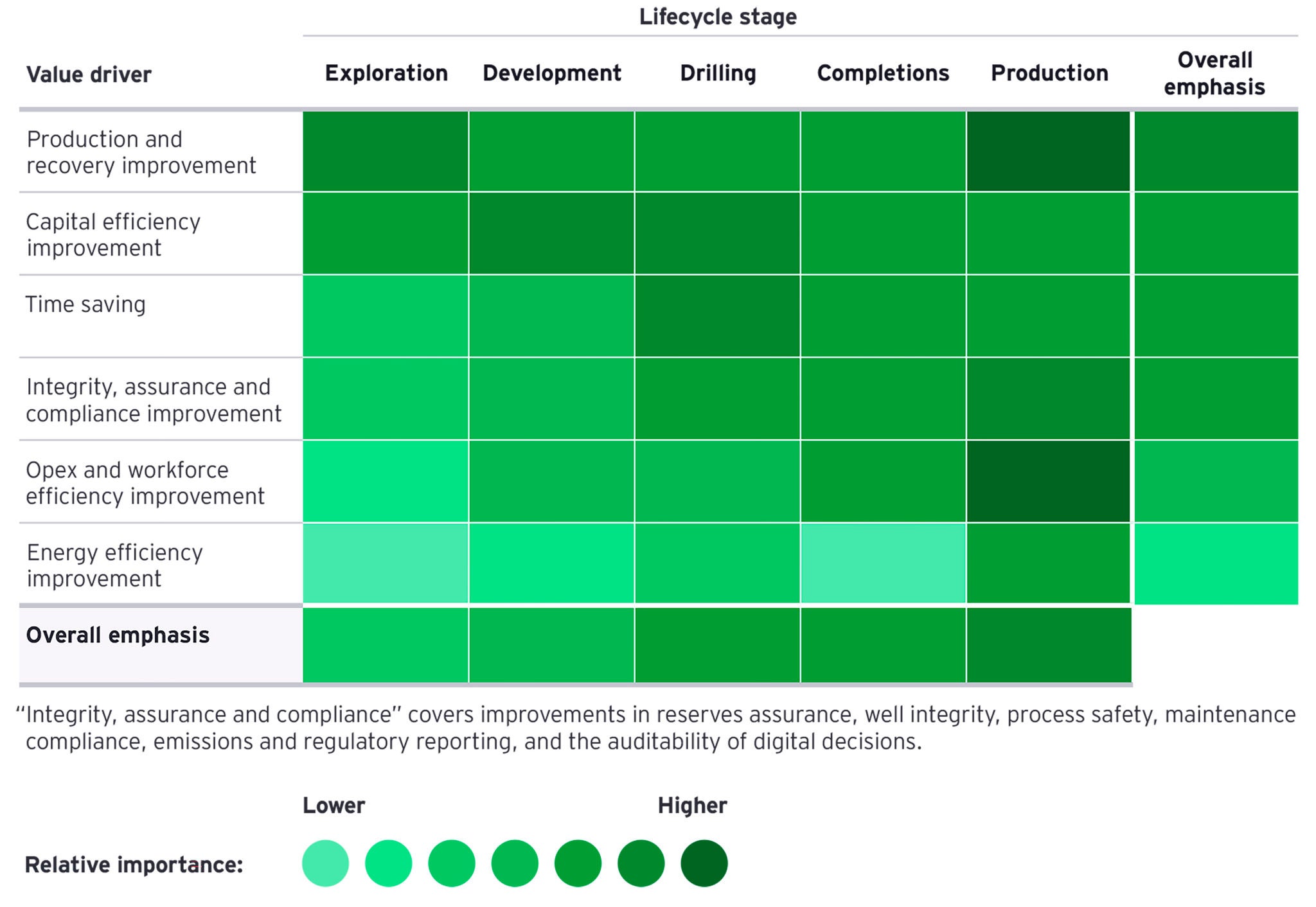
Our survey respondents believe the most important contributions from digital are improvements in production and recovery, improvements in capital efficiency, and time savings. At the production and development stages of the upstream lifecycle, over 60% of respondents report gains of at least 10% on these dimensions as a result of digital solutions.
Relative importance of value drivers within the oil and gas field lifecycle
Examples of digital solutions that drive these forms of value include:
- Production and recovery improvement: AI-enabled systems are being used to monitor the wealth of available data and help optimise system parameters, e.g. through artificial lift optimisation and flow assurance analytics. Digital approaches to reservoir management are also helping to slow production decline and to boost incremental recoverable barrel numbers, because of improved intervention targeting and optimisation across reservoirs, wells and facilities.
- Capital efficiency improvement: Advanced analytics and screening tools are significantly improving the understanding of uncertainties in resource and reserve estimation, resulting in faster, more accurate and more reliable exploration decisions and project prioritisation. Meanwhile, remote operations, real-time drilling optimisation and workflow automation are driving significant capital efficiencies in the drilling stage. Digital twins and reservoir modelling also allow more value to be extracted from capital sunk into wells, facilities and infrastructure, extending asset life and deferring the need for replacement capex.
- Time savings: Time to first oil is being reduced by digital solutions for integrated subsurface-well-facilities planning, scenario modelling and schedule risk analysis. These help reduce the number of design iterations and allow producers to achieve revenues faster. Meanwhile, non-productive time is being reduced by advances in AI-enabled data analysis. At the drilling stage, these are improving real-time decision-making and preventing predictable failure modes. At the production stage, companies are seeing improvements in uptime, and reductions in deferment, using tools that support real-time operational visibility and predictive maintenance. Such technologies help avoid downside surprises and stabilise cashflows.
We are trying to adopt solutions which allow disciplined capex, focussing on optimising output from existing infrastructure rather than relying on new drillings.
Unlocking value from AI
Although the oil and gas industry has used forms of AI (such as machine learning) for decades, companies are in the early stages of generative AI (GenAI) and agentic AI adoption. According to our survey, most of the current AI spend and subsequent value is in the exploration and production (E&P) stages of the lifecycle, where traditional AI accounts for the largest category of spend.
Distribution of 2026 spend on AI through the upstream lifecycle
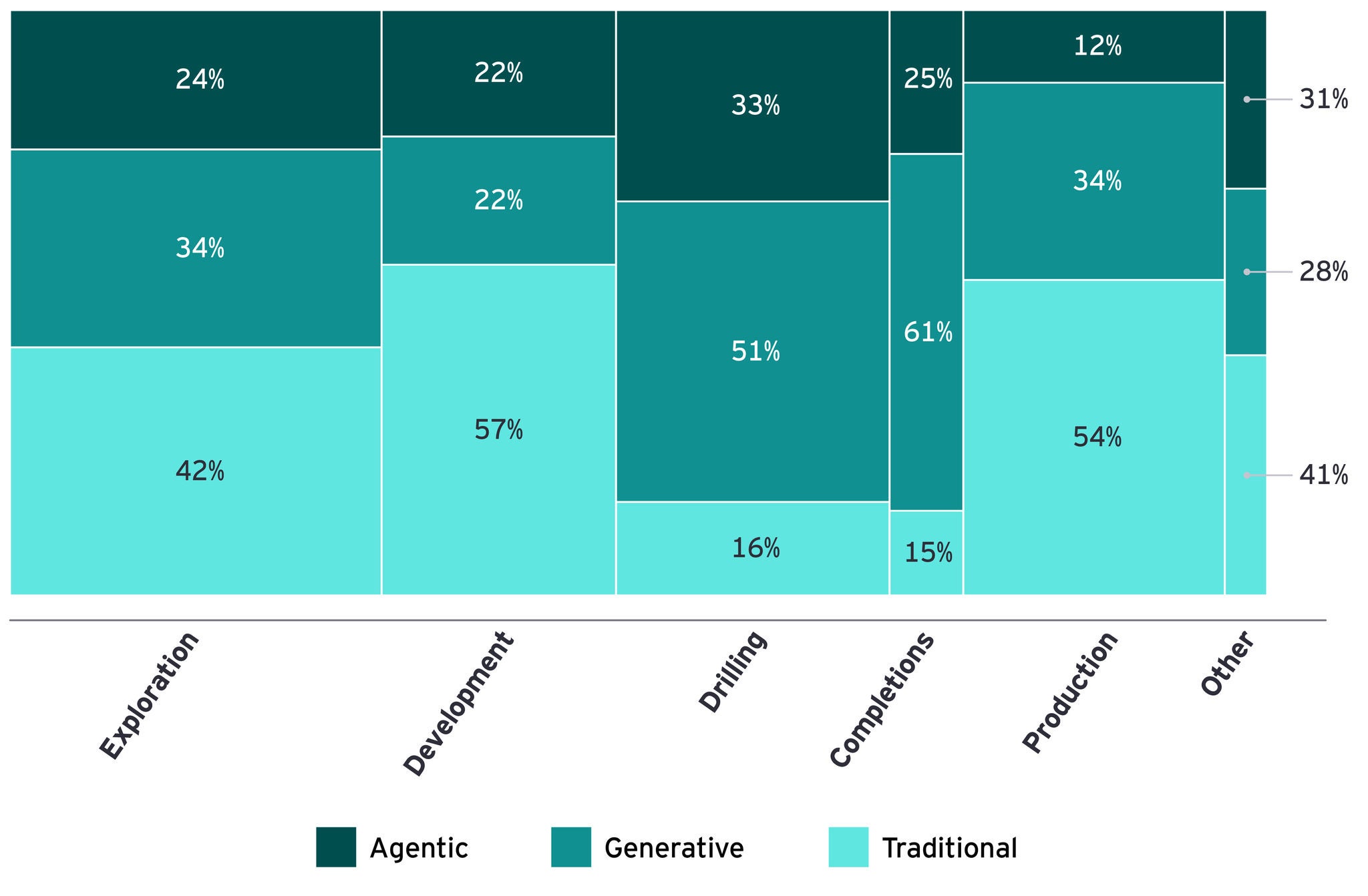
The responses also indicate growing investment in GenAI and agentic AI, to analyse data faster and drive productivity. Agentic AI has great potential to enhance upstream oil and gas activity, automating and optimising workflows and production and increasing the efficiency of logistics and procurement.
In drilling optimisation, drilling agents monitor real-time drilling data and adjust parameters like weight, revolutions per minute and weight on bit (WOB)…For maintenance, agents are used to predict equipment failures, create work orders, and schedule crews and parts.
Digital maturity across upstream oil and gas players
Digital maturity varies across the upstream oil and gas industry. The Majors and Middle East National Oil Companies (NOCs) are seen as the most digitally mature. The former tend to prioritise value and ease of integration over cost in purchasing decisions and are advancing GenAI and agentic AI pilots. Middle East NOCs, on the other hand, are adopting digital solutions to optimise sovereign resources and in-country value chains.
For other NOCs, AI adoption remains uneven, constrained by legacy infrastructure and regulatory and organisational barriers. These companies are focussed on data security and sovereignty and cost reduction. Integrated E&P players and Independents tend to favour off-the-shelf, ‘plug and play’ solutions with high ease of integration, reflecting their smaller in-house development teams.
The strategic drivers of digital solution adoption are cost reduction and solution scalability across our entire organisation.
2
Chapter 2
Overcoming barriers to digital transformation
Unlocking value from digital solutions requires an informed, flexible strategy and an approach to deployment that encompasses people and processes as well as technology.
Despite its technical sophistication, the oil and gas sector can be slow to adopt new digital technologies. A 2025 study by the International Energy Agency found that “only 2.3% of energy start-ups have an AI-related value proposition, lower than the 7% for life sciences and 4.3% for agriculture.”4
With their emphasis on capital efficiency, operators may be wary of spending heavily on new, unproven technologies, preferring to wait for evidence from other companies. Boom‑and‑bust oil and gas cycles can also undermine long-term digital investment. In a traditionally risk-averse sector, where mistakes can be life-threatening and downtime carries high costs, new ways of working may be regarded with caution. Data security and regulatory constraints (such as restrictions on using cloud computing in some countries) create further barriers. Many operators struggle to present an effective investment case for digital investment, because solutions that integrate different domains may have impacts that cut across different value assessment mechanisms.
Technical integration is challenging, due to siloed organisational structures and fragmented legacy systems. Data are often confined within certain applications, preventing sharing. Consequently, digital solutions are frequently introduced in specific areas, rather than connected end-to-end.
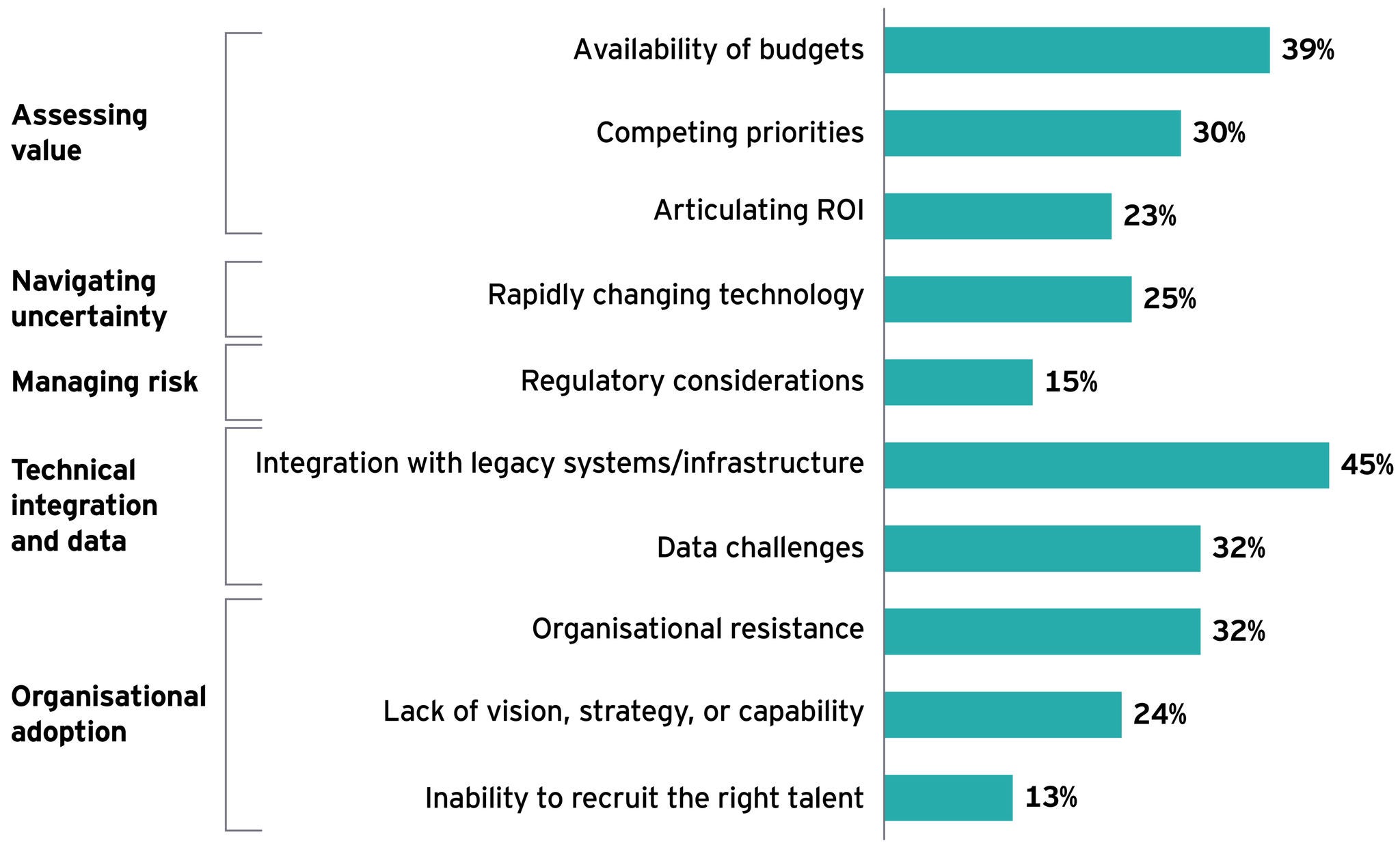
When asked to list the top challenges to implementing digital in their organisations, respondents named integration with legacy systems and infrastructure (45%), budget availability (39%), data challenges (32%) and organisational resistance (32%).
Proportion of respondents that saw each of the following as among the top three challenges to implementing digital in their organisations
Measuring the ROI of digital solutions is hard. It gets more difficult with efficiency gains. It is very difficult to measure whether that increased activity is actually resulting in better decisions. I have rarely seen people truly nail that part of the measurement.
Accelerating digital solutions in upstream oil and gas
Despite the above challenges, over 90% of our survey respondents expect their organisation’s digital spending to grow in the next 5 years, and 46% expect faster growth than in the last five years. But how can oil and gas producers get the most out of digital solutions?
Some of the most compelling applications of digital solutions involve improving collaboration between activities. Recognising this value requires unified frameworks that can account for the overall benefit to the company, which might go beyond what has previously been measured in any one domain.
It is also important to create a digital strategy that gives the company flexibility to pivot, to respond to a changing economic environment and fast-developing technologies.
To enhance risk management, companies need processes that bring together the right insights and decision-making authority from across the organisation. This should enable holistic, proportionate risk mitigation decisions, without delays from excessively long approval cycles.
Companies will also need to find ways to unlock the potential of their data. The leading oil and gas producers have already made progress towards building more robust data foundations, standardising systems and centralising data governance. The next step will require investment in the semantic architecture of data, and in the ability to track the transformation of data over time, to enable effective application of AI.
With ever increasing socio-economic complexity, effective change management is essential to help teams understand the value of new digital solutions, accept and buy into new ways of working, and develop the skills they need to benefit from the change. In a forthcoming publication, we plan to discuss in more depth what is needed for effective change management in this sector.
3
Chapter 3
Gaining competitive advantage from digital solutions
In a complex ecosystem, collaboration and connectivity can help to speed up digital deployment and realise its many benefits.
To compete in upstream oil and gas in the next decade, producers need to secure ever greater value from digital solutions – in turn creating opportunities (and challenges) for digital solution providers, investors and governments.
Here are some recommendations for the industry to unlock value from digital solutions.
Oil and gas producers
- Unify frameworks for value assessment, refine risk frameworks and reinforce data.
- Conduct rapid cashflow assessments to help determine gaps in capital efficiency and productivity; use this to set goals for digital solutions.
- Build a change management programme to enable effective scaling of digital solutions across the organisation.
- Ensure that solutions are business-led, with close support from the digital or IT functions, and address workflow, data and IT issues in parallel.
Digital solution providers
- Build a deeper understanding of how different customers define value, and shift the sales message from selling solutions to creating value.
- Co-create business cases with customer teams, to support articulation of value and help evolve trust and customer relationships.
- Provide customers with ‘digital business case validation clinics’ to map the pathway to deployment and help uncover the main challenges to adoption and integration.
- Continue to invest in innovation, to build new generative and agentic AI use cases, and improve service reliability and cybersecurity.
Investors
- Assess digital maturity and evaluate how producers and digital solutions providers can unlock upstream digital value and gain competitive advantage; determine companies’ ability to overcome barriers to digital solutions deployment.
- Review companies’ ability to adapt and drive change within their organisations.
- Assess the potential of companies’ partnership arrangements to drive digital value creation.
Governments
- Re-assess the value from sovereign resource basins in light of increased digitally-driven value creation.
- Review upstream data regulation to realise value from cloud and AI workflows, while addressing cybersecurity risk and data sovereignty challenges.
- Analyse potential value from research and development (R&D) investment or subsidy, to support targeted adoption of new digital solutions in NOCs.
The mounting pressures on oil and gas companies and the rapid pace of technological development, including AI, are increasing the importance of realising value from digital solutions. However, there are major challenges to overcome in order to translate digital spending into better corporate performance and competitive advantage. To succeed, companies need to build robust, integrated data foundations, and to enhance their management of processes and people alongside their technology.
Ultimately, no single company can go it alone in realising the potential of digital solutions, partly because of the scale of investment and partly because of the range of capabilities needed (e.g. in cloud infrastructure, data contextualisation, domain experience and organisation design). This makes partnerships more essential than ever to unlock the value that remains in the upstream oil and gas sector.
Summary
As energy security and affordability move up the agenda in the UK and around the world, it is becoming more important to maximise value from oil and gas resources. Digital solutions have the potential to drive improvement in upstream oil and gas productivity, efficiency, safety and revenue. By building connected systems and data, and working closely with other ecosystem players, companies have an opportunity to accelerate their transformation and increase value from their digital investments.
How EY can help
-
EY-Parthenon energy strategy consulting teams help C-suites drive future value-creation. Learn more.
Read more -
Our Digital operations team in oil and gas can help your business boost production, lower costs and deliver a more sustainable future. Learn how.
Read more -
EY-Parthenon's Digital Strategy Consulting teams design and deliver digital business strategy to help accelerate business transformation and fuels growth.
Read more