Team members collaborating and sharing ideas at a long conference table.

Canada’s AI learning paradox: why confidence is high but capability is thin

Canada’s AI learning gap is widening. See why deeper training is key to workforce capability and productivity.


In brief

  • Only 52% of Canadian employees report sufficient job-related learning, compared with 66% across the rest of the G7.
  • Nearly half of Canadian employees receive under four hours of AI training, limiting productivity and capability gains.
  • Canada’s AI opportunity depends on deeper, manager-led learning that turns confidence into measurable workforce capability.

There’s no shortage of belief in Canada when it comes to AI. Leaders talk about it with conviction. Budgets are moving. Platforms are being rolled out. Employees are encouraged to “get curious” and “lean in.”
 

But belief is not the same as capability. When we look past what organizations think they are providing and focus on what employees actually experience, a different picture emerges: Canada is falling behind its G7 peers because it’s investing just enough in AI learning to look active, but not enough to build real capability.

Canada’s place in the G7: a structural outlier

As part of EY’s Work Reimagined Survey 2025, we asked employees a straightforward question: In the past year, have you spent sufficient time in job-related learning?

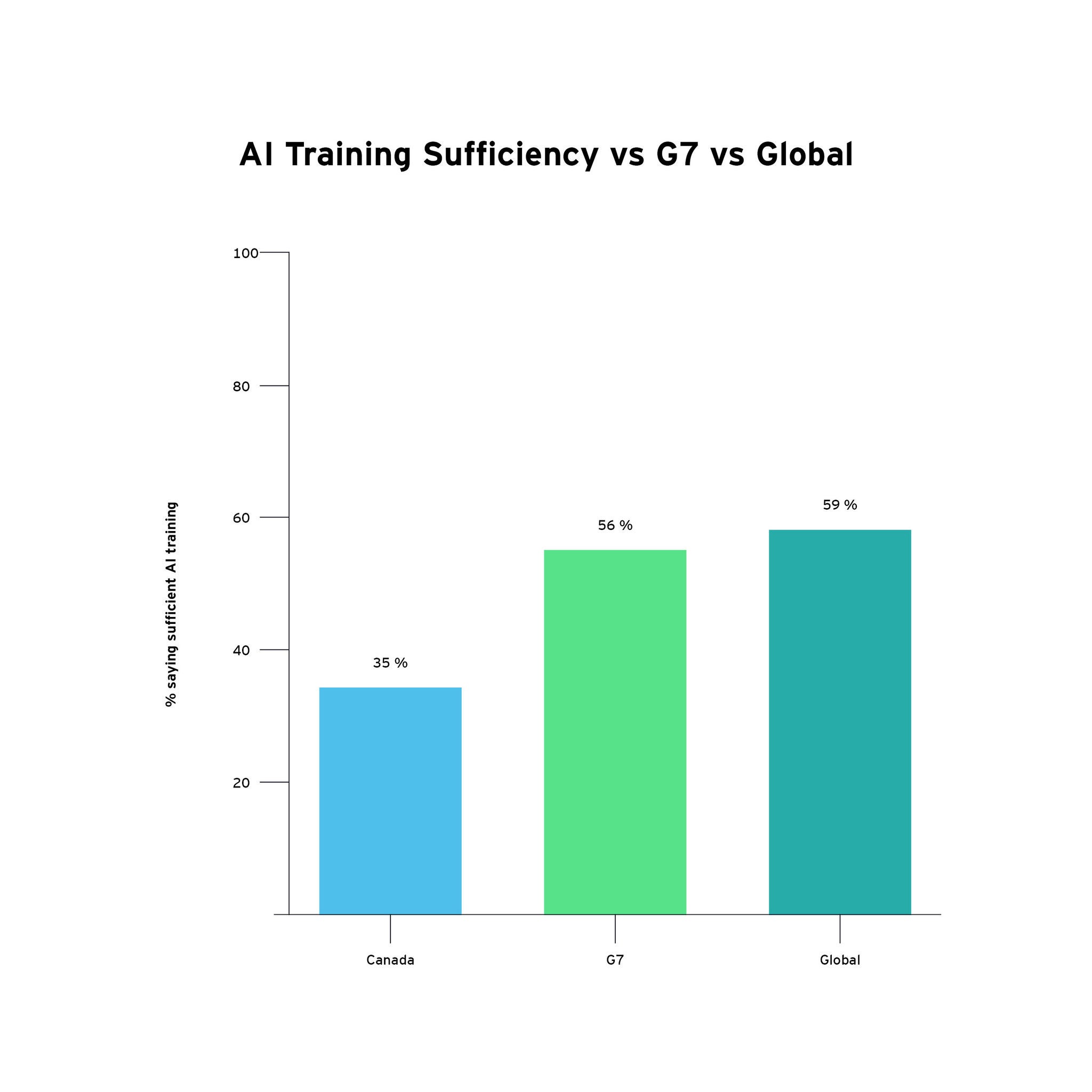
Only 52% of Canadian employees say they have spent sufficient time in job-related learning, compared with 66% across the rest of the G7.1

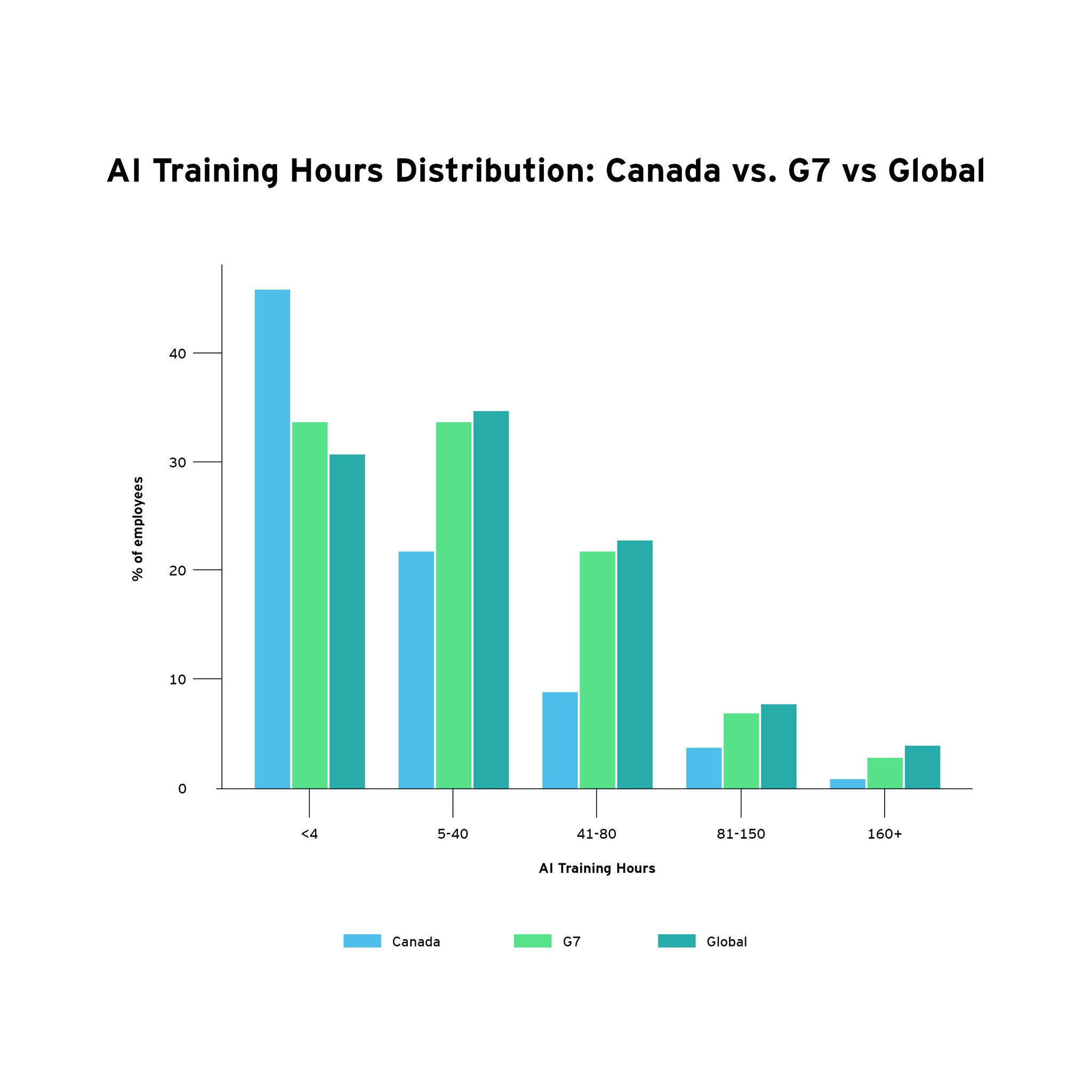
When the lens narrows to AI learning specifically, the gap widens. Nearly half of Canadian employees (46%) report receiving less than four hours of AI training in the past year. In the G7, that figure is 34%. Globally, 31%.

At the other end of the spectrum, only 14% of Canadians receive more than 40 hours of AI training, against nearly 30% among G7 and global peers. This is critical, because our Work Reimagined survey shows that at 40 hours of AI learning, employees are able to use AI for basic work tasks, and at 80+ hours of AI learning that results in real business outcomes.

This is not a marginal gap. It shows that Canada is underinvesting in the depth of AI learning needed to build capability at scale.

Graph 1

Figure 1. Nearly half of Canadian employees receive less than four hours of AI training per year, far higher than the G7 or global averages, while only a small minority reach the level where AI learning begins to drive real productivity.

The uncomfortable truth: less than four hours is performative

Less than four hours of AI training is not enough to build awareness, let alone capability.

The data shows that employees who receive less than four hours of AI training report almost no productivity benefit from AI. Time saved is minimal, and meaningful capability does not form.

At that level, organizations may be encouraging visible AI activity without generating much value in return.

AI learning works — but only for the few

What makes Canada’s situation particularly paradoxical, rather than simply concerning, is what happens when Canadians do receive meaningful AI training.

The relationship between AI training hours and productivity gains is one of the most consistent findings we’ve encountered. Across every G7 country, the pattern holds: the more learning hours, the more time saved through AI. The curve is stable and predictable.

What’s notable is where Canada sits on that curve.

At less than four hours — which describes nearly half the workforce we surveyed — Canadian employees report among the lowest productivity gains in the G7. The return on those hours is negligible, meaning shallow investment produces almost no business benefit.

But at 80 or more hours, something striking happens: Canadians report the highest productivity gains of any G7 country, even above the global aggregate. Not merely competitive. The highest.

In other words, Canada does not have an effectiveness problem. It has a reach problem. When the investment is real — when people are given genuine time, structure and depth — the results exceed what our G7 peers achieve. The system knows how to build AI capability. The challenge is that too few Canadian employees ever get there.

High confidence, thin capability

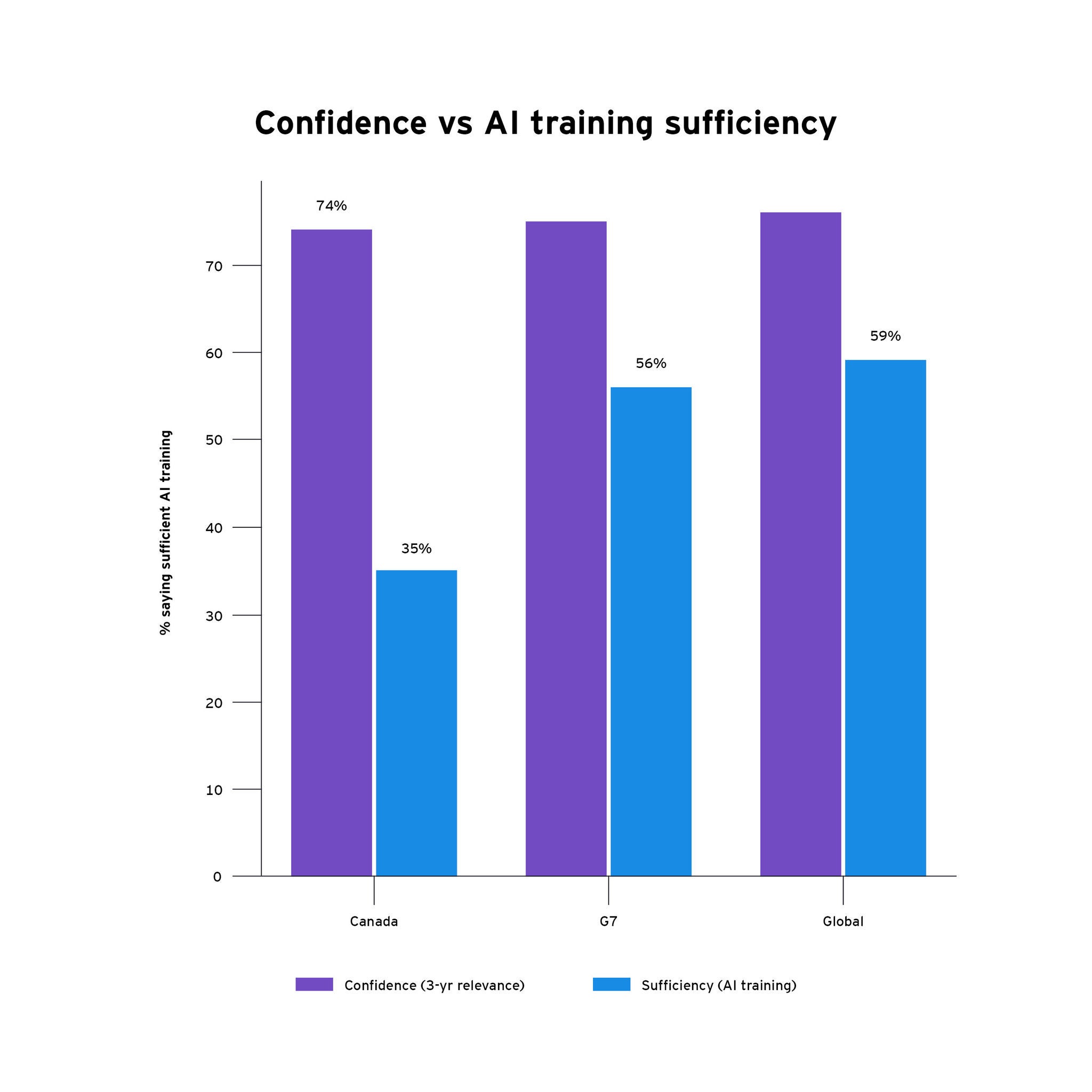
Roughly three-quarters of Canadian employees say they are confident their skills will remain relevant over the next three years, broadly in line with G7 averages.

Employers are even more confident. Canadian employers rank relatively high within the G7 on beliefs that they provide learning opportunities, support upskilling and invest in AI training. Canada ranks highest in the G7 when employers are asked whether they provide the “right mix” of on-the-job learning, formal training and external development.

Graph 2

Figure 2. Canadian employees are far less likely than their G7 peers to believe they are receiving sufficient AI training, despite similar levels of confidence in future skill relevance.

In most G7 countries, employer confidence and employee experience track more closely. In Canada, they do not.

That gap matters because confident leaders are less likely to redesign the system. Instead, they may add more content, platforms or participation without testing whether any of it is building the capability that matters.

Graph 3

Figure 3. Canadian employees’ confidence in their future skills closely mirrors G7 and global levels, but their reported sufficiency of AI training lags far behind, revealing a widening confidence–capability gap.

Where the system breaks: the managerial middle

When we looked at the learning data by role and generation, the biggest gap showed up in a place many organizations tend to miss. And when we looked more closely, it became clear that rank and job level mattered more than age alone.

Leaders in Canada receive relatively more AI learning than other groups. Individual contributors and essential workers receive very little. But the sharpest disconnect sits with managers, particularly mid-career (Gen X) managers.

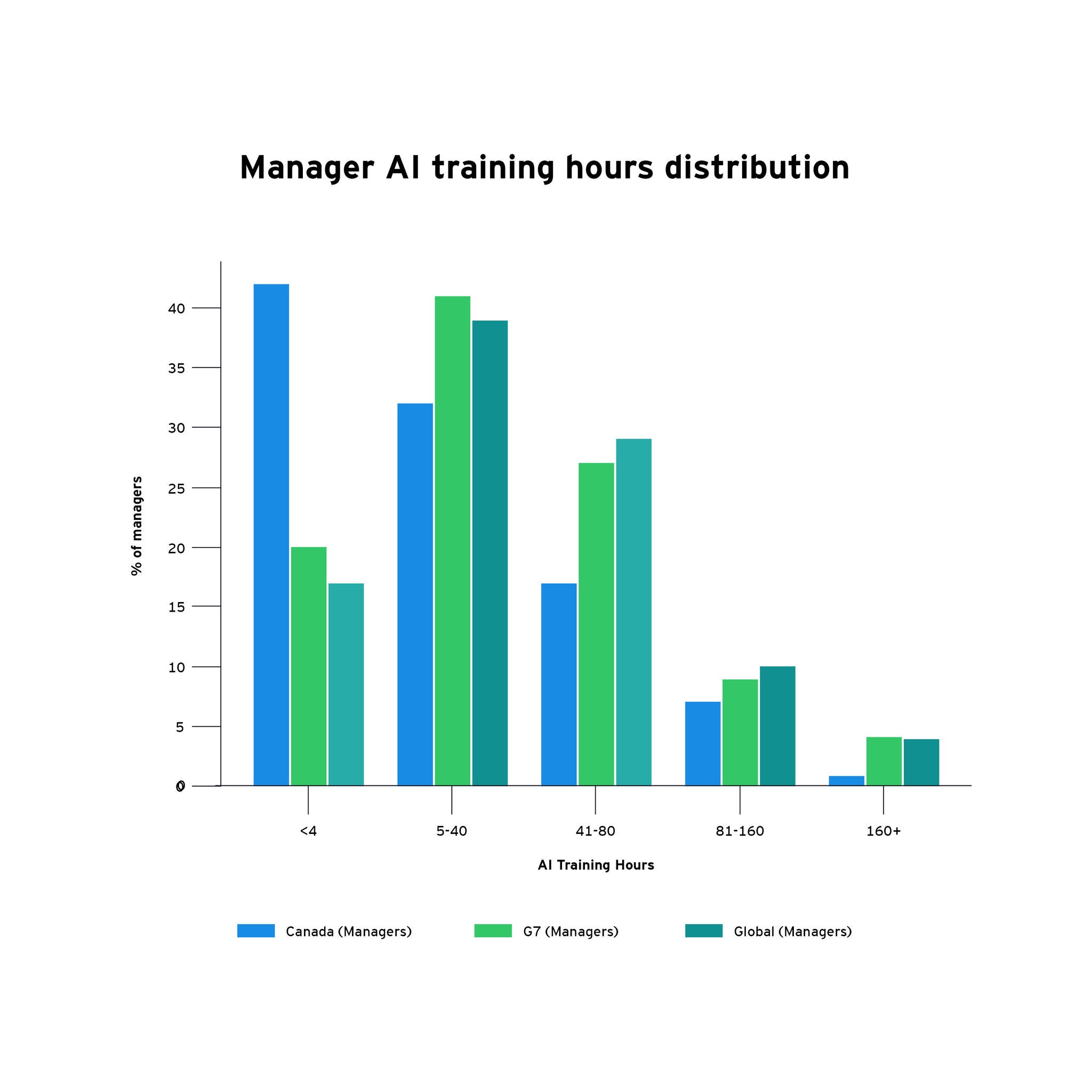
The sharpest disconnect sits with managers, particularly mid-career (Gen X) managers. Compared with G7 peers, Canadian managers are:

  • Far less likely to say they receive sufficient learning
  • 18-20 points behind on AI training sufficiency
  • Twice as likely to receive less than four hours of AI learning
  • Much less likely to reach the 40-80+ hour range where capability forms

This matters because managers are the diffusion layer of any capability shift. They’re expected to embed AI into workflows, guide their teams through adoption and make judgment calls about how AI should be used in practice.

A strategy that does not reach managers will not reach the organization. When this group is under-enabled, adoption becomes uneven and capability diffuses slowly.

Graph 4

Figure 4. Canadian managers receive significantly less AI training than their G7 counterparts, despite being the critical layer responsible for translating AI strategy into day‑to‑day execution.

A quiet generational divide in Canada’s AI learning investment

Beneath the structural gaps in Canada’s AI learning system sits a quieter but important generational pattern, one that is more pronounced in Canada than in the rest of the G7.

As Canadian employees progress through their careers, AI learning intensity drops sharply with age. Among Gen Z and Millennials, roughly half receive less than four hours of AI training per year. That figure rises dramatically for older cohorts: more than three‑quarters of Gen X and Boomer employees receive fewer than four hours of AI learning annually, far higher than comparable groups in the G7.

This decline is not simply a universal aging effect. In peer economies, older workers also receive less AI training than younger ones – but the drop‑off is far less severe. Canada’s learning curve steepens faster and collapses earlier.

Mid- and late-career Canadian employees report high confidence that their skills will remain relevant, even as their exposure to AI learning thins. The pattern points to an allocation problem: AI learning in Canada is concentrated early in careers and tapers off precisely when judgment and influence matter most.

There is also a second‑order risk. Canada’s AI learning depth is currently being carried disproportionately by Millennials, who are most likely to reach the 80+ hour learning threshold, where productivity gains accelerate. Yet these same employees also show higher intent to leave the organization once deeply trained, as shown in our broader Work Reimagined report. Without broader investment across career stages and building a talent advantage, Canadian employers risk building AI capability narrowly, then losing it.

Why traditional learning and development models are failing AI

Part of the explanation is that most organizations are still approaching AI training with models built for a different kind of skill. The common threads are:

  • It’s a content problem, solvable with more courses, more modules, more platform access.
  • It’s an awareness problem, addressable through AI literacy programmes that introduce concepts without building competence.

But AI learning does not respond to these approaches the way compliance training or software onboarding does. The data suggests that meaningful gains begin only once learning becomes sustained, structured and reinforced in the flow of work.

This requires a shift from:

  • Courses → capability pathways
  • Access → time allocation
  • Central programs → manager‑enabled learning
  • Awareness → embedded application in real work spread over months, not hours

For learning to stick, sustained exposure and practice are non-negotiable. Anything less may generate activity, but not capability.

What Canadian must do differently

If Canada wants to close its AI capability gap within the G7, the learning model itself change.

Five actions stand out:

1. Allocate time, not just content. AI capability does not form in the margins of a workday. Organizations need to explicitly protect learning time, particularly for managers and mid-career professionals who are expected to lead adoption but are currently receiving the least support.

2. Design AI learning for managers first. Mid-career managers are central to diffusion and currently among the least enabled. Equipping them creates a cascade through their teams; bypassing them slows adoption.

3. Build pathways, not programs. Our Work Reimagined Survey data points to a threshold: real returns begin around 40 hours and become transformational beyond 80 hours. That level of depth requires sustained, structured pathways — blending formal learning with hands-on experimentation, peer exchange and coaching – not isolated workshops or self-directed catalogues.

4. Embed learning in the flow of work. The most effective AI learning happens in context through workflows, prompts, copilots, labs, peer problem-solving and manager-led practice. Separating learning from application produces awareness more often than capability.

5. Measure capability, not participation. Completion rates and enrolment figures show who took part, not who can use AI to improve work or create value. Until organizations measure demonstrated capability, they will continue to mistake activity for progress.

One natural hesitation: invest deeply in people and they may leave. The 2025 Work Reimagined Survey demonstrated that employees with more than 80 hours of AI training are more likely to leave than those who have fewer hours invested. But the alternative — a workforce that’s confident but incapable — is a slower and more costly risk to Canada’s workforce capability development. The question is not whether investment carries retention uncertainty. It’s whether underinvestment carries a competitiveness cost Canada can afford.

Canada’s window of opportunity is narrowing

Canada still has a significant opportunity. The data shows that when Canadian employees receive meaningful AI learning, they perform strongly — sometimes better than their G7 peers.

As AI capability becomes a baseline expectation across the G7, the countries that build it broadly will compound their gains. The question for Canada is whether it will invest deeply enough in learning to turn belief into capability.


Author:
Alexandra Lee, Partner, People Advisory Services

Summary

Canada’s AI learning gap is becoming a competitiveness risk. While Canadian employees and employers express high confidence in future skills, many workers receive too little AI training to build real capability. Nearly half get under four hours annually, producing limited productivity gains. Yet when Canadians receive deeper training, especially 40 to 80+ hours, they outperform G7 peers. The article argues Canada must move beyond awareness-based learning to sustained, manager-led AI capability pathways embedded in real work, with protected time, broader investment across career stages and measurement focused on outcomes rather than participation.


Related content

AI and people at work: the five tensions that can make — or break — success

Master five AI-human tensions at work: training and retention, time gains, anxiety, shadow AI, and change fatigue, to unlock value from AI.

Learning at work: embedding AI in daily life

Canadian organizations can unlock AI value by embedding learning into daily work: apprenticeship, practice and coaching that keeps pace with change.

Future ready or falling behind: why Canadian organizations can’t wait on learning

Canadian organizations can’t wait on learning. Build a future-ready workforce with protected time, tailored upskilling, and learning in the flow of work. Read more.

About this article