EY helps clients create long-term value for all stakeholders. Enabled by data and technology, our services and solutions provide trust through assurance and help clients transform, grow and operate.
At EY, our purpose is building a better working world. The insights and services we provide help to create long-term value for clients, people and society, and to build trust in the capital markets.
In the current era of geopolitical shifts, supply chain realignments and rapid advancements in AI, business leaders can no longer afford to wait for stability. In this episode of the EY India Insights podcast, we explore the strategies of Indian CEOs looking to drive growth amid uncertainty with Anurag Gupta, Leader, EY-Parthenon India. From building resilience into operating models and rethinking capital allocation to leveraging India’s rise as a global growth hub, the discussion also features the leadership capabilities, strategic choices and future-ready skills that will separate market leaders from the rest in the next decade.
Key takeaways
Resilience outweighs efficiency as companies now look to redesign supply chains, embed geopolitical factors and prioritize sustainable growth over speed.
India is evolving from a China Plus One alternative into a strategic global growth hub for capital, technology and supply chains.
Leading CEOs balance bold AI and growth investments with disciplined risk management, capital agility and smart hedging.
Future-ready leadership requires adaptability, rapid decision-making and the ability to navigate uncertainty with resilience and speed.
Companies that lead in the future will likely combine AI-native operating models, ecosystem partnerships, talent fluidity, resilience and region-specific strategies.
The emerging CEO playbook is clear: invest boldly in long-term opportunities while staying disciplined, selective and risk aware.
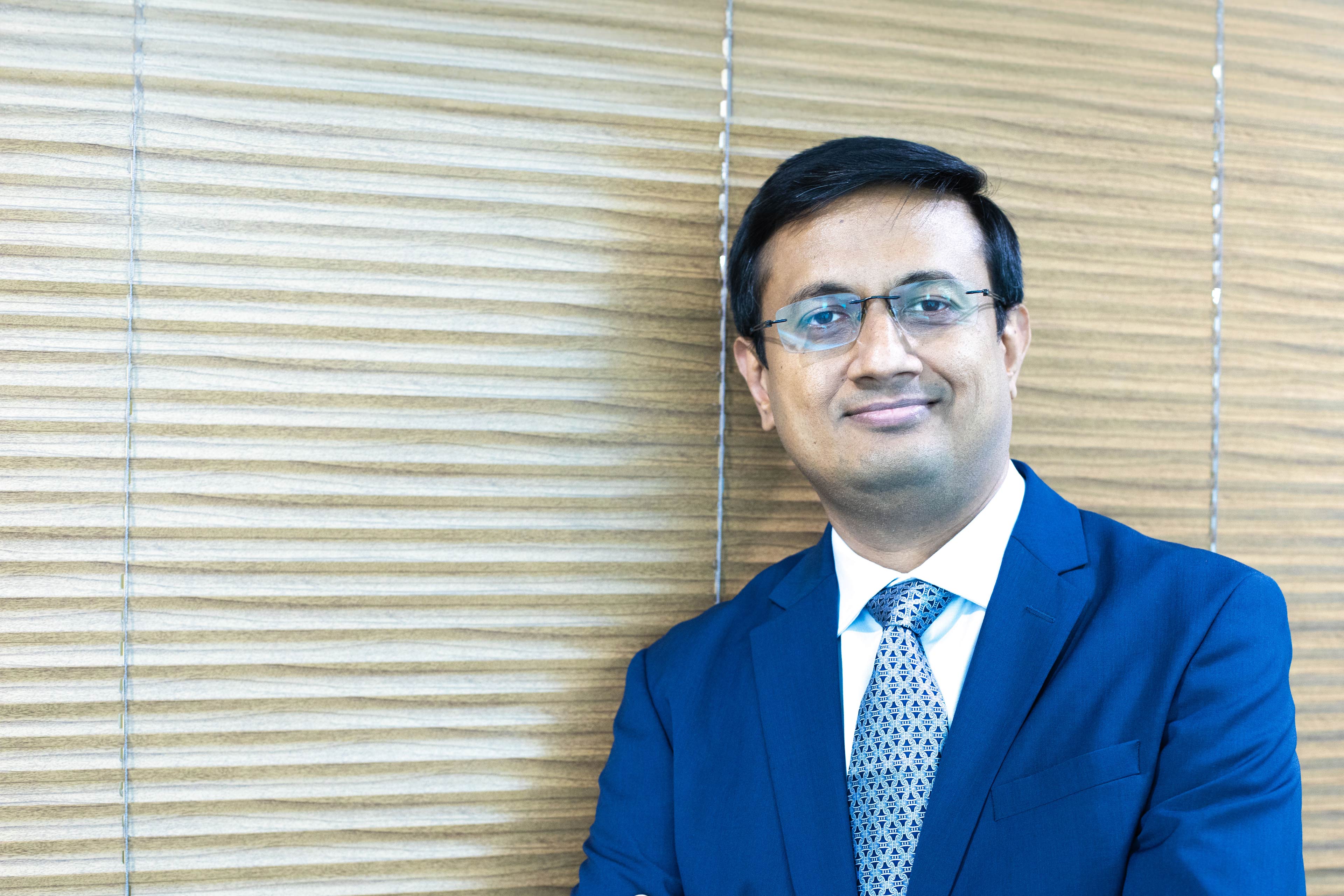
Anurag Gupta
Leader, EY-Parthenon India
For your convenience, a full text transcript of this podcast is available on the link below:
Welcome to another episode of EY India Insights podcast. I am your host Pallavi, and today we are joined by Anurag Gupta, Leader, EY-Parthenon India to discuss how Indian CEOs are resetting strategy in an increasingly fragmented geopolitical landscape. From supply chain resilience and AI-led transformation to India’s rising role in the global economy, we will explore how business leaders are navigating uncertainty while building long-term growth strategies.
Hi Anurag, a very warm welcome to you. Thank you for joining the podcast today.
Anurag
Hi, thank you for having me.
Pallavi
In today's fragmented geopolitical environment, how are Indian CEOs balancing resilience, growth and global expansion while staying agile enough to respond to constant disruption?
Anurag
On multiple vectors, the business environment for Indian CEOs has evolved. It is no longer, as one would call it, very stable. Whether it is geopolitics or advancement in technologies or some other aspects of trade, we are clearly seeing that we are operating in a very disruptive phase.
As a result, one big change that Indian CEOs have brought in is the mindset of not wanting to wait for stability anymore because in the earlier era, there used to be cycles of stability and then a bit of disruption. And CEOs would wait out the disruptive time and wait for stability to come back. That is no longer the case.
CEOs have realized that they have to continue to deliver growth and returns to shareholders in the current disruptive times as well. So, they have evolved their leadership and decision-making frameworks or playbooks. They are now embedding geopolitical risk explicitly into their strategy and investment decisions. They are moving away from efficiency-led models we used to have earlier to more resilient-leading strategies, which are designed for volatility.
They are also redesigning supply chains with diversification and buffers in mind and capital deployment is becoming far more targeted. In the current environment, success is increasingly measured in terms of sustainable business growth rather than the speed of expansion. CEOs are favoring nimble moves over large one-time bets. They prefer forming strategic alliances instead of pursuing large, risky acquisitions.
They are testing markets before scaling and deploying AI smartly and selectively to reduce downside risks, evolving their organizations and learning and preserving flexibility.
If I were to use some examples, we are seeing a lot more Indian CEOs aligning to national policy frameworks to evolution of trade and trade relationships and corridors. They are building in financial and operational buffers, stronger balance sheets, building redundancy in critical inputs, whether it is rare earth magnets, energy, semi-conductors or logistics. They are doubling down on India's structural advantage, which is both strong domestic consumption plus the demographic scale. Likewise, they are making very smart bets along the value chain and in sectors. When it comes to global expansion, the approach is far more calibrated – looking very selectively at markets where trade alliances are favorable, regulatory risk is manageable and there are cultural and business synergies that exist. So, we have seen these Indian CEOs evolve their playbook. Given the current fragmented political environment, they are not waiting and they are clearly evolving their playbook to still deliver growth and value in the current environment.
Pallavi
India is increasingly being seen as a strategic global growth hub. How are business leaders leveraging this moment across supply chains, technology and investment decisions?
Anurag
Across each of these three critical vectors of supply chain, capital allocation and technology, there is a lot that is working in India's favor. Given the geopolitical reset, we have all heard about the ‘China Plus One’ strategy. That is now evolving, with India increasingly being viewed as a core supply chain node rather than simply a de-risking alternative.
So, global companies are redesigning their supply chains and they are moving away from efficiency and more towards resilience. That is where India has become central to it. They are looking at India as a core node rather than only as an additional geography to supply for their global customers. So, there is a lot of regionalization and localization of value chains that is happening given the shift that we are seeing in supply chains.
Leaders are no longer just offshoring. They are localizing value chains; setting up end-to-end manufacturing ecosystems, integrating India into regional trade corridors, depending on the trade arrangements that various regions and countries have. So clearly, we are seeing new supply chain opportunities emerging out of India, given some of these changes.
Similarly, when it comes to technology, we are no longer just moving from back office to becoming the innovation engine, leveraging technology. So, there are a lot of Global Capability Centers (GCCs) in India, which are just not outsourcing destinations with the supporting R&D, AI and product engineering. We have a massive STEM talent pool and a growing startup ecosystem, which is enabling the role of India and in becoming an innovation engine through technology.
We obviously have some strong strategic advantages, like the India Stack, which is opening up great opportunities to scale digital businesses rapidly and build low-cost, high-volume platforms, drive financial inclusion and customer reach. And AI, cloud and digital ecosystem are areas where there is a lot of accelerated investment in India. We have seen massive investment numbers play out across cloud, AI infrastructure, data centers, digital services, automation and Industry 4.0.
Last, in terms of capital allocation, the investment strategy is for India to be a core growth market. It is no longer an emerging market allocation principle that applies to India, but a strategic growth pillar. We have a great combination of high growth, large domestic market and policies, policy stability, which is driving a lot of the investment strategy for global investors as well as corporates in India.
A lot of policy-driven initiatives such as PLI, liberalized FDI trade agreements are driving market access, as well as reducing the risk and improving returns. So, India is becoming a base for both domestic demand as well as exports. And companies are using India for domestic consumption as well as export for global markets, driven by many of the trade agreements as well as cost competitiveness that India offers.
We are seeing India as a stable growth hub among a lot of disruption that is happening globally. It offers great opportunity for business leaders to leverage India across many sectors, as well as across supply chains, technology and where to invest capital.
Pallavi
With AI transforming industries at the same time, geopolitical uncertainty is rising. How are the CEOs deciding where to invest boldly versus where to stay cautious?
Anurag
These are unique times for CEOs. They have had to do a fine balancing act between betting bold and at the same time staying cautious.
There are some areas where there is a long-term structural shift and AI is one such example. Many of the CEOs are betting big when it comes to long-term structural shifts, but they are cautious trying to bet on any short-term cyclical bets. So, there is a very smart hedging that CEOs are doing and there is a CEO decision playbook that is emerging, which is focusing on investing boldly as well as staying cautious at the same time.
They are looking to invest big if they can have high control, whether it is technology, data or talent. But if they have high dependency on external factors, they tend to be more cautious. When it comes to geopolitics, they are investing boldly in India as well as other stable markets and saying cautious and out of politically volatile regions. If it is technology, they are avoiding or being cautious with legacy technology, which is more disruption prone and are investing more in AI-led technologies.
So, we are clearly seeing a very in a smart hedging that CEOs are doing where they are investing big and bold in supply chains, in AI, in some of the key stable, large growth markets, in future facing sectors, which are more long-term structural shifts such as energy transition. However, at the same time, they are cautious in areas or projects which could be capital intensive with long paybacks, areas or sectors vulnerable to AI disruption, sectors which had over globalized operating models or sectors or in geographies which are geopolitically sensitive.
Pallavi
Looking ahead, what capabilities will separate the companies that merely survive disruption versus from those that truly lead in the next decade?
Anurag
Companies that truly lead and not just survive, I will differentiate them not by just one capability, but a complete system of capabilities or competencies that cut across technology, strategy, organization as well as mindsets. Can companies really build an AI-native operating model and not just look at adopting AI?
What leaders do is rebuild these AI-native operating models, core processes around AI rather than just leverage AI for a little bit of efficiency or productivity. Will the companies that truly lead be those that reconfigure their strategies, rather than rely on old, static annual planning cycles and react slowly to external shocks?
Resilience will have to be embedded by design, and companies that truly do that will lead as compared to others who will treat resilience just as a backup to survive. Hyper localization with local scale – strategically, companies that lead will be able to operate with region-specific strategies rather than one-size-fits-all, and a mindset which is more being globally connected but locally optimized.
Talent will undergo a lot of evolution. Talent fluidity, the skill sets required and the collaboration between humans and AI is what leading companies will enable. They will build a workforce that is continuously reskilled, comfortable with AI, organized around problems but not roles, and shift from hierarchies to a more fluid organization and project-based teams.
The other thing that clearly companies that will lead will do is ecosystem orchestration; not try and have a top-down, vertically integrated value chain completely under one's control. It is difficult to build these in today's day and age. You have to compete as part of networks and ecosystems and not alone. And that is something what leading companies in today’s day and age will do. So, value creation will move from individual firms to ecosystems, and leaders will orchestrate, not control that.
So, those are some capabilities across technology strategy, organization and mindsets that leading companies will demonstrate as compared to those who will merely survive these disruptive times.
Pallavi
Thank you, Anurag. That brings us to the end of this episode of EY India Insights podcast. Thank you so much once again for joining us and sharing all your insights on how Indian CEOs can navigate geopolitical shifts, AI disruption, and the future of growth. Thank you.
Anurag
Thank you, Pallavi.
Pallavi
Thank you to all our listeners for tuning in. Stay connected with EY India Insights podcast for more conversations shaping the future of business. Until next time, this is Pallavi, signing off.
Explore EY-Parthenon's strategy consulting services in India, offering expertise in digital transformation, corporate growth, transaction execution, and turnaround strategies.
Insights to help CEOs rethink strategies, put people at the center of enterprise transformation and focus on long-term value creation for all stakeholders.