






aerial-view-of-solar-on-the-water-energy-saving-alternatives

How route diversification could strengthen global energy security

A regional energy corridor could diversify Middle East exports, reduce chokepoint risks and strengthen global energy security.


In brief

  • The Strait of Hormuz disruption could affect nearly one-quarter of global seaborne oil trade and 19% of global LNG trade.
  • Alternative energy export routes cover only 45% of normal Hormuz oil exports, leaving more than half of the region’s export capacity exposed.
  • Strategic energy infrastructure in Oman could enable continued Gulf exports and strengthen energy security for Asia.

Approximately 20 million barrels per day of crude oil and refined products, equivalent to nearly one-quarter of global seaborne oil trade, pass through the Strait of Hormuz. It also carries 19% of global liquefied natural gas trade, including most LNG exports from Qatar and the UAE. With nearly 80% of oil volumes destined for Asia, ongoing disruption in the Strait of Hormuz is affecting producers, importing economies and consumers far beyond the Gulf.

Reduced flows have triggered production shut-ins, higher freight and insurance costs and the repricing of crude benchmark. Brent reached a peak average of US$117 per barrel in April 2026, while pressure on refined fuels spread across global markets. For Asian importers, the impact is amplified because many refineries rely on medium and heavy sour Middle Eastern crude grades that cannot be replaced quickly at scale. Disruption increases acquisition costs, interrupts industrial activity, intensifies inflation and creates balance-of-payments pressure. Its effects also extend to Europe, Africa and the Americas through higher fuel prices, freight market volatility and slower economic growth, demonstrating that the shock is global rather than confined to the Middle East and Asia. A sustained 90-day disruption could impose an estimated US$81 billion burden on Gulf producers and major Asian importing economies, making energy route diversification a global strategic priority.

Why existing alternative pipeline routes remain insufficient

Existing alternative energy export routes provide incomplete protection. Saudi Arabia and the UAE operate the principal pipeline bypasses, while Kuwait, Qatar and Bahrain lack independent alternatives. Together, active bypass capacity of approximately 8.8 million barrels per day covers only 45% of the 19.9 million barrels per day normally exported through Hormuz, leaving an 11.1 million-barrel-per-day structural deficit.

The exposure also extends beyond Hormuz. Saudi exports routed through Yanbu rely on the Red Sea to reach Asian markets. A disruption at Bab el-Mandeb requires diversion through the Suez Canal, the SUMED pipeline or the Cape of Good Hope, adding handling requirements, transit time and cost. Simultaneous constraints at Hormuz and Bab el-Mandeb significantly limit the region’s principal export pathways. These interconnected energy transit chokepoints reinforce the case for diversifying oil export routes through direct access to the Arabian Sea.

Middle East energy export gateway: Shared value for producers and importers

The region needs an alternative energy gateway supported by producing, transit and consuming countries. Within this wider proposition, Oman is well placed to serve as an important enabler. Its ports face the open Arabian Sea and lie beyond both Hormuz and Bab el-Mandeb, while its logistics base could support export continuity strategies. Existing strategic energy infrastructure provides a credible foundation. Duqm’s port infrastructure includes deep-water facilities and a dedicated oil berth for large crude carriers. The Ras Markaz storage hub provides storage, blending and marine handling, while the Salalah logistics hub adds connectivity and optionality. Together, these assets could support a regional energy export hub linking Gulf production with Asian demand.

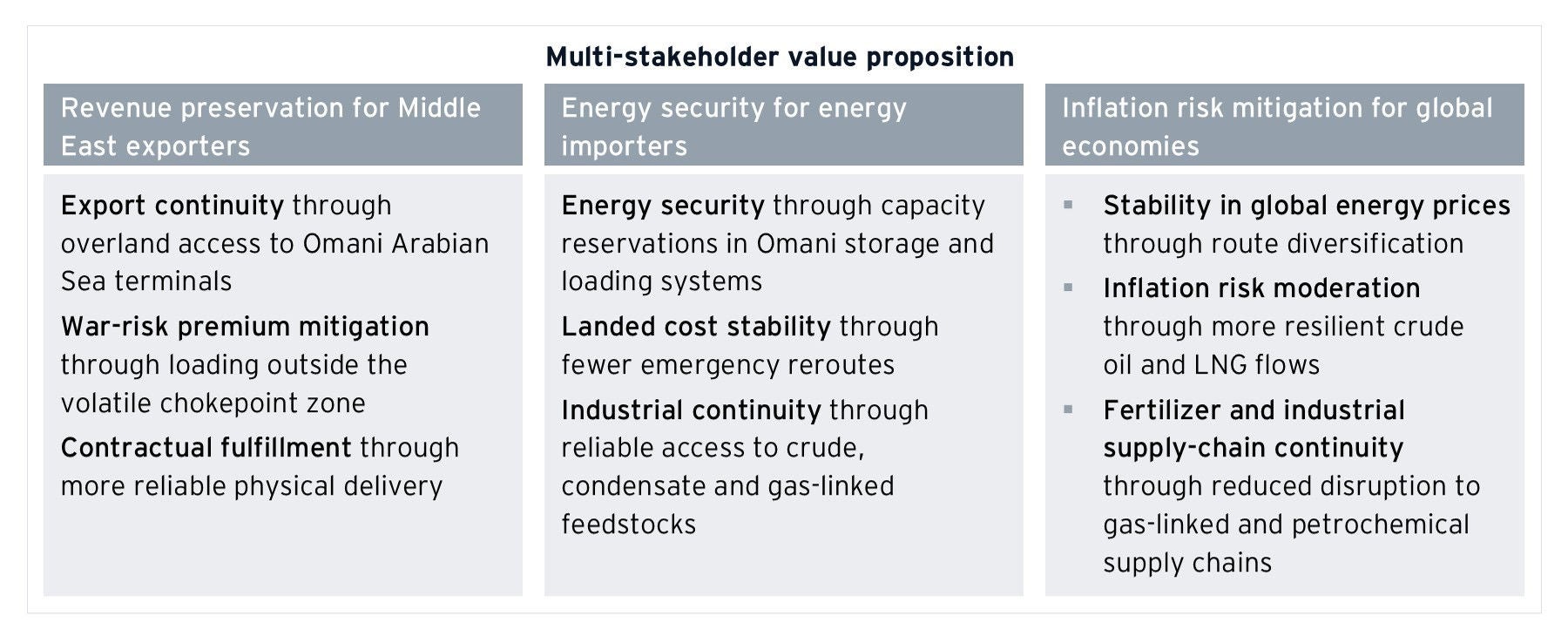
Broadly, the strategic rationale for an integrated Omani bypass route spans three distinct global market participant groups, offering operational, financial and risk-mitigation benefits.

Alternative Energy corridor: Multi-stakeholder value proposition

Arabian Sea energy corridor: The economic case for investment

A proposed GCC energy corridor could comprise two large pipelines with a combined capacity of approximately 10 million barrels per day, extending from southern Iraq through Kuwait and along the Gulf coast to Omani terminals. The estimated investment of about US$50 billion is substantial but materially lower than the quantified economic burden of a prolonged disruption. This comparison provides a compelling strategic rationale that extends beyond transportation economics.

Under stable conditions, conventional crude oil transportation routes through Hormuz remain cheaper. During conflict, however, war-risk premiums, insurance and rerouting costs can reverse that advantage. The possibility of variable Hormuz transit tolls adds uncertainty. At crude prices of US$60 per barrel, a 3% toll would amount to approximately US$1.80 per barrel, narrowing the peacetime cost difference between Hormuz and the alternative corridor. The corridor’s value is therefore best assessed in terms of avoided losses, reliable market access and supply chain resilience. It would complement, not replace, Hormuz by adding strategic redundancy.

Energy dialogues podcast series

Industry leaders share insights and perspectives in energy transition through dialogues that address global challenges and opportunities with a shift towards renewables.

Know more

Future of Middle East energy exports: Why diversification matters


Oil and gas are expected to remain important energy sources for decades. Resilient Middle East energy exports are therefore likely to depend on diversified pathways to market. Investments in an alternative corridor could help preserve producer revenues, improve supply assurance for Asian importers and moderate the global consequences of future disruptions. They could also support the long-term competitiveness and reliability of Gulf energy supplies as importing economies reassess their exposure to concentrated maritime routes.


Potential pathways for an alternative energy export corridor


Development could follow a phased, multistakeholder pathway. An intergovernmental platform could initially align strategic objectives, governance, ownership, risk sharing and cost allocation. Subsequently feasibility assessments could evaluate routes, capacity, environmental considerations and commercial structures.

Learn more about building resilient energy corridors and supply chains.


Download the full pdf

Summary

The corridor would provide an alternative export route that bypasses the Strait of Hormuz, enhancing route diversification, strengthening supply security and reducing dependence on a single maritime chokepoint. A consortium involving governments, national oil companies, infrastructure investors and Asian participants could support financing, while long-term transportation, storage, capacity-reservation and offtake agreements could strengthen bankability. Regulatory approvals and financing commitments would provide the basis for phased construction and implementation.

Related articles

Powering growth in India’s evolving energy ecosystem

Explore how India’s energy transition can align core and clean energy with digital technology to advance energy security, resilience and sustainable growth.

How India's bioenergy opportunity is shaping the next phase of growth

Explore bioenergy in India, including ethanol blending, SAF, biomass pellets and biofuel investments driving energy security and decarbonization.

Why India's BESS growth story depends on delivering bankable projects

Explore India's BESS market growth, tender pipeline, financing costs, project bankability and policy support shaping grid-scale battery storage deployment.

About this article