



EY refers to the global organization, and may refer to one or more, of the member firms of Ernst & Young Global Limited, each of which is a separate legal entity. Ernst & Young Global Limited, a UK company limited by guarantee, does not provide services to clients.
Recent Searches

How families can build structured, future-ready leadership pathways that enable continuity, stewardship and preserve their long-term legacy.
In brief
- Family enterprises that thrive beyond the third generation shift from one-time succession handovers to viewing leadership as a continuous, multi-generation system.
- Competency frameworks, tiered development pathways and governance mechanisms enhance fairness, transparency and long-term enterprise continuity.
- A blended leadership model combines family commitment with external talent, strengthening strategic capabilities without diluting the organization’s culture.
Family enterprises that thrive beyond the third generation do so not through luck, but through design. Their longevity reflects a shift from viewing succession as a one-time handover to understanding leadership as a continuous, multi-generation system. In an era defined by digital disruption, geopolitical uncertainty and rising stakeholder expectations, families should rethink how they develop leaders who can sustain both legacy and growth. This requires structured pathways, strengthened governance and a philosophy that blends stewardship with strategic innovation.
Redefining the next generation's role
The first major shift for future-ready family enterprises is redefining the role of the next generation (NexGen). Traditionally, heirs were groomed quietly and stepped into leadership only when transitions were imminent. This passive approach is no longer viable. Today's business landscape demands early exposure, diverse experiences and leaders who can demonstrate capability long before formal succession.
To achieve this, the NexGen should be shaped as entrepreneurial catalysts — individuals who drive innovation, champion culture and expand opportunities.
External work experience across industries and geographies builds independent credibility and broadens perspective. Inside the enterprise, structured value-creation roles — leading digital transformation, sustainability initiatives or new-market entries — enable younger leaders to build tangible track records. Cross-functional rotations with real accountability further develop business fluency, while reverse mentoring allows younger leaders to infuse fresh insights into strategic discussions.
By empowering the NexGen to deliver measurable impact early, families cultivate a culture where leadership is earned and continuously evolving.
Building a structured leadership architecture
The shift, however, should be supported by robust internal systems. One of the greatest strengths of family businesses — trust, informality and close-knit relationships — can become a risk as the enterprise grows. Informal grooming often leads to unclear expectations and uneven preparedness. To future-proof leadership, families should transition from intuition-based development to structured, competency-driven leadership architecture.
This begins with Leadership Success Profiles that clearly define the skills, behaviors and mindsets needed for critical roles. These profiles offer a blueprint for objective development rather than assumptions or seniority. Tiered leadership pathways then categorize individuals as Emerging, Ready-Soon or Ready-Now based on demonstrated capability. Formal assessments, personalized development plans and executive coaching strengthen rigor and readiness.
By professionalizing leadership development, families enhance fairness, coherence and transparency. They minimize bias, reduce conflict and enable readiness — not lineage — to determine leadership roles.
Strengthening governance for continuity
A professionalized leadership pathway thrives only when anchored in strong governance.
Governance is often misunderstood as bureaucracy, but in family enterprises, it is the glue that enables clarity, continuity and unity. It reduces friction, supports balanced decision-making and creates a shared framework for managing transitions.
A meaningful governance structure typically includes a Family Constitution articulating purpose, values, employment norms and conflict-resolution mechanisms. This provides a stable foundation for how the family engages with the business. A Family Council builds on this foundation by strengthening communication, shaping education and aligning priorities across generations.
On the business front, an empowered Corporate Board — with a thoughtful blend of family members and independent directors — brings both legacy intelligence and external objectivity. Role charters that distinguish owners from board members and executives prevent overlaps and promote effective decision-making. Transparent remuneration systems, succession plans and emergency protocols eliminate uncertainty and maintain seamless continuity.
In combination, these governance mechanisms enable family enterprises to remain resilient even as leadership evolves.
Embedding a stewardship mindset
Strong governance naturally reinforces the deeper philosophy that sustains multi-generation enterprises: stewardship. Stewardship reframes leadership from a privilege to a responsibility — where each generation sees itself as a custodian of the enterprise, accountable for strengthening it for those who follow.
Families can cultivate this mindset by embedding dual scorecards that measure both performance and values-driven behavior. Celebrating leadership narratives centered on ethical decision-making, resilience and long-term thinking helps future leaders internalize what the enterprise truly stands for. Codifying legacy stories preserves institutional memory and provides guidance during periods of uncertainty.
Encouraging the NexGen to participate in philanthropy, ESG initiatives and community leadership enables them to practice stewardship early, grounding their leadership identity in purpose and empathy. In doing so, families nurture leaders who are not only competent but also conscious — anchored in values that transcend financial outcomes.
Integrating professional leadership
As enterprises scale, the complexity of leadership demands often exceeds internal family capabilities. The most future-ready organizations embrace a blended leadership model, combining the long-term commitment of family leaders with the deep knowledge of external professionals.
This requires clarity in decision rights, so that professional leaders can operate without informal override. Long-term incentive structures help attract and retain world-class talent. And a thoughtful onboarding process helps external executives understand the family's ethos, history and non-negotiables — creating alignment without diluting the culture.
When integrated intentionally, external professionals amplify the family's strategic strengths, broaden perspectives and accelerate innovation.
The way forward
Building a multi-generation leadership pipeline is not about replacing one leader with another. It is about institutionalizing leadership — creating systems where capability, character and culture reinforce each other generation after generation.
Families that invest in structured pathways, disciplined governance, stewardship mindsets and blended leadership models position themselves not just to navigate generational transitions but to thrive through them.
The future belongs to family enterprises that choose design over chance — and leadership as a system, not a moment.
*This article was originally published on the Campden website in its April newsletter (April Newsletter Printable File_compressed)
Garima Bangar, Senior Manager, Tax, EY India, contributed to this article.
Summary
Family enterprises that endure across generations share a common trait: they view leadership development as an ongoing institutional commitment rather than a periodic event. By cultivating entrepreneurial next-generation talent early, applying competency-based assessment, building coherent governance and purposefully integrating external talent, families create enterprises capable of adapting to change while remaining anchored in their founding values. Long-term continuity is the outcome of deliberate architecture, not circumstance.
How EY can help
-
Private Tax Services at EY help private clients and businesses in managing complex tax accounting, including tax planning, compliance and business structuring.
Read more -
Family offices in India manage wealth, succession and governance. EY supports ultra-high-net-worth families with tailored setup, tax and strategic advisory.
Read more -
The EY Family Enterprise DNA Model pinpoints the key areas of focus for family enterprise leaders to achieve their personal and business ambitions.
Read more
Related content
How rising mobility is reshaping tax and cross-border planning
Explore tax, family succession and cross-border compliance risks for globally mobile Indian families, with strategies for wealth continuity and governance.
How India’s family offices are evolving into long-term wealth institutions
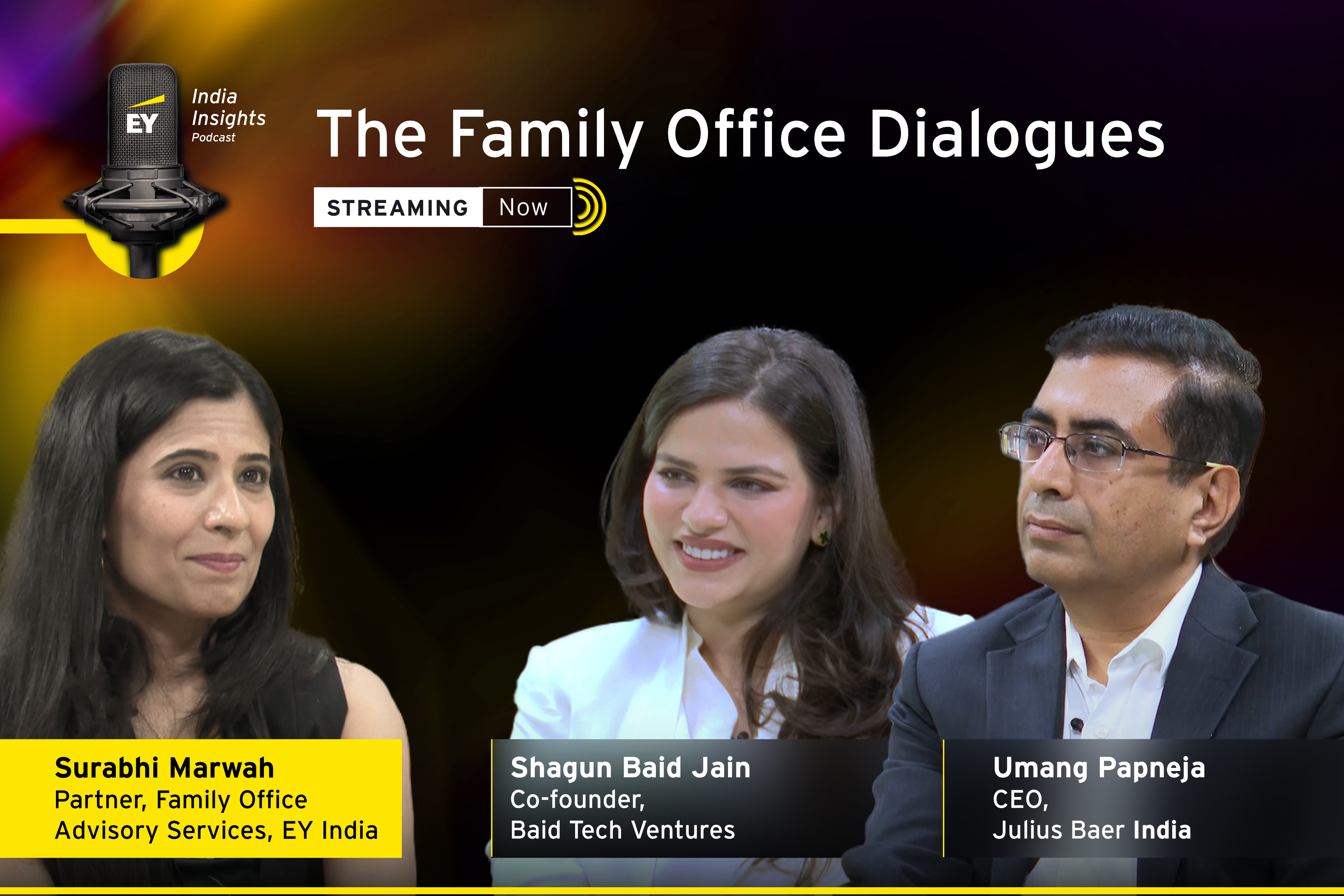
Listen to our latest conversation on how Indian family offices are transitioning from informal wealth management structures to professionally governed institutions focused on preservation, growth and intergenerational continuity.
37m 19s
The rise and future of family offices in India
Tune into EY India’s podcast on the evolution of family offices covering succession, investment trends & future outlook for high-net-worth families in India.
11m 49s