


EY refers to the global organization, and may refer to one or more, of the member firms of Ernst & Young Global Limited, each of which is a separate legal entity. Ernst & Young Global Limited, a UK company limited by guarantee, does not provide services to clients.
Recent Searches

1. Pillar Two status
- Malta has not introduced any component of the OECD Pillar Two Initiative and continued to apply the derogation afforded by the Minimum Tax Directive. This means that Malta has not, so far, introduced the Income Inclusion Rule (‘IIR’) or Undertaxed Profits Rule (‘UTPR’). Similarly, Malta has not introduced a qualified domestic top-up tax (‘QDTT’).
- Nonetheless, Malta has transposed into its local legislation the European Union’s Global Minimum Tax Directive (the ‘Directive’), including the administrative provisions of the Directive.
- Outside of Malta, the Inclusive Framework on BEPS has recently released the Side-by-Side package consisting of:
- Introduction of the Side-by-Side System, which applies to MNE Groups headquartered in jurisdictions recognised by the Inclusive Framework as having an eligible tax regime (so far, only the United States has been recognised as such). The System introduces two safe harbours: (1) the Side-by-Side Safe Harbour, which exempts those MNE Groups from IIR and UTPR (but not QDMTT) in other jurisdictions, and (2) the UPE Safe Harbour, which only exempts the UPE jurisdiction from the UTPR. The Side-by-Side System is applicable for fiscal years commencing on or after 1 January 2026;
- A permanent simplified ETR safe harbour;
- A one-year extension to the Transitional Country-by-Country Reporting Safe Harbour; and
- A permanent Substance-based Tax Incentives Safe Harbour.
2. Pillar Two compliance
- The government has issued a legislative update concerning Pillar Two compliance obligations in Malta.
- Under the amended legislation, constituent entities of groups which are in scope of the GloBE Rules and which are located in Malta shall be exempt from:
- filing a top-up tax information return in Malta; and
- the obligation to notify the Malta tax authority of the jurisdiction and identification of the designated filing entity in which the top-up tax information return of the Group is filed.
- These exemptions shall apply irrespective of the location of the ultimate parent entity of the group.
- This means that, to the extent that the introduction of an IIR and UTPR is delayed and a QDTT is not introduced, constituent entities of groups which are in scope of the GloBE Rules and which are located in Malta will not have any filing obligations related to Pillar Two in Malta.
- The aforementioned exemptions are without prejudice to the compliance obligations focusing on exchange information within the MNE Group that are envisaged for MNE Groups which are headquartered in Malta.
- The guidelines were also updated to factor in this legislative update.
3. Tax treatment of Special Limited Partnership Funds
- The tax treatment applicable to certain partnerships has been extended to a Special Limited Partnership Fund (‘SLPF’) established in terms of the Investment Services Act (Special Limited Partnership Funds) Regulations, (S.L. 370.53).
- A SLPF will therefore have the option of either having its income taxed at the level of its partners or otherwise electing to be treated as a ‘company’ and having its income taxed as if it was a company.
4. Super-deduction for research, development and innovation
- Through the recently published Budget Measures Implementation Act, 2026, a super-deduction in respect of costs incurred for research, development and innovation activities has been introduced.
- Under this provision, a person engaged in any trade, business, profession or vocation shall claim a super-deduction equal to 175% of expenditure incurred for research, development and innovation activities, provided that such expenditure was incurred for the use and benefit of the relevant trade, business, profession or vocation.
- Where the expenditure in respect of which the deduction is claimed is an expenditure of a capital nature, and provided that it is not a capital expenditure in respect of which tax depreciation (capital allowances) are allowed, the deduction shall be spread equally over the year in which it has been incurred and the five subsequent years.
- This super-deduction shall be applicable from the year of assessment 2027 (financial year ending in 2026).
5. Introduction of Self-Compliance Questionnaire for CRS and FATCA
- The Malta Tax and Customs Administration has launched a new Self-Compliance Questionnaire (‘SCQ’) for CRS and FATCA purposes.
- Essentially, the SCQ is a new annual reporting obligation for all entities that qualify as Reporting Maltese Financial Institutions (‘RMFIs’) and Maltese Non-Reporting Financial Institutions (‘NRFIs’) for CRS and/or FATCA purposes.
- The first SCQ related to the 2025 reporting period and should have been completed and submitted by 13 March 2026.
6. Update to the Implementing Guidelines on Automatic Exchange of Financial Information
- A new version of the Implementing Guidelines on Automatic Exchange of Financial Information V4.8 has been published by the Malta Tax and Customs Administration on 23 February 2026.
- The updates to the guidelines concern:
- The process to de-register RMFIs;
- Amendment to the Trustee Declaration Return submission procedure;
- A new section on the SCQ, mentioned above; and
- Updates to exchange jurisdictions in annex 1 and 2 of the guidelines.
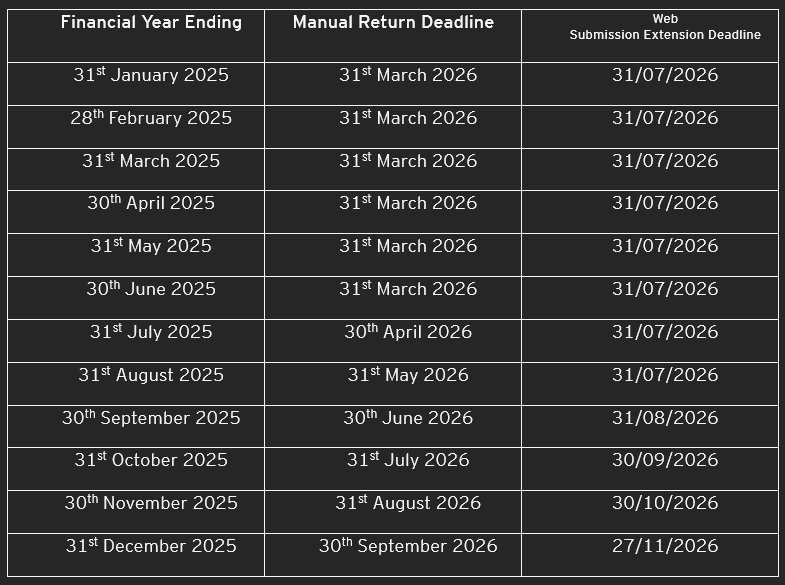
7. Extension of deadlines for filing electronic returns for 2026
- The Commissioner for Tax and Customs has notified that the deadlines for electronic filing of income tax returns for companies have been extended as follows:
8. Election for the Final Income Tax Without Imputation Regulations
- Malta has introduced an elective (i.e., non-mandatory) domestic minimum top-up tax, by virtue of Legal Notice 188 of 2025. Under this framework, an entity in Malta may elect to have its chargeable income subject to tax in Malta at the rate of 15%, instead of the statutory corporate income tax rate.
- The Commissioner for Tax and Customs issued a notification informing taxpayer that the above election is to be made via the income tax return and through the completion of the relevant questions therein.
- Further information as to how such election is to be made as aforesaid will be issued once the relevant income tax return becomes available.
- Such an election must be made by not later than the applicable online filing deadline mentioned above and, once made, it is binding on the taxpayer for 5 consecutive years.
9. Introduction of the Highly Skilled Individuals Rules
- The Highly Qualified Persons Rules, (S.L. 123.126), which were introduced to attract specialized talent in certain sectors to Malta are set to terminate by 31 December 2030, and no new determinations could be issued under such rules after 31 December 2025.
- In light of this, the government has recently issued consolidated Rules, named Tax Treatment of Highly Skilled Individuals Rules (L.N. 20 of 2026) (the ‘HSI Rules’), which came into force on 1 January 2026.
- At the option of the taxpayer, the HSI Rules provide for a flat final rate of 15% on qualifying employment income earned by non-Maltese domiciled individuals who hold a qualifying contract of employment governed by Maltese law with an entity licensed or authorised by one of the relevant competent authorities.
- Amongst other qualifying criteria, the income from a qualifying contract of employment shall not be less than €65,000 (exclusive of the annual value of any fringe benefits), adjusted by an increase of €10,000 every 5 years with effect from the year subsequent to the year in which the HSI Rules come into force.
- Applications must be submitted within the period between 1 January 2026 to 31 December 2035, and no determinations may be issued after 31 December 2036. Any approved benefit may only apply to income earned up to 31 December 2040.
10. Time limit to file an adjustment form
- The Budget Measures Implementation Act, 2026 has amended the Income Tax Management Act rule providing for a time limit for a taxpayer to submit an adjustment form where that taxpayer disagrees with the Commissioner’s determination made following the submission of a self-assessment return.
- The time limit has been extended from five years from the date on which the person is notified of such determination, to ten years from the same date.
Contacts
Dr. Robert Attard
EY Malta Partner & Tax Leader
International Tax & Transaction Services
robert.attard@mt.ey.com

Silvio Camilleri
EY Malta Director
International Tax & Transaction Services
silvio.camilleri@mt.ey.com

Martina Sciberras
EY Malta Manager
International Tax & Transaction Services
martina.sciberras@mt.ey.com