The Caribbean lens hero image

EY-Parthenon Caribbean

The Caribbean Lens: IFRS S1 and S2

As the ISSB’s IFRS S1 and S2 shape global investment, the Caribbean has a key opportunity to strengthen its resilience and competitive edge.

In brief

  • The ISSB’s IFRS S1 and S2 reporting frameworks are levelling the playing field for sustainability-related disclosures: Presenting a global baseline for communicating sustainability-related risks and opportunities.
  • More than just compliance checks: Four in five investors now factor ESG considerations into their investment decisions (SG Analytics, 2025) making IFRS S1 and S2 useful tools Caribbean entities can leverage to showcase relevance on the global market, especially amidst the dynamic geopolitical risk landscape.
  • Mobilizing capital: The Caribbean experiences the highest global physical risks from climate change-related damages, alongside low capacities for adaptation (EIB, 2025), highlighting the acute need for progress on sustainability priorities to demonstrate investment readiness.

Why the Caribbean, and why now?

Sustainability reporting in the Caribbean remains constrained due to limited voluntary adoption, slow regulatory momentum on sustainable development, and reversals in sustainability commitments by many large players on the global stage. Persistent challenges, such as weak cross-institutional coordination, outdated data systems and financial uncertainty amid global market volatility, continue to limit regulatory progress.

Despite the volatile regulatory landscape, companies are now recognizing the growing need for stronger governance, modernized data management, and more robust risk strategies to manage climate risk exposure and financial pressures, especially amidst the growing threat of disruption from climate and geopolitical events.

These factors create a pivotal moment for Caribbean entities to adopt sustainability reporting as a strategic tool to manage operational vulnerabilities, and to enhance their visibility and credibility to investors.

Distorted perspective, oval bay of Caribbean sea at Dominican Republic in summer, cloudy day, fish eye lens
1

Part 1

From market shifts to regional objectives

Aligning international best practices

Globally, the sustainability agenda is uneven. Some countries are scaling back on sustainable policy development due to political and economic pressures, while others are ramping up their decarbonization and adaptation strategies, with institutions increasingly viewing sustainability as a strategic tool for efficiency, innovation and competitiveness. While this divergence creates uncertainty, it also drives a bigger need for common ground and reliable reporting frameworks.

IFRS S1 and S2 are helping to bridge these gaps by offering a baseline for sustainability and climate-related disclosures. The adoption of these standards is being implemented incrementally across regions, with evolving regulations being tied to national sustainability strategies. Currently, 17 jurisdictions across major continents are actively implementing these requirements for disclosure by diverse public and private entities. For instance, Australia’s AASB S1 and AASB S2 directly draw on IFRS S1 and S2, whilst  our Latin American neighbours Brazil, Bolivia, and Costa Rica are set to implement aligned mandates in 2026.

Though Caribbean markets have not taken firm stances on adoption, corporates that trade internationally will also be under public scrutiny as their global trade partners seek value chain data in our region for compliance. Caribbean entities that embrace these disclosures position themselves competitively for regional and international partnerships, funding, and growth.

IFRS S1 and S2 allow the region to display both its needs and value through quantifying sustainability-related risks and opportunities that may otherwise be overlooked, demonstrating strategic sustainable business models and attracting capital aligned with development priorities and aligning with Nationally Determined Contributions (NDCs) and other commitments. This offers a clear pathway for the Caribbean to elevate its sustainability ambitions in harmony with global best practices, advancing its economic resilience.


Advancing sustainable development

When applied regionally, IFRS S1 and S2 can help to facilitate the transition from policy ambition to finance mobilization. Through standardized, credible data, entities can translate their national sustainability plans and strategies into comparable, decision-useful financial information, positioning themselves more competitively for international climate financing from multilateral banks and green bonds.

This is especially crucial for Caribbean nations, whose ambitious conditional climate targets under their Nationally Determined Contributions largely depend on access to finance, technology transfer and capacity-building from international partners. Across Latin America and the Caribbean, the financing needs to deliver on low-carbon transitions is estimated at US$150-300 billion annually, highlighting the urgent need for mobilization of capital. Moreover, by embedding climate disclosures within financial reporting, governments can better align public investment strategies with national objectives, ensuring that infrastructure, tourism, and energy policies are accountable and climate-resilient.


IFRS S1: sustainability-related risks and opportunitiesIFRS S2: climate-related risks and opportunities
Enables Caribbean entities to communicate on vulnerabilities like fossil-fuel dependency, water scarcity, coastal degradation, or agricultural and biodiversity losses.Strengthens data and decision making on greenhouse gas emissions, risks related to inaction towards mitigation and adaptation, and scenario analysis, which all supports progress towards country NDCs.

The ISSB standards thereby empower the Caribbean to move from conditional ambition to bankable action, providing the transparency and accountability needed to de-risk sustainable investment, attract the financing required to meet targets, and strengthen progress towards mitigation and adaptation.

Isola di Cayo Rico, Cuba
2

Part 2

Resiliency in Caribbean business

Risk management is a resilience mechanism

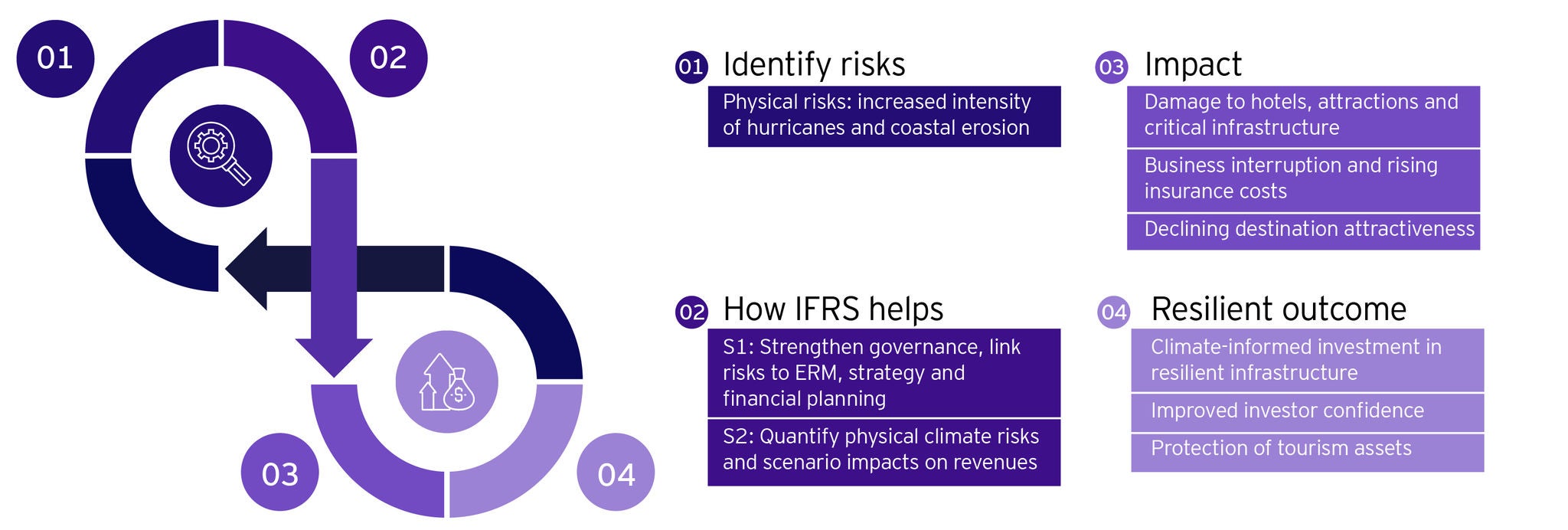
Caribbean economies face persistent risks from physical threats, such as hurricanes and flooding, to transitional hurdles including slow technological and regulatory adoption and compliance. IFRS S2 directly addresses this by requiring companies to identify, assess, and disclose climate-related physical and transition risks using standardized metrics and scenario analysis in their environment, social and governance (ESG) strategies. For local entities, this framework provides clarity: It moves sustainability from an abstract concept to measurable, decision-relevant data that can guide investments, asset management, and insurance planning.​

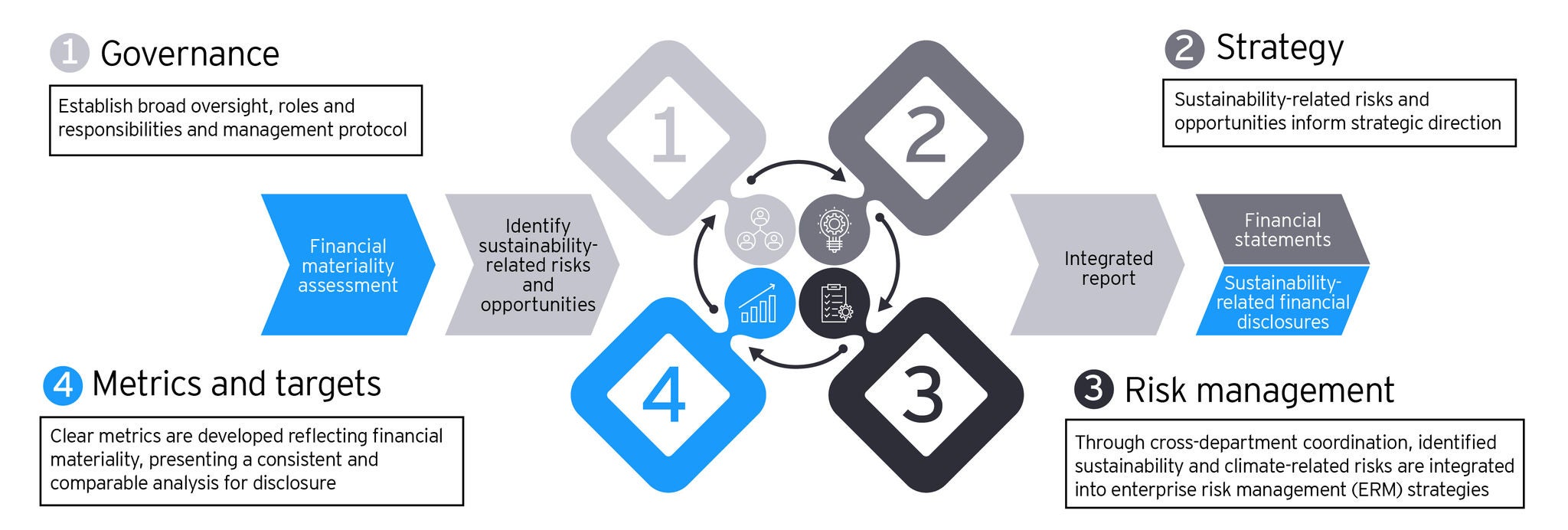
By integrating climate and sustainability risk into existing enterprise risk management (ERM) processes, Caribbean entities can reduce vulnerability and future-proof their operations. This integration also promotes cross-departmental collaboration between finance, risk, and operations- critical for MSMEs where resources are limited- helping ensure that their sustainability-related financial disclosures are consistent with financial statements and better aligned between operational performance and strategic resilience.


Conceptualizing risk management with ISSB standards

Unlocking latent business opportunities

IFRS S1 and S2 help Caribbean companies provide a pathway to operate more efficiently, grow sustainable business models, and build resilience for the future. They help organizations identify where they can save energy, cut costs, and even create new products and services that appeal to changing markets and consumer demands. 


Examples of latent business opportunities across sectors

Tourism and hospitalityFinancial institutionsEnergy and manufacturing
Use IFRS S2 methodologies to assess and communicate their climate risk management plan, making it easier to plan for natural disasters, apply mitigation measures and uncover how they can promote themselves as attractive and responsible eco-friendly destinations. Apply IFRS S1 to determine the vulnerability of their investment portfolios to environmental and societal risks and assess their financial contribution to greenhouse gas emissions and environmental degradation.Energy and manufacturing firms can utilize the standards to guide how they can utilize resources more efficiently, reduce greenhouse gas emissions and related carbon-border adjustment tax and unlock opportunities in the circular economy.

These standards allow flexibility, so that even smaller or mid-sized Caribbean companies can begin with the data they have, gradually improving their reporting over time. By focusing on their most significant material topics, like energy consumption and management, supply chain reliability, or workforce skills - businesses identify the most important opportunities for growth and savings. Over time, this builds stakeholder trust, opens doors for investment opportunities, and gives Caribbean companies a crucial advantage in economies often constrained by high borrowing costs and climate exposure, so that they can compete and succeed in a changing world.


View of a tour boat and a woman free diving at 'Sancho' beach in the archipelago of Fernando de Noronha - Brazil
3

Summary

Future trends and adaptation

The Caribbean faces some of the highest climate risks in the world; rising temperatures, stronger hurricanes, and sea-level rise impact the resiliency of our economies. Even as some regions roll-back their sustainability policies, the Caribbean must consider its vulnerability to climate change and economic disruptions. Alongside this, globally, the shift towards sustainability in business is clear: Regulations may change, but climate-smart strategies are an imperative for resilience and growth.

The Caribbean should embrace a mindset of agility by staying informed on market trends, anticipating shifts, and developing adaptable core strategies. By acting now, companies turn compliance into an opportunity for innovation and long-term stability- showing that complacency is not a risk we can afford.


The path forward: From readiness to advantage

Caribbean organizations that adopt early not only stand out in a nascent sustainability market but are also better equipped to navigate the next wave of change. How can you begin?

  1. Start where you are: Begin disclosures with available data and refine aggregation systems over time. Early transparency communicates commitment and accountability, even if data is incomplete.
  2. Institutionalize governance: Cultivate continuous engagement between boards and executive teams, ensuring sustainability integration is a shared responsibility, and a regular agenda item. Establish sustainability committees involving members across entity departments and clarify oversight responsibilities.
  3. Integrate into ERM and data strategy: Embed climate and sustainability risks into existing corporate risk registers and frameworks in line with IFRS S1 and S2 disclosures.
  4. Educate and upskill teams: Train management, finance and risk professionals to understand the implications of sustainability on operational and financial outcomes.
  5. Engage stakeholders: Create channels for transparent communication with investors, employees, regulators, and communities to align expectations and demonstrate accountability.


EY Caribbean: Roles and support

At EY Caribbean, we help organizations turn IFRS S1 and S2 compliance into a strategic advantage. Our sustainability reporting experts deliver end-to-end support in sustainability baseline assessment, strategy development, sustainability data architecture, assurance, tailored training, policy development and more. We bring deep technical knowledge of the IFRS Sustainability Disclosure Standards, combined with sector-specific insights, to ensure clients’ disclosures are accurate, credible, and provide informed decision-making.

We work side-by-side with our Caribbean clients, co-creating solutions that reflect their unique business models, stakeholder expectations, and long-term goals.

The result? Strategic opportunities, sustainable business growth, and robust reporting that ties it all together.