






Towards scalable, efficient and accountable healthcare in India

Towards scalable, efficient and accountable healthcare in India

The future of accountable healthcare in India must cater to evolving needs through strategies that deliver transparent and effective care.


In brief

  • India’s healthcare system has scaled efficiently, but the next two decades face an aging population and higher Non-Communicable Diseas (NCD) burden with earlier onset and delayed detection.
  • Shifting demographic and disease profile may increase demand for hospitalization and current expenditure on healthcare in India.
  • This necessitates a shift from episodic care to quality-driven longitudinal healthcare models that deliver equitable health outcomes, efficiently.
  • However, structural gaps persist: Fragmented providers and payers; uneven access, infrastructure, capabilities, quality standards and digital adoption.
  • A cohorted, bespoke playbook based on levers including tiered quality standards, reimbursement models, digital integration and quality-cost balance is essential. 


As healthcare in India continues to expand and diversify, it is critical to plan for the complexities that lie ahead while continuing to deliver scale and efficiency. A Viksit Bharat demands that the system move to care models that incentivize quality and embrace collective governance, while leveraging digital innovation to deliver equitable and measurable improvements in health outcomes. 

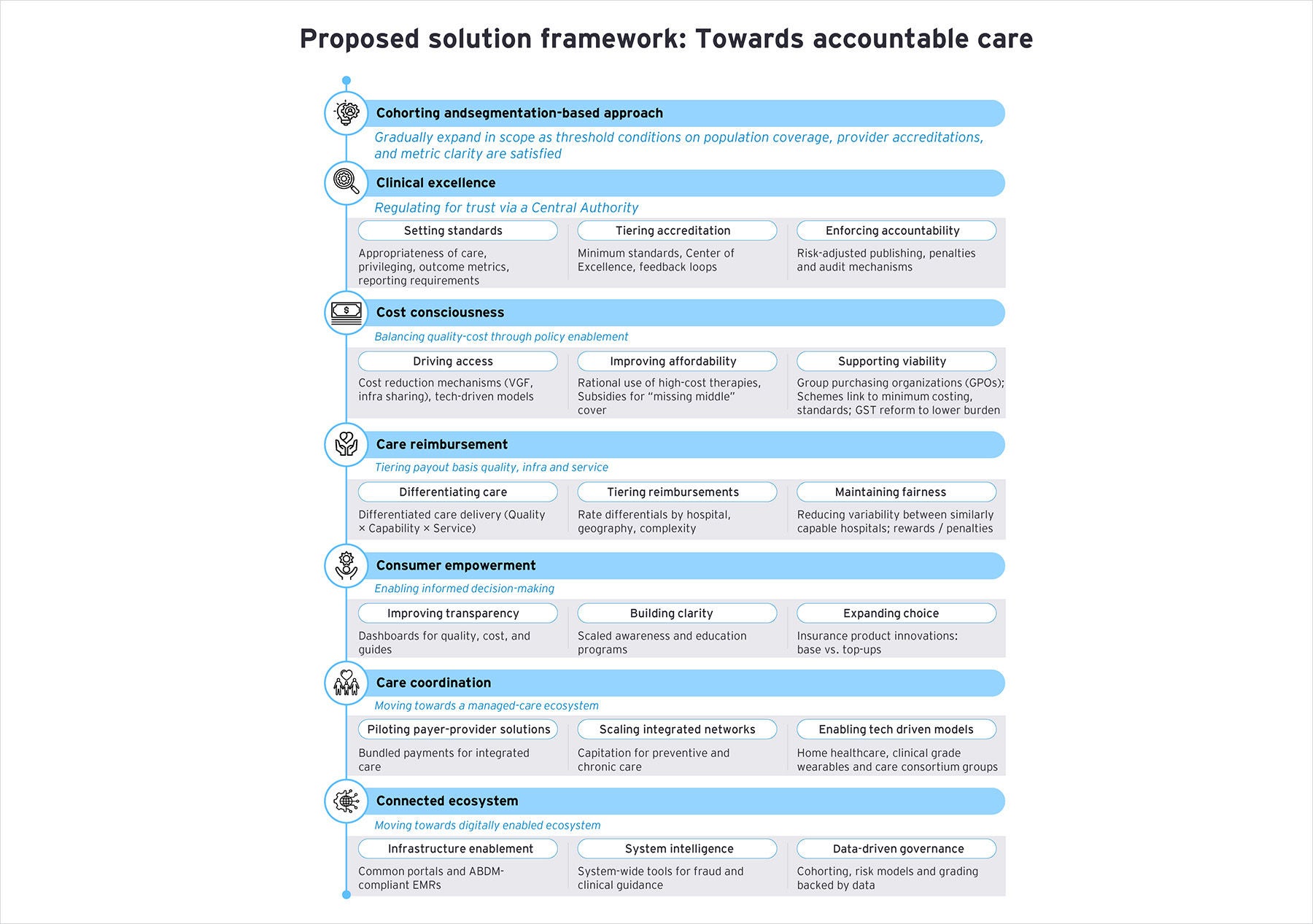
EYP worked with the FICCI task force on quality and viability to develop a knowledge paper titled, True accountable care – Maximizing healthcare delivery impact, efficiently. It sets out a practical “7Cs” healthcare framework to align incentives and quality to build a healthcare ecosystem that is both resilient and equitable. 

Viewing India’s healthcare transformation through four lenses

Over the past two decades, India has expanded hospital capacity, improved access and delivered care at a fraction of global costs. Yet, the challenges ahead are more complex and urgent. The transformation journey both so far and the one that lies ahead must be viewed through four lenses: 

  • Value - From cost to outcomes
  • Complexity - From episodic to longitudinal care
  • Trust - From fragmentation to transparency and quality
  • Action – From one-size-fits-all to a cohorted, bespoke approach 

Value: From cost to outcomes

India has a legacy of price efficiency. Analysis by EY-P shows that procedures often cost ~70% less than in developed markets and core price inflation has held at 3%-4% annually. Long-term realization growth (9%–9.5%) has come mainly from case mix shifts, with more tertiary procedures, advanced therapies and complex admissions as access and affordability improve.

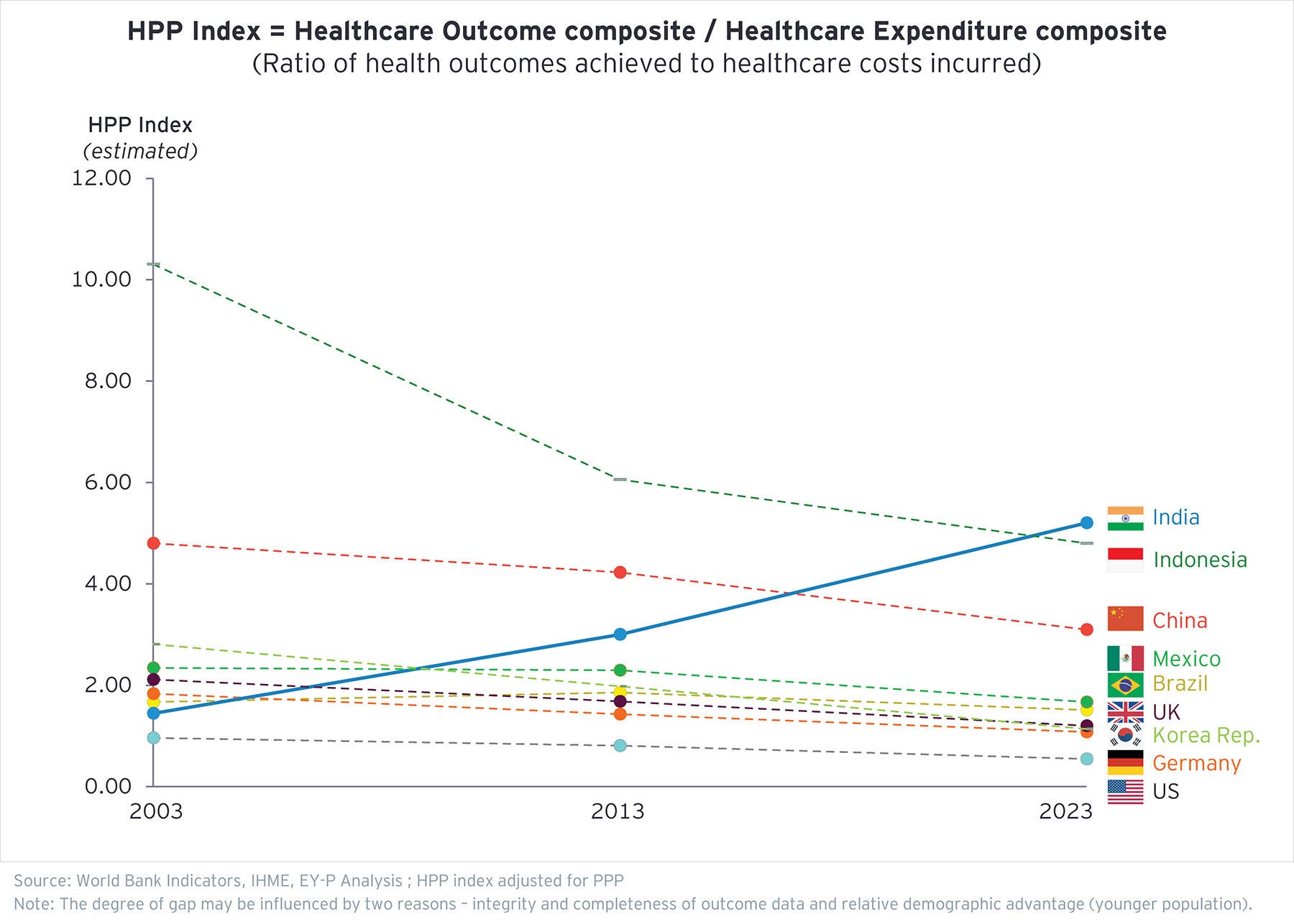
On the EY-P Healthcare Productivity and Performance (HPP) Index, a new composite measure for health system efficiency basis outcomes provided per rupee spent, India outranks compared countries on efficiency largely due to its cost advantage. However, the future demands a dual focus on both frugality and outcomes. Sustained outperformance on the HPP Index will hinge on significant gains in clinical outcomes.

EY-P Healthcare Productivity and Performance (HPP) Index

Complexity: From episodic to longitudinal care

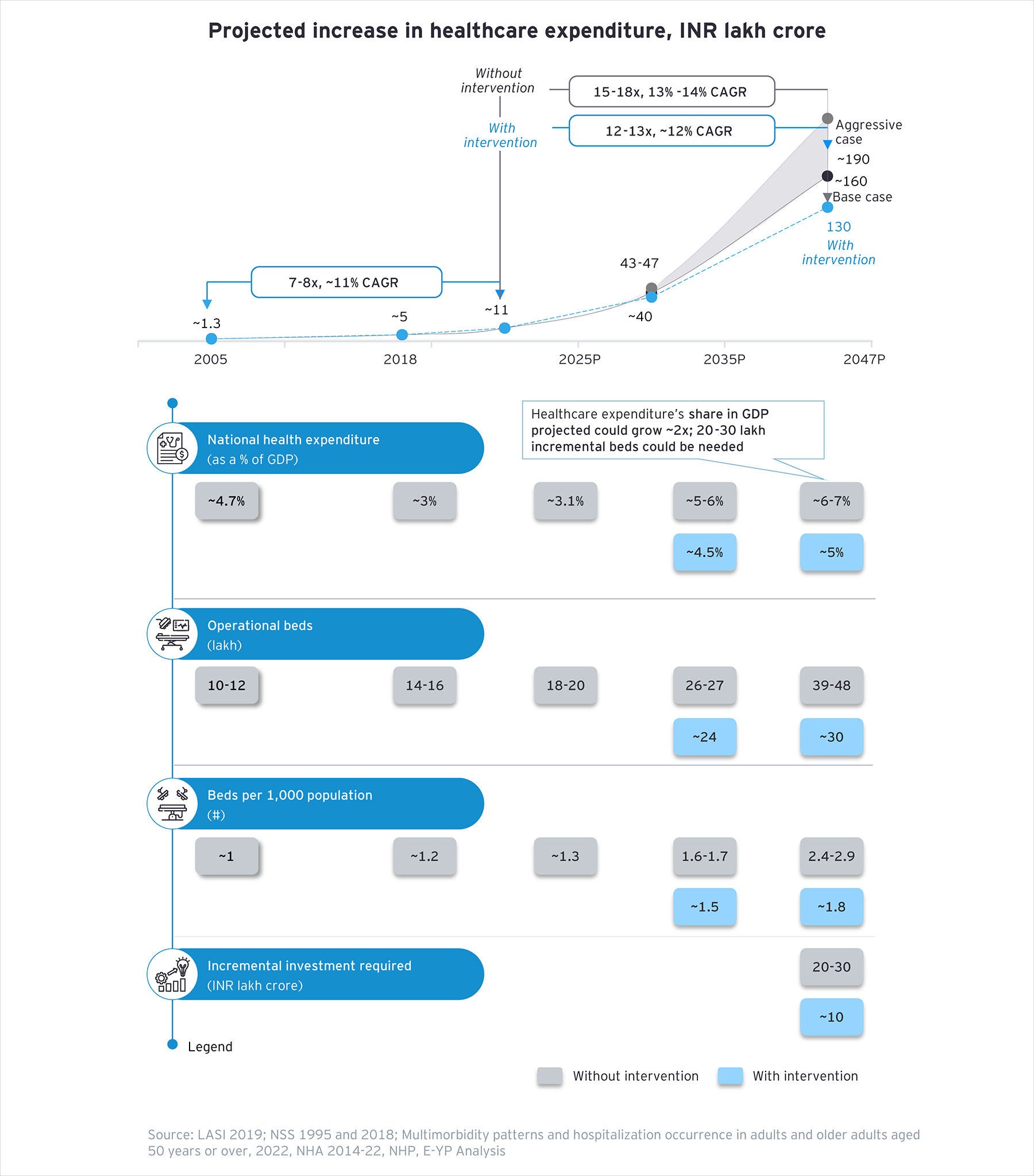
An aging population and rise in chronic diseases are compounding healthcare needs. By 2047, the population aged 60+ years is estimated to grow nearly fivefold1, driving up co-morbidity levels (already increased 20-fold in the 1995-2018 period2). Aggregate hospitalizations are projected to rise 2.5–3 times, requiring health expenditure to potentially double its share of GDP to 6%-7%3

The traditional episodic model is insufficient; a shift to longitudinal healthcare models  is essential for prevention, early intervention and coordinated disease management. Such an approach could help India contain the health expenditure curve at ~5% of GDP and chart a unique pathway to best-in-class outcomes at a fraction of global cost benchmarks. 

Healthcare expenditure

Trust: From fragmentation to transparency and integration

India’s fragmentation problem is multi-layered and deeply structural, defined by uneven access to care, dual provider and payer fragmentation and uneven adoption of defined quality standards and digital measures. Existing quality frameworks are extensive but offer scope for greater specificity and coverage.

Key stakeholders though, appear to be ready to support this significant shift. The survey of over 1,000 patients shows that patients increasingly (~80%) seek objective, accessible information to guide their choices. Of these, nearly 90% say they would pay more for certified quality. Similarly, the survey of over 100 clinicians shows there is strong intent to measure and share outcomes (~ 65%), with many doctors supporting proactive reporting (~35%) and need for standardized protocols to enhance outcomes (~90%).

This convergence of patient and clinician aspirations creates an opportunity to formalize quality through clearer standards, licensing and reimbursement linked to minimum thresholds, outcome reporting and interoperable records. 

Action: From one-size-fits-all to the 7C healthcare framework of solutioning

The knowledge paper advocates for a pragmatic, multi-pronged reform agenda anchored in creating bespoke pathways and aligning system incentives for health system actors of varying maturities to achieve measurable quality.

Two critical initiatives are proposed. An illustrative, scientific reimbursement model for private insurers and the creation of a Central Authority for clinical excellence in healthcare. The proposed reimbursement model is geared to reward investments in quality and delivery of best-in-class outcomes through tiered reimbursements – thus, reducing the variability in pricing across similar hospitals and bringing in a more structured and transparent regime. The Central Authority could drive clinical excellence in healthcare by setting appropriateness of care standards, enforcing minimum quality standards, mandating and publicly reporting outcome metrics and creating tiered accreditation standards.

Healthcare solution framework

At this pivotal moment of transformation, the healthcare system is uniquely positioned to redefine possibilities in accountable care in India – building on decades of progress, while boldly addressing the challenges that lie ahead.

Ankur Dhandharia, Partner, Healthcare Consulting, EY-Parthenon India, and Tara Ravi, Partner, EY-Parthenon India, have also co-authored this article.

Download the full pdf

Summary

A framework addressing the challenges of healthcare in India must consider value, complexity, trust and action. As India faces challenges in the future due to an aging population and rising chronic diseases, effective healthcare would need a shift from episodic to longitudinal care models. In addition, a tailored approach can align incentives and enhance quality. To create a resilient and equitable healthcare ecosystem, the approach must expand on India’s proven frugality while leading to improved health outcomes.

Related articles

How innovation is shaping India’s key sectors

Explore how innovation in India leads growth across agriculture, energy, healthcare via agritech, clean energy, telemedicine, AI and sustainable tech.

How GCCs in India are shaping the future of the Life Sciences industry

Explore how India’s GCCs are transforming future of life sciences from handling core and enabling functions to driving innovation, outcome-oriented growth.

How to expand future-ready healthcare in India

Read how India’s healthcare is going digital with AI, telemedicine, data analytics, value-based care and interoperable platforms for better access & outcomes

    About this article

    Authors