






How GCCs in India are shaping the future of the Life Sciences industry

How GCCs in India are shaping the future of the Life Sciences industry

Life Sciences GCCs in India are strategic engines for innovation, data-driven decisions and business outcomes.


In brief

  • Of the top 50 global Life Sciences companies, around 23 have set up Global Capability Centers (GCCs) in India.
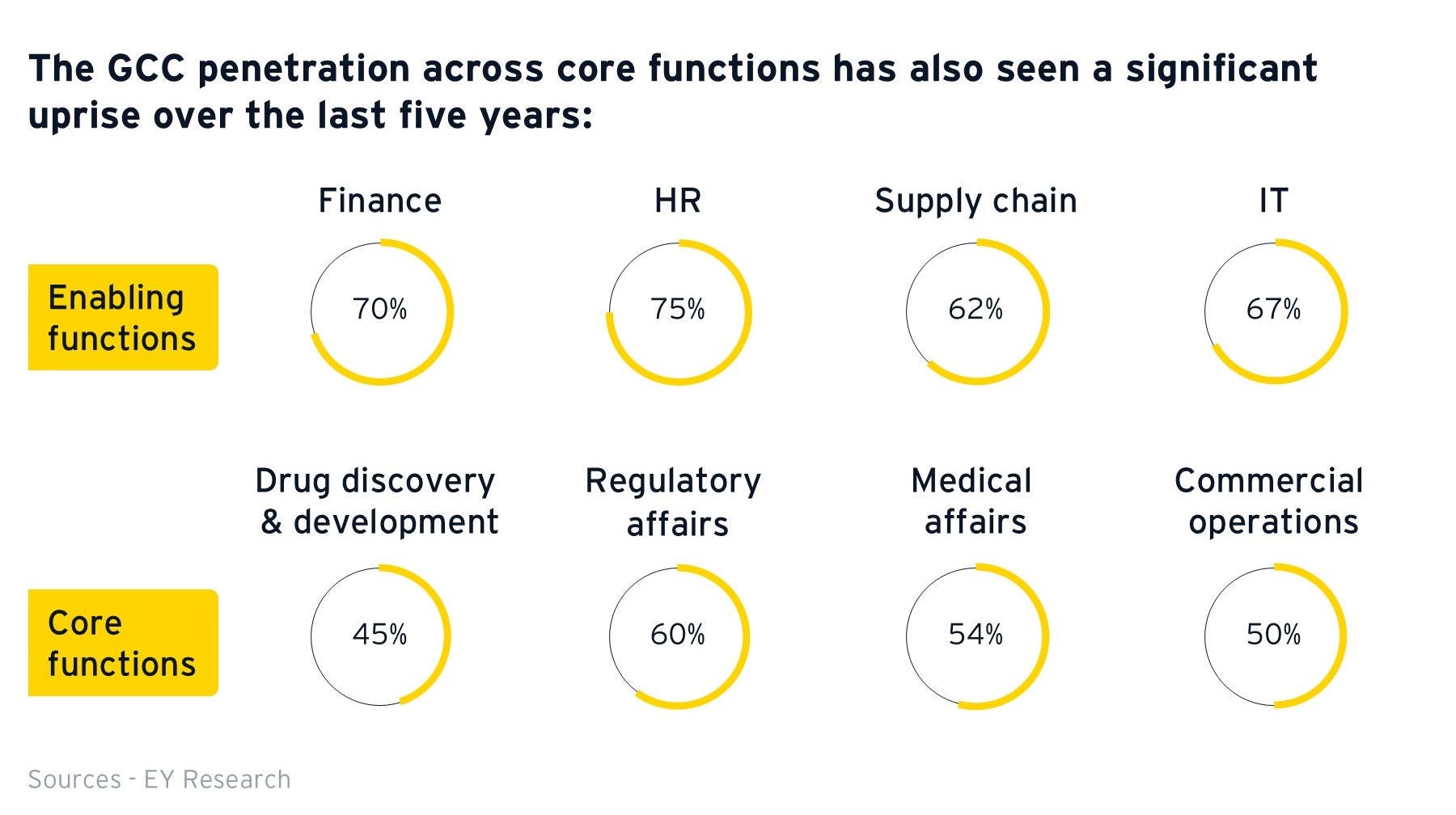
  • Pharma GCCs handle more than 60% of enabling functions like finance, HR, supply chain, and IT for global firms. 
  • These GCCs are working in tandem with main decision centers of companies, co-owning global pipelines and outcomes. 

Over the past five years, India has grown to become a global hub for Life Sciences Global Capability Centers (GCCs), with 23 of the world's top 50 Life Sciences companies now operating centers in the country. India's GCCs have evolved from providing back-office support functions to becoming strategic engines of innovation in pharma, driving end-to-end value creation in both core and enabling functions, contribution both to the global Life Sciences industry and the Indian pharmaceutical industry’s growth.

This report by EY India, ‘Reimagining Life Sciences Global Capability Centers,’ highlights how leading pharma GCCs are actively looking for opportunities to add extended value by directly targeting business outcomes. Rather than a support center, the GCCs are positioned as a “twin” of the “headquarters”, gaining a seat at the table, accelerating data-driven decisions and providing an environment to innovate. In addition, there is a renewed focus on leveraging the external ecosystem to mitigate risks, tap into extended capabilities, and innovate beyond boundaries—demonstrating the growing role of Pharmaceutical GCC innovation.

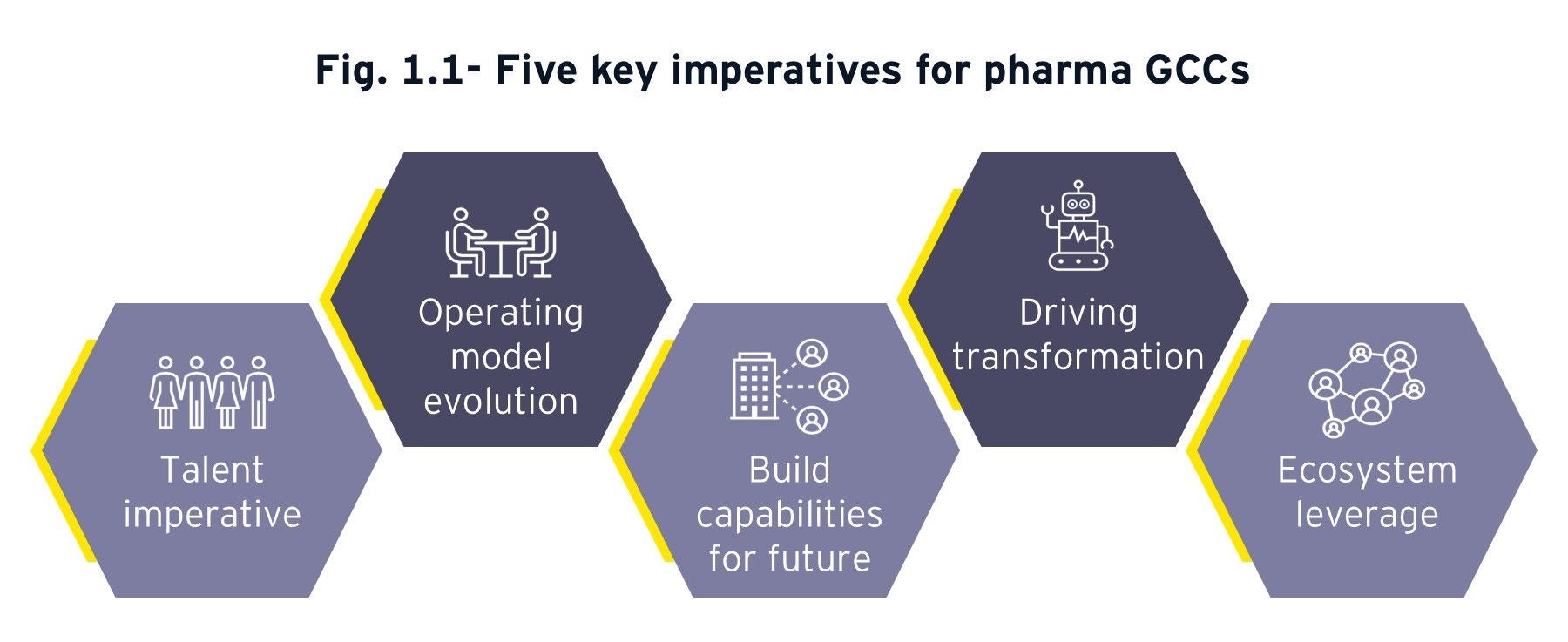
Key imperatives in Pharma GCCs

EY GCC Leadership Dialogues

Join Arindam Sen, EY India Partner & GCC Sector Lead, in a video series with top leaders on global capability centres highlighting growth & future trends.

Know more

Evolving role: From back office to innovation engine

As the report analyzes, Life Sciences GCCs in India are playing a critical role across both enabling and core functions. Today, they run the bulk of global functions like finance, HR, supply chain, and IT for their parent firms, while also taking on critical mandates across functions like regulatory affairs, medical, and commercial. By embedding advanced technologies like AI, these centers help accelerate drug pipelines and deliver more patient-centric innovation. The shift marks India’s rise as a pharma GCC hub, transforming from a transactional base to a strategic center driving end-to-end value for the global Life Sciences industry.

GCC penetration across functions

India’s strengths: Talent, policy and ecosystem

India’s rise as a global hub for pharmaceutical Global Capability Centers (GCCs) is not accidental. It is the result of policy foresight, unmatched healthcare talent availability and a mature ecosystem that together create the ideal foundation for innovation-driven healthcare operations and Pharmaceutical research.

Governments at both central and state levels have identified GCCs as powerful engines for digital exports and employment. Over the last few years, foreign investment norms have been relaxed, while states such as Karnataka, Telangana, Uttar Pradesh, and Madhya Pradesh have rolled out targeted incentives, ranging from capital expenditure subsidies and rental reimbursements to skilling programs and land rebates. This policy push has provided global firms with both the confidence and the means to scale in India’s healthcare sector.

The talent advantage is a key factor. India has over 2.7 million professionals in the Life Sciences sector. Every year, another 2 million STEM graduates and more than 110,000 medical graduates enter the workforce. For global pharmaceutical firms looking to build GCCs that do not just execute tasks but co-create solutions, this talent pool offers a unique mix of scientific depth, digital fluency, and scale.

Beyond talent, the ecosystem surrounding Life Sciences is maturing fast. Access to global-quality contract research organizations (CROs), partnerships with leading academic institutions, and a thriving startup network—home to more than 100 unicorns—make India a fertile ground for experimentation and cross-industry collaboration in pharmaceutical research innovation. Add to this the availability of Grade-A commercial spaces across metros and Tier II/III cities, and the path to scalable, cost-efficient growth becomes clear.

The FS GCC playbook

Welcome to an exclusive video series by EY India where we dive into the strategies and best practices driving the success of Global Capability Centers (GCCs) in the financial sector. Watch our latest episodes below!

Know more

Outlook for pharmaceutical GCCs in India

Pharma GCCs are increasingly sharing accountability for innovation and outcomes across the enterprise. Three shifts will define this journey: building future capabilities to drive transformation and resilience; moving from transactional delivery to outcome-based partnerships; and cultivating agile talent skilled in generative AI, bioinformatics, and digital health. Together, these advances would position India not just as a base for pharma GCCs, but as the engine room where the future of global healthcare is designed and scaled.

Download the full pdf

Summary

India is rapidly emerging as a strategic hub for Global Capability Centers (GCCs) for Life Sciences firms. These centers have become pivotal in driving innovation and transformation, leveraging the country's extensive pool of healthcare talent. Supportive government policies and the adoption of advanced technologies, including digital health solutions are facilitating a transition from traditional back-office functions to strategic engines of growth. This shift marks a significant departure from a cost-centric model to one focused on capability and value creation, which is a step forward in solidifying India's status as a global leader in Life Sciences innovation.


Related articles

How Agentic AI can transform industries by 2028

Agentic AI: Transforming industries by 2028 with autonomous decision-making, improved efficiency, and ethical frameworks. Learn how it’s reshaping businesses.

Tapping into data management and data lineage strategies for Banks and their Global Capability Centers (GCCs)

Discover how banks and GCCs leverage data lineage beyond compliance, transforming it into a strategic enabler for governance, risk management, and decision-making.

How financial services are adapting to global outsourcing trends

Explore GBS evolution in financial services, addressing regulatory challenges, digital transformation, and AI innovation for operational excellence.


    About this article

    Authors