





EY refers to the global organization, and may refer to one or more, of the member firms of Ernst & Young Global Limited, each of which is a separate legal entity. Ernst & Young Global Limited, a UK company limited by guarantee, does not provide services to clients.
Recent Searches

Agentic AI is revolutionizing the future of industries by automating tasks, boosting adaptability, and minimizing reliance on human oversight.
This article is part of EY Agentic AI series.
In brief
- Unlike traditional AI, Agentic AI makes autonomous decisions based on goals rather than following predefined rules.
- Sectors such as healthcare, manufacturing, financial services, and FMCG are exploring Agentic AI to improve efficiency and adaptability.
- Despite the advantages of Agentic AI, there are concerns regarding oversight, trust, and accountability in decision-making processes.
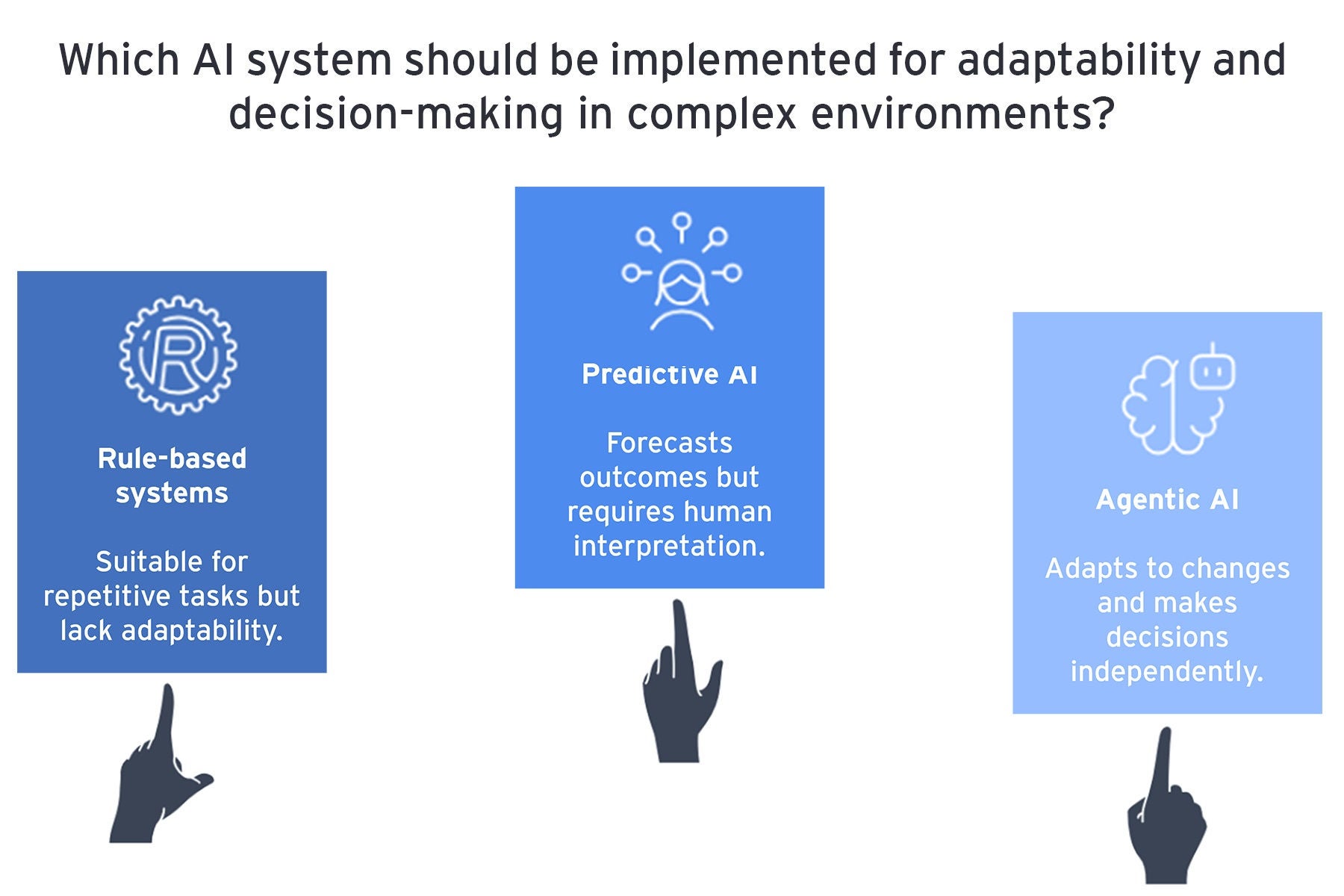
What happens when machines do not need instructions but make their own decisions? Agentic AI is one such technology. Unlike rule-based systems or predictive AI, Agentic AI takes goal-driven decisions and acts independently in complex and changing environments. Now, industries from healthcare to consumer goods are exploring Agentic AI to improve speed, streamline workflows, and address evolving challenges like operational delays and dynamic decision-making.
Navigating business challenges with Agentic AI
Businesses today manage complex operations while receiving vast amounts of data from customers, suppliers, and market trends, making it difficult to analyze information quickly. With Agentic AI, regular tasks can be automated, and the AI system adjusts rapidly to new circumstances. By enabling faster data-driven actions, it reduces reliance on human input. This frees teams to focus on critical work and respond better to market shifts. However, it is important to note that human oversight remains crucial to find the right balance between automation and decision-making.
Agentic AI’s growing enterprise footprint
Major firms expect Agentic AI to reshape enterprise decisions, operations, and automation by 2028. As per Gartner, Agentic AI will be featured in 33% of enterprise software by 2028, leading to 80% of customer service problems being solved independently, which saves 30% of the total costs by 2029.
In addition, Agentic AI is expected to globally oversee 15% of work choices, and around 40% of companies will rely on AI to guide their employees’ behaviors by 2028. IBM and Salesforce expect one billion AI agents to be operational across the world by the end of 2026. Going forward, 10% of global boards are predicted to seek guidance from AI for key executive decisions by 2029.
Agentic AI is expected to globally oversee
15%
15%
of work choices
and around
40%
40%
of companies will rely on AI to guide their employees’ behaviors by 2028
Research indicates that 80% of customer service around the world will be carried out by machines, with strong expected growth from Indian companies. Besides, AI will play a role in making decisions in 10% of sectors’ executive boards, and 15% of work tasks will be handled by it. According to Gartner, 25% of enterprise cybersecurity incidents will be due to the misuse of AI agents by both attackers from outside and internally suspicious individuals by 2028.
The practical reach of Agentic AI
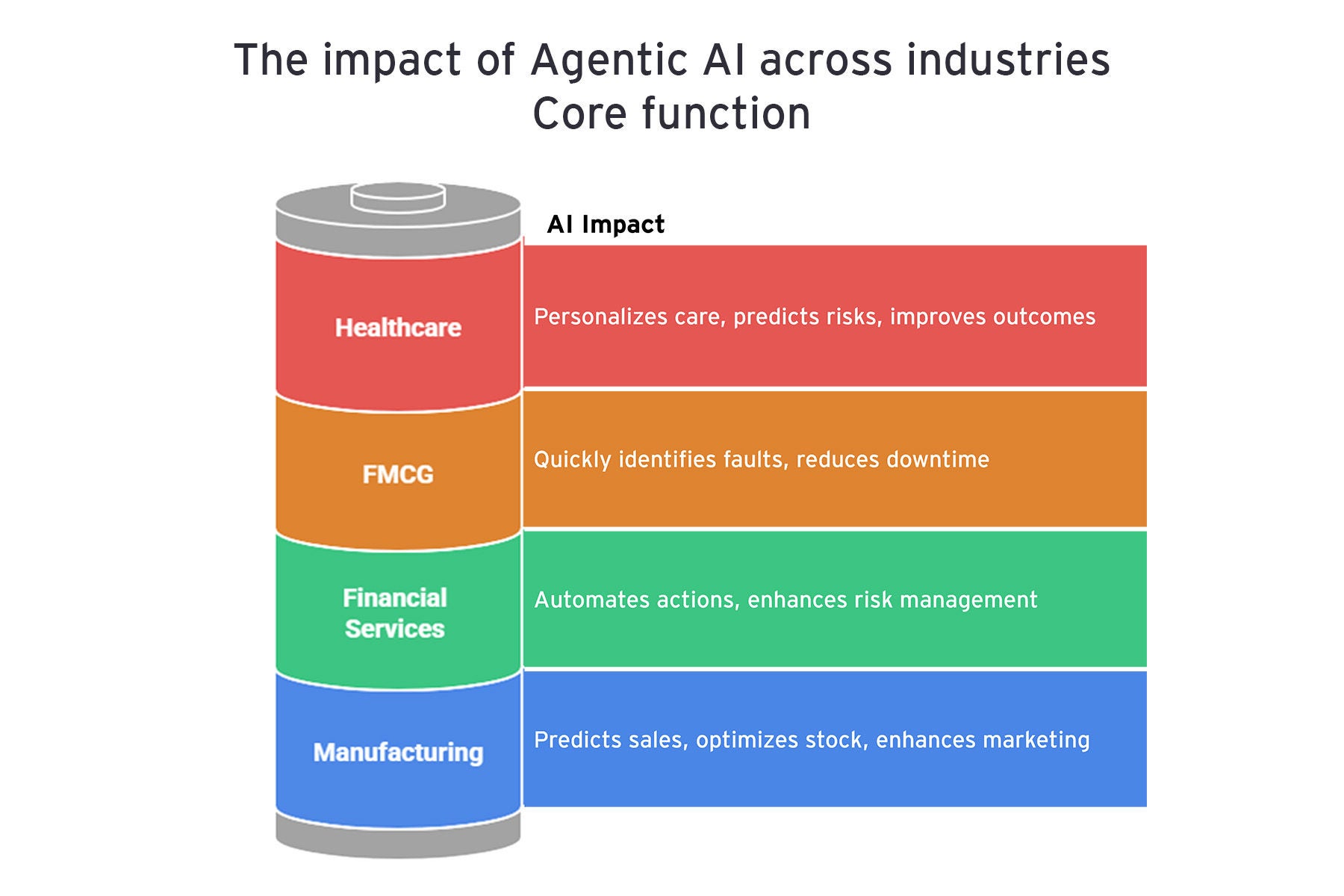
While technical skills matter, Agentic AI’s real strength is its ability to adapt to industry-specific needs, whether that means precision, speed, or scale. Here are a few examples of how it is reshaping different sectors.
Emerging trends in Agentic AI driving enterprise transformation
Autonomous decision-making at scale
Agentic AI is shifting from aiding human choices to making decisions independently. For example, in the manufacturing sector, it continuously adjusts using real-time inputs from machines to reroute supplies and control factory energy use.
Human-AI collaboration models
In a few cases, people set strategy while Agentic AI handles defined tasks, though such use remains limited. This helps teams meet deadlines, as AI manages aspects such as code testing, inventory, and customer support, leaving the team free to work on critical deliverables.
Edge-to-cloud intelligence networks
Enterprises are exploring the use Agentic AI at the data source like machines or sensors to respond faster when needed. These local systems, known as edge devices, work with cloud platforms to form a smart, connected network, resulting in quicker response time.
Ethical AI Governance frameworks
With AI gaining autonomy, companies are building strategies to ensure fairness, transparency, and value alignment. These models detect bias, explain decisions, and suggest actions to build trust and avoid pitfalls.
AI-as-a-Service (AIaaS)
By making no-code platforms, Agentic AI is expanding the possibilities for businesses using AI. Using these services, non-technical workforce can configure their own agents for automatic marketing and predictive maintenance, helping businesses become more efficient with no expensive upfront costs.
Download the full pdf
Summary
Across industries, Agentic AI is moving from experimentation to a key solution for task execution and decision-making. At present, it is improving both operations and customer experiences in healthcare, manufacturing, finance, and consumer goods. Agentic AI brings real-time decisions, greater efficiency, stronger supply chains, improved customer experiences, and seamless system collaboration to industries. While Agentic AI offers significant improvements in efficiency and decision-making, it is equally important to focus on risk management and governance to ensure its responsible and secure implementation.
How EY can help
-
EY-Parthenon AI Strategy Consulting Services guide organizations with AI readiness, value accelerators and due diligence to scale AI adoption and drive growth.
Read more -
Our Consulting approach to the adoption of AI and intelligent automation is human-centered, pragmatic, outcomes-focused and ethical.
Read more -
EY LLM solution transforms India's BFSI sector by addressing 29 key themes, enabling compliance, improving cost efficiency, and enhancing customer service integration. Find out more.
Read more
Related articles
How Agentic AI is transforming the future of intelligent systems
AI in intelligent systems leverages agentic AI with autonomy, reasoning & governance protocols to enhance decision-making. Discover EY India insights.
Agentic AI: The next frontier in automation
Agentic AI is transforming automation by enabling autonomous, adaptive decision-making. EY explores Agentic AI architecture, framework, & its applications.
How companies can secure language models against emerging AI cyber risks
Large Language Models (LLMs) cybersecurity explores risks, safeguards, and practical solutions to protect AI-driven systems against evolving cyber threats.