For many years, Malta's success was built on a strong foundation of stability, accessibility and a pro-business environment. These strengths helped attract investment, create jobs and establish the country as a trusted destination for international business.
They remain important today. Yet the environment in which Malta competes is changing rapidly.
Global markets are becoming more fragmented. Geopolitical developments are reshaping investment decisions. Technology is transforming how industries operate, creating new opportunities while disrupting established models. At the same time, countries are competing not only for investment, but also for talent, innovation and ideas.
In this environment, investors are asking different questions.
The conversation is no longer focused solely on whether a country provides a stable place to do business. Stability has become an expectation rather than a differentiator. What investors increasingly want to understand is how a country is positioning itself for the future and what makes it stand out in a crowded global marketplace.
That competitive advantage will depend on the choices Malta makes today.
The country has many strengths to build upon. A strategic location, a highly connected business community, an agile private sector and a resilient economy have all contributed to Malta's success story. These attributes have enabled the country to respond to change and seize opportunities over the years.
However, the next phase of growth requires a different mindset.
Future competitiveness will increasingly be driven by factors such as digital transformation, infrastructure, workforce development, innovation and sustainability. The ability to adapt quickly and execute effectively will become just as important as the strengths that brought Malta to where it is today.
This is not simply a business issue. It is a national conversation.
Ensuring that Malta remains competitive requires collaboration between the public and private sectors, academia and civil society. It requires a shared understanding of the challenges ahead and a willingness to take decisive action in response.
At EY, we have been engaging with international investors operating in Malta to better understand how they view the country's prospects and priorities.
The message last year was encouraging. Investors recognised the country's strengths and its ability to adapt. Yet there is also a growing expectation that Malta must continue to evolve in order to maintain and strengthen its position.
The countries that succeed in the years ahead will be those that anticipate change rather than react to it. They will be the ones that invest in capability, embrace innovation and create the conditions for sustainable long-term growth.
For Malta, the question is not whether it has achieved success. The question is what comes next.
How can the country strengthen its competitive edge? How can it attract the talent and investment needed for future growth? And how can it position itself to thrive in an increasingly complex and fast-moving global economy?
These are the questions that will shape Malta's next chapter.
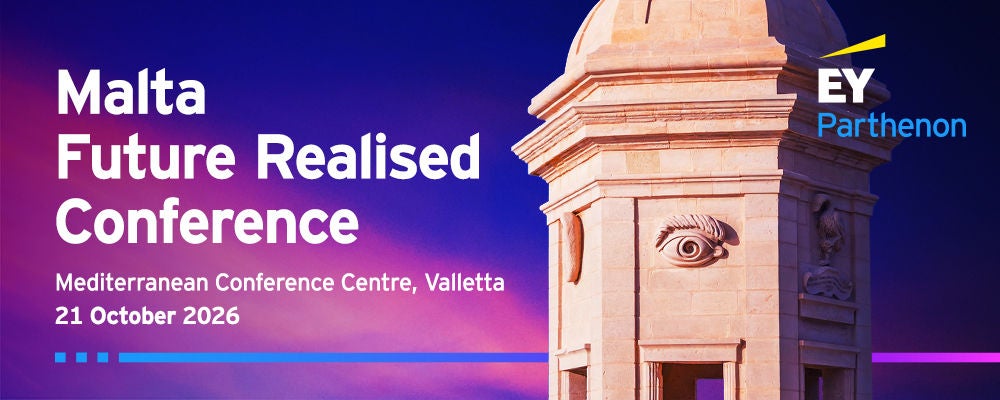
Over the years, Future Realised has become Malta's flagship forum for exploring these issues at a time when clarity, competitiveness and execution matter more than ever.
The future will not be defined by chance. It will be shaped by the decisions we make today.
Join the conversation and help shape what comes next by registering for Future Realised 2026 at https://www.ey.com/en_mt/events/future-realised-2026