


EY refers to the global organization, and may refer to one or more, of the member firms of Ernst & Young Global Limited, each of which is a separate legal entity. Ernst & Young Global Limited, a UK company limited by guarantee, does not provide services to clients.
Recent Searches

Most leaders in the Caribbean did not introduce AI into their organizations. It arrived anyway, through small practical choices: a document drafted faster, an analysis assembled in minutes, a quiet experiment by someone solving a problem with whatever was available. No formal decision. Just usefulness, finding its way into the work.
That pattern is now widespread. In most Caribbean organizations, AI is already shaping how work gets done, even where it has not been named, structured, or guided. And the data from a recent EY Caribbean study of 239 leaders across 13 countries puts precise numbers to what many leaders have sensed but lacked the language to describe.
Download the full Caribbean AI Sentiment Survey Report here

1
Part 1
85% of Caribbean leaders are comfortable using AI tools in their work.
Fewer than one in five feel prepared to guide that use across their organization.
Only 26% of Caribbean leaders say there is clarity about how AI is governed or who is accountable. And 42% describe their approach as "figuring it out as we go."
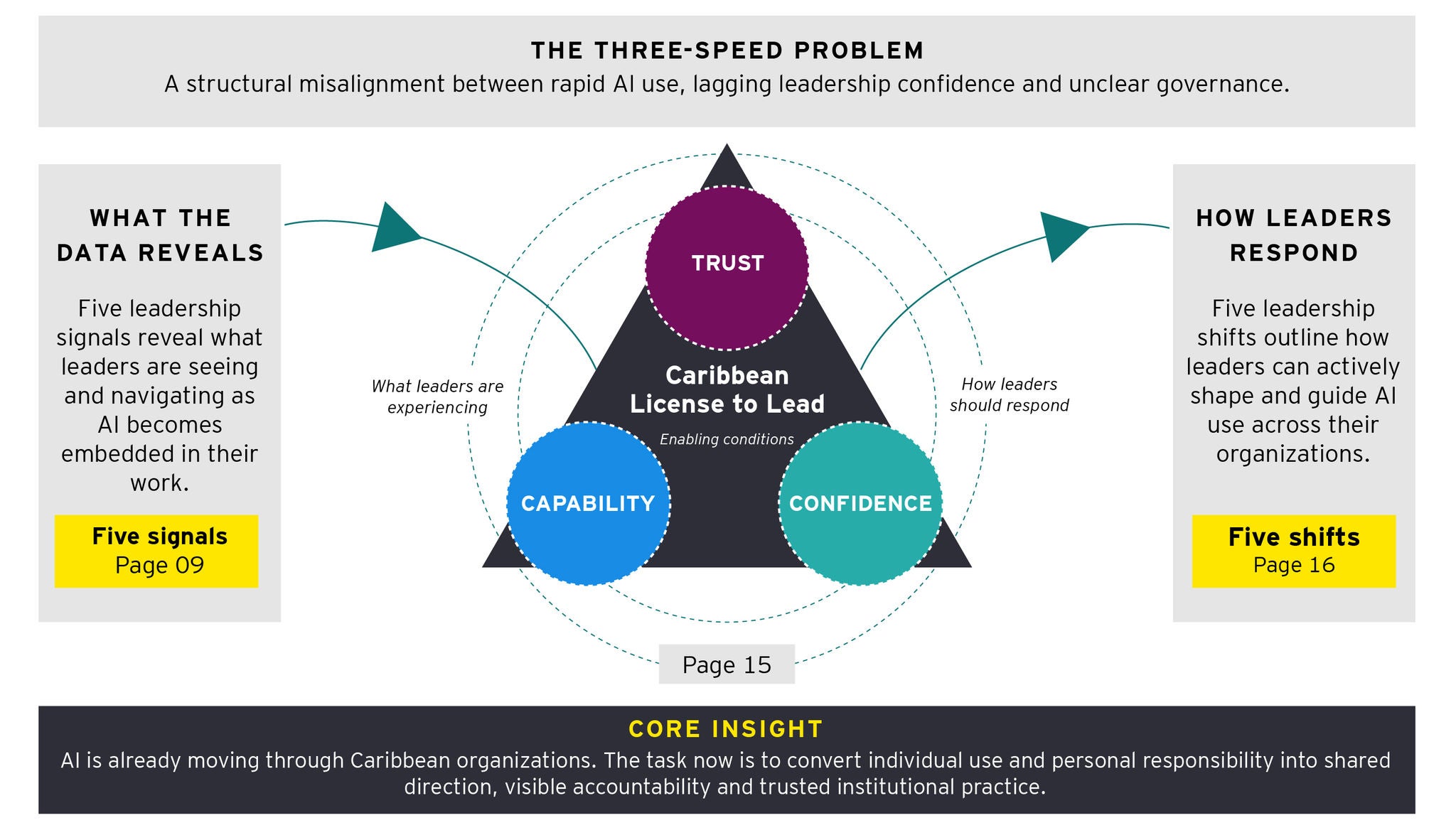
The report names this the three-speed problem. AI use is advancing rapidly, driven by individual initiative and practical need. Leadership confidence in how to guide that use is developing more gradually. And governance, the structures that would give decisions consistency and accountability, is forming most slowly of all. Each layer is moving but they are not moving together.
This pattern is visible in organizations around the world. What makes it land differently in the Caribbean is the environment in which it plays out.
In small island states, workforces are close. Professional networks overlap. Changes are noticed quickly and discussed openly. Leadership is visible in a way that larger markets can absorb but smaller ones cannot. People do not only hear what leaders say. They watch what they do, talk about what they see, and draw conclusions long before any formal communication arrives. Decisions about technology do not stay inside internal systems. They move through communities.

2
Part 2
52% of the leaders surveyed say they feel deeply responsible for how AI is introduced.
In this context, that responsibility is not abstract.
Responsibility sits in everyday calls about what is acceptable, where to encourage experimentation, and where to hold back. But when governance is still forming, those calls are made individually. One division approves AI-assisted client recommendations. Another prohibits them. Neither knows the other's position. The intent may be the same. The outcome is inconsistency, and in a connected labour market, inconsistency is noticed fast.
The longer this continues, the more the risk compounds. Not dramatically. Quietly. One uncoordinated decision at a time. One team building confidence in a tool that another team is quietly told to avoid. Over months, what looks like progress becomes fragmentation. Standards drift. Effort is duplicated, and fragmentation, once embedded in how an organization operates, is very difficult to reverse.
This is not a story about reluctance. More than 90% of Caribbean leaders are open, positive, or cautiously hopeful about AI. The dominant posture across the region is willingness. What the data shows is that willingness without shared structure produces motion without direction. People are making decisions. They are making them alone, without common ground to stand on.
There is also a gap in how learning moves. Leaders are experimenting and adjusting, finding ways to apply AI in their own environments. But that learning develops within teams, sometimes within individuals, and then stalls. Across sectors, similar problems are being solved in parallel without connection. The appetite for learning is evident across the region. The pathways that would let it travel and build are not.
These are not separate problems. They are expressions of the same condition: organizations doing more with AI than their leadership systems were designed to guide. And the three-speed problem tells us that the gap is not closing on its own. It is widening.
What the research points toward is not a set of technical fixes. It is a shift in how leaders treat AI within their organizations. The question is no longer whether AI will be used. It is whether leaders can build enough shared understanding, visible governance, and connected learning to guide what is already underway.

3
Part 3
The report frames this around three conditions
TRUST grows when people see how decisions are made and know they will be reviewed fairly. CONFIDENCE develops when leadership moves in step and expectations are clear. And CAPABILITY strengthens when learning spreads across teams and institutions.
These conditions require deliberate, repeated action. And they require something the report describes as the Caribbean License to Lead.
This is not a credential. It is not secured through policy statements or technical knowledge. It is legitimacy, earned quietly over time through what people can actually observe. A leader who makes decisions visible and holds to stated boundaries, even as the pace increases, earns it. A leader who acknowledges risk openly, rather than retreating from it or explaining it away, earns it. It accumulates through consistent practice, not through a single announcement.
It is not something that can be claimed. It is granted by the people watching. And in the Caribbean, the people watching are close.
The work has already begun. In many organizations, it is further along than leaders expected. What is less certain is whether leadership practice can develop at the pace the technology now demands, and what it will cost the region if it does not.
That is the question at the center of the full Caribbean AI Leadership Sentiment Survey. The report goes further than this article can. It maps five signals emerging from what leaders shared. It defines the three conditions and how they reinforce one another. It lays out five concrete shifts, each with 90-day action frameworks tailored to public sector, private sector, and civil society leaders. The data is specific. The guidance is practical. And it is grounded entirely in what leaders across the region said about their own experience, not imported from global frameworks that were never designed for this context.
For those leading in the Caribbean right now, this is the clearest picture available of where the region stands and what deliberate leadership requires next.
Download the full Caribbean AI Sentiment Survey Report here
- End -
About EY
EY is building a better working world by creating new value for clients, people, society and the planet, while building trust in capital markets.
Enabled by data, AI and advanced technology, EY teams help clients shape the future with confidence and develop answers for the most pressing issues of today and tomorrow.
EY teams work across a full spectrum of services in assurance, consulting, tax, strategy and transactions. Fueled by sector insights, a globally connected, multidisciplinary network and diverse ecosystem partners, EY teams can provide services in more than 150 countries and territories.
All in to shape the future with confidence.
EY refers to the global organization, and may refer to one or more, of the member firms of Ernst & Young Global Limited, each of which is a separate legal entity. Ernst & Young Global Limited, a UK company limited by guarantee, does not provide services to clients. Information about how EY collects and uses personal data and a description of the rights individuals have under data protection legislation are available via ey.com/privacy. EY member firms do not practice law where prohibited by local laws. For more information about our organization, please visit ey.com.