1. New Rules and Norms: The Rise of State Interventionism
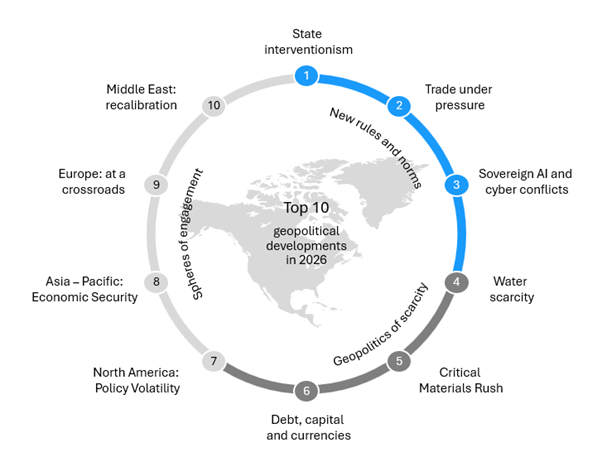
In 2026, state interventionism will flourish, with differences shaped by domestic fiscal pressures, political dynamics and institutional capacity. The era of laissez-faire economics is fading. Governments are increasingly intervening in markets through subsidies, ownership stakes, and local content mandates. What began as emergency measures during the pandemic and energy crises has hardened into structural policy.
Established state interventionists will continue to use policy to shape their economies, but domestic dynamics such as demographic pressures and fiscal stress may reshape these models in 2026. Selective state interventionists will continue using industrial policies and expanded tools to steer activity in strategic sectors, although fiscal pressures will force trade-offs between priorities. For instance, the EU will likely seek to implement proposed rules to force foreign investors to transfer their technology and use local inputs and labour. Emerging state interventionists will continue their shift from a tradition of free-market systems to state interventionist tools in strategic sectors, mostly justified by national security concerns.
Trade is under pressure. Tariffs, export controls, and local content requirements will continue to reshape global supply chains. The US is expected to maintain historically high tariffs and may introduce new ones on critical minerals and strategic components, while China and the EU tighten export controls on sensitive technologies. These measures signal a shift from cost-driven globalization to geopolitically motivated “friendshoring” and regionalization.
In 2026, AI will serve as a force multiplier of cyber conflicts, as it continues to be the primary technology of geopolitical competition. Governments are expected to increasingly treat AI assets such as foundation models, training data and computing infrastructure as a national security priority and an increasingly important piece of critical infrastructure.
For businesses, this means adapting to a world where policy, not price, determines competitiveness.
2. Geopolitics of Scarcity: Water, Minerals, and Capital
Scarcity is becoming a defining geopolitical driver. Competition for critical resources (from lithium and cobalt to fresh water) is intensifying. Nearly four billion people already face severe water stress for at least one month annually, and this figure is rising. In 2026, water rights and usage will both cause and exacerbate political conflicts, leading to trade-offs in resource allocation across industries.
The race for critical minerals is particularly fierce, as they underpin technologies from electric vehicles to AI infrastructure. More than 30 new processing facilities are expected globally by 2026, but supply risks remain high due to geographic concentration and export controls.
Debt and capital flows add another layer of complexity. Global debt stands at 235% of GDP, and governments are issuing record levels of sovereign bonds to fund defence and industrial policies. This fiscal trajectory risks crowding out private investment and keeping borrowing costs high; a challenge for businesses seeking growth capital.
3. Spheres of Engagement: Four Regions to Watch
Geopolitical competition will concentrate in four regions: North America, Europe, Asia-Pacific, and the Middle East.
- North America faces policy volatility, with US tariffs and deregulation reshaping trade and investment. The renegotiation of the US-Mexico-Canada (USMCA) trade agreement will ripple across supply chains.
- Asia-Pacific remains the epicenter of economic security strategies, as governments push for regionalization and technological sovereignty amid US-China rivalry.
- Europe is at a crossroads, balancing security commitments in Ukraine with competitiveness challenges. Expect more EU initiatives to boost industrial self-reliance, alongside political uncertainty from elections in France, Spain, and Hungary.
- The Middle East is recalibrating, with Gulf states leveraging energy wealth to attract investment in AI and infrastructure, even as regional conflicts persist.
Strategic Imperatives for 2026
EY-Parthenon emphasizes three priorities for organizations navigating this landscape:
- Build resilience for the unexpected. Risk leaders should move away from relying solely on traditional controls and mitigation measures and toward a “risk strategist” approach of proactively addressing any vulnerabilities to strengthen operational and financial resilience.
- Reassess governance for geostrategy. Cross-functional teams spanning risk, compliance, technology, and public policy, are essential to manage political risk proactively.
- Adapt global supply chains and strategy. Regionalization and localization will accelerate as companies seek to de-risk geopolitical exposure. Adopting a corporate strategy that is attuned to geopolitics can help executives make consistent decisions on where to invest, where to exit and how to shape operations and partnerships in this environment.
The Bottom Line
In a NAVI world, agility is the ultimate competitive advantage. For policymakers and business leaders alike, 2026 is not just about managing risk; it’s about reimagining strategy for a world where geopolitics is the new gravity.
This article was written by Glenn Fenech, Senior Manager - EY Malta Economic Advisory and Kylie Attard, Senior Associate - EY Malta Economic Advisory, adapted from the report authored by EY’s Geostrategy team.