Rear view of a man looking at New York City skyline at sunrise, USA

Top 10 priorities shaping the future of wealth management leadership

Decision-oriented convictions reveal how wealth managers must adapt to rapidly evolving drivers of value creation.


In brief
  • The latest EY study of wealth management industry developments frames the defining drivers of change as decision-oriented convictions.
  • Mapping convictions in the Wealth Management Strategy Radar framework allows leaders to navigate priorities.
  • Sustainable value creation will depend on how effectively firms develop and execute transformative initiatives.

Pivotal shifts — global changes in wealth creation, the acceleration of self-directed investing, the emergence of artificial intelligence (AI) as both client advisor and operating infrastructure, and the largest private wealth transfer in history — are reshaping global wealth management and redefining the industry’s logic of value creation.

Faced with profound changes in client relationships and industry structures, the defining challenge for wealth management leaders today is identifying how to win in terms of sustainable growth, profitability and competitive advantage. The latest EY Global Wealth Management Industry Report uses a dynamic Strategy Radar to explore:

  • How value creation mechanisms will be transformed
  • Which factors will drive outperformance in an evolving market
  • What firms must do to develop winning strategies

As in previous editions, the report’s goal is to map the future of wealth management, to help leaders navigate the industry’s changing paradigms and drive outperformance in the medium to long term.


The Wealth Management Strategy Radar not only maps the convictions; it helps wealth managers prioritize their next steps by exposing the trade-offs they must make between growth and efficiency, offense and defense, or immediacy and long-termism. It allows leaders to identify what they are doing right, what moves they need to make now, and what gaps they must proactively address to achieve sustainable differentiation.

This article highlights 10 of the convictions, illustrating the extent to which the industry’s levers of value creation are changing, the scale of impact this will have, and the need for adaptation by future winners. The relevance of each conviction will vary for different wealth managers, but few firms can afford to overlook most of them.

1. The strategic meaning of AI for wealth management

The more we learn about AI’s effect on wealth management, the clearer it becomes that the impact will be both strategic and structural — for incumbent firms and new entrants alike.

The difficulty lies in making precise strategic predictions. On one hand, AI alters the economic and operating practicalities of service delivery, and for the first time allows the industry to deliver wealth planning at scale. On the other hand, it is likely to increase self-direction and compress the value of traditional services. And yet that, in turn, could increase the premium on judgement and trust in more complex situations.

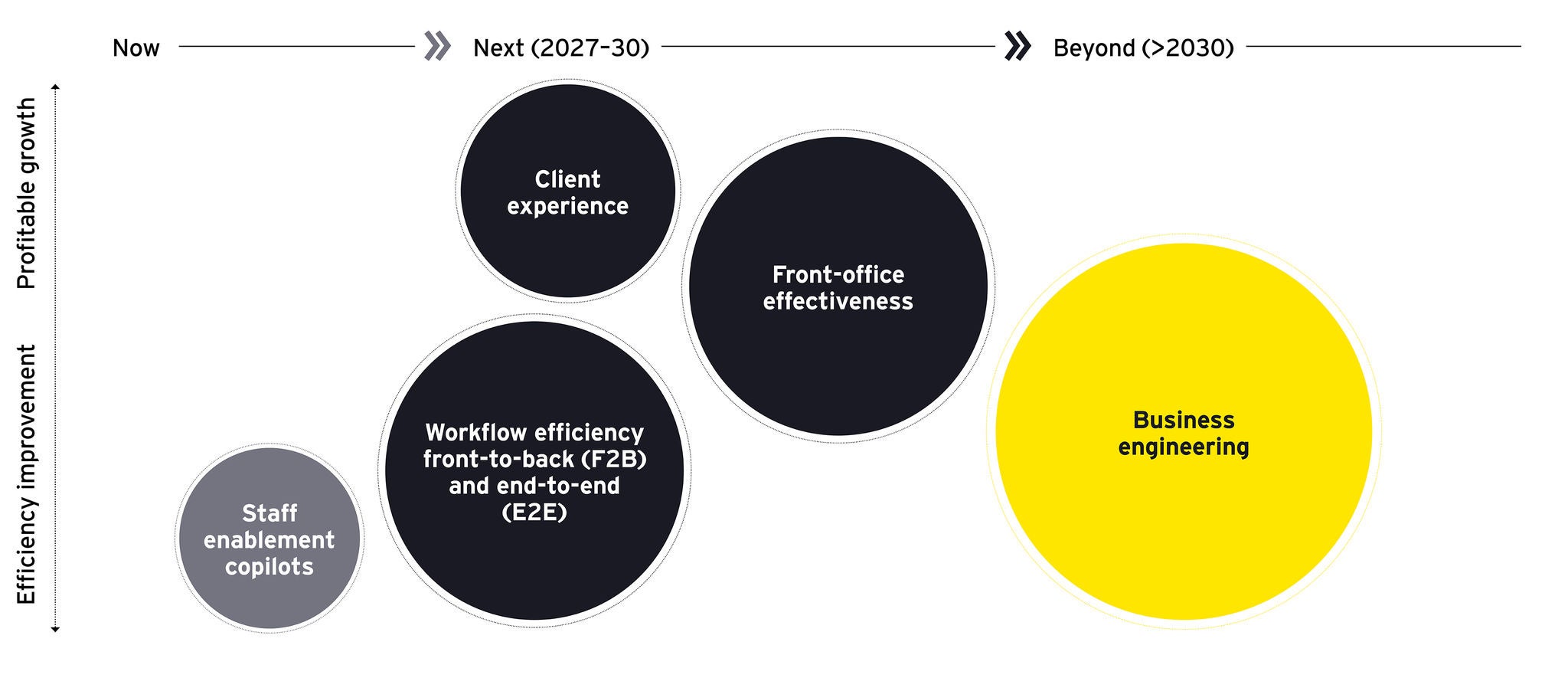
The practical implications of AI for wealth managers can be viewed through a “5E” schema covering staff enablement, workflow efficiency, client experience, front office effectiveness, and guided business engineering. These are not parallel impacts, but a compounding value pathway: Early productivity gains create the conditions for client experience uplift and front office enablement; AI-guided business engineering becomes possible once adoption, data maturity and control frameworks scale.

The compounding value of AI in wealth management

The compounding value of AI in wealth management

For now, AI adoption is accelerating but uneven. Leaders are learning through experimentation, followers remain cautious, third-party providers are creating strategic dependencies, and regulators are focused on validation and control.

The main challenge is likely to lie in implementing change across operations, organizations and people — institutional resistance will be significant. Firms that can scale adoption in a controlled way will climb the learning curve fastest.

Key takeaway: View AI implementation as a redesign of operating and governance models with humans in the loop, not an IT project — driving change across silos, spanning workflows and scaling controlled adoption.

2. Cohort-specific value propositions unlock profitable growth

For affluent and lower high-net-worth (HNW) individuals, firms need to translate multidimensional client intelligence into cohort-specific value propositions — delivering differentiated experiences, personalized propositions and profitable growth.

EY research1 shows that leaders increasingly seek holistic and contextual guidance. The good news is that cohort-specific value propositions are not built from scratch. They are defined by a firm’s core proposition for a defined client group with distinct needs, triggers and economics. Well defined and executed cohort value propositions give clients the sensation of bespoke service, but this is often hindered by legacy technology and scaling constraints. Client segmentation is well established, yet firms are still catching up in translating evolving expectations such as demand for financial planning (45% mass affluent) and values-based investing (29% vs. 23% HNW) into proactive, cohort-specific experiences.

Wealth managers that succeed in implementing cohort-specific value propositions will evolve client segmentation from static asset-tiering to multidimensional cohort creation. By translating multidimensional client intelligence into propositions shaped around distinct needs, behaviors and economics, firms can deliver experiences that feel bespoke while remaining scalable.

This shifts segmentation from static asset-tiering to a more dynamic commercial engine.

Key takeaway: Embed cohort differentiation into code, translating segmentation into distinctive client journeys, offers and services — and integrating cohort-specific guidance into client advisor enablement.

3. Simulation turns psychometric insight into higher conversion rates

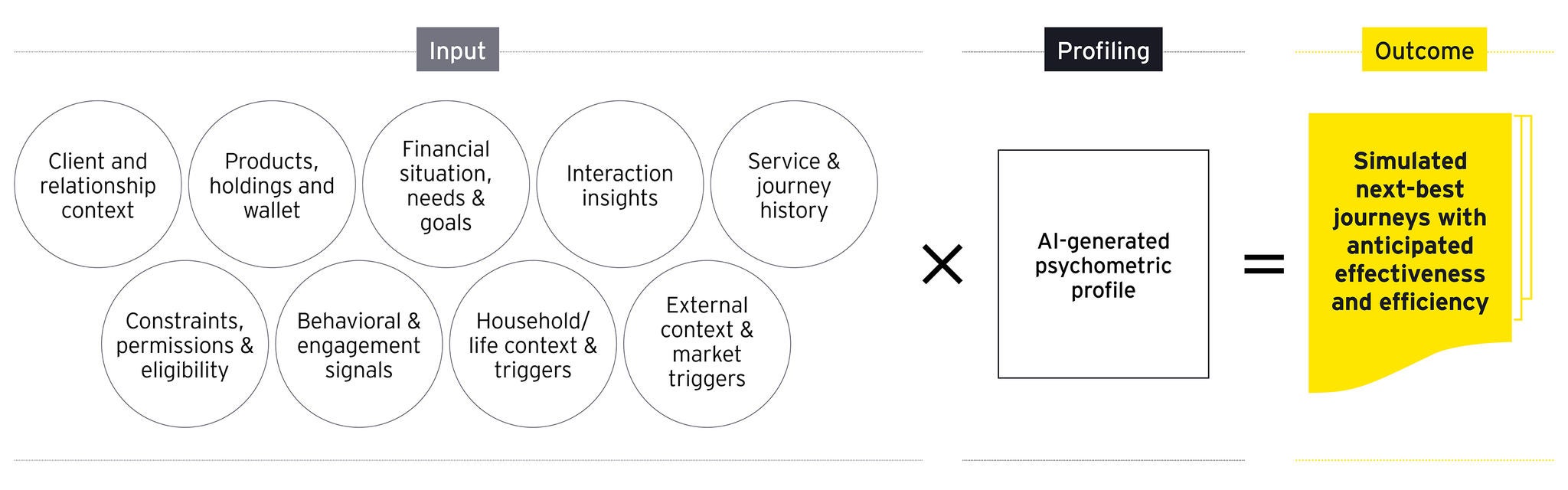
The next competitive edge may come from a deeper understanding of how clients make decisions. Successful relationship managers and wealth advisors have always been able to anticipate what target clients think, feel and do — and to translate that insight into higher conversion rates. However, many firms have struggled to act on behavioral signals in real time and at scale. AI-driven simulation applied to psychometric profiling, while still in the experimental stages, has the potential to fill this gap and become an important driver of profitable growth.

Research suggests that wealthy clients cluster into a range of specific psychometric profiles. Applied to simulated client interactions, these profiles can allow firms to model and stress test client responses in advance without impact. Accurate profiling enables a more targeted, orchestrated next-best experience and more effective engagement at scale across acquisition, activation, development and retention.

Psychometric profiling steps up client information towards the next best journey

Psychometric profiling steps up client information towards the next best journey

Embedding behavioral intelligence into frontline service and advice can push mandate conversion beyond the limits of traditional customer relationship management (CRM) and segmentation. At a time when many clients are switching in search of personalization, psychometric insights have the potential to predict churn, improve conversion, boost revenues and reduce service costs.


Key takeaway: Deliver distinctive client experiences via personalized offers triggered by intent signals, with mandate proposals aligned to client risk preferences, priorities and goals.

4. Sustainable private markets growth requires liquidity discipline

Today, the challenge is not to access private markets, but to scale these offerings without creating liquidity expectations that cannot be met in times of stress. Winning firms will put liquidity discipline at the core of their operations and client propositions — embedding it into suitability, education and portfolio design.

Semi-liquid structures are driving the growth of private market investments within wealth channels, creating a multi-trillion-dollar opportunity for wealth managers. But while these wrappers make it easier to invest in private markets, they do not make the underlying assets easier to exit especially during market stress. Managing liquidity expectations is critical to client satisfaction.

As private markets democratize, liquidity will be transformed from a technical feature into a key driver of trust and client experiences. Failures of suitability or communication will damage reputation in the precise area where firms are hoping to build recurring revenues.

Leading firms will move liquidity governance upstream from portfolio management, embedding it into suitability, mandate design, product selection, client dialogue and education. Over time, transparent liquidity discipline will become a source of retention and differentiation, as well as contributing directly to profitable growth.

Key takeaway: Calibrate private market allocations against explicit client liquidity budgets, embedding those constraints into mandate terms, portfolio construction and product selection.

5. Pricing complexity intensifies as scrutiny shifts to provable value

The pricing challenge in wealth management is no longer about transparency, but the eroding link between how firms charge and where clients perceive value. As supervision tightens and client perceived value gravitates toward complexity — management, preservation and accountability, legacy asset-under-management (AUM) fee grids will become harder to defend. Future pricing power will depend on realigning price with service intensity and provable client benefit.
Regulatory and client scrutiny are exposing this structural disconnect. In some markets, supervision now looks beyond fee disclosure to consider service delivery and fair value. Elsewhere, firms face growing expectations to show suitability, relevance and client benefit.

This shift matters. Although asset-based fees still power many advisory models, firms are starting to propose hybrid pricing structures as client needs become more complex. Furthermore, the economics of advice vary by model and market. For example, US advisor-led firms have an explicit advisory-fee logic, while relationship manager (RM) led private banking models in Europe and channel-based banking in Asia often embed pricing within broader relationship economics that include lending, structuring and execution.

As wealth transfer accelerates and comparisons become easier, premium pricing is likely to migrate toward accountable advice on complex issues like succession, tax, lending, liquidity events and family governance. Asset-based pricing will not vanish, but hybrid models will become more defensible and cross-subsidies harder to justify. Cross-border firms face the challenge of redesigning pricing across advisory models, legal entities, booking centers and regulatory environments. Future pricing power will depend on demonstrating clear alignment between client costs and client value.

Key takeaway: Differentiate more clearly between lower, simpler charges for increasingly standardized features, and higher fees for more tailored services where complexity and intervention remain hard to substitute.

6. The accelerated rise of self-directed investors

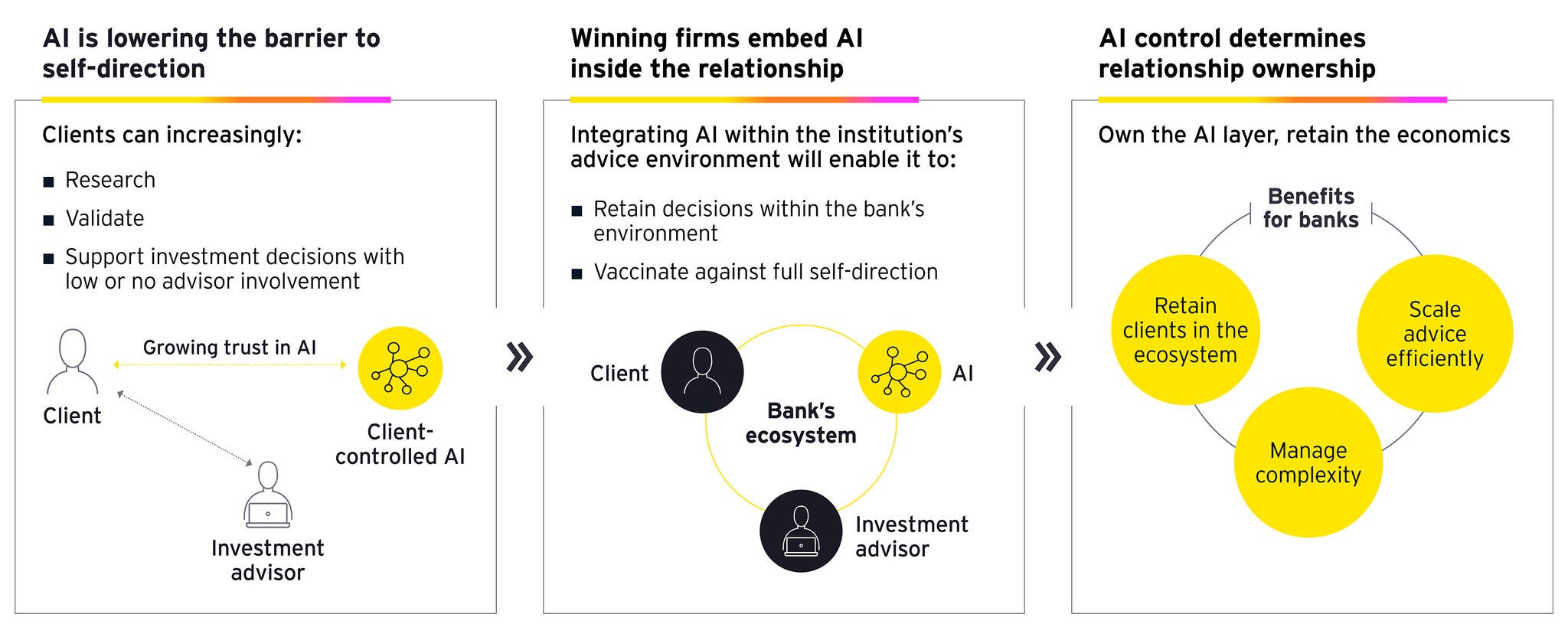
Wealth managers face a narrowing window to integrate AI into their advisory offerings in order to retain clients shifting towards self-direction — before client-controlled AI begins to mediate those relationships.

Self-directed investable assets are predicted to continue the strong growth of the last 20 years. In our view, this trend is likely to accelerate as AI reduces barriers to self-direct, pushing mature markets towards a potential equilibrium of about 35% fully and 50% partially self-directed clients in coming years. Self-direction typically follows a consistent pattern. Self-reliant, cost-sensitive investors with perceived above-average financial literacy begin shifting some assets or cash inflows into execution-only offerings. Over time, silent attrition accelerates as more assets migrate to self-direction.

AI-enabled platforms offering wealth management skills could drive revenue erosion, shifting more capital into lower-fee products and more assets into execution-only status. Standard investment guidance will become harder to defend at a premium, with human-priced advice concentrating in areas where judgment, accountability and complexity remain decisive.


The shift between client-controlled and institution-governed AI

The shift between client-controlled and institution-governed AI

Related articles

How AI simulation accelerates growth in wealth and asset management

Harness the power of AI simulation to anticipate client behavior and make faster, smarter decisions. Learn more.

The strategic challenge for wealth managers is not how to prevent self-direction, but how to keep it within the ecosystem. Leading firms will segment clients behaviorally and embed institution-governed AI inside the advisory relationship. The future model is less “advisor versus AI” and more client, advisor and governed AI working together.


Key takeaway: Separate downside defense from upside offense — intervening early to retain clients at risk of silent asset leakage and focusing growth efforts on clients open to keeping hybrid mandates within existing relationships.


7. Live tax visibility as the catalyst for net-outcome transparency

Tax is being pulled into the core of wealth management by client demands for net-outcome clarity. As transparency broadens and data becomes more structured and accessible, winners will not out-opine peers on tax specificities; they will industrialize tax clarity at scale through ex-ante decision previews, ex-post reconciliations, audit-ready evidence and exception-led handoffs that preserve clear advice boundaries.
 

Tax in wealth management is no longer a year-end reporting item, but a continuous evidence-based discipline. Clients are focusing less on after-tax benchmarks and more on post-fee, post-FX, post-tax, and post-inflation net outcomes that shape their financial lives.
 

This shift is visible in cross-border and multi-platform books, where booking center and tax residence differ and clarity is less common. Transparency regimes are also widening reportable perimeters, increasing the premium on robust data, due diligence and evidence readiness.
 

The result is a shift towards two horizon models: Ex-ante decision previews, paired with ex-post reconciliations that explain variances and produce defensible records. This is not a question of replacing tax professionals – it’s about wealth managers playing an elevated, scalable role as orchestrators of data, handing off when needed, with clear advice boundaries.
 

Industrialization is key to success. As complexity rises, manual cross-border tax support becomes uneconomic. A sustainable operating model requires automation for the “normal plus expert exception” review, underpinned by portable, audit-ready lineage across custodians and jurisdictions.
 

Key takeaway: Extend net-of-fees reporting discipline to foreign exchange, tax and inflation — building a broader sense of outcomes, improving accountability and moving conversations from what must be explained to what firms can influence.

8. Global competitiveness blends efficiency with market adaptation

Global wealth management has never converged around one dominant business model, and the impact of local economics is expected to keep increasing. Winning firms will combine local impact with scalable, global efficiency. As revenue and profit pools migrate, decisive gains will flow to firms that separate where they originate, book and service wealth – accessing key markets via multi-hub franchises. 

Wealth management is global in ambition for leading providers, but not in economic logic. Key markets cluster around different models: Adviser-led in the US and Australia, RM-led in Switzerland, product-led in Asia, and banking-integrated across much of continental Europe. What matters commercially is which model defines prevailing value propositions, service standards and cost structures. 

Widening disparities in organic growth and profitability are also becoming a strategic issue. Europe illustrates the effect of diverging dynamics: European AUM reached a record €33t in 2024, up 11.7% from 2023, yet industry operating profit margins had declined sharply in 2022 and 2023 and only recovered slightly in 2024. In 2023, margins had fallen to 11.1 bps of average AUM, the lowest level since the 2008 financial crisis.2

In a more fragmented world, profitable markets will combine domestic scale, trusted client franchises and booking-center relevance. The US is expected to remain a leading contributor to industry profitability, remain with Asian momentum focused on Hong Kong SAR and Singapore, and a stabilized Gulf offering upside potential.
The strategic reality is that single models underperform globally. Winning firms will combine agile coverage with function-led efficiency at the core, and increasingly separate where they originate, book and service private wealth. Growth-market exposure and multi-hub franchise design will become central to growth, margins, valuation and long-term relevance.

Key takeaway: Localize target segments more sharply, but without increasing local product variation — using stronger standardization to make greater use of a more centralized operating backbone.

9. Risk and compliance shift from static defense to real-time trust

Risk and compliance must keep pace with accelerating change by becoming an automated preventive control function producing real-time evidence. This reflects a rising governance burden, due in part to reliance on third parties and complex AI’s potential lack of explainability. Ex-ante compliance is key: executing controls within delivery pipelines and making governance a client-level trust asset.

Risk and compliance functions need to shift from documenting policy execution to demonstrating continuous control to enable change and business. Firms face rising expectations from clients—whose trust currently runs on assumption rather than proof — and a regulatory burden that’s compounding rapidly across resilience, AI governance, financial crime and customer outcomes.

In addition, as the speed of transformation exceeds the speed of governance, manual second-line review is increasingly becoming a bottleneck that slows product launches and project rollout.

In response, risk and compliance are being urgently pulled away from siloed, reactive models toward a new operating reality. Firms should develop control architectures that are integrated into operating models: reusable, auditable controls embedded into workflows and transformation pipelines, producing evidence continuously rather than after the event.

Key takeaway: Integrate controls seamlessly into code, turning the second line of defense from spreadsheet owner into platform controller — enabling real-time querying by the first line, third line and supervisors.

10. Personal advisory engines emerge as reliability earns data access

The question is no longer whether AI will enter wealth advice, but who will earn the trust and data access to make it matter. With more clients testing AI for wealth guidance, banks face a major threat of disintermediation in early stages of client journeys. Those that deliver a reliable, auditable, human-backed AI advisor experience will retain mandates, deepen relevance and outperform purely digital competitors.

Wealthy individuals increasingly view external AI tools as the first stop for wealth-related guidance, forming advisory habits outside wealth management firms. This matters profoundly, and not just because public AI is getting better at handling everyday questions. Each off-platform interaction also weakens firms’ visibility of client intent, needs and behavior. Wealth managers not only risk advice substitution, but loss of relevance – and displacement from the start of the advisory journey.

While clients are willing to test and use AI, deeper reliance will depend on how the relevance and value of AI advice compares with that of existing providers. That provides a limited window of opportunity for wealth managers. Institution-controlled AI advisory engines, using verified financial data within a controlled environment and connected seamlessly to human advisors, can deliver continuity, accountability and contextual relevance that external AI tools cannot easily match. Winning firms will close the proactive advice gap quickly, keep more of the advisory journey inside the bank, and make human escalation frictionless.

Key takeaway: Establish a reinforcing loop within the firm, in which more usage improves the advice, and better advice drives more usage – shaping client journeys better than is possible from episodic human interactions.

Conclusion

The shifting wealth management landscape reveals the need for wealth management leaders to build sharper foresight and execution discipline: thinking ahead, understanding the drivers of change and building cognitive intelligence – the ability to adapt to changing circumstances with speed, clarity and client-led conviction.

Achieving real change depends on leaders, driven by an inspiring sense of purpose, having the vision to overcome skepticism and the inertia of the organizational “immune system.” However, firms should focus on purposeful change only. Despite the industry’s speed of transformation, clients’ fundamental needs remain unchanged: a relationship they can trust and support they can rely on at critical and complex moments.

Special thanks to Jonathan Castella and Damian Żamojda.


Access the full report and the Wealth Management Strategy Radar

EY wealth management professionals will be delighted to explore the implications for your organization through a tailored deep dive, along with actionable insights on achieving change that provides outperformance. 


Summary

With the drivers of success and financial performance in wealth management being rapidly rewritten, understanding how to win is vital to sustainable profitability and growth. The latest EY wealth management industry report frames the drivers and pivots of change as a portfolio of convictions, mapped with a Wealth Management Strategy Radar that’s designed to help leaders navigate the challenges they face and prioritize effectively for future success.


Related articles

How leaders can aim for success as private markets change the rules

Private markets are going retail and reaching systemic scale. Understand the strategic choices around liquidity, regulation and resilience. Read more.

How AI simulation accelerates growth in wealth and asset management

Harness the power of AI simulation to anticipate client behavior and make faster, smarter decisions. Learn more.

Top 10 resolutions for wealth and asset management success in 2025 

Our global outlook highlights 10 resolutions that wealth and asset managers should take to drive growth in 2025.

Jun Li + 2

About this article

Authors

Contributors