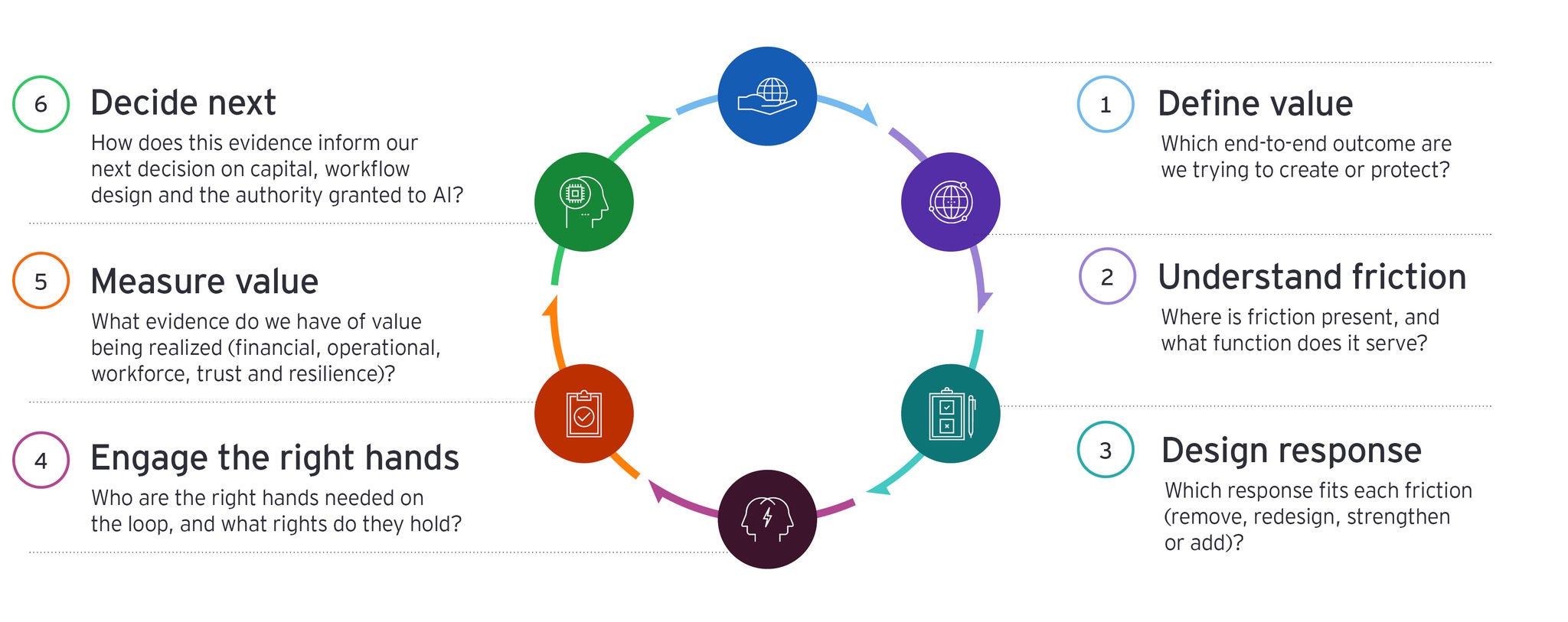
Treating friction as a design choice can start with the value stream in which AI’s agency is growing fastest. The five priorities below form a checklist for this value stream and for every significant AI-enabled program that follows. They broadly track the stages of the cycle in Chapter 4, and each ends with the questions its owners should be able to answer.
1. Start with the outcome and map the value stream that delivers it
Primary owners: CEO and COO, working with leaders across the value stream.
Identify the outcome the enterprise needs to change and trace the work that delivers it from start to finish, recording the decision rights, risks and accountabilities along the way. Check whether improvements in one function create additional work or exposure in another. Name one owner for the outcome and design the operating model around the value stream instead of the functions it crosses.
Which end-to-end outcome are we trying to change?
2. Use the full range of responses to friction
Primary owners: CEO and COO, with the CRO, general counsel, CISO, and CIO or CTO.
Find where delays exist in the value stream and what each instance does, whether it wastes effort, provides assurance, builds skills, sustains relationships, or supports recovery. Then decide what to remove, redesign, strengthen and add, knowing that a single response will rarely fit a whole workflow.
Where is friction present, and what, if anything, does it do? Which response fits each source of friction?
3. Get the right hands on the loop
Primary owners: CEO, with the CFO, CHRO, CRO and CIO or CTO.
Assign responsibility for outcomes, judgment, stewardship, economics and challenge. Make sure these people can stop and change the system, and help redesign where necessary, rather than merely approve its output. Write down the conditions under which an agent must hand a decision back to a person.
Who are the right hands on the loop?
4. Make the role of judgment explicit and build the workforce to supply it
Primary owners: CHRO, with business unit leaders.
Identify the moments where better context could change the outcome of AI-enabled work and assign that judgment to people with the evidence to exercise it. Redesign roles, incentives and career paths to promote the development of judgment, particularly in teams where people work alongside agents.
What skills do these people need, and when should AI hand a decision back to them?
5. Govern value continuously
Primary owners: CFO, with the CEO.
Establish an AI value management practice or similar capability as a standing management discipline that connects investment to the full cost, business outcomes and workforce effects. Let the evidence decide whether AI’s autonomy should expand, contract or be redesigned as conditions change.
What evidence do we have that value is being realized, and what will we do next?