







Indian CEOs AI adoption

Indian CEOs adopt AI for future success: CEO Outlook Pulse Survey 2024

Indian CEOs are integrating AI investments into their business agenda.


In brief

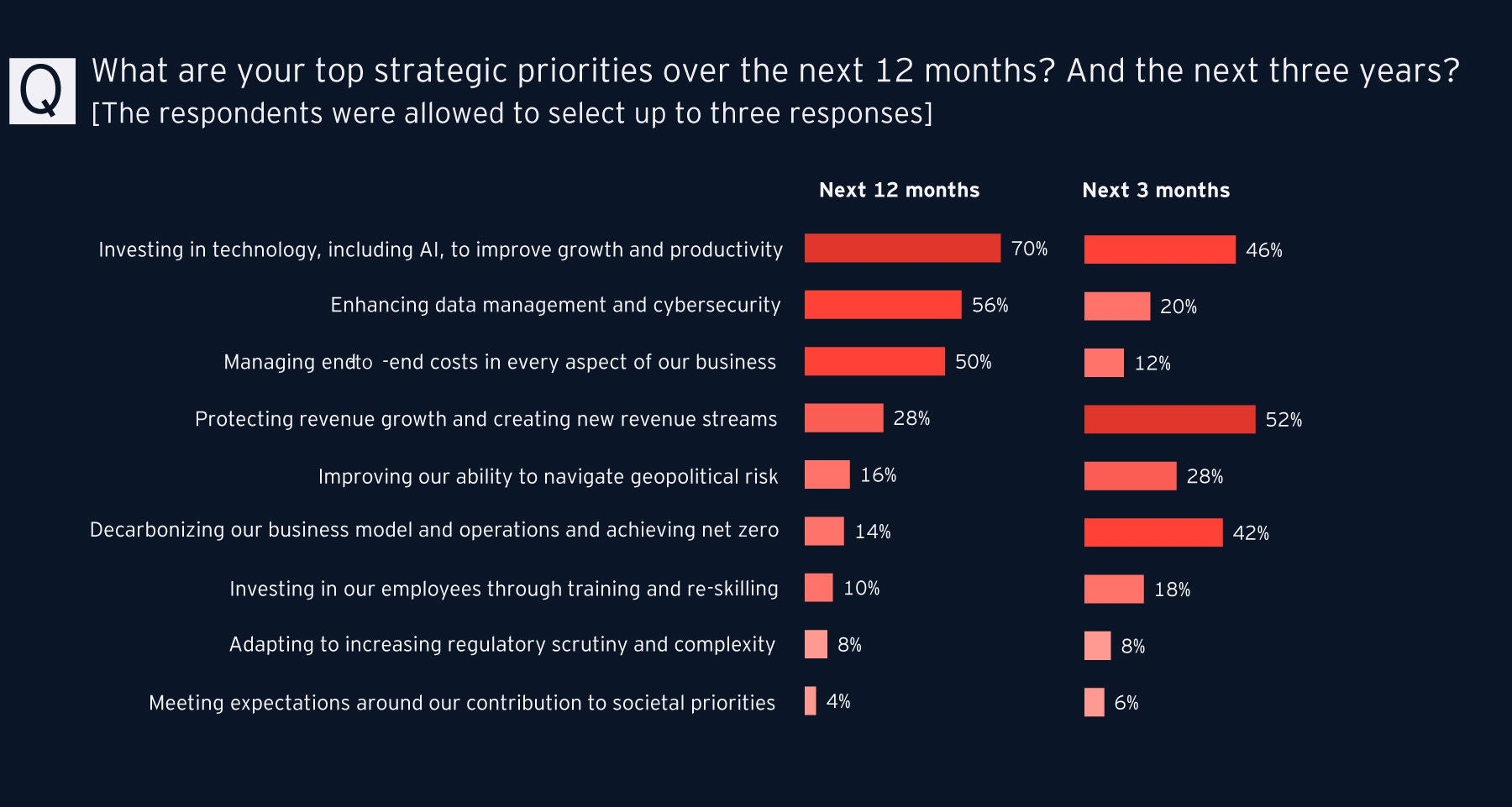
  • With corporates moving towards AI readiness, 70% of Indian CEOs plan to increase spending on technology and AI to enable growth and productivity over the next year.
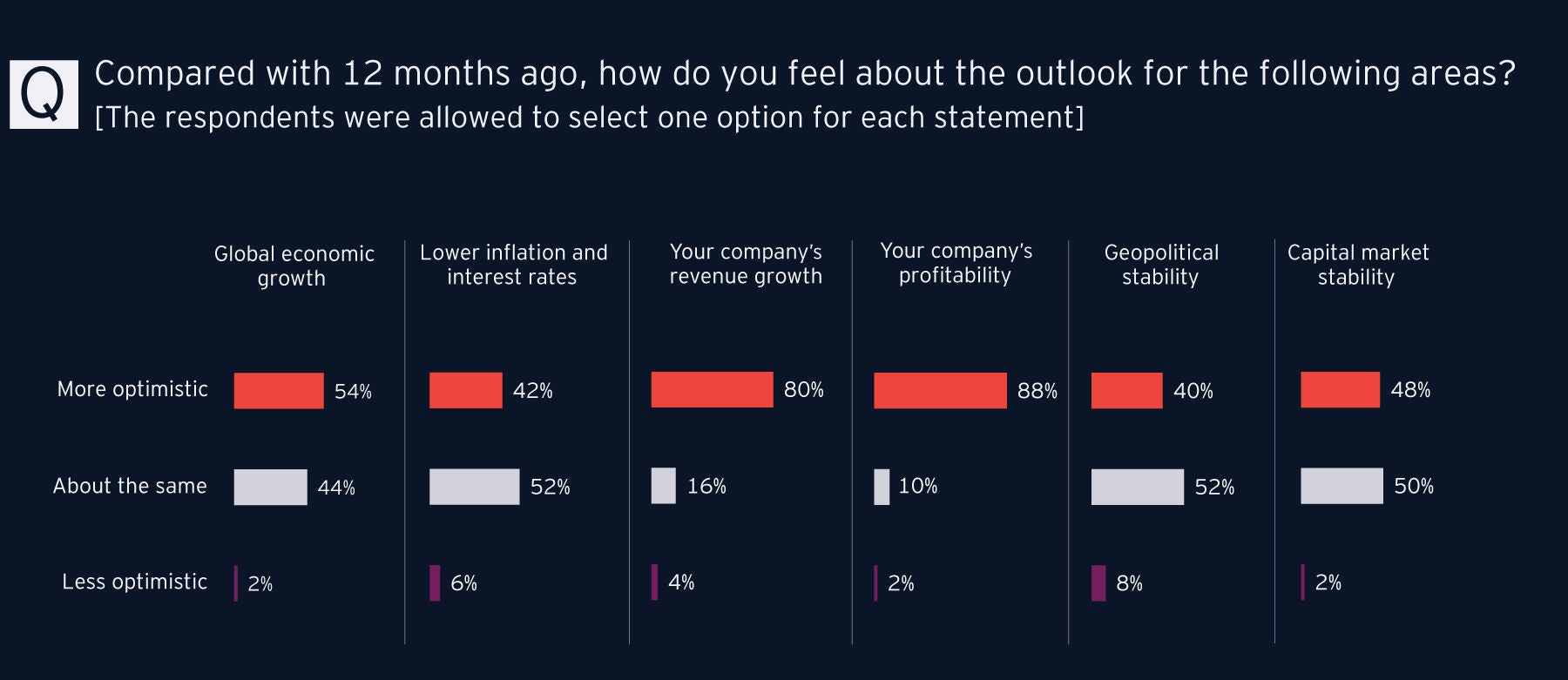
  • 80% of CEOs are optimistic about their companies’ revenue prospects, while 88% are confident of profitability.
  • 60% acknowledge the importance of sustainability but a phenomenon known as ‘green-hushing’ is also emerging.
  • There is strong optimism for Mergers & Acquisitions (M&A) with 96% respondents considering transactions in the upcoming year.

The recent EY CEO Outlook Pulse Survey reveals the confidence of Indian CEOs in artificial intelligence (AI) for business success. Indian CEOs expect technology, including AI, to enable growth and productivity, thus influencing investment strategies. CEOs are also optimistic about the growth trajectory of their companies, projecting increased revenue and profitability. They, however, maintain a cautious approach toward the broader economic landscape with an eye on geopolitics, capital market stability and inflation and interest rates.

Indian CEOs adopt AI for future success: CEO Outlook Pulse Survey 2024

Key strategic priorities

The latest survey shows that a robust 80% of surveyed CEOs are optimistic regarding their companies’ revenue prospects, while an even higher 88% confident of profitability. Indian CEOs have a positive outlook in the Mergers & Acquisitions (M&A) landscape as well, with an overwhelming 96% of respondents actively considering transactions in the upcoming year, primarily through initial public offerings (IPOs).

With Indian corporate moving towards AI readiness, technology remains a common theme through many of the strategic growth decisions. For example, 44% of CEOs identify acquisition of technology, new production capabilities, or innovative start-ups as key drivers while also planning to increase spending on technology and AI (70%). These numbers reflect a firm belief in the potential of strategic technology investments to yield positive financial outcomes in the near term.

Even as new technologies emerge and there is widespread adoption, threats to digital assets are also on the rise. Organizations have to ensure robust protection and efficient handling of data to maintain user trust, comply with regulations and leverage tech advancements for competitive advantage. Therefore, parallel to higher technology investments, Indian CEOs (56%) emphasize enhancing data management and cybersecurity to protect digital assets.

The survey indicates that to remain competitive in an increasingly unpredictable business environment, CEOs will continue to focus on managing the end-to-end costs in every aspect of the business (50%). Over a three-year horizon, the focus is sharply on protecting revenue growth along with creating new revenue streams (52%).

Indian CEOs adopt AI for future success: CEO Outlook Pulse Survey 2024

Sustainability, policy, and regulations

With 60% of CEOs acknowledging the importance of sustainability over the past year, it is gaining prominence on the corporate agenda. However, the sustainability discourse is still evolving with regulations, objectives and impacts being redefined. In such a fluid scenario, a phenomenon called ‘green-hushing’ has emerged. Even as companies adopt sustainability initiatives, they are opting to stay silent rather than engage in sustainability discourse to steer clear of accusations of greenwashing. Reflecting the flux in the sector, CEOs indicate in the outlook survey that there is a need for improved alignment between consumer behavior and sustainability objectives, underscoring the role of technology and AI in tackling sustainability challenges.
 

Interestingly, the survey reveals a divided perspective on sustainability due to financial pressures and shifting boardroom priorities. About 44% of CEOs are keenly aware of sustainability’s impact on supply chains, but 40% are also opting for ‘green-hushing’ to avoid greenwashing concerns. Putting forth a compelling financial case for sustainability investments is also a challenge (42%).
 

Sustainability, however, is a business imperative – over the next three years, for 42% Indian CEOs decarbonizing their business model and operations and achieving net zero targets is among the top strategic priorities.
 

CEOs advocate global governmental coordination and consistency in addressing climate change, even as they are mindful of the financial risks associated with stranded assets and ESG-related regulations. CEOs are in favor of subsidies and tax incentives for green technology investments, with 65% emphasizing the importance of government investment in sustainable infrastructure.

Mergers, acquisitions, and transactions

Business imperatives are also influencing CEOs’ growth strategies around transactions, motivated by the pursuit of technology and innovative startups, expansion of market share, adapting to shifts in customer behavior, and ensuring supply chain security.
 

The M&A trends show that a staggering 96% of CEOs are actively considering transactions. While 64% are contemplating divestments, IPOs, and spin-offs, 50% plan to explore M&A. Along with these, 28% are looking at joint ventures or strategic alliances in the transactions mix.
 

CEOs are confident of their organizations’ ability to navigate the complexities of structuring deals. This includes functional (52%) and advanced capabilities (42%) in managing tax implications of the deal, anticipating potential regulatory challenges ahead of the deal, integration challenges. All of this can include cultural alignment and data and cybersecurity risks, as well as opportunities.
 

However, the survey interestingly shows that the CEOs are most confident of their organizations’ ability to have a comprehensive narrative to engage all stakeholders (66%), covering areas such as inclusive growth, job creation, investing in communities and social impact.
 

Along with the above-mentioned factors, sustainability is increasingly becoming integral to M&A strategies, influencing integration plans, deal terms, target identification, and due diligence.

Conclusion

Indian CEOs are navigating complex challenges of geopolitical risks, decarbonization, and AI adoption by adapting to disruptions and focusing on stakeholder value. However, they are optimistic about economic growth and company performance, which is driving their emphasis on technology, innovation, M&A and government infrastructure investments.


Download the full pdf

Related articles

Data 4.0: how to make your enterprise data AI-ready

AI and Data: Data 4.0 approach at EY helps organizations modernize data, improve governance, and build AI-ready foundations for analytics & GenAI success.

Identifying AI generated content in the digital age: the role of watermarking

Explore the future of AI content and the critical role of digital watermarking in protecting creators' rights and ensuring content authenticity.

Tech Trend 06: Unleashing next-gen employee experience with digital and AI

Discover how AI is revolutionizing the workplace with EY's insights on next-gen employee experiences. Learn strategies to enhance engagement & productivity in our Tech Trend 06 update.

    Summary

    The recent EY CEO Outlook Pulse Survey highlights Indian CEOs' confidence in AI for business success, with a strong focus on technology adoption and M&A strategies. CEOs prioritize revenue growth, technology investments, and data management amid increasing digital threats. Sustainability emerges as a key concern, with CEOs seeking alignment between consumer behavior and sustainability objectives. Despite financial pressures, decarbonization and achieving net zero targets remain strategic priorities. CEOs advocate for global coordination on climate change while emphasizing the importance of subsidies for green technology investments. Overall, Indian CEOs remain optimistic about economic growth and company performance amidst evolving challenges.


    About this article