






EY refers to the global organization, and may refer to one or more, of the member firms of Ernst & Young Global Limited, each of which is a separate legal entity. Ernst & Young Global Limited, a UK company limited by guarantee, does not provide services to clients.
Agentic AI in GCCs: From delivery hubs to intelligence engines
Explore the EY.ai Unplugged podcast on how AI-powered GCCs are evolving into intelligence engines driving smarter decisions and enterprise transformation.
Why organizations need Agentic AI governance
Traditional enterprise systems are fundamentally human-led, with technology supporting execution. Governance evolved around validating outputs reviewing predictions, recommendations or responses for accuracy and compliance. That model works when AI assists humans. Agentic AI fundamentally changes those assumptions.
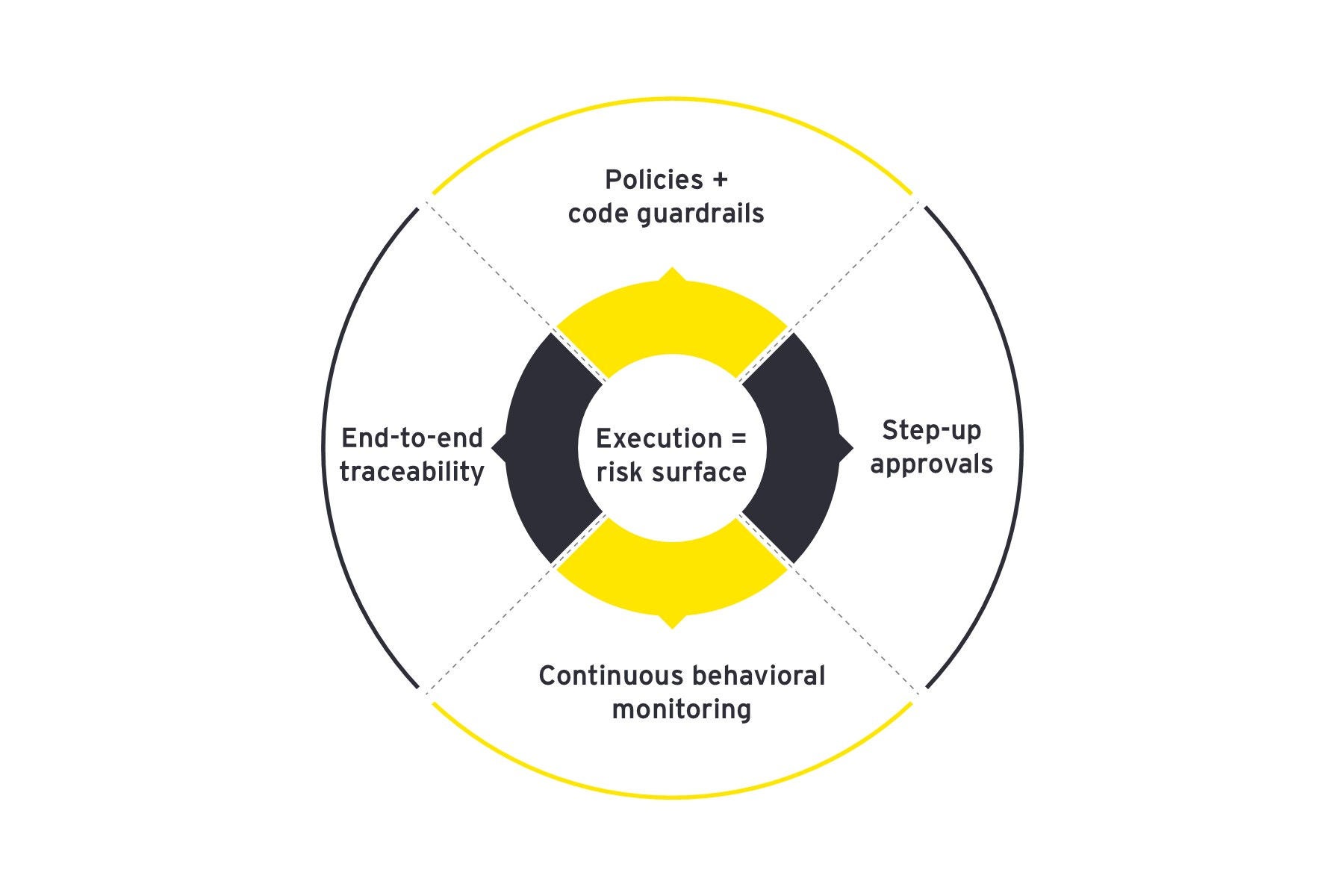
When agents act independently, accountability becomes harder to define. Agentic systems operate with delegated agency: they determine next steps, initiate actions, coordinate across systems, and adapt decisions with minimal human intervention. The challenge is no longer simply whether an output is correct. The more important question is whether the system continues to behave as the enterprise intends: consistently, safely, over time and at scale. This marks a fundamental shift from validating outputs to assuring behavior.
Indian enterprises face additional complexity. Many organizations operate through federated structures with diffused ownership and fragmented accountability. According to the EY report The AIdea of India: Outlook 2026, nearly 65% of Indian companies identify data governance and security as severe challenges in AI adoption. AI adoption is often business-led, outside central technology or risk functions, increasing the likelihood of shadow autonomous agents operating with limited oversight. The reuse of agents across teams can create invisible risk propagation, where a flaw in one workflow spreads into multiple processes.
In agentic environments, risk no longer arises from a single incorrect decision. It emerges through patterns of action, context-dependent behavior, cascading interactions and cumulative impact across interconnected systems. Governance must resemble organizational risk management rather than traditional model validation. Oversight needs to become continuous rather than episodic. Governance boundaries must define acceptable behavior, and escalation mechanisms should be triggered by potential business impact, not by technical errors.