





EY refers to the global organization, and may refer to one or more, of the member firms of Ernst & Young Global Limited, each of which is a separate legal entity. Ernst & Young Global Limited, a UK company limited by guarantee, does not provide services to clients.
Recent Searches

Earn-outs bridge valuation gaps by linking consideration to future milestones, reducing risk for buyers and sellers.
In brief
- Earn-outs help bridge valuation gaps by linking part of the deal consideration to future performance milestones, aligning buyer and seller expectations.
- Contingent consideration is measured at fair value initially and remeasured over time, making valuation analysis important for financial reporting and decisions.
- Appropriate valuation methodologies and significant assumptions are important for earn-out measurements.
Contingent consideration is a mechanism wherein a portion of the purchase consideration is payable in the future upon the achievement of pre-determined performance targets, milestones, or other contingent events. Such arrangements are used in acquisitions and fund raises primarily to bridge valuation gaps between the buyer and the seller.
From a commercial perspective, contingent consideration enables buyers to mitigate the risk of upfront overpayment while allowing sellers to participate in future upside performance. As a result, it is becoming an increasingly common feature of transactions, especially in high-growth companies or start-ups.
The increasing prevalence of contingent consideration in transactions is driven by high fluctuations in valuation multiples due to uncertainty regarding future operating performance. Earn-out structures enable parties to mitigate this uncertainty by deferring a portion of the consideration and tying it to the achievement of predefined financial or operational targets, thereby aligning the interests of buyers and sellers.
Accounting standards for financial reporting covering business combinations prescribe that contingent consideration should be measured at fair value on the acquisition date and further trued up on each subsequent reporting date.
Typically, the payout of contingent consideration is based on the following metrics:
- Revenue targets
- EBITDA or profitability targets
- R&D achievements
- Regulatory approvals
- Product commercialization milestones
Financial metrics (revenue and EBITDA) are the most widely adopted performance measures, as their measurement is highly objective and directly aligned with value accretion.
Key valuation methodologies
The Appraisal Foundation's guidance on the valuation of contingent consideration identifies the following approaches:
- Scenario-based method (SBM)
- Option pricing method (OPM)
The selection of an appropriate valuation methodology depends primarily upon the nature of the underlying metrics and the payoff structure of the contingent consideration. The diagram below represents a snapshot of the process:
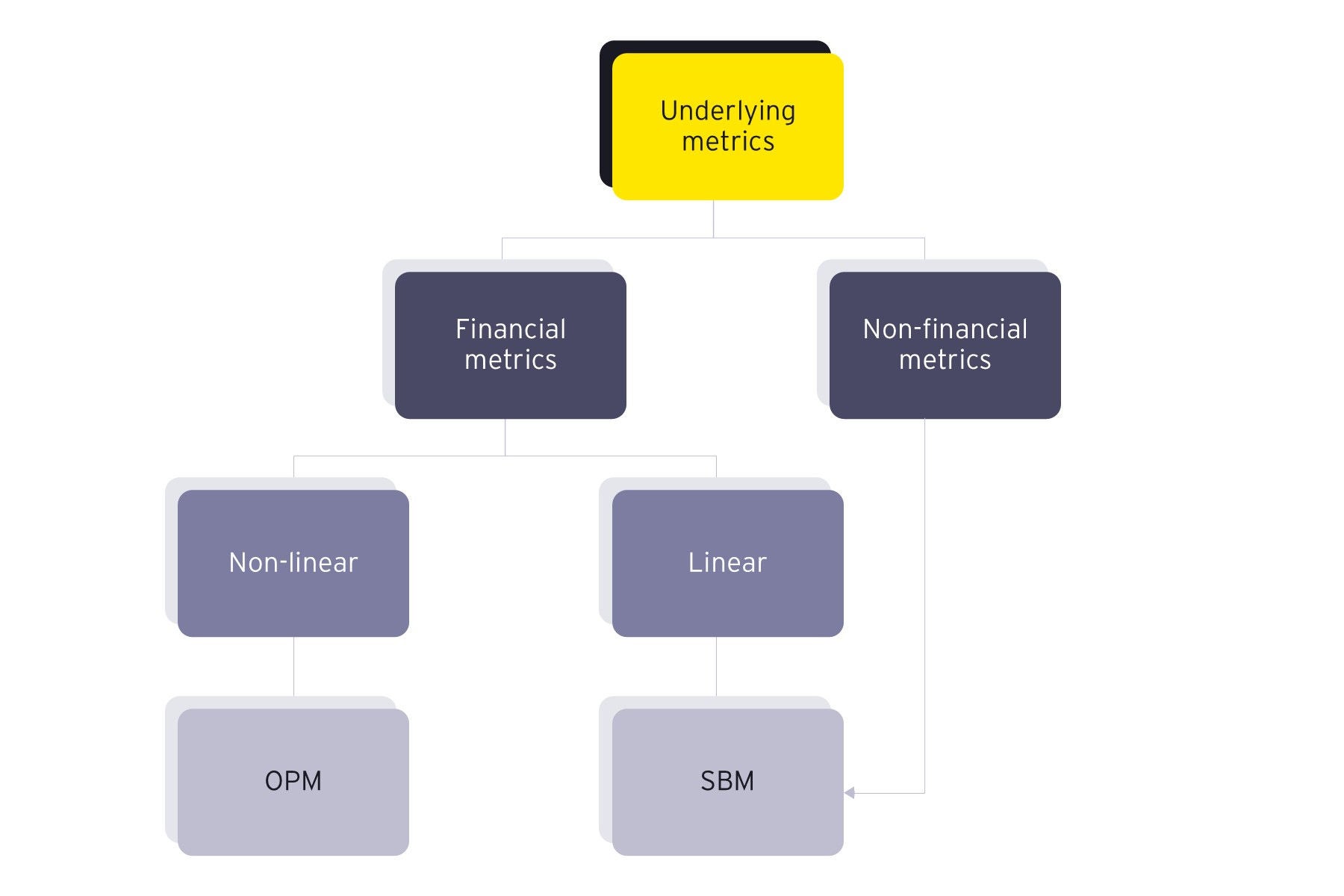
For the selection of the valuation methodology, the first step would be to identify the type of underlying metric upon which the payoff is dependent.
If the underlying metric is a financial metric, the second step is to understand and categorize the structure of the payoff as either linear or non-linear.
Scenario-based method (SBM)
Scenario-based method requires an estimation of possible future outcomes for the underlying metrics and the payoff associated with each outcome. The contingent payment corresponding to each outcome is estimated along with its probability, followed by probability-weighted computation to arrive at the expected payout. The expected payout is then discounted to present value using an appropriate discount rate.
This methodology is generally appropriate when:
- Outcomes can be clearly identified
- The payoff structure is relatively simple or linear
- Risks are diversifiable
- Milestones relate to specific binary outcomes such as regulatory approvals or R&D
Key valuation considerations include:
- Time value of money
- Counterparty credit risk
- Probability assessment
- Risk-adjusted discount rate
Option pricing method (OPM)
The option pricing method treats contingent consideration as a financial option because payments are triggered only when specified thresholds are achieved. This method is relied upon when the underlying metric is a financial metric with non-diversifiable risk and the payoff structure is non-linear. OPM circumvents the difficulties associated with estimating a discount rate for accounting the risk specific to the underlying metric and payoff structure. Alternatively, it relies on a risk-neutral framework.
The method is particularly used for:
- Non-linear payout structures
- Multiple threshold arrangements
- Cap-and-floor mechanisms
- Interdependent performance metrics
- Path dependent structures
Common techniques include Black-Scholes Merton, Binomial or Monte Carlo simulation models.
OPM is commonly used when contingent payments depend upon future EBITDA, revenue, enterprise value, or share value exceeding predefined thresholds.
Learn more about earn-out structures
Download the full pdf
Summary
Contingent consideration has become a widely used mechanism in M&A transactions, helping bridge valuation gaps and balance risk between buyers and sellers amid uncertainty in future business performance. Its fair value should be determined using valuation methodologies that reflect the arrangement’s economic characteristics, with scenario-based methods suited for simple outcomes and option pricing models or Monte Carlo simulations for complex structures. Given its impact on transaction value, post-acquisition earnings and financial reporting, a robust and transparent valuation process is important for compliance and reliable stakeholder reporting.

How EY can help
-
EY M&A Due Diligence consulting help businesses assess value drivers, optimize deal structures and mitigate risks to drive opportunities in M&A deals.
Read more -
Discover M&A advisory services from EY when you buy and integrate. We help enable strategic growth through integrated mergers and acquisitions, joint ventures and alliances.
Read more -
M&A Consulting services at EY helps to Perform portfolio review, assess businees strategy, due diligence & determine the right valuation & approach for funding
Read more
Related content
How Indian CEOs are resetting strategy amid geopolitical fragmentation
Indian CEOs are resetting their strategy amid geopolitical fragmentation, using AI and discipline to drive resilient growth and long-term value.
How India is driving dairy value to lead the global market by 2047
India’s dairy sector must shift from volume to value through productivity, quality, infrastructure and export readiness to build global competitiveness.
How selective investing shaped India’s M&A deals in 2025
India’s M&A in 2025 favored fewer, larger deals as value rose 18%. Infrastructure-led and cross-border deals surged; PE remained disciplined amid uncertainty.