





EY refers to the global organization, and may refer to one or more, of the member firms of Ernst & Young Global Limited, each of which is a separate legal entity. Ernst & Young Global Limited, a UK company limited by guarantee, does not provide services to clients.
Recent Searches

Education GCCs can help institutions scale operations, adopt AI and build resilience amid growing complexity across the education sector.
In brief
- UK international student enrollment fell 6%, while new enrollments in Australia declined 15%, highlighting the limitations of traditional education delivery models.
- Education GCCs can help institutions scale student services, digital learning, analytics and global operations while building long-term capabilities.
- With 92% of GCCs delivering value beyond cost arbitrage, AI-enabled GCCs are emerging as strategic growth engines for the education sector.
The legacy model, built on high-fee international students and centralized physical delivery, is structurally exposed. India's Global Capability Center (GCC) ecosystem, which already powers core operations for global banking, technology and healthcare leaders, offers a tested answer. For educational institutions, the window to move is now: the talent base is deep, competition for education-focused talent is still limited and AI is reshaping what an Education GCC can do. Early movers will not just save costs; they will own the capability that defines how they compete.
Global education is at an inflection point. International student enrollment in key destination markets is contracting, delivery models are fragmenting across degrees, Massive Online Open Courses (MOOCs) and micro-credentials, to name a few, and unit costs are rising faster than revenue.

1
Chapter 1
Why educational institutions need an Education GCC now
Traditional education operating models are facing increasing pressure from enrollment, cost and delivery challenges.
The current model is under strain
Three forces are converging, and each one amplifies the others.
Enrollment volatility is structural
US universities hosted approximately 1.2 million international students in 2024-25, a 5% increase, but that aggregate masks sharper deterioration elsewhere. In the UK, enrollment fell 6% to 6,85,565 and Australia hosted 8,46,321 international students in 2025, with new enrollments down 15%. Tighter visa policies in major destination countries are turning what once looked like temporary dips into permanent recalibrations. Institutions built on a narrow set of source countries are now structurally exposed and diversifying that base is an operational challenge, not a marketing one.
Delivery is fragmenting faster than institutions can respond
Globally, 264 million people enrolled in higher education now expect degree programs, certifications, MOOCs, micro-credentials and hybrid formats, often from the same institution simultaneously. Universities, publishers, edtech firms and assessment bodies are forming international collaborations to meet this demand, but building such networks requires shared systems, common data models and consistent quality assurance. This growing complexity is accelerating higher education digital transformation and forcing institutions to rethink how services, platforms and operations are delivered at scale.
Costs are rising while revenue is under pressure
Technology infrastructure, content localization, compliance across jurisdictions and digital delivery all carry significant and growing costs. Institutions cannot reduce unit costs by doing more of what they already do. They need a delivery model built for growth, not one that was designed for a single campus and adapted for a global operation.
Why is GCC (not outsourcing) the right response
Many education organizations first look at outsourcing. A GCC works differently. It is a captive center owned by the parent institution, built to develop capability over time rather than deliver a fixed contract. That difference is decisive.
In sectors that moved early, GCCs now support core functions such as product engineering, R&D, risk analytics, advanced analytics and customer experience. Their strength comes from concentrated talent, shared knowledge and scale in one location, not just lower costs. According to the EY Global Capability Center Pulse Survey 2025, 92% of GCCs report delivering value beyond cost arbitrage.
India makes this model easier to build. Deep English-speaking talent, mature service infrastructure, established GCC frameworks and favorable policies support growth. In FY26, the GCC sector generated about US$98.4 billion, hosting around 2,117 GCCs and employing about 2.36 million professionals, with Bengaluru leading, followed by Hyderabad, Chennai and Delhi NCR.
For universities, an Education GCC can go beyond education shared services. It can support student services transformation, enrollment analytics, learning platform engineering and long-term institutional capability building.

2
Chapter 2
Building the next Education GCC in India
AI and digital capabilities are expanding the role of Education GCCs beyond operational support.
The maturity curve for GCCs in the education sector
A GCC in the education sector may begin with admissions or student support, then expand into learning platforms, enrollment forecasting and curriculum analytics. The path is well-understood:
Year 1–2 Establish and reduce cost | Year 3–5 Own platforms and data | Year 5+ Drive institutional strategy |
Student operations, IT support, finance and HR functions where scale delivers immediate savings and allows institutional leadership to focus on strategy. | Learning platform engineering, assessment systems, enrollment analytics and student outcome modeling move in-house. The center becomes a knowledge asset, not just a delivery arm. | AI-native curriculum design, predictive employer alignment and global compliance capabilities. The center shapes how the institution competes not just how it operates. |
What Education GCCs do today
Several international higher education networks, assessment bodies, publishers and edtech firms already run India-based delivery arms at scale, offering specialized services to manage growing demand for international education, academic collaborations and institutional internationalization.
How Education GCC functions are evolving from execution to strategic ownership
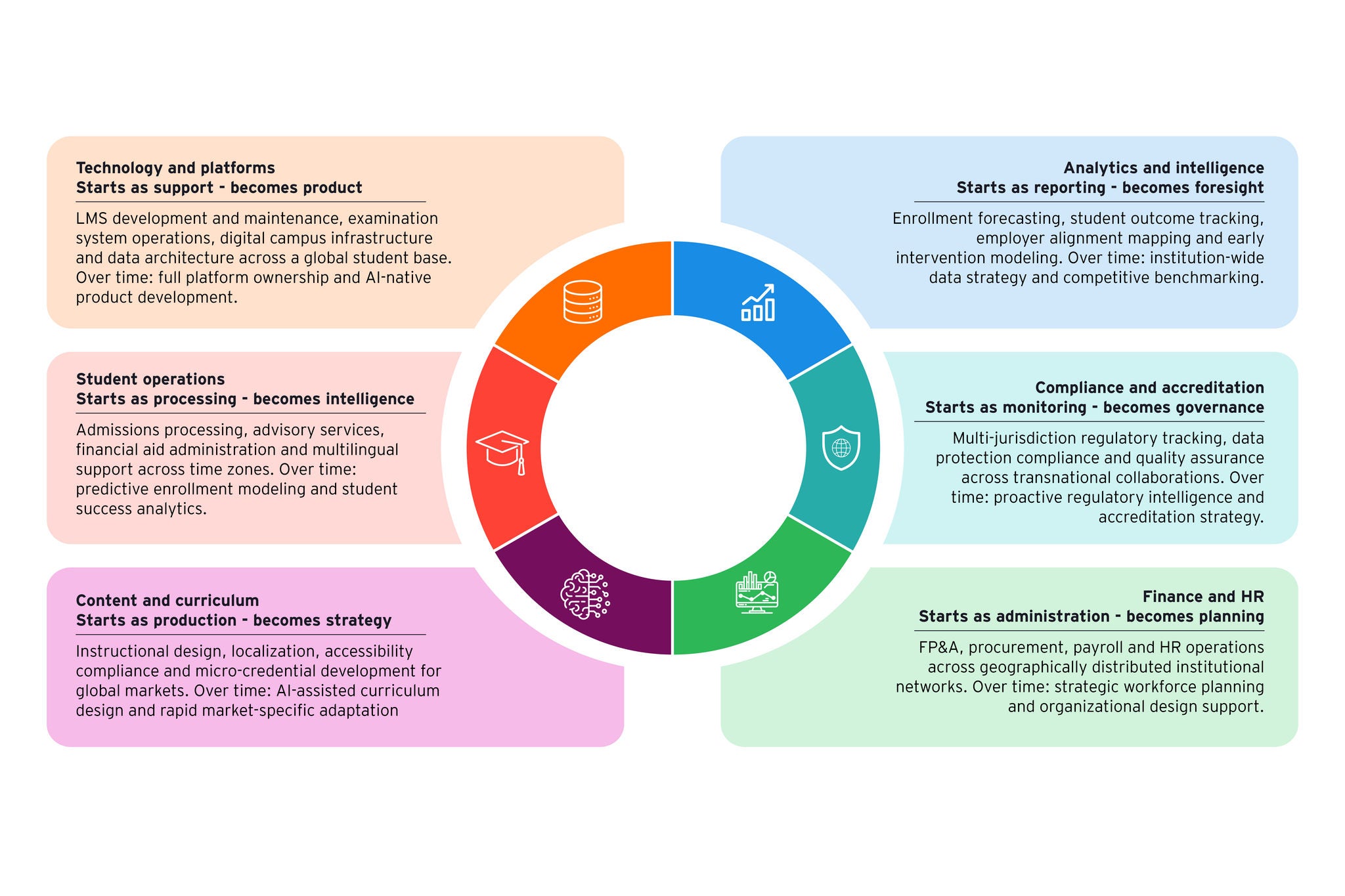
Organizations have seen consistent success by establishing GCCs in India, where these centers increasingly support enterprise strategy, growth and operating models. While many sectors run mature GCCs, the education sector presents untapped potential. India's talent base and cost-efficient structure provide a strong capability foundation to address sector challenges and support sustained value creation.
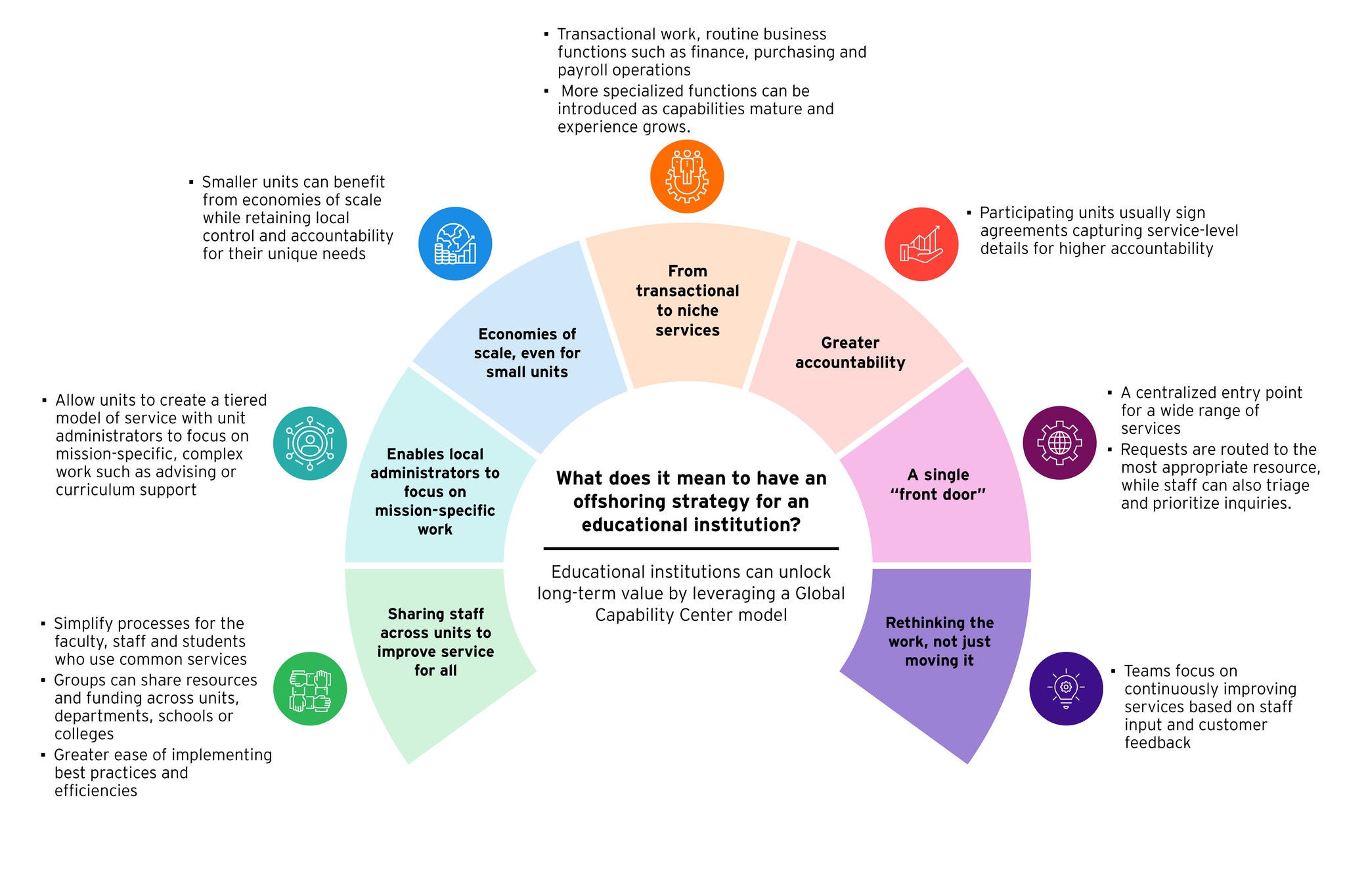
Use cases
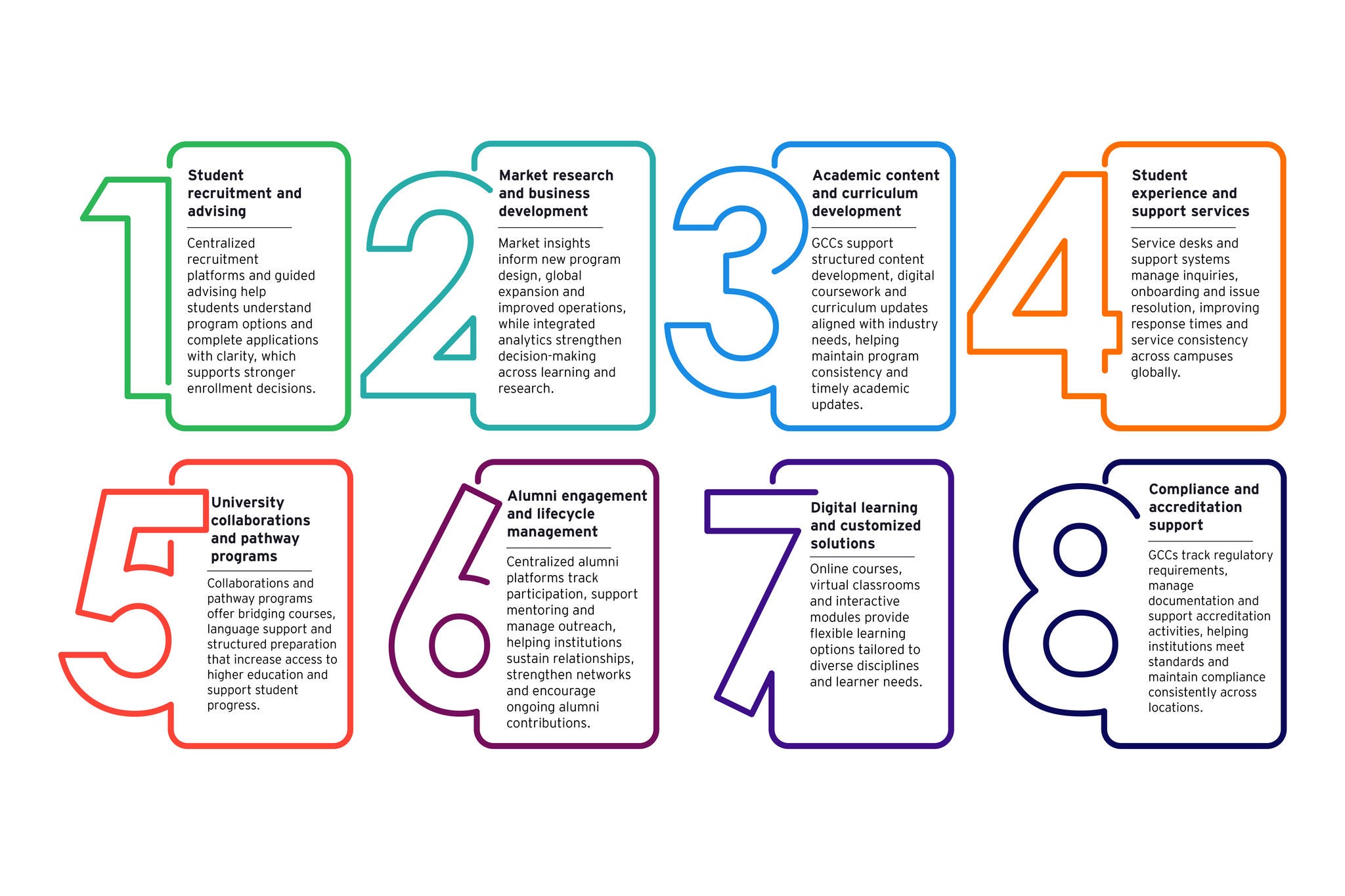
Education GCCs offer specialized services to manage the growing demand for international education, academic collaborations and institutional internationalization efforts. Current use cases include:
Key areas where Education GCCs deliver value

3
Chapter 3
The future of Education GCCs: AI and the early-mover advantage
As AI reshapes higher education, Education GCCs are emerging as strategic capability centers that help institutions innovate, scale and stay ahead of disruption.
Why the next GCC looks nothing like the last one
The GCC of 2026 is not the same as the one established over a decade ago. AI has fundamentally shifted what a GCC can deliver, and for education, this is where the strategic prize lies.
As Education GCCs in India evolve from administrative hubs to strategic centers driving innovation in edtech, curriculum and student services, demand for specialized talent will continue to grow, including:
- Technical competencies in GenAI, ML, LLMs, AI governance, data science, predictive modeling, cloud and platform engineering
- Pedagogical capabilities in digital curriculum design, instructional content for global markets and virtual faculty enablement
As digital campuses expand, GCCs enable consistent systems, structured data practices and inclusive program design, while also identifying early risk signals. They further strengthen alignment with employers by tracking hiring trends, addressing skill gaps and supporting multisite delivery.
AI in higher education is also changing the role of the GCC for universities. An AI-enabled GCC can support personalized student engagement, credential pathways, curriculum analytics, compliance monitoring and scalable academic operations.
The early-mover advantage
India’s GCC model is mature. Early entrants in banking, technology and healthcare now run centers that sit close to core operations. Over time, they built talent pipelines, operating knowledge and digital capability that later entrants cannot replicate quickly.
Education is at an earlier stage, but the foundation is already in place. Institutions do not need to build the model from scratch. They can use an established talent market, delivery infrastructure and operating know-how from day one.
Those that move now can:
- Secure specialized talent before demand rises
- Shape digital capability around their own institutional needs
- Build knowledge that compounds year after year
- Integrate AI capabilities while costs remain favorable
In GCCs, timing matters. A few years of lead time can create a gap that is difficult to close.
What should leaders do now?
Education GCCs are opening new pathways as institutions respond to evolving learner expectations, global collaborations and digital expansion. To support this shift, organizations can:
- Create shared service catalogs with clear ownership and defined service levels
- Build common data models for outcomes, credentials and skills with strong governance
- Run collaboration labs that connect faculty, industry mentors and students on live projects
Over time, Education GCCs can play a defining role in building capabilities across edtech product management, global compliance, accreditation, data protection and strategic functions such as finance and HR, emerging as trusted hubs that establish consistency and deliver sustainable long-term value to global education systems.
Learn more about GCC-powered customer experience transformation
Summary
The education sector is facing a once-in-a-generation operating model shift. Institutions that treat GCCs as a cost-saving measure will capture only a fraction of the value. Those that view them as capability and AI engines, owning their platforms, data and talent pipeline from India, will define the next era of global education.
While the window of opportunity is currently open, it will not remain so indefinitely.
How EY can help
-
Learn how EY-Parthenon helps K-12 schools, districts, higher education institutions, education service providers and education investors.
Read more -
Global Capability Center-as-a-Service (CaaS) at EY offers end‑to‑end GCC setup, scaling and transformation solutions to drive strategic innovation and growth.
Read more -
Our Global Capability Centers(GCC) Advisory practice, led by a team of professionals can help your business be future-ready for the digital disruption.
Read more
Related articles
Why GCC operating models offer a new competitive advantage
GCCs are shifting from cost centers to strategic hubs, with evolving operating models to drive business transformation.
How a strong trade credit policy drives business growth and liquidity
Read how a strong trade credit policy with GCC support enhances growth, protects liquidity and improves risk management through structured controls and analytics.
How are Agentic AI GCCs shaping enterprise operating models
Learn how agentic AI is redefining Global Capability Centers as enterprise intelligence hubs, shifting from cost efficiency to AI-first autonomous models.