






How are Agentic AI GCCs shaping enterprise operating models

How are Agentic AI GCCs shaping enterprise operating models

Related topics

Agentic AI GCCs represent a new phase in enterprise operations, defined by autonomous workflows, governance discipline and AI‑led transformation.


In brief

  • AI now handles routine tasks, allowing teams to focus on judgment, problem solving and guiding work where human insight is needed.
  • With 83% of GCCs testing new tech and 58% trying agent-based systems, leaders may align people, oversight and structure.
  • GCCs need strong skills, clear rules and modern systems to support long term growth.

Global Capability Centers are entering one of the most consequential transitions in their 25‑year history. What began as a cost‑efficient service extension has evolved into a strategic engine for digital capability and innovation, driving GCC transformation strategy across global enterprises.

A recent whitepaper by EY and AMCHAM titled ‘The Agentic AI-first Global Capability Center’, outlines a new phase of reinvention: the emergence of the Agentic AI–first GCC, where autonomous intelligence becomes the operating model’s execution layer rather than a tool retrofitted onto legacy processes. 

Why the transition is unavoidable

Enterprise AI has moved firmly into production, with nearly half of large organizations already running mature AI use cases. As per the EY GCC Pulse Survey 2025, a task level analysis shows that 24% of enterprise tasks are fully automatable and another 42% can be significantly augmented, signaling a major enterprise automation shift and accelerating GenAI adoption across industries.

Coupled with falling compute costs, rapidly advancing foundation models and increasing pressure for decision velocity, the rationale for AI first operating models is no longer experimental — it is becoming strategic.

What makes an Agentic AI GCC different

Agentic systems represent a new category of enterprise capabilities. These systems can perceive context, plan multi step actions, invoke tools and APIs, coordinate across platforms, and learn continuously from feedback loops — forming the backbone of autonomous workflow systems and autonomous decision-making systems.

In practice, workflows no longer move through linear approvals. They operate as event‑driven environments where autonomous agents handle execution and escalate only the exceptions requiring human judgment.

For GCCs, this shift moves teams away from repetitive execution toward oversight, intervention and strategic interpretation —fundamentally altering both the shape of work and the skills required.

Why India is an ideal test bed for Agentic AI innovation

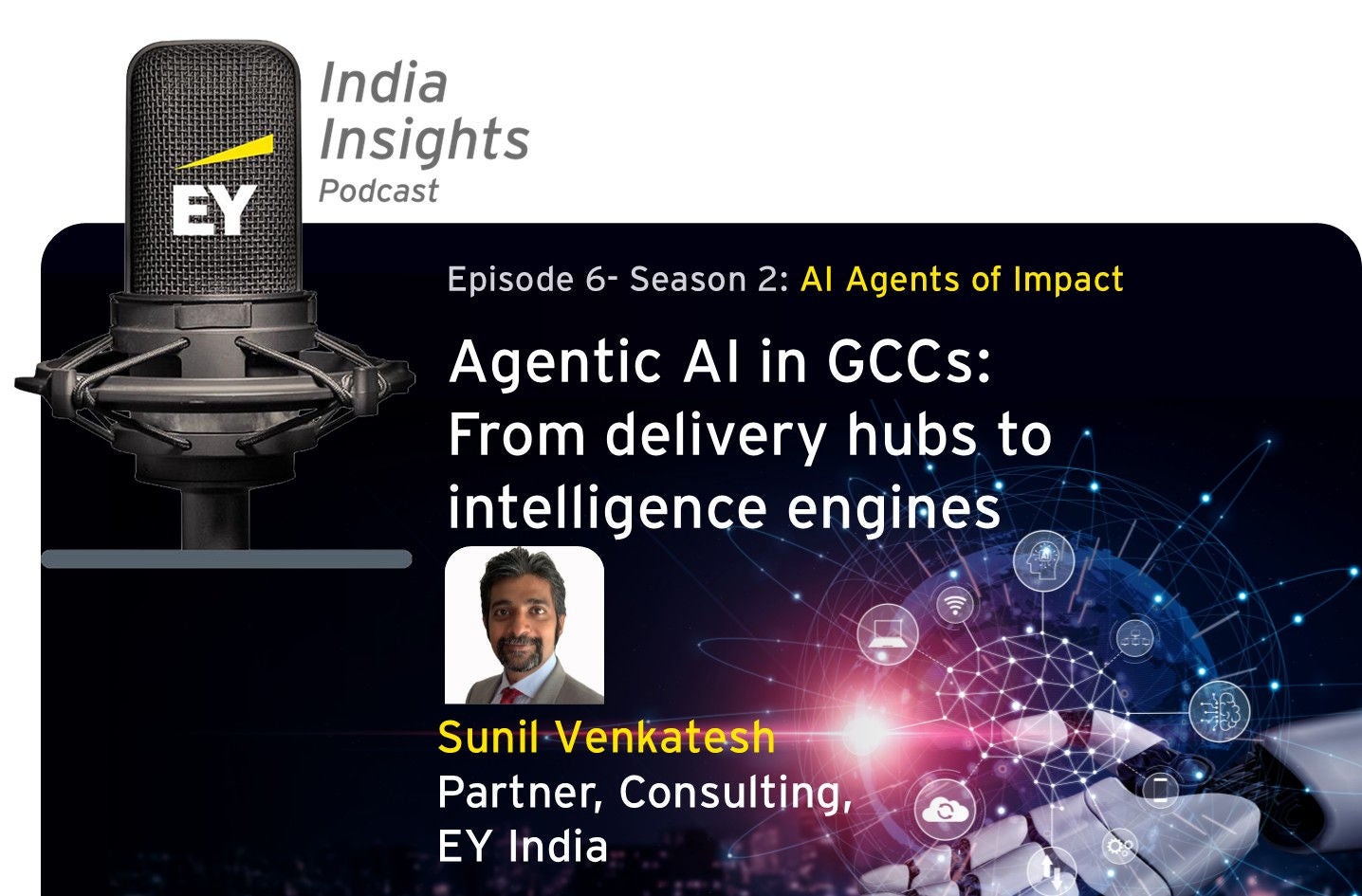
Listen to our podcast on how Agentic AI is moving beyond automation to reshape enterprise workflows, public services and the broader digital ecosystem. 

Know more

GCC as the enterprise intelligence center

GCCs are structurally positioned to lead this shift. They bring together cross‑functional talent, enterprise‑wide data access, engineering scale, governance maturity, and the connective processes required for scaling enterprise‑wide autonomous AI systems.
 

This combination makes the GCC a natural center of gravity for AI, reducing the fragmentation that arises when business units attempt to build capabilities independently. Industry momentum reinforces this: as per the EY GCC Pulse Survey 2025, 83% of GCCs are already engaging with GenAI adoption, and 58% are actively developing agentic capabilities.
 

The economic case for an AI‑first architecture

The rationale for this transition is grounded in structural value creation rather than incremental efficiency gains. Traditional levers such as Lean programs, ERP consolidation, and robotic automation have typically delivered only 5%–15% improvements, and many enterprises are now reaching the limits of these approaches. 

Agentic AI enables end‑to‑end enterprise AI orchestration, continuous optimization, and exception‑driven execution — unlocking productivity through Agentic AI systems. As workflows are redesigned around autonomous intelligence, GCCs evolve from delivery hubs into engines of enterprise‑wide value creation, anchoring next‑generation digital operating models.

A blueprint for building the AI‑first GCC

Sustained transformation requires aligned investment across four interdependent pillars that define a robust GCC transformation strategy:

  • Agentic‑native talent and culture: Shifting human roles toward oversight, judgment and orchestration
  • Agentic platforms and architecture: Hybrid stacks, API‑first platforms and modular design enabling interoperability
  • Governance and accountability: Designing Responsible AI governance frameworks through an embedded AI governance framework with explainability and human‑in‑the‑loop controls
  • Operating‑model redesign: Event‑driven orchestration replacing linear and approval‑based workflows

These pillars reinforce one another; neglecting anyone constrains the potential of others.

Capability Center-as-a-Service: How EY can help build your Capability Center in India

Global Capability Center-as-a-Service (CaaS) at EY offers end‑to‑end GCC setup, scaling & transformation solutions to drive strategic innovation & growth. 

Know more

Accelerating the journey

As organizations reimagine their GCC transformation strategy, many are looking for structured ways to align architecture, governance and talent while avoiding fragmented experimentation. Approaches that combine advisory insight with execution support, such as the EY Intelligent GCC solution suite powered by EY.AI, can help institutions design AI native centers, embed autonomous workflows and strengthen Responsible AI practices — enabling faster and more confident transitions without added complexity.
 

Governance and workforce: The real differentiators

AI first operating models depend on trust. Embedding Responsible AI principles — reliability, security, compliance and lifecycle monitoring — is essential for scaling safely and maintaining stakeholder confidence. Equally important is the workforce transition: modeling how roles evolve, how capabilities shift, and how institutional knowledge is retained as organizations move toward exception based roles.
 

Mayank Gaur, Director, Business Consulting, EY India contributed to this article.

Download the full pdf

FAQs

Summary 

The strategic questions are becoming clearer. Who owns the AI execution architecture? Is the GCC equipped to lead enterprise AI orchestration? Are governance frameworks, platforms and talent models ready for autonomy at scale?

Global Capability Centers are evolving from efficiency‑led delivery hubs into Agentic AI–first intelligence centers that reshape enterprise operating models. As more work becomes redesignable through automation and augmentation, GCCs are uniquely positioned to lead this shift.

Leaders who succeed may invest deliberately in talent, architecture, governance and operating‑model redesign to build AI‑intelligent centers that set the enterprise pace.


Related articles

How AI is becoming central to oil and gas finance strategy

AI is helping oil and gas CFOs unlock trapped working capital, improve cash flow resilience and fund energy transition through predictive and agentic automation.

Where does India’s opportunity lie in pharma’s new architecture?

Pharma is shifting to AI-led platform models, integrating discovery, data and manufacturing — positioning India as a key player in global biopharma innovation.

How India GCCs are powering core industry processes in Retail and CPG sector

India’s GCCs are powering global Retail and CPG brands through AI, analytics, merchandizing, marketing, customer service and store operations transformation.

    About this article

    Authors