







EY refers to the global organization, and may refer to one or more, of the member firms of Ernst & Young Global Limited, each of which is a separate legal entity. Ernst & Young Global Limited, a UK company limited by guarantee, does not provide services to clients.
EY GCC Leadership Dialogues
Join Arindam Sen, EY India Partner & GCC Sector Lead, in a video series with top leaders on global capability centres highlighting growth & future trends.
A model-wise view
Extended office
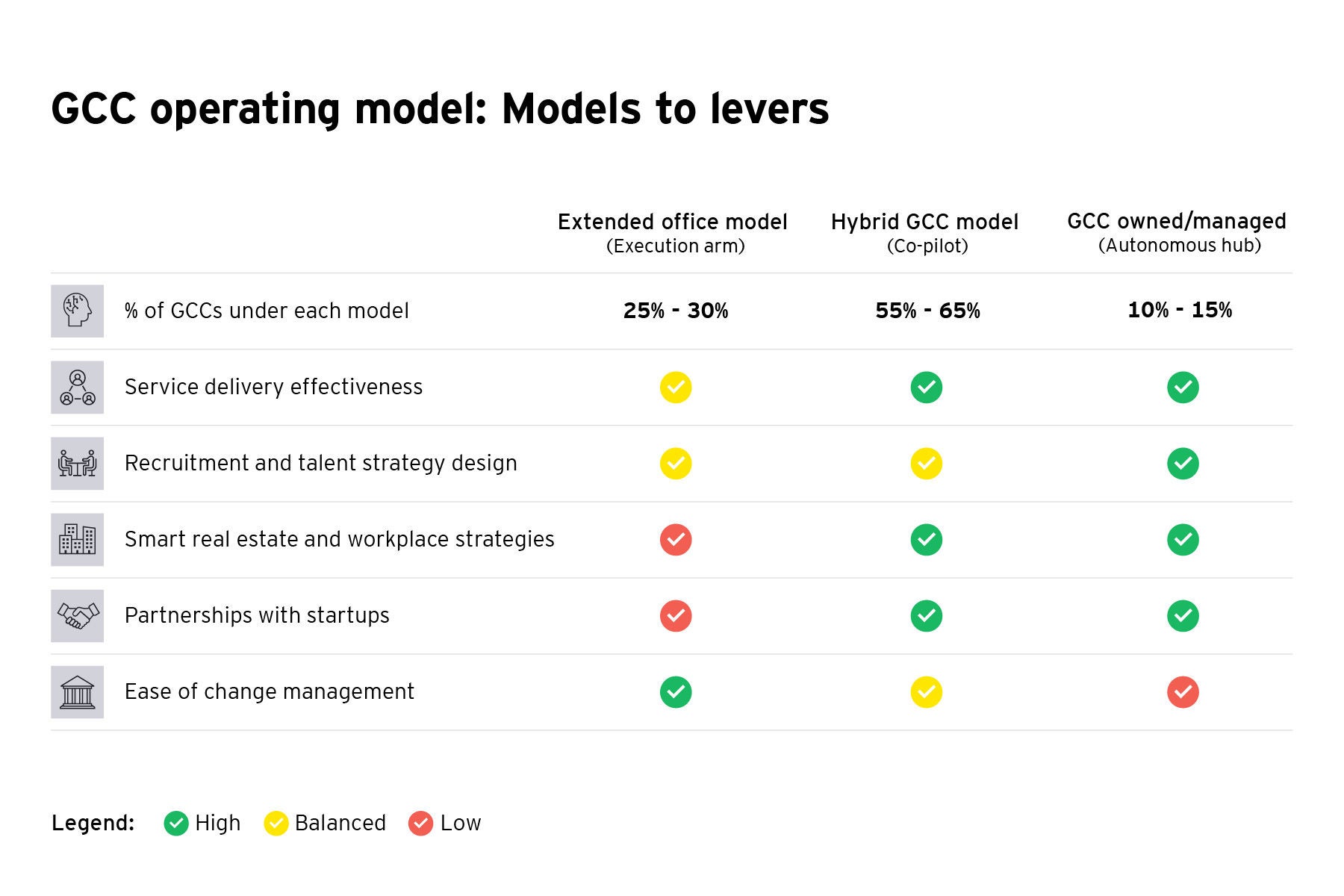
The extended office is the most traditional GCC construct. It is designed primarily for cost‑efficient, standardized delivery under close headquarter, region and business unit oversight. Strategy, budgets, technology choices, and policy decisions remain centralized, while the GCC focuses on execution at scale.
Leadership empowerment is limited, governance is centralized, and success is measured largely through cost-efficiency and SLA adherence. This model continues to be relevant for risk‑sensitive, transaction‑heavy work and for organizations at an early stage of their GCC journey.
Best suited for stable operations, regulatory‑heavy functions and early‑stage GCCs.
Hybrid office
The hybrid model represents a deliberate shift toward shared ownership. Headquarters hold strategic direction, while GCCs assume greater responsibility for execution excellence, process redesign and selective innovation. Decision rights are distributed, supported by dual reporting structures and joint GCC governance frameworks. This model is the preferred choice across industries. At EY Conclave 2025 in Pune, 68% of GCC leaders indicated a preference for hybrid models, signaling a clear pivot toward agility without fully decentralizing control1.
Best suited for organizations balancing control with speed, scaling digital and analytics capabilities, and innovating with ambitions for collaborative growth.
GCC-owned / managed model (autonomous hub)
In the GCC-owned or managed model, the center operates as an autonomous value hub with end to end ownership across delivery, talent, budgets and innovation. GCC leadership reports directly to enterprise leadership and is accountable for outcomes, not just capacity.
These GCCs go beyond service delivery to drive continuous improvement, incubate enterprise capabilities, and shape global transformation agendas. This represents the highest level of maturity and leadership empowerment.
Best suited for enterprises pursuing AI led transformation, product and platform ownership and global capability leadership.