







How global capability centers can rethink talent and innovation strategies

How global capability centers can rethink talent and innovation strategies

Global capability centers need to reshape their approach to talent and innovation.


In brief

  • As global capability centers (GCCs) mature, their mandates shift from cost efficiency to talent access and innovation, marking a transition from cost to value.
  • The employee value proposition (EVP) for GCCs is critical for transformation, as work environment strategies and innovative practices enhance engagement and retention.
  • EVP priorities across different maturity stages of GCCs vary by industry, reinforcing the need to build a differentiated EVP to support the growth mandates of GCCs.

India’s Global Capability Centres (GCCs) are evolving from cost centers to strategic collaborators. The Employee Value Proposition (EVP) rapid diagnostic study indicates newer centers are prioritizing innovation and business integration from day one—helping global enterprises move faster, compete stronger, and attract better talent. The Employee Value Proposition (EVP) rapid diagnostic study indicates newer centers are prioritizing innovation and business integration from day one—helping global enterprises move faster, compete stronger, and attract better talent.

The evolving equation: Talent, innovation, digital

Cost efficiency dominates early-stage GCCs, often forming the primary justification for their establishment. However, as centers grow in size and tenure, this focus steadily recedes, marking a clear shift in the GCC mandate toward capability and value. 

What replaces it is not a single mandate but a more complex mix of integrated talent, innovation and digital strategy. Mature GCCs increasingly take on higher-value roles, contributing to GCC growth mandates, operating model redesign, product lifecycles and enterprise-wide transformation agendas.

Yet the data also suggest that this evolution is uneven. While many GCCs are expanding their scope, they have yet to be fully integrated into enterprise strategy. This gap between capability and influence raises important questions about how organizations define GCC success and highlights the role of an impactful EVP in GCC transformation.

The industry shapes the priorities 

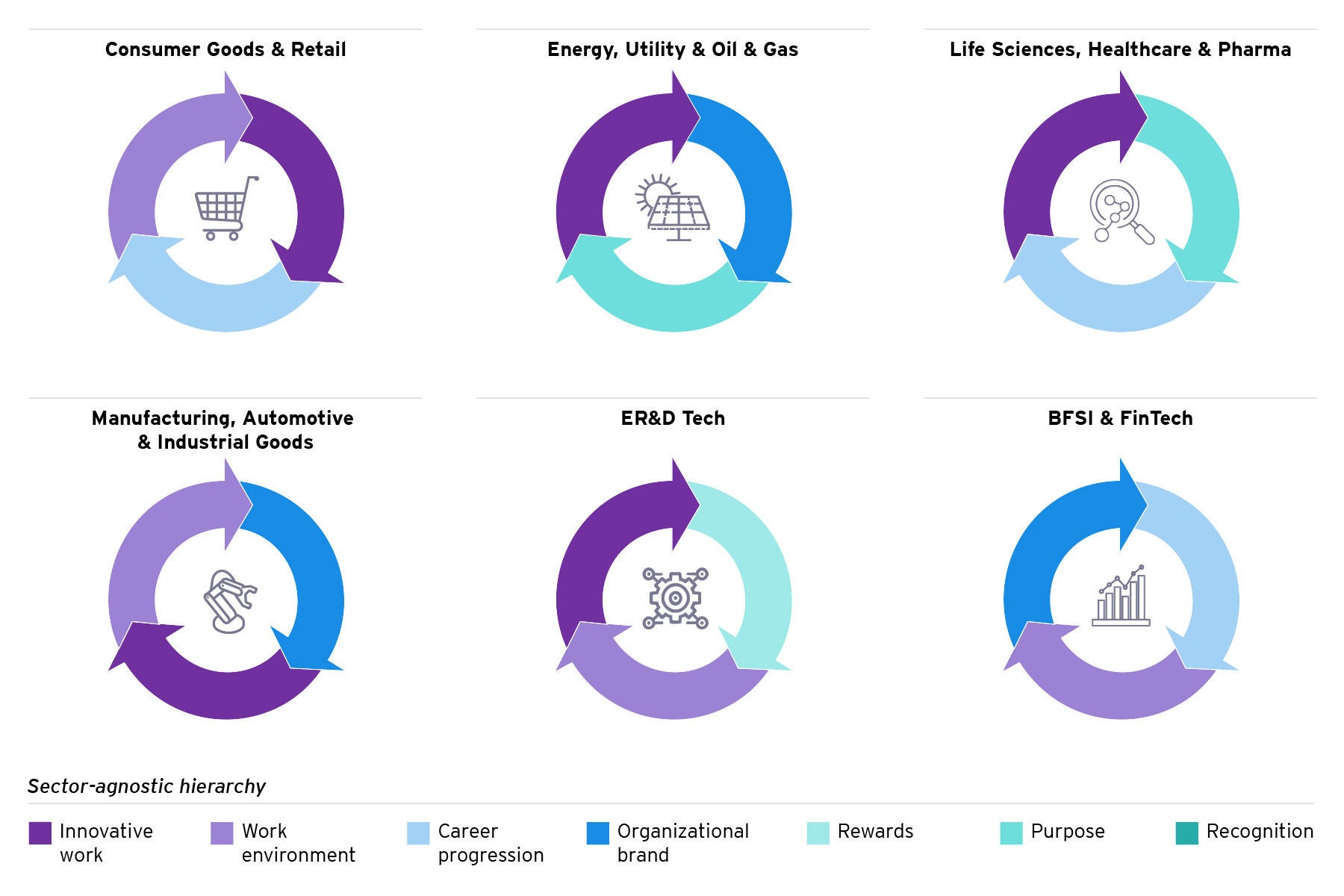
Strategic priorities differ sharply by industry, shaped by sector-specific pressures and competitive realities.

Technology and engineering GCCs lean heavily toward innovation and talent depth, reinforcing the need for talent access and innovation in GCCs to support rapid product cycles and emerging technologies. Life sciences and healthcare GCCs focus strongly on specialized talent to accelerate research, compliance and development. Manufacturing, energy and utilities GCCs continue to emphasize cost efficiency and GCC operating model transformation as they modernize legacy systems and global operations.

EY GCC Leadership Dialogues

Join Arindam Sen, EY India Partner & GCC Sector Lead, in a video series with top leaders on global capability centres highlighting growth & future trends.

Know more

Recognizing the talent risk and trust premium in shaping the proposition 

Newer GCCs, by contrast, offer the “startup vibe” paying a risk premium—a combination of early responsibility and “founding member effect” that appeals strongly to the modern workforce. Winning EVPs prove long-term intent through leadership access, autonomy and risk-mitigating benefits. Across both archetypes, one expectation is universal: borderless pathways, closely followed by a differentiated work environment strategy. 
 

However, the data also suggest that EVP maturity does not always keep pace with GCC ambition. While many centers aim to position themselves as innovation hubs, their EVP often remains anchored in earlier-stage priorities, creating friction between strategy and employee experience.
 

While innovative work consistently features as a top priority across multiple sectors, it is particularly prominent for energy, oil and gas, life sciences, healthcare and pharmaceuticals. ER&D and technology-oriented organizations reflect similar patterns due to their expertise-led mandates. In contrast, career progression and work environment emerge as more dominant levers for consumer goods and retail, as well as manufacturing, automotive and industrial goods sectors.
 

The report offers deeper insights into employee proposition priorities across the GCC maturity curve and what it implies to stay relevant. 

Focusing on what matters: Prioritization of proposition levers by sector

Emerging function enabled by GCC in CPR sector

What this means for GCC leaders

The survey raises several strategic questions for GCC and enterprise leaders:

  • Where is our “capability” outpacing our “influence”—and what will close the talent integration gap? 
  • Is the employee proposition a strategic lever for what the enterprise needs next—or just a hiring pitch for today?
  • Where does the lived employee experience validate or contradict the employee value proposition and strategic mandate?  

Looking ahead: From delivery centers to capability hubs

GCCs are entering a phase where longevity will be determined by strategic depth and ownership of outcomes. The next chapter will favor centers that make conscious choices about what they build, how they attract talent, and where they fit in the enterprise value chain. In this phase, relevance is earned deliberately by shaping demand.

Contributors:

Download the full pdf

Summary

India’s GCCs are evolving from cost-driven delivery units to innovation-led strategic hubs. Insights from the EVP survey by EY show that while early-stage GCCs focus on cost efficiency, mature centers prioritize talent access, innovation and digital transformation. A strong GCC EVP—with an emphasis on work environment strategy and career growth—is critical for retaining talent and driving enterprise impact. EVP maturity in GCCs varies by industry, highlighting industry-specific EVP priorities and the importance of building a differentiated EVP for GCCs to support their growth mandates.


Related articles

How India GCCs are powering core industry processes in Retail and CPG sector

India’s GCCs are powering global Retail and CPG brands through AI, analytics, merchandizing, marketing, customer service and store operations transformation.

How Eastern India can lead the next GCC wave

Eastern India is emerging as a strategic GCC hub as enterprises shift to intelligence-led models powered by AI, data and automation, with Kolkata at the core.

How do global capability centers drive compliance and efficiency in intercompany processes?

Read how GCCs can manage intercompany processes, prevent piling up of intercompany balances and optimize processes from purchase order stage to month-end close.


    About this article