






Managing intercompany processes: GCCs best practices

How do global capability centers drive compliance and efficiency in intercompany processes?

GCCs can manage intercompany processes, prevent piling up of intercompany balances and optimize processes from purchase order stage to month-end close. 


In brief

  • Organizations face challenges in managing intercompany processes, which impacts finance efficiency.
  • Technology-driven solutions and governance measures can streamline operations and enhance compliance.
  • The value of a future-ready intercompany model lies in driving transparency and control.

Intercompany transactions, representing about 80% of global trade, are crucial yet complex. As organizations grow, intercompany finance often becomes very challenging and ambiguous. Global Capability Centers (GCCs) help streamline these processes, centralizing control, and implementing standardization and technology solutions to address challenges effectively.

The high-stakes impact: Removing bottlenecks

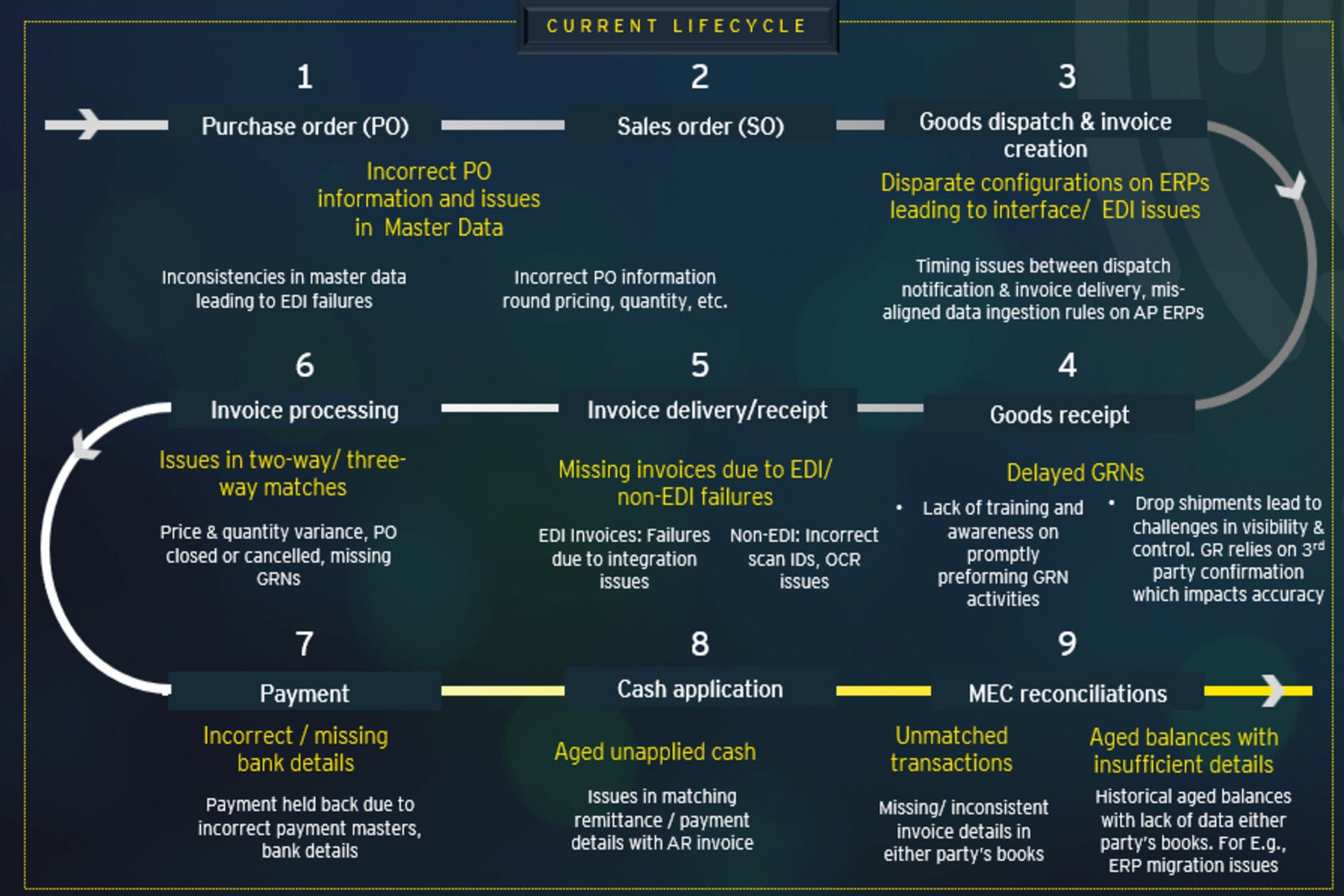
Intercompany balances, if unreconciled, pose risks such as tax errors, financial losses, and compliance issues. Organizations and GCCs must detect problems early, prioritize high-risk areas and implement measures to reduce financial exposure. Discrepancies in pricing, vendor and customer master data may cause electronic data interchange (EDI) failures and delays in order requisition. Payment processing faces two-way and three-way match issues, sometimes resulting from discrepancies in price, quantity missing or invalid purchase order (PO) numbers, cancelled POs, duplicates, delays or unprocessed receipts. Partial deliveries and non-conforming goods further complicate matters. Missing invoices, whether EDI-related or otherwise, can disrupt payment timelines and reserve calculations. Month-end close (MEC) reconciliation can be held up by unmatched transactions due to inconsistent records between parties. These issues collectively impact the efficiency and accuracy of intercompany financial processes.

Intercompany financial process flow

EY GCC Leadership Dialogues

Join Arindam Sen, EY India Partner & GCC Sector Lead, in a video series with top leaders on global capability centres highlighting growth & future trends.

Know more

Solving the problem : Role of responsive GCCs    

Intercompany finance is critical due to its significant risks, with only very few having dedicated standards in their GCCs. Many are now moving toward a Global Center of Excellence (CoE) model within GCCs to streamline ownership, standardize policies and enable real-time financial governance. While not always formally labelled CoEs, centralized intercompany teams within GCCs are already delivering impact.


For instance, a large US-based security equipment manufacturer resolved ~US$24 billion in out-of-balance transactions spread across 140-plus ERPs by leveraging its GCCs to clear 50% of the backlog within three months and co-develop a global policy for intercompany dispute resolution and prevention (EY analysis). Likewise, a UK alco-beverage company used its GCC to drive automation and greater KPI visibility through a successful transition to Blackline for its intercompany processes.

Intercompany dispute management

Organizations often handle intercompany disputes with less rigor than third-party disputes, leading to unsustainable higher costs. A centralized model, governed by GCCs, establishes robust policies and clear authority delegations, enabling effective dispute resolution and oversight on high-volume trading relationships. This structure helps maintain operational efficiency and financial integrity.

Robust program management

Effective program governance is crucial for successful transformations, with GCCs playing a key role. It establishes governance frameworks, Responsible, Accountable, Consulted, and Informed (RACI) matrices, and Risks, Actions, Issues, and Dependencies (RAID) logs to monitor progress and risks. GCCs provides real-time visibility through reporting dashboards and addresses historical financial imbalances, allowing corrective and preventive measures to be implemented.

Business change management

People are central to problem-solving and transformation. Organizations and GCCs must prioritize change management, distinct from program management, to enable effective communication and stakeholder buy-in. GCCs are vital in analyzing stakeholder impact, obtaining leadership support and managing resistance when implementing new intercompany policies or transitioning to technology solutions.

The FS GCC playbook

Welcome to an exclusive video series by EY India where we dive into the strategies and best practices driving the success of Global Capability Centers (GCCs) in the financial sector. Watch our latest episodes below!

Know more

Sustainable technology solution

GCCs play a pivotal role in intercompany finance by centralizing and standardizing processes, driving technology transformation through shared platforms, and providing digital visibility. It enables effective dispute management, robust program governance and business change management, ultimately leading to operational efficiency and financial integrity. GCCs have also been implementing Agentic AI solutions to make various processes touchless and minimizing human oversight. Ultimately, with GCCs, technology transformation is not just implemented but sustained and continuously improved.  


Continuous improvement

Companies are increasingly adopting framework-driven risk and quality management approaches like Corrective and Preventive Action (CAPA) and Failure Mode and Effects Analysis (FMEA) to mitigate intercompany risks. CAPA enables prompt issue identification, root cause analysis, and preventive action planning. FMEA complements this by identifying potential failure modes, assessing severity, likelihood, and detection, and calculating a Risk Priority Number (RPN) to prioritize mitigation. These initiatives involve engaging GCC teams - including Accounts Payables (AP) and Accounts Receivables (AR) stakeholders, Business Units financial controllers, procurement, and on-ground operations - through focused discussions for comprehensive risk identification and integrate into risk review cycles (monthly, quarterly, or annually).


Overall, intercompany finance has evolved into a strategic priority, necessitating robust governance and technological transformation. GCCs lead the way in standardizing processes, ensuring compliance, financial accuracy, and corporate transparency.


Summary

Intercompany finance has evolved into a strategic priority, necessitating robust governance and technological transformation. GCCs lead the way in standardizing processes, enabling compliance, financial accuracy, and corporate transparency.


Related articles

How GCCs in India are shaping the future of the Life Sciences industry

Explore how India’s GCCs are transforming future of life sciences from handling core and enabling functions to driving innovation, outcome-oriented growth.

How financial services are adapting to global outsourcing trends

Explore GBS evolution in financial services, addressing regulatory challenges, digital transformation, and AI innovation for operational excellence.

Tapping into data management and data lineage strategies for Banks and their Global Capability Centers (GCCs)

Discover how banks and GCCs leverage data lineage beyond compliance, transforming it into a strategic enabler for governance, risk management, and decision-making.


    About this article

    Authors