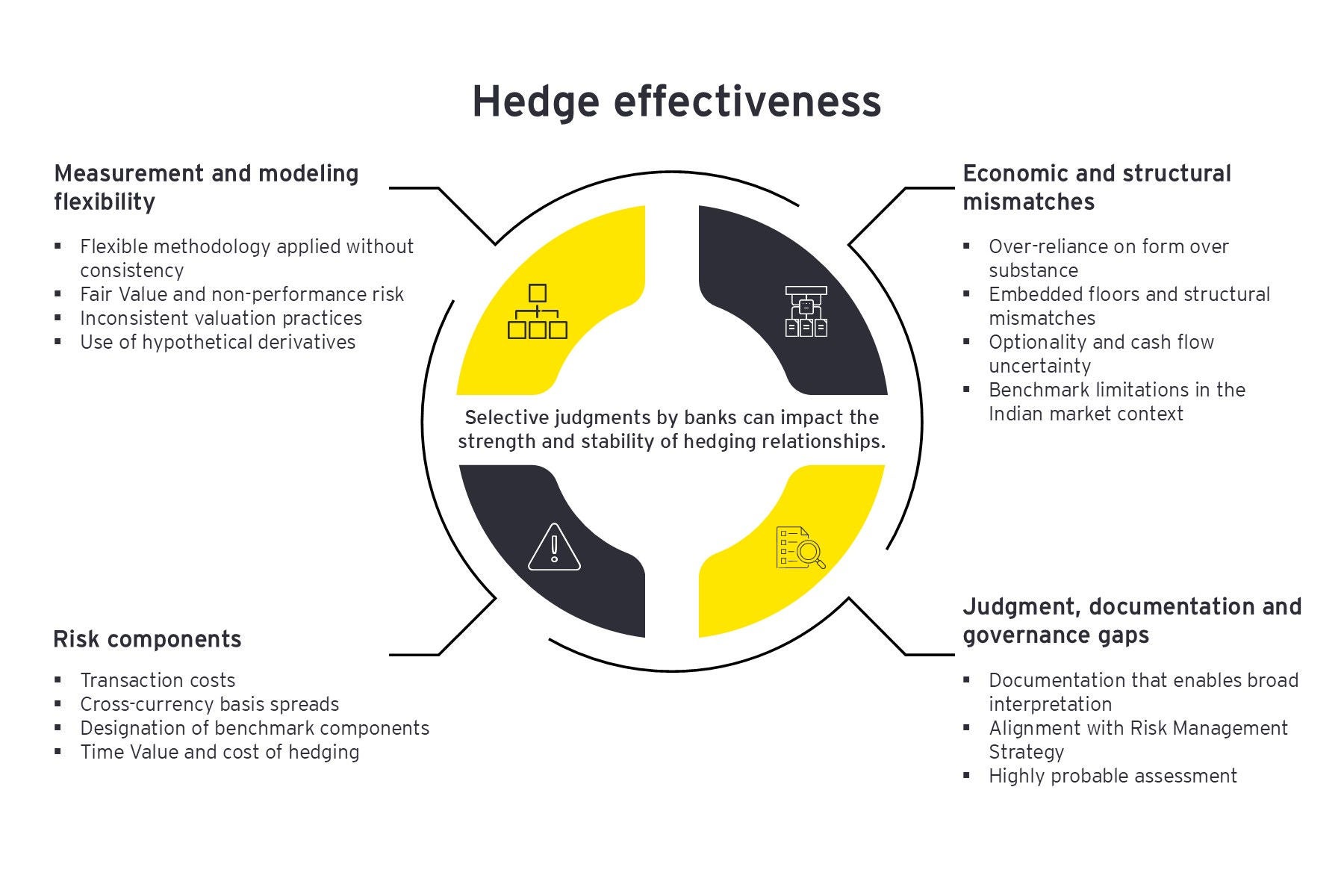
Risk components
Transaction costs such as brokerage, commissions, bid–ask spreads and funding costs are typically excluded from the designated hedging relationship. In practice, where such costs are embedded within the pricing structure and not separately identified or designated, they may not be explicitly reflected in hedge effectiveness assessments, even though they can indirectly contribute to hedge ineffectiveness.
- Cross-currency basis spreads
Cross-currency swaps often include basis spreads that reflect differences in funding conditions and liquidity across currencies. If these spreads are not clearly designated or appropriately accounted for — typically under the cost of hedging approach — they can introduce volatility that is unrelated to the core hedged risk. Failure to treat these components consistently can distort effectiveness assessment and complicate the interpretation of hedge performance.
- Designation of benchmark components
For hedge accounting to be credible, the benchmark risk component designated must be both independently identifiable and reliably measurable. Where benchmarks are vaguely defined, not observable, or proxy-based without strong justification, the effectiveness assessment becomes less robust. This can lead to challenges in demonstrating a clear economic relationship, particularly under audit or regulatory scrutiny.
- Time value and cost of hedging
Under the cost of hedging framework, components such as the time value of options are typically deferred in Other Comprehensive Income (OCI) and amortized over time. Misalignment between the recognition of these components and the hedged exposure can lead to artificial ineffectiveness. Consistent and disciplined treatment is essential to enable hedge performance that reflects the intended economic outcome.
Economic and structural mismatches
- Over-reliance on form over substance
The requirement to demonstrate an economic relationship in hedge accounting may, in practice, be satisfied through structural alignment (e.g., matching critical terms) without sufficiently evaluating how the hedge performs under real conditions.
This can lead to important sources of ineffectiveness being underassessed, including:
· Differences in underlying benchmarks (basis risk)
· Mismatched cash flow timings
· Credit risk impacts on either leg of the hedge
As a result, the hedge relationship may appear valid in design, but its ability to deliver consistent offset remains overstated.
- Embedded floors and structural mismatches
Financial instruments often include embedded features such as interest rate floors or caps, which may not be mirrored in the hedging instrument. These structural differences create inherent sources of ineffectiveness, especially when such features become economically significant, for instance, in low-interest rate environments. If not properly captured in effectiveness assessments, these mismatches can lead to unexpected volatility.
- Optionality and cash flow uncertainty
Optionality features such as prepayment options, call/put features, or early termination clauses introduce uncertainty into the timing and amount of cash flows. This directly affects the ability to demonstrate a stable hedge relationship, particularly for cash flow hedges. If not adequately incorporated into the hedge design and assessment, these features can weaken the reliability of effectiveness conclusions over time.
- Benchmark limitations in the Indian market context
In the Indian banking environment, a structural challenge arises from the limited availability of tradable and observable benchmarks for common lending rates such as Marginal Cost of Funds Based Lending Rate (MCLR), base rate or internal transfer pricing curves. Since hedging instruments are typically linked to observable market rates like Overnight Index Swap (OIS) or Mumbai Interbank Outright Rate (MIBOR), there is an inherent disconnect between the exposure and the hedge. The resulting reliance on proxy benchmarks introduces basis risk and makes effectiveness assessment more judgment-driven. While not prohibitive, this environment demands stronger methodological rigor, clear justification and robust documentation to support hedge accounting conclusions.
Judgment, documentation and governance gaps
- Documentation that enables broad interpretation
Hedge documentation is expected to clearly articulate the risk management objective, the hedged risk and the basis for assessing effectiveness. In practice, however, documentation may be:
· High-level or template-based
· Insufficiently linked to actual treasury strategies
· Broad enough to accommodate multiple interpretations over time
This reduces discipline in the application and allows continued justification of hedge accounting treatment even when effectiveness weakens, limiting transparency.
- Alignment with the risk management strategy
Hedge accounting should be a direct extension of the entity’s Board-approved risk management framework, including clearly defined objectives, permissible instruments and exposure limits. Where a hedging relationship appears to deviate from these principles, it raises concerns about whether the hedge is genuinely risk-driven or influenced by accounting considerations. Even if the technical criteria of hedge accounting are met, weak alignment with internal risk governance can undermine the credibility of the designation and raise questions about the substance of the relationship.
- Highly probable assessment
Cash flow hedge accounting requires forecast transactions to be highly probable and supported by objective evidence such as budgets, contractual pipelines or historical patterns. Where this assessment is based on weak or overly optimistic assumptions, there is a heightened risk of hedge failure. In such cases, accumulated amounts in OCI may need to be reclassified to profit or loss, resulting in delayed recognition of volatility.