





EY refers to the global organization, and may refer to one or more, of the member firms of Ernst & Young Global Limited, each of which is a separate legal entity. Ernst & Young Global Limited, a UK company limited by guarantee, does not provide services to clients.
Recent Searches

Strengthening India’s energy security is critical to mitigating macroeconomic risks.
In brief
- India’s crude oil import dependence has increased to more than 90% in FY26 from 55% in FY99
- Petroleum refining efficiency in India has improved by about 33% in FY26 as compared to FY98.
- Energy intensity of India’s GDP as also the use of petroleum products in GDP have fallen over time.
India has remained strategically dependent on a set of key imports, particularly crude. Any external disturbances affecting the supply of these imports or their prices critically radiate into the working of the domestic economy. Their impact is on both producers and consumers. Producers are affected because of supply bottlenecks and often higher input costs. Consumers are affected because of lower supply and higher prices. It is important to identify these key vulnerabilities and develop strategies for minimizing their impact as part of India's oil security strategy. In this article we focus on India’s petroleum sector, particularly its evolving landscape.
India’s growing dependence on imported crude oil
A critical feature characterizing the vulnerability of the Indian economy is its high oil import vulnerability, driven by rising crude oil imports. The contribution of domestic production of crude oil has remained quite limited. Chart 1 shows that India’s degree of dependence on imported crude oil has increased in a secular way rising from 55% in FY99 to slightly above 90% in FY26.
This increase in dependence is primarily due to the inordinate rise in the volume of domestic consumption of PoL products which increased from 90.6 million metric tons (MMT) in FY99 to 243.2 MMT in FY26. Further, after having reached a peak of 35.9 MMT in FY12, the volume of domestic production has eased gradually to 26.0 MMT in FY26. This trend reflects the challenge of reducing India’s oil import dependence.
Increasing efficiency in refining crude
A key strength of India’s petroleum sector is its domestic capacity to refine imported crude oil and its ability to export these refined PoL products over and above its domestic needs. Chart 2 shows a consistent upward trend in petroleum refining efficiency in India[1], which has risen from just above 0.95 in FY98 to 1.27 in FY26, implying a 33% improvement over this period. This has supported the growth of petroleum product exports, partially offsetting external imbalances.
Consumption patterns: Growing volume, falling intensity
Even though the degree of dependence on imported crude oil has increased over time, primarily because of increasing volume of domestic consumption of PoL products, one redeeming feature is that the rate of growth of consumption of PoL products has been less than the rate of growth of real GDP (at 2022-23 prices). This is reflected in a falling intensity of consumption of PoL products with respect to GDP as shown in Chart 3. Further, this is also evident in a falling trend of energy intensity of GDP in India. This may be due to a combination of use of improved technology and structural changes in output.
Among the three major output sectors, namely agriculture, industry and services, the energy intensity of agriculture is the least and that of industry, the highest. Over time, however, there has been an increase in the share of services, which has a lower energy intensity as compared to industry.
Thus, four features relating to the petroleum sector stand out: (1) volume of domestic production of crude has fallen over time, (2) degree of dependence on imported crude has increased from a level of 55% in FY99 to 90.4% in FY26, (3) efficiency in producing petroleum products in the Indian economy has increased by about 33% since FY98 and (4) consumption intensity of petroleum products with respect to GDP has fallen over time.
Forex cost of increasing dependence on imported crude
There is a widening gap between value of imported crude vis-à-vis exported PoL products by India in US$ terms, leading to a rising oil import bill. This growing difference is due to 1) higher volumes of imports linked to growth in domestic consumption of PoL products, vis-a-vis growth in volume of exports and 2) the global crude oil price impact on India.
The CAGR of domestic consumption of PoL products has been significantly higher at 3.9% as compared to the exports of PoL products at 2.1% considering the period FY06 to FY26. This imbalance makes India vulnerable to the macroeconomic impact of higher oil imports.
Years in which crude prices, measured in terms of price of Indian crude basket (ICB), increased saw a rise in both imports of crude and exports of PoL products in US$ terms, over their respective trendlines, while declines in global crude prices led to corresponding falls below trend growth rates. However, the asymmetry between imports and exports continues to widen (Chart 4), increasing the foreign exchange cost of crude oil imports.
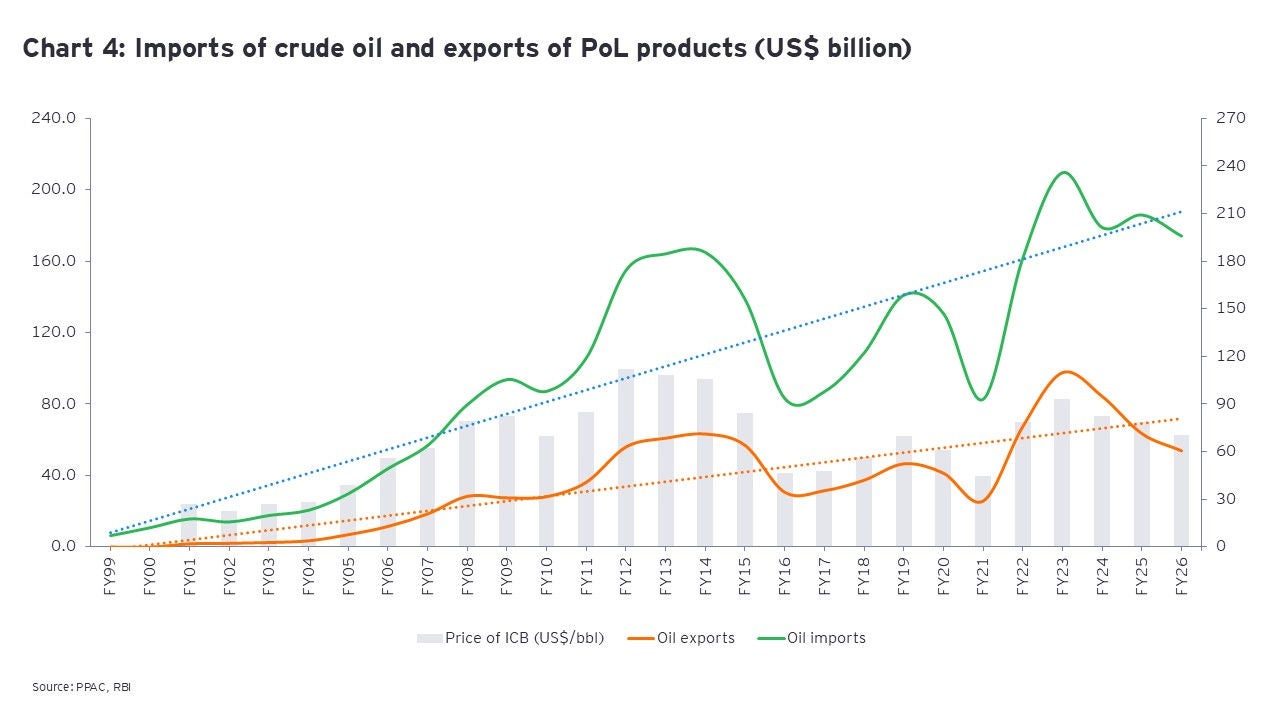
The volume of crude imports is generally price inelastic, implying that demand does not fall significantly even when prices rise. As a result, the price effect dominates, increasing the economic burden. Additionally, rising prices and/or growing shortages of crude tend to exert pressure on exchange rates. These interdependencies amplify India’s exposure to crude oil supply shock risks.
Role of buffer stock for crude oil
Considering India’s specific vulnerabilities in relation to fuel, fertilizer, food and rare earths, there may be a need to strengthen India’s energy security by building strategic reserves in respect of these sectors to minimize the impact of excessive volatility in their supply and prices on India’s overall growth. Building strategic reserves requires decisions regarding 1) optimum size of stock, 2) building of infrastructure to hold the reserves, 3) timing of purchase, 4) carrying costs, 5) timing of release from stock, and 6) maintenance of a suitable balance of inflows and outflows. In the case of foodgrains, India has done well and tackled effectively the economics of holding strategic reserves. With respect to crude, India has initiated efforts toward building strategic petroleum reserves, but current levels need to be considerably augmented. As shown by Chart 5, India’s strategic oil inventories cover 4.9 days of consumption, significantly lower than other major economies.
Going forward, India may consider continuing to augment its refining capacity which has helped save refining costs had India been forced to directly import refined petroleum products. The trend towards growing dependence on imported crude may need to be reversed while accelerating the shift towards greener options and other alternative sources of energy, including nuclear energy.
Download the full pdf
Learn more about India's petroleum economy
Summary
India’s petroleum sector reflects rising vulnerability driven by sharply increasing dependence on imported crude, now exceeding 90%, amid falling domestic production. While refining capacity and efficiency have improved, facilitating growth in exports of petroleum products, this has not offset the widening forex burden from higher import volumes and prices. Encouragingly, energy and petroleum intensity of GDP have declined, reflecting structural and technological shifts. However, exposure to global supply and price shocks remains high, compounded by limited strategic reserves. Strengthening energy security through larger buffer stocks and resilience strategies is critical to mitigating macroeconomic risks emanating from external supply disruptions.
How EY can help
-
Watch provides an in-depth review of salient developments in India’s macro economy and economic policy in a global context.
Read more -
Tax policy advisory services by EY India offers insights & strategies to navigate complex tax regulations, driving business growth and compliance.
Read more -
EY helps Oil & Gas and Chemicals clients optimize productivity and capital efficiency — earning the right to grow, innovate and unlock future value.
Read more
Related articles
Preserving India’s long-term growth amid evolving economic clouds
OECD 2025 projects India to become the leading economy in a selected feasible scenario, surpassing the US by 2045 and China by 2063 in PPP terms.
Why recent macro fiscal shifts call for a reassessment of FC16 projections
New GDP data, GST changes and global uncertainty call for a reassessment of FC16 projections and fiscal sustainability in India.
GoI-state fiscal transfers: The next five years
The 16th Finance Commission report analyzes tax devolution, grant discontinuation and fiscal transfer shifts impacting the finances of states and Center.