


EY refers to the global organization, and may refer to one or more, of the member firms of Ernst & Young Global Limited, each of which is a separate legal entity. Ernst & Young Global Limited, a UK company limited by guarantee, does not provide services to clients.
Recent Searches

Actionable insights for CXOs on workforce transformation, business strategy, AI adoption and global competitiveness.
For more insights, download our magazine: EY India Insights
Designing an AI-first workforce at the modern enterprise
AI-enabled is not AI-first. The next phase of transformation requires redesigning workflows, roles and delivery structures so that humans and AI operate together, improving speed and decision intelligence across the organization. The future workforce is likely to be leaner at the base and broader in mid-skill layers, powered by AI copilots and automated execution engines.
- Up to 24% tasks can be fully automated, 42% significantly accelerated, reveals survey.
- Workforce models shift from pyramid to diamond shape as operational layers compress.
- In a hybrid pod structure, AI copilots handle high- volume execution, humans drive oversight, creativity and judgment.
- Governance, ethics and skill maturity are key to defining responsible scaling.
Ready to transform your organization into an AI-first enterprise?
Imperatives of diversification: Lessons from auto ancillaries industry
Market disruptions, evolving powertrain technologies and shifting trade routes have made diversification more crucial than ever. As the Indian auto components industry shows, spreading capability, customer base and geographic exposure can build resilience, lead to better utilization of assets and enhance margin stability.
- Diversified firms show stronger profitability and lower volatility.
- Geographic and customer diversification offers natural protection from industry shocks.
- Diversification works best when aligned with core strengths and executed deliberately.
- Auto ancillaries industry in India has used powertrain diversification to support long-term growth and future readiness.
What are the principles that can make your diversification strategies effective?
Diversification challenges
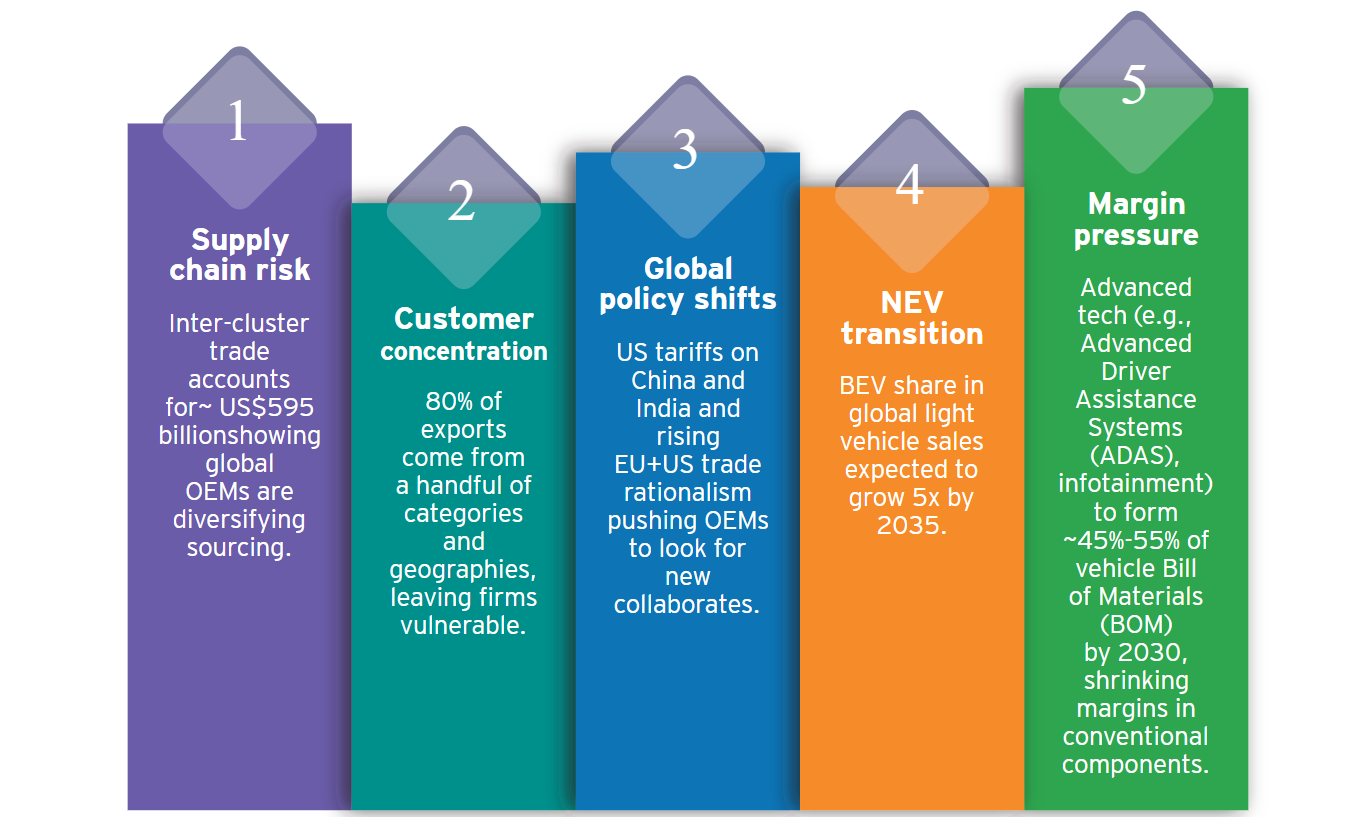
Different diversification strategies
Rebalancing growth, value and outcomes in India’s healthcare
Rising care complexity, early-onset chronic diseases and widening outcome gaps are pushing India’s healthcare system toward a decisive reset. The future lies in shifting from episodic, cost-led care to longitudinal, outcome-driven and digitally integrated models that improve quality, equity and sustainability at scale.
- Hospitalizations could triple by 2047 without a shift to preventive and lifecycle-based care.
- Longitudinal care models can reduce projected hospitalizations by 20%–30%.
- Tiered accreditation and outcome-linked reimbursement can strengthen trust and accountability.
- Digital integration through interoperable health records is critical to coordinated, value-based care.
Ready to reimagine healthcare delivery for outcomes, trust and long-term value?
Powering the nuclear revival for a resilient energy future
Clean, reliable and scalable energy is no longer optional. As utilities face decarbonization targets, energy security concerns and rising demand, nuclear power is re-emerging as a crucial pillar of the future energy mix. The next phase of the nuclear revival will be defined by modernized technology, new delivery models and stronger collaboration across the ecosystem.
- Nuclear energy offers stable, zero-carbon baseload power to support energy transition goals.
- Advanced reactors and small modular reactors (SMRs) are improving safety, flexibility and deployment speed.
- Utilities must rethink financing, supply chains and regulatory engagement to unlock nuclear’s full potential.
- Workforce readiness, digitalization and public trust are also essential for long-term success.
Is your organization ready to lead in the next chapter of the nuclear energy transformation?
The power of commercial and supply chain collaboration
Supply chains are evolving into shared-visibility networks where suppliers, manufacturers, logistics partners and commercial teams operate as one connected system. Data-driven collaboration enhances forecasting, improves throughput, reduces bottlenecks and unlocks cost advantages across the value chain.
- Multi-party integration builds resilience and cost efficiency.
- Shared visibility improves demand prediction and delivery performance.
- Commercial-supply chain alignment accelerates response to market shifts.
- The future favors collaborative ecosystems not isolated vendor models.
Ready to unlock integrated, high-resilience supply chain performance?
- Consumer products companies can see gains in commercial and supply chain efficiency through an integrated approach to portfolio and supply chain management.
- Companies can simplify product portfolio complexity by 20% or more and significantly improve responsiveness to customers.
- The supply chain can be tailored to the streamlined product portfolio to enhance operational efficiencies and maximize capacity.
CEO and CXO FAQs: Actionable insights on AI, business strategy, innovation and global competitiveness
About the authors

Hari Balaji
Partner, Technology Consulting, Generative AI | AI-led Transformation, EY India

Som Kapoor
Partner and Leader, Future of Mobility, EY-Parthenon India

Kaivaan Movdawalla
Partner and Healthcare Sector Leader, EY-Parthenon India

Thomas J. Flaherty, III
EY-Parthenon Senior Advisor, Strategy and Transactions, Ernst & Young LLP

Mile Milisavljevic
Principal, EY-Parthenon, Ernst & Young LLP

Dr. Michael Albritton
EY-Parthenon Principal, Strategy and Transactions, Ernst & Young LLP