







EY refers to the global organization, and may refer to one or more, of the member firms of Ernst & Young Global Limited, each of which is a separate legal entity. Ernst & Young Global Limited, a UK company limited by guarantee, does not provide services to clients.
EY Competency Connect - Smarter talent decisions, powered by AI
AI Academy helps enterprises scale AI skilling initiatives to upskill their workforce, equipping them to adapt and innovate in the GenAI era. Its training modules are tailored to deliver measurable business impact—driving revenue growth, lowering operational costs, improving customer experience, and mitigating risks.
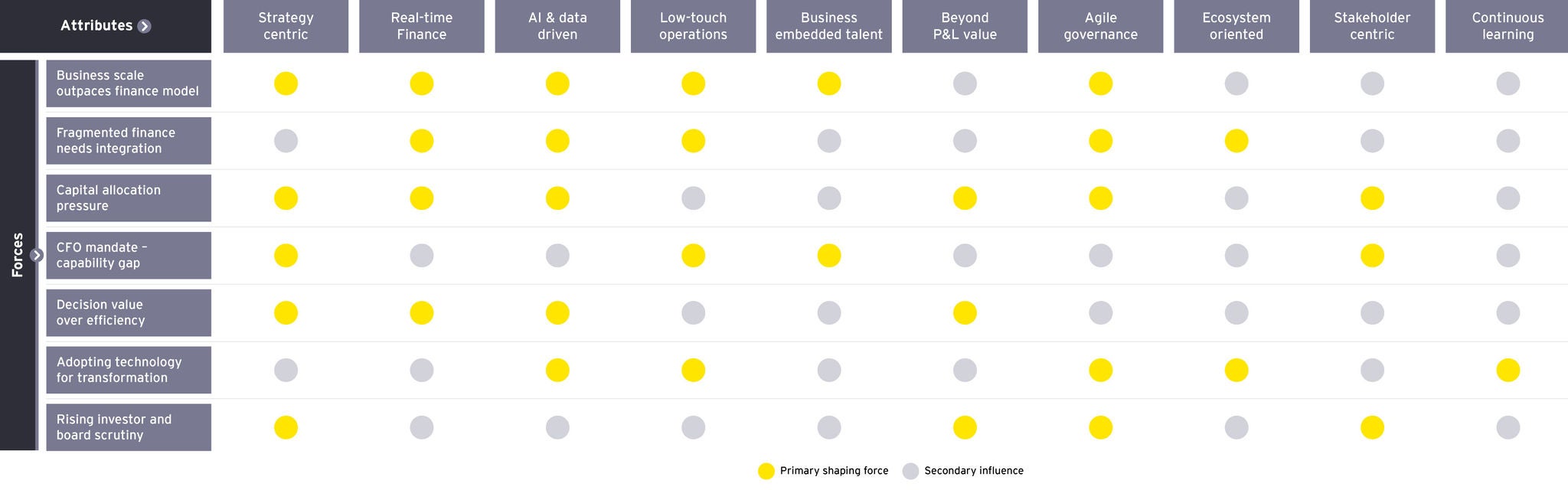
Seven forces driving finance transformation
Against this backdrop, the finance agenda is being reshaped by seven structural forces. Together, they explain why traditional finance models are no longer fit for purpose and why CFOs must rethink the finance operating model end-to-end. These pressures are not isolated challenges to be managed independently; instead, each force places new demands on finance and collectively redefines the CFO’s role and the finance operating model required to support it.
- The business has outgrown the current finance model
Modern organizations operate in volatile, capital-constrained and stakeholder-centric environments. While business demands continue to grow, many finance functions remain focused on periodic reporting, manual processes and retrospective assessments, which creates strategic obstacles.
- Integrating core and niche finance functions
CFOs reach the next level of maturity by connecting core domains (R2R, O2C, P2P, FP&A) with specialized functions (tax, treasury and risk). Integration transforms outcomes, turning finance from a reporting function into a forward-looking value driver.
- Capital allocation is the burning platform
Partial visibility and slow scenario analysis limit decision-making. Continuous forecasting, trade-off analysis, and insight into key value drivers enable agile, strategic and ROI-driven choices.
- The CFO mandate has expanded faster than the finance engine
CFOs now co-own strategy, portfolio decisions and growth, while finance remains heavily transactional. The gap between accountability and capability makes finance strategically irrelevant.
- Efficiency is not the primary argument
Transformation is not merely about cost-cutting. Real value comes from making better investment decisions, delivering enhanced forecasts, providing faster responses to risk and enabling confident stakeholder communication. One improved decision can outweigh years of incremental cost savings.
- Technology enables change but does not define it
AI and automation accelerate processes, but true transformation requires redesigned processes, new skills, governance and disciplined data management. AI has become a dominant operating system, orchestrating humans, systems and workflows to create value.
- Investor activism and growing board expectations
Stakeholders demand clear narratives linking strategy, KPIs and financial outcomes. A transformed finance function strengthens the CFO’s license to lead the enterprise value story.
Together, these seven forces make one thing clear: the current finance operating model is no longer fit for the scale, speed and complexity of modern enterprise decision‑making. However, understanding the drivers is only the first step. The real question is what the finance function must become in response. The answer is a future‑ready finance organization — one that is insight‑led, technology-enabled and deeply embedded in business decision cycles.