





EY refers to the global organization, and may refer to one or more, of the member firms of Ernst & Young Global Limited, each of which is a separate legal entity. Ernst & Young Global Limited, a UK company limited by guarantee, does not provide services to clients.
Recent Searches

How Indian banks can turn digital momentum into intelligent and trusted growth.
In brief
- India’s next-gen customers expect seamless, mobile-first banking that mirrors their cross industry everyday digital experiences.
- Despite the progress in digitization, banking customer onboarding often remains fragmented, tedious and inconsistent.
- Banks that simplify customer onboarding journey and responsibly adopt newer technologies such as GenAI can have differentiated customer experience.
India’s digital-banking platform market is projected to rise from US$776 million in 2021 to about US$1.48 billion by 2028.[1] The COVID pandemic accelerated banks’ shift towards digital services, mobile banking and mobile-first experiences, making mobile-first onboarding the default.
At the same time, India’s demographic landscape is evolving rapidly. With a population of around 1.45 billion, Gen Z (12–27 years) makes up 377 million, and Gen Alpha (born 2010–2025) is emerging as the next dominant cohort.
These generations are digital natives, accustomed to managing their lives through smartphones. For them, visiting a bank branch for routine tasks is not just inconvenient, it is ‘irrelevant’.
What this generation seeks is speed, simplicity and personalization—banking that feels as seamless as the apps they already use. To meet their growing expectations, the question for banks is no longer whether services are digital, but how intelligent, adaptive and tailored those digital experiences can be. This has made customer onboarding transformation a strategic imperative.
That is where ‘Generative AI (GenAI)’ comes in. With adaptive, self-learning capabilities, GenAI in banking can transform the very first interaction between banks and their customers by powering intelligent onboarding solutions. Institutions that balance innovation with governance and trust can redefine customer acquisition and loyalty.
Digital customer onboarding: A market ready for intelligence
With digital banking being the minimum baseline, customers expect fast verification, real-time updates and seamless account maintenance. Every onboarding moment across savings accounts; loans, credit cards, insurance policies and investments must meet the standard.
To assess how well institutions are delivering on these expectations, EY studied digital savings-account opening journeys across five Indian banks, including public, private and small finance banks.
Strong progress was evident:
Paper-heavy onboarding has given way to mobile-driven processes and steps like video KYC verification and digital signatures are firmly established. At the same time, challenges remain, including the following:
Figure 1: Current challenges in banking customer onboarding
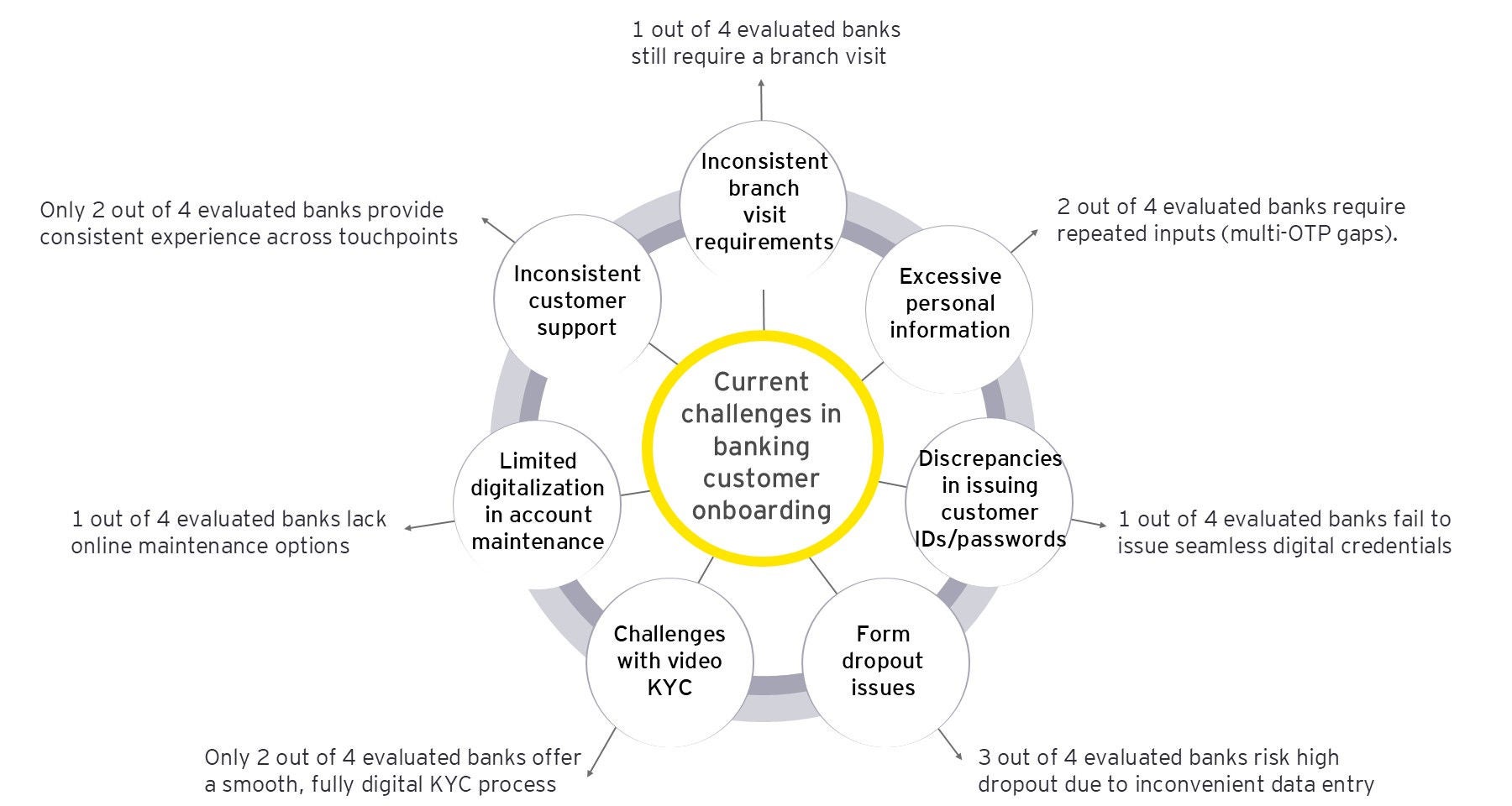
These frictions lengthen activation times and quietly chip away at customer confidence as “digital” does not always mean “effortless.”
Technology’s expanding role: GenAI in banking
The study by EY highlighted that while banking technology adoption has accelerated, customer experience is uneven. Some banks provide end-to-end digital journeys, while others still require manual touchpoints that slow down account activation. These issues not only extend the onboarding time but can also negatively impact customer satisfaction. To address challenges, well-defined customer journeys across all onboarding touchpoints, whether for an account, loan, card, or policy, must be supported by digital technologies and process automation that streamline operations, reduce manual effort and enable consistency.
Gen AI adds a new layer of intelligence. It can personalize onboarding flows in real time, support nuanced fraud detection and enable conversational agents that guide customers through requirements with greater clarity. With Gen AI, banks can track micro-journeys, identify the precise moments where applicants hesitate and test corrective actions in near real time, turning onboarding into a living system that continually improves itself.
The shift will not be just from paper to mobile, but from static processes to adaptive ones that learn and improve continuously.
Looking ahead
India’s digital-banking market is entering a new phase where convenience is expected and intelligence is the true differentiator. Banks would need onboarding processes that are fit for purpose today, while also preparing for the next wave of GenAI-powered digital transformation. By addressing current customer pain points and adopting intelligent solutions, banks can turn onboarding into a demonstration of trust, adaptability and care, setting the benchmark for years to come.
Step 1: Customer journey enhancement
Today, some banks are still catching up. Delivery of basic frictionless digital journeys can be inconsistent across products. Therefore, the focus should be on making onboarding seamless, consistent and reliable across all touchpoints:
- Customer communication: Provide clear instructions and account-opening procedures to build trust and transparency.
- Simplify verification: Use tools like facial recognition or OCR scanning to shorten approval times and reduce manual review.
- Communicate charges transparently: Show charges and fees of all products and services in a simple, easy-to-understand format.
- Digitalize account updates: Offer seamless digital options to update email, phone and address details.
- Enable digital account closure: Let customers close accounts entirely online for a smooth experience.
- Clear branch-visit guidelines: To reduce uncertainty, explain in advance when and why a branch visit might be needed.
Step 2: GenAI adoption
For banks, a major opportunity lies in building journeys that are not only digital but intelligent. Once baseline digital journeys are stabilized, GenAI in banking offers the chance to transform onboarding into something more than a compliance exercise. It can become the first demonstration of trust, adaptability and customer care. Those who move decisively yet responsibly will set the benchmarks for onboarding in the years ahead. Below are few use cases of utilizing Gen AI in customer onboarding in banking:
- Predictive personalization: Recommend products and next best actions based on real-time customer behavior.
- Intelligent service bots: Deploy chat and voice assistants to handle complex queries and continuously learn from interactions.
- Smart compliance: Monitor transactions and flag risks proactively, reducing manual effort.
- Continuous learning loops: Incorporate customer feedback into AI models to refine onboarding and servicing in real time.
By adopting GenAI responsibly and balancing ambition with governance around data privacy, fairness and accountability, banks can set the benchmark for onboarding that is both intelligent and trusted.
Summary
The future of digital customer onboarding in banking is about addressing today’s gaps while building for the customer experiences tomorrow. By addressing current frictions and using intelligent solutions responsibly, banks can turn every first interaction into a moment of trust, build stronger relationships and set the standard for the next-gen banking experience.
How EY can help
-
Payment services and solutions at EY India help drive innovation, enhance security, and optimize performance in the evolving digital payments ecosystem.
Read more -
Automated Reporting Tool (ART) is an end-to-end regulatory reporting automation platform that simplifies financial reporting, enhances accuracy, and reduces compliance risks for banks, NBFCs, and insurers.
Read more -
EY LLM solution transforms India's BFSI sector by addressing 29 key themes, enabling compliance, improving cost efficiency, and enhancing customer service integration. Find out more.
Read more
Related articles
From pilots to scale: How financial services firms invest in technology
FS firms in 2025 focused on cloud, AI, cybersecurity, core modernization, and customer experience; 2026 priorities shift to ROI, governance, and cost optimization.
RBI gold loan guidelines 2025: Impact assessment and key changes
Read our full report on the significant changes in RBI's Gold Loan Guidelines for 2025 and their potential impact on the financial landscape in India.
How financial services are adapting to global outsourcing trends
Explore GBS evolution in financial services, addressing regulatory challenges, digital transformation, and AI innovation for operational excellence.