







AI treasury transformation

How agentic AI is transforming treasury beyond spreadsheets 

CFOs and treasurers can build AI-ready treasury functions through strong data foundations, governance and trust. 


 In brief

  • Most treasury bandwidth goes toward aggregating data, manually validating figures and producing reports that may be outdated before they reach decision-makers.
  • Organizations that deploy AI on fragmented data see inconsistent outputs. The fix starts with a governed treasury datalake architecture, not the AI tool itself.
  • The shift from manual coordination to intelligent treasury operations happens in phases. Governance and data readiness come before scale, not after.

Finance and treasury functions have spent the last few decades running on spreadsheets. For much of that time, the spreadsheet was among the best tools available. That is no longer the case. The EY white paper, ‘From spreadsheet heroics to autonomous treasury: An agentic AI adoption playbook for CFOs and treasurers,’ reveals that a large share of bandwidth among treasury analysts and managers goes toward aggregating data across systems, manually validating figures against counterparty thresholds and producing reports that are frequently outdated before they reach decision-makers. A typical mature treasury function runs between 50 and 100 interconnected spreadsheets covering cash positioning, foreign exchange (FX) exposure, investment tracking, debt management and regulatory reporting. Each one is a silo with its own version control and associated risk of error. This spreadsheet dependency is not a cosmetic problem. It is a structural barrier to treasury digital transformation.

DigiTreasury  Technology Solutions

DigiTreasury is an advanced, integrated treasury analytics platform, delivering data-driven insights to the C-Suite and treasury function.

Know more

Why AI pilots keep failing

The most common reason AI experimentation in treasury does not scale is a sequencing error. Organizations deploy AI tools on top of fragmented treasury data governance structures and the outputs are inconsistent. Treasury teams trial the tool, observe inconsistent recommendations and revert to their spreadsheets. The root cause is a weak data foundation, not a limitation of the technology.
 

A well-structured treasury datalake architecture consolidates structured data from ERP and Treasury Management System (TMS) platforms alongside unstructured inputs such as contracts, emails and market data. It creates a single, governed source of truth. Without this foundation, no AI layer produces outputs that treasury professionals will trust or act on. Building the datalake before deploying agentic AI in treasury is not optional. It is the prerequisite.
 

The architecture that underpins sustainable treasury workflow intelligence has four distinct layers, each of which should be designed deliberately:

How treasury workflows change with agentic AI

The shift to agentic AI in treasury does not happen in one step. It begins at the workflow level, where digital processes replace manual handoffs with system-driven execution. At scale, these changes create smart treasury workflows where routine coordination runs without human intervention.

In FX risk management automation and interest rate risk management, agents ingest real-time exposures alongside live market data, run multiple hedge scenarios in minutes and auto-generate IFRS-compliant documentation with a full audit trail. In AI-powered cash flow planning, agents aggregate multi-bank, multi-currency balances in real time and flag funding gaps 30 to 60 days ahead with measurable forecasting accuracy.

What this means for treasury professionals

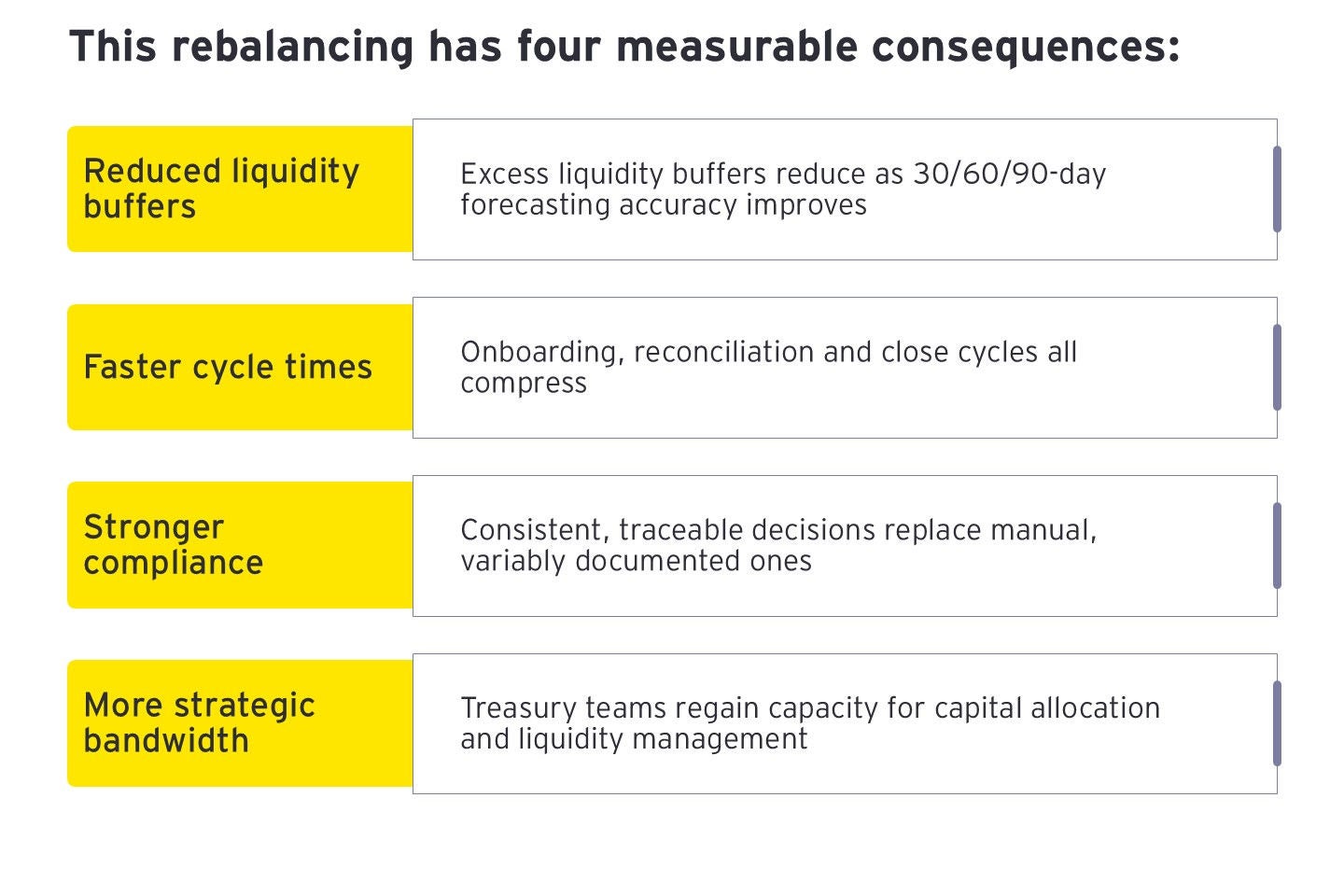
Enhancing treasury professionals’ capabilities involves giving them quicker access to information, clearer insights and decision support that highlights the right questions at the right time.

This rebalancing has four measurable consequences:

four-measurable-consequences

AI-powered technology solutions tailored for every business need

EY India delivers technology solutions to drive digital transformation, improve efficiency, manage risk, and support industry-specific business goals.

Know more

A treasury automation roadmap built on trust

 Scaling agentic AI in treasury demands a disciplined approach. The recommended practice is to wrap AI agents around existing systems via APIs rather than overhauling core infrastructure.
 

Three principles govern responsible expansion:

  • Keep agents in advisory mode before granting autonomous execution.
  • Establish governance councils, approval workflows and audit logging before expanding scope.
  • Measure liquidity buffer reduction and cycle time, not just model accuracy.

This is what a credible treasury automation roadmap for CFOs looks like in practice.
 

The phased roadmap runs across 18 months, from a single high-impact pilot in cash forecasting automation or cash reconciliation automation toward a Treasury Center of Excellence (CoE) that owns the datalake pipelines, the agentic workflow library and the governance framework for the global treasury function. The Treasury CoE operating model becomes the mechanism through which intelligent treasury operations develop and improve over time.

Download the full pdf

Learn more about how Agentic AI is transforming treasury operations

Summary 

The business case for treasury digital transformation is rarely the primary obstacle. The more significant barriers are gaps in treasury data governance, fragmented data infrastructure and the organizational tendency to scale before the foundational work is in place. CFOs and treasurers who address the data layer first, govern early pilots with appropriate rigor and expand only after outcomes have been validated will build treasury functions capable of making better-informed decisions with greater efficiency. A structured approach that incorporates maturity assessment frameworks, governance design and CoE operating models can help organizations accelerate adoption while strengthening decision-making, operational efficiency and long-term value creation.

Related articles

How GenAI is driving real estate transformation with actionable insights

Explore how GenAI is reshaping Indian real estate by accelerating decisions, reducing delays and enabling data-led planning, sales and customer engagement.

Agentic AI governance: Why Indian enterprises need a new control model

As AI agents become autonomous, organizations need strong Agentic AI governance to manage risk, security, accountability and continuous oversight at scale.

How AI governance supports confident and responsible growth

AI governance is now a boardroom priority. Find out why enterprises should embed accountability, oversight and trust in AI-driven decisions.

About this article