



EY refers to the global organization, and may refer to one or more, of the member firms of Ernst & Young Global Limited, each of which is a separate legal entity. Ernst & Young Global Limited, a UK company limited by guarantee, does not provide services to clients.
Recent Searches

In 2024, BRICS+ accounted for 42.5% of global GDP based on Purchasing Power Parity (PPP) and 54% of the global population.
In brief
- Increasing share of BRICS+ in global GDP, population and trade may facilitate the evolution of the global economy towards a multilateral system.
- With the share of BRICS+ in global merchandise exports steadily increasing between 2000 and 2024 and that of G7 moderating, they are now at comparable levels.
- New development is expected to play a key role in providing accessible infrastructure financing for BRICS+ members.
- As the market exchange rates converge towards the PPP$ rate, India could be the largest gainer in terms of size of GDP.
Rising importance of BRICS+ group
The 17th BRICS+ summit was held in Rio de Janeiro during 6-7 July 2025. BRICS+ group presently has 10 members and nine partners. The 10 BRICS+ member countries are: Brazil, Russia, India, China, South Africa, Egypt, Ethiopia, Indonesia, Iran, and United Arab Emirates (UAE). Its nine partner countries include Belarus, Bolivia, Cuba, Kazakhstan, Malaysia, Nigeria, Thailand, Uganda and Uzbekistan1. The BRICS+ group represents a diverse set of countries, some of which are resource rich in terms of availability of crude and other mineral resources, some have higher per capita incomes and some, relatively large population.
BRICS+ countries together accounted for
54%
54%
of world population in 2024.
With respect to the share of BRICS+ group in global GDP, there are significant differences when measured in US$ market exchange rate terms vis-a-vis purchasing power parity (PPP) terms. In 2024, its share was 28.9% in market exchange rate terms. In PPP terms, which is more representative of relativity in economic activities, it was 42.5% in 2024, higher than its corresponding level in 2000 by 18.5% points. Further, in 2024, the per capita GDP (PPP terms) of the BRICS+ group, representative of the Global South, was 0.8 times the global per capita GDP. This relativity was at three for the G7 group, which represents the Global North.
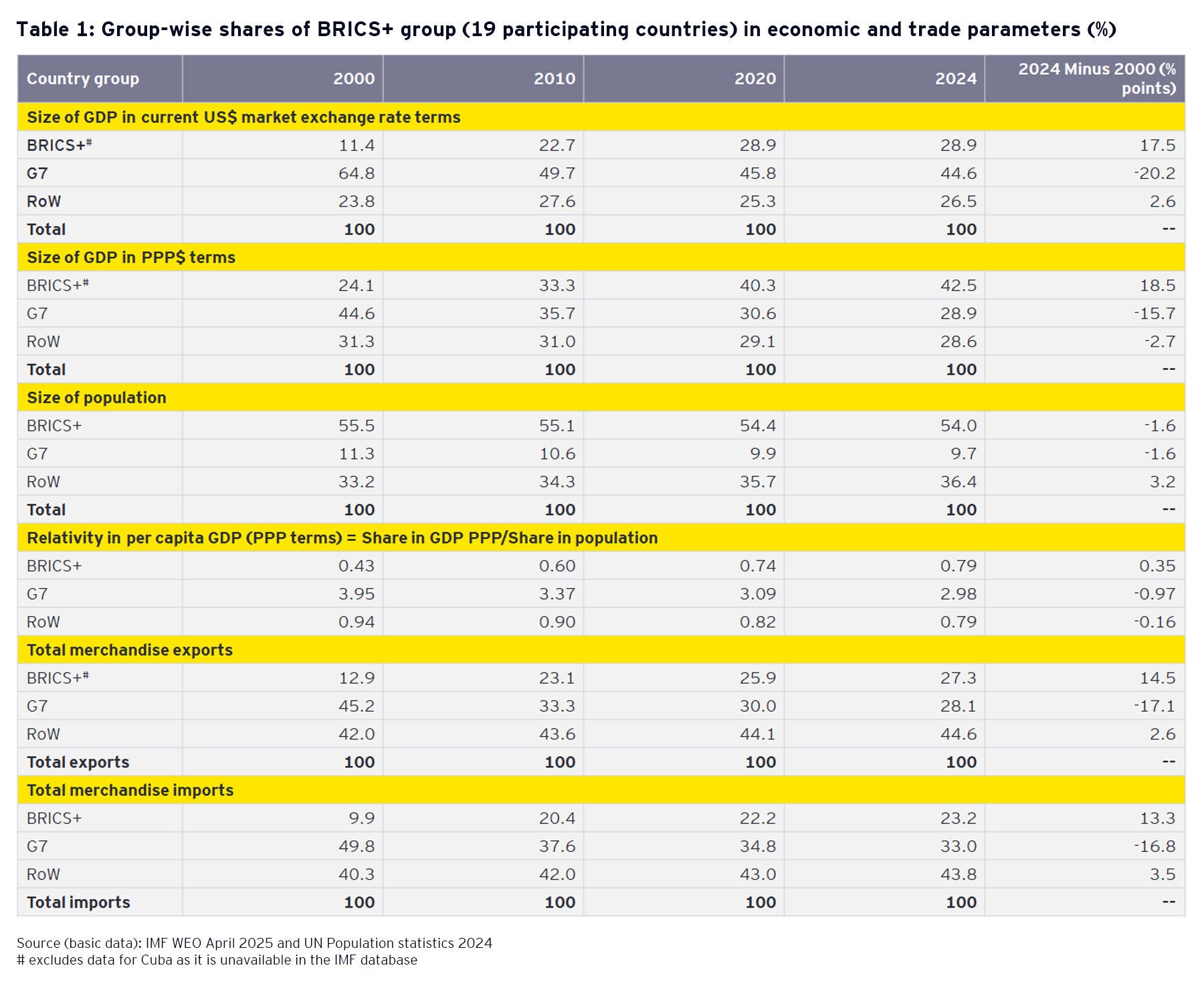
Table 1 shows that in terms of share in global merchandise exports, BRICS+ showed a steady increase from 12.9% in 2000 to 27.3% in 2024, an increase of 14.5% points. This share for G7 declined from 45.2% in 2000 to 28.1% in 2024, becoming comparable to that of BRICS+. A similar pattern prevails in the case of merchandise imports. Thus, the growth in BRICS+ shares of exports and imports closely corresponds with a reduction in the respective shares of the G7 group.
The BRICS+ group is not positioning itself as opposed to any other country bloc or platform, but its growing share in terms of various economic and trade parameters may facilitate the evolution of the global economy towards a multilateral system.
Comparisons of market exchange rate and PPP$
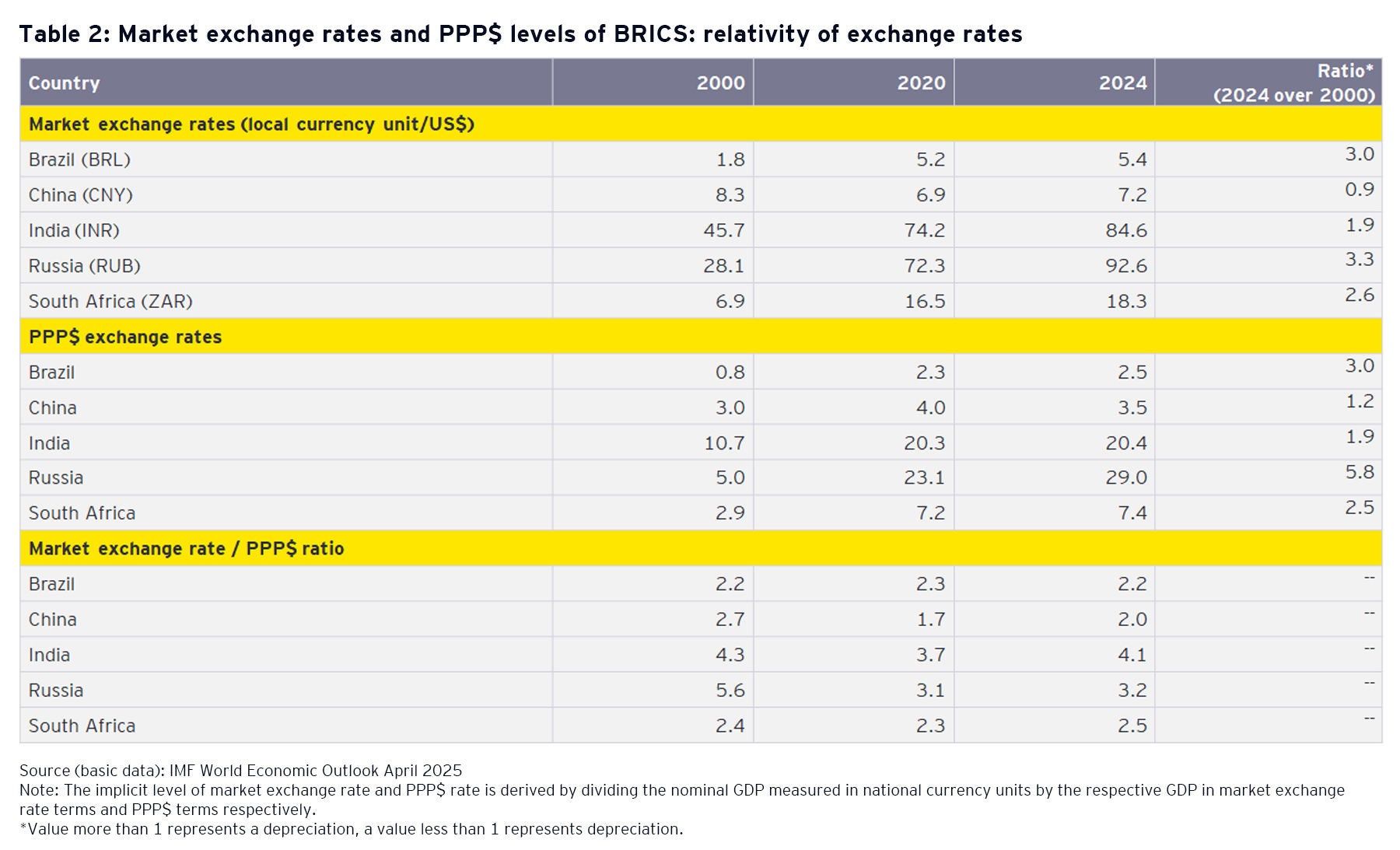
Table 2 shows that, for all BRICS countries, except China, the (market) local currency exchange rate measured in terms of local currency unit per US$ has depreciated over time. The INR depreciated by just a little less than two times. There is a comparable level of depreciation in PPP terms also for India. With respect to the relativity of market exchange rate to PPP$, India had the largest magnitude at 4.1 in 2024 while in the case of Brazil, China and South Africa, it ranged between 2 to 2.5. As the market exchange rates converge towards the PPP$ rate, India could be the largest gainer in the size of its GDP. Such convergence may happen when the market exchange rate is driven by the relative purchasing power parities.
Progress in key BRICS+ development priorities: Payments platform, BRICS bank, and Contingent Reserve Arrangement (CRA)
The BRICS+ group has undertaken three key institutional initiatives namely BRICS payment system, a BRICS bank called the New Development Bank and BRICS Contingent Reserve Arrangements (CRA). These initiatives have evolved over time and are becoming progressively more effective.
BRICS+ cross-border payment system
The BRICS+ group is promoting greater use of local currencies in global trade transactions and settlement frameworks. In this context, the BRICS+ group has developed a cross-border payments platform based on blockchain technology. A key theme of the 17th BRICS+ Summit was to assess this platform’s progress. On this platform, trade among BRICS+ participants and even with countries outside of this group is likely be denominated in local currencies. With such a mechanism, the US dollar may not be necessary for pricing or conducting transactions. Thus, BRICS+ group’s cross-border payment initiative is likely to help not only in the creation of the platform to promote increasing use of local currencies in global trade but also promote financial stability, investment and economic growth in the BRICS+ countries.
BRICS bank
In this context, BRICS bank, named the New Development Bank, is expected to play a key role in providing investment flows into the BRICS+ countries through loans and credit arrangements that may be given at relatively modest interest rates and near condition-free financing.
BRICS Contingent Reserve Arrangement
Another institutional arrangement of BRICS+ pertains to the BRICS Contingent Reserve Arrangement (CRA). This is a framework established by BRICS nations to provide short-term liquidity support through currency swaps during balance of payments crises. It aims to mitigate potential crises and strengthen financial stability among member countries.
The emphasis of the BRICS+ group policies is to promote intra-BRICS trade undertaken in local currencies using the BRICS payment platform. In addition, they are also promoting relatively condition-free flow of financial resources that can enhance investment including that in infrastructure in the BRICS+ participating countries thereby promoting BRICS+ economic growth.
Given current trends, we expect that the BRICS+ group would account for more than 50% of global GDP in PPP terms by 2030, both due to growth prospects of the current members and partners and induction of additional countries into the group.
Download the full pdf
Summary
The BRICS+ initiatives — BRICS payment system, New Development Bank and BRICS Contingent Reserve Arrangements — are aimed at promoting growth, global trade, and a multilateral trading system in the world.
How EY can help
-
Watch provides an in-depth review of salient developments in India’s macro economy and economic policy in a global context.
Read more -
Tax policy advisory services by EY India offers insights & strategies to navigate complex tax regulations, driving business growth and compliance.
Read more -
EY offers integrated tax advisory and compliance services to optimize tax strategies, meet regulatory demands, and drive long-term business value.
Read more
Related articles
Budgeting for defence expenditure
India's defence needs a 3% GDP benchmark to ensure modernisation, steady funding, and Aatmanirbhar growth amid fiscal constraints and global challenges.
How India is advancing its EO/IR tech for multi-domain surveillance
Is India ready to lead multi-domain surveillance? Explore EO/IR systems' role in security, tech trends, industry growth, and Aatmanirbhar Bharat's goals.
Getting India future-ready: Role of rare earth elements
Rare earth elements are key to India's future. EY explores the role of rare earth metals, minerals & elements technology in mining industry to drive growth.