







India’s workforce reimagined: Preparing organizations for talent reset

India’s workforce reimagined: Preparing organizations for talent reset

Related topics

India’s workforce is being reimagined through strong culture and AI adoption—but execution will define productivity and long-term workforce confidence.


In brief

  • The EY Work Reimagined Survey 2025 shows India leading global GenAI adoption — with 88% of employees using AI at work and 37% using it daily — accelerating productivity and changing how work gets done.
  • India ranks highest globally on talent health (82%), anchored in strong culture, trust and empowerment, even as AI-driven work intensity rises.
  • Structured AI learning and balanced rewards are key to engagement and retention, with AI skills directly linked to higher productivity and lower intent to leave.

India’s workforce is at an inflection point. Workplace expectations are shifting, technology is changing how roles are designed, and employees are reassessing what truly matters in their careers. Organizations now face the challenge of not just attracting talent, but also maintaining engagement, trust, and performance in a quickly changing environment.

Findings from the latest EY Work Reimagined Survey 2025 reveal that generative AI is moving from experimentation to everyday use, placing India among the leading markets in workforce transformation. Insights from 800 employees and 50 employers in India point to a resilient, engaged workforce, underpinned by a strong cultural foundation.

What stands out is not just the pace of change, but how employees are responding to it. High levels of trust, connection and empowerment suggest that many organizations are navigating this transition with intent. 

AI adoption and workforce impact

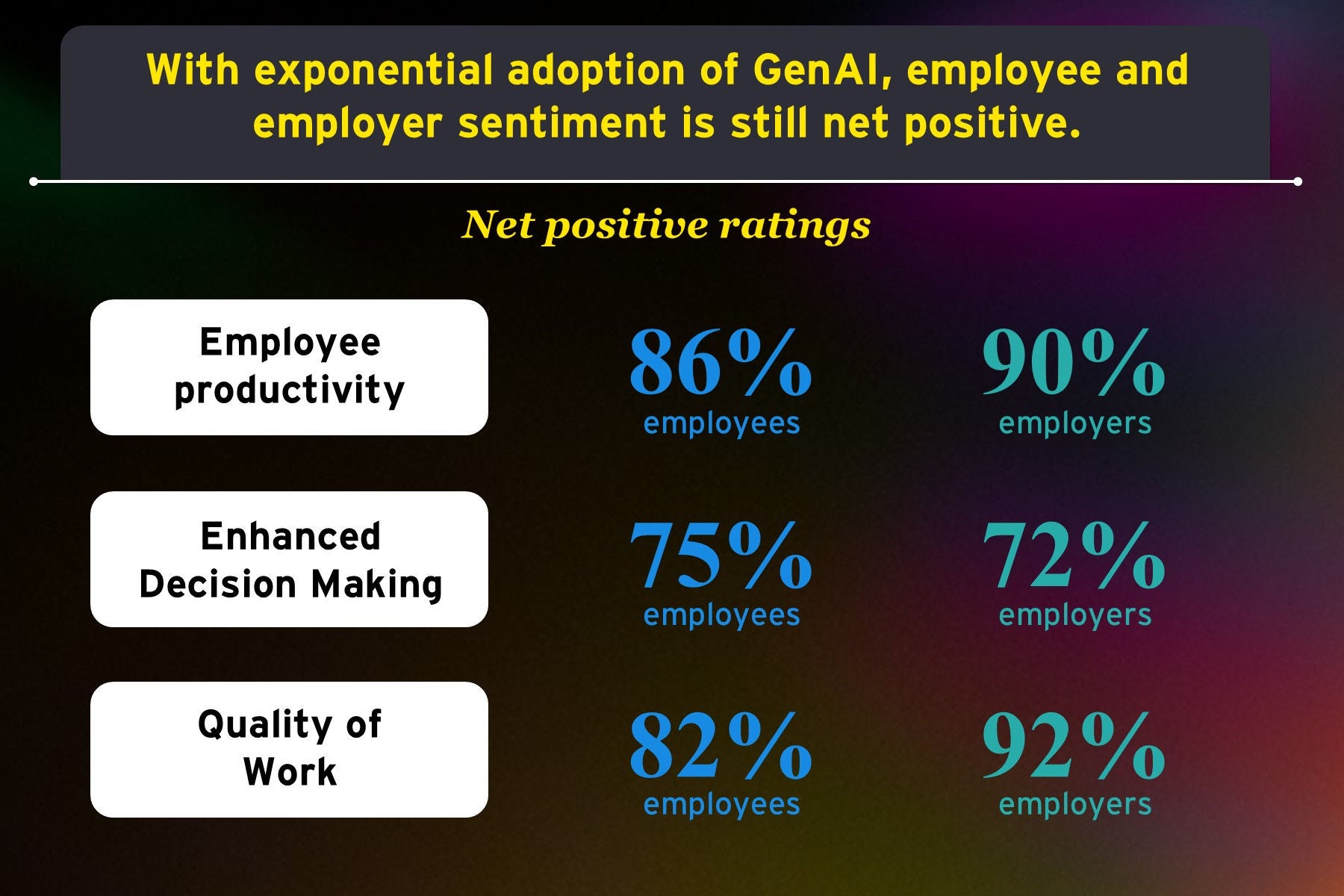
The scale of GenAI adoption in the workforce is unprecedented. Nearly 9 in 10 employees now use AI at work, with more than a third doing so daily. This widespread adoption reflects how deeply GenAI at work in India is influencing productivity, decision-making and output quality. For many organizations, AI is already embedded into core workflows, accelerating employee productivity with AI and reshaping how work gets done.

Net positive ratings

While AI enables efficiency gains, it has also contributed to rising workloads. A significant proportion of employees report that work intensity has increased over the past year, suggesting that AI is often layered onto existing roles rather than driving role redesign. At the same time, concerns about the AI impact on jobs remain. These dynamics underscore the importance of responsible AI governance. Although confidence in ethical AI use is high, employees consistently express more caution than employers around transparency, explainability, and data confidentiality. As AI becomes more widely used in workplaces, closing this perception gap will be key to sustaining trust.

Rewards and priorities

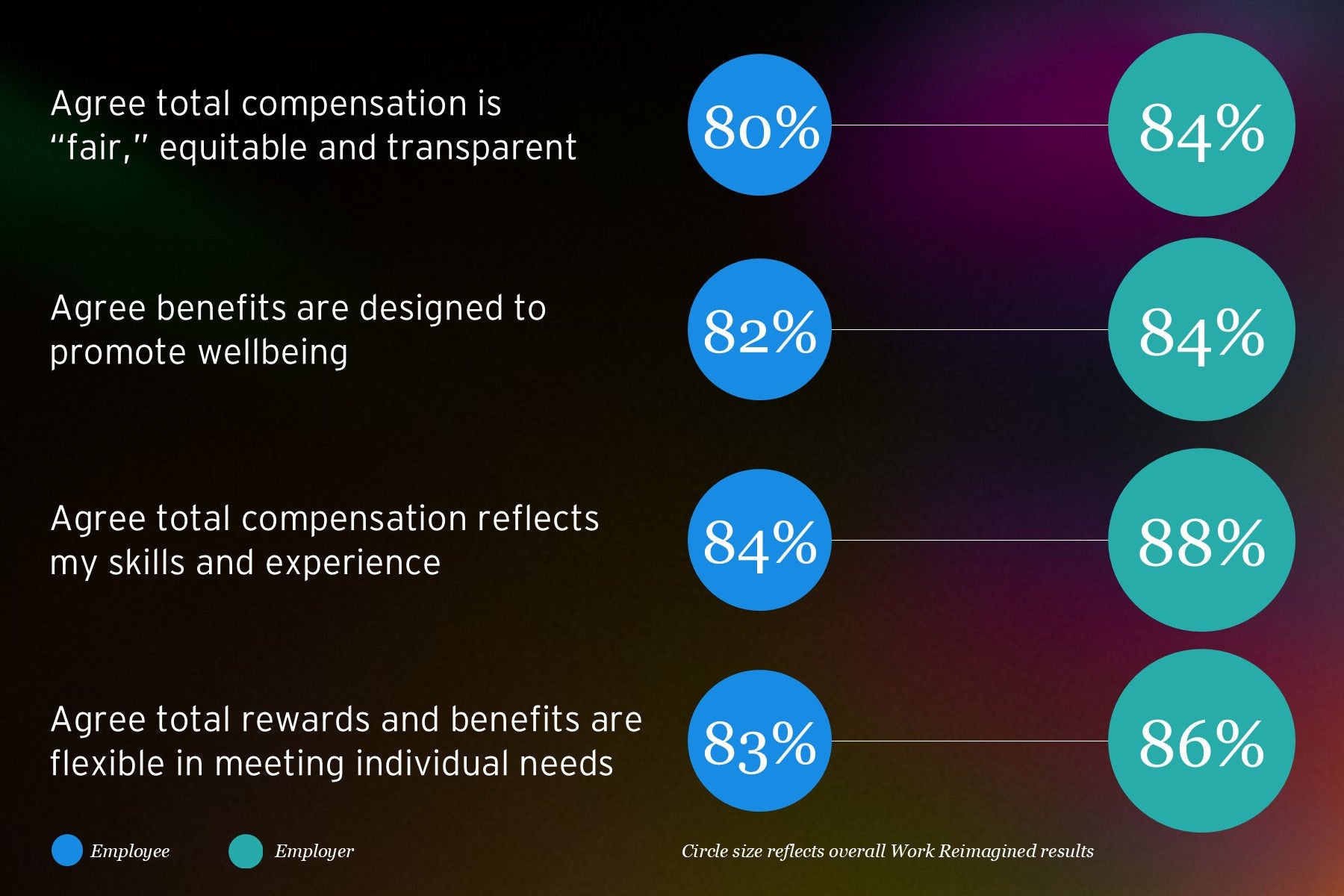
The findings reveal that rewards continue to play a central role in shaping employee experience in India. They contribute roughly 32% to India’s Talent Health score, reinforcing their importance in engagement and retention. Employees remain focused on fundamentals such as performance-linked pay, flexibility, cost-of-living aligned compensation, and wellbeing benefits. Employers, meanwhile, are increasingly prioritizing future-oriented offerings, including AI initiatives, alongside traditional rewards. 

Circle size reflects overall work reimagined results

AI Academy Empowering GenAI training and talent transformation

EY India AI Academy offers GenAI upskilling programs for data scientists, data engineers, and GenAI engineers with role-based learning paths & trainings.

Know more

For organizations navigating workforce transformation in India, the implication is clear: reward strategies must balance immediate employee needs with future readiness. Those that align compensation, flexibility and wellbeing with evolving skill requirements will be better positioned to maintain engagement in a competitive talent market.
 

Learning and skills

The role of AI in the workforce has amplified the importance of continuous learning. Skill development is widely recognized as essential, with 87% of employees and 90% of employers agreeing on its importance. Yet despite this shared understanding, actual investment in structured AI learning remains limited for many employees.
 

The data shows a strong link between AI skills development, productivity and retention. Employees who spend more time building AI capabilities report significant time savings each week and show lower intent to leave. This connection between AI learning and workforce retention reinforces the business case for moving beyond ad hoc training toward structured, role-based learning pathways.

Most employees report less than 40 hours dedicated to AI learning per year

41 - 80 hours

5 - 40 hours

81 + hours

< 4 

36%

30%

28%

7%

EY Competency Connect - Smarter talent decisions, powered by AI

Explore Competency Connect by EY India – an AI-driven talent assessment platform that enables smart hiring, skill-gap analysis, and workforce planning.

Know more

As GenAI reshapes work in India, organizations will need to embed learning into everyday work, career progression, and workforce planning. Effective future-ready workforce strategies in India will treat upskilling not as a benefit, but as a strategic lever for performance and resilience.
 

Talent health and culture

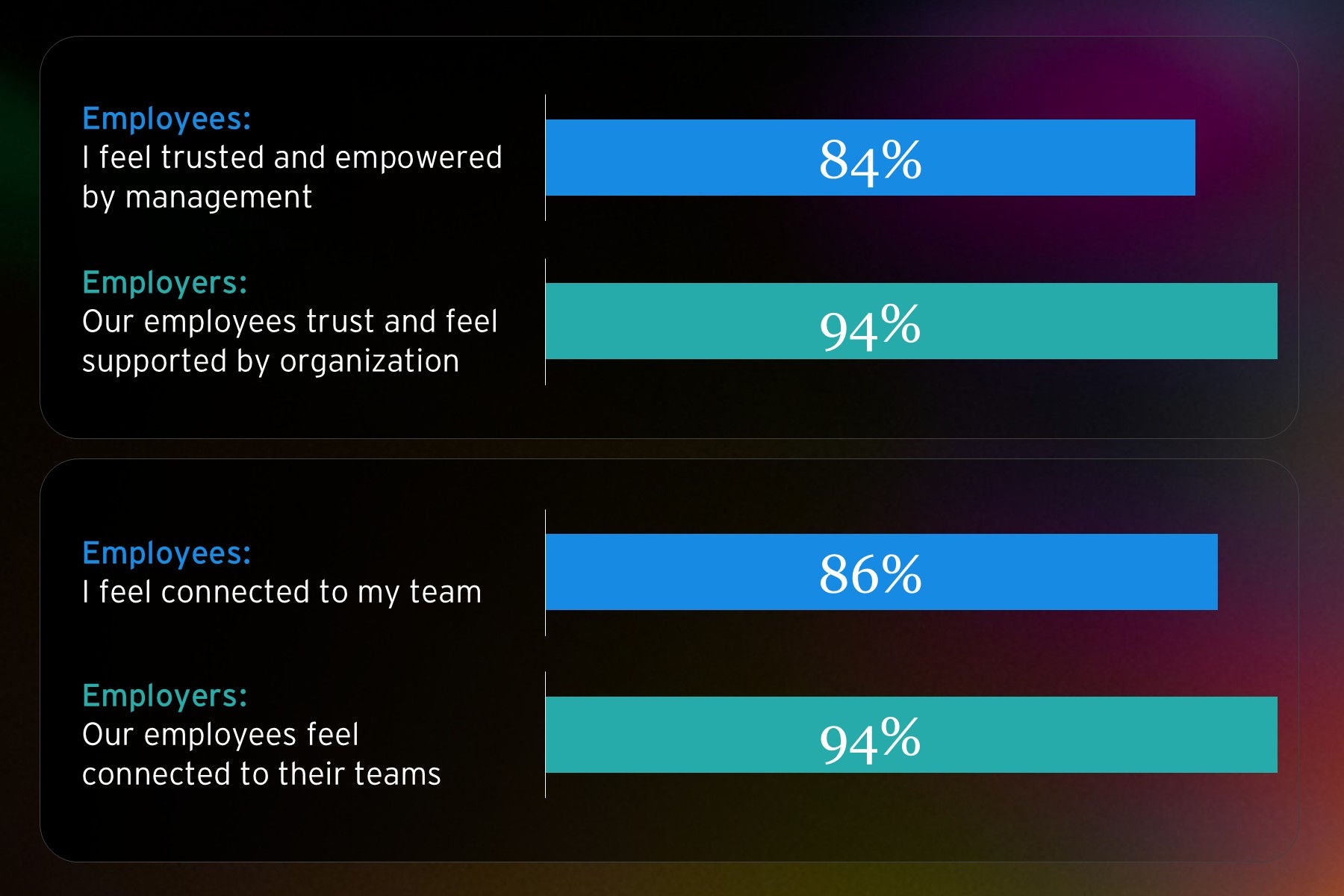
India’s leadership in talent health is underpinned by a strong cultural foundation. Culture accounts for about 40% of the overall talent health score, making trust, empowerment and team connection central to the employee experience. High levels of trust and collaboration continue to differentiate Indian workplaces, even amid rapid technological change.
 

Encouragingly, most employees and employers believe workplace culture has improved since 2021. This momentum suggests that organizations are making progress in combining innovation with human-centric values. In AI-driven workforce transformation, culture acts as a stabilizing force—helping employees adapt to change while maintaining engagement and confidence.

Talent health and culture

Ultimately, the survey highlights a clear insight: the link between AI and talent health is undeniable. While technology may drive efficiency, it is culture, learning, and trust that determine whether transformation is sustainable.

The findings point to an Indian workforce that is engaged, adaptable, and increasingly confident about the future of work. However, sustaining talent health will require more than adoption alone. Employers that invest in capability building, communicate clearly on role evolution, and balance productivity with employee experience will be best positioned to build resilient, future-ready organizations.

Summary 

Strong culture and trust continue to anchor India’s talent landscape, even as technology reshapes roles and ways of working. The next challenge for organizations is execution, i.e., translating capability-building and technology adoption into sustained productivity, clarity on roles and long-term workforce confidence. 


Related content

How investigation-ready HR teams can build ethical organizations

As workplace misconduct rises, HR must adopt an investigative mindset and structured frameworks to ensure fairness, compliance, and organizational integrity.

Designing an AI-first workforce for the modern enterprise

Our Agentic AI report 2026, chapter 4, explores how enterprises build AI-first workplaces, integrate human-AI collaboration and redefine roles.

Agents and the promise of the infinite digital workforce

AIdea of India: Outlook 2026 chapter 1 explores how Indian enterprises adopt agentic AI to build digital workforces, redesign human-AI collaboration and govern autonomous agents.

    About this article