

















EY refers to the global organization, and may refer to one or more, of the member firms of Ernst & Young Global Limited, each of which is a separate legal entity. Ernst & Young Global Limited, a UK company limited by guarantee, does not provide services to clients.
Recent Searches
Companies Act
Our Companies Act consulting service is specifically designed to help the board and key stakeholders of the companies address their concerns around increased complexities.
The Companies Act, 2013 (Act), effective from 1 April 2014, brought a radical change in the area of corporate governance. It introduced stricter regime for unlisted public companies and severe consequences for non-compliance. The Ministry of Corporate Affairs (MCA) has been issuing various amendments and clarifications regarding the Act and the corresponding rules to remove practical challenges faced by companies while implementing certain provisions of the Act.
EY’s Companies Act consulting service is specifically designed to help the board and key stakeholders of the companies address their concerns around increased complexities. This provides a robust corporate governance framework and enables them to make continuous amendments.
It is a solution which helps companies in identifying key exposure areas and enables them to build an implementation roadmap to deal with necessary changes required.
EY’s consulting service on the Companies Act, 2013 aims to:
- Increase a dialogue in the critical areas of corporate governance within the company, industry bodies, government and others.
- Identify and support in tightening the legal and regulatory compliance requirements.
- Implement a compliance management process for effective oversight.
- Streamline internal control financial reporting process.
If your company has not yet addressed any of these matters, our team can help you adopt best practices for efficient conduct of the business:
- Do you have a framework to identify significant business risks and ways to mitigate them?
- Is there a periodic compliance reporting process to identify non-compliances?
- Do you have a record of all applicable laws and is it being updated regularly?
- Do you have a set up process for identification of significant financial controls?
- How do you ensure periodic operating effectiveness of these controls?
- Do you have a process for identification of related party transactions?
- Do you ensure that adequate approvals are obtained with respect to related party transactions?
- Does your current board structure and its role and responsibilities address expectations of the new governance?
- Do you have a CSR strategy in place?
- Are your current secretarial procedures and practices in accordance with requirements of new act and rules?
Our detailed methodology comprises of steps on how we can help
- Understand current policies and practices of the company.
- Diagnose and identify key exposure areas due to enactment of the Companies Act, 2013 and new rules and notifications introduced thereunder.
- Develop an implementation roadmap for the company.
- Set up a team of professionals that will project manage and guide you transition to the new regime across corporate and group companies.
- Realign existing policies and procedures to meet enhanced governance requirements.
- Set up processes and policies to ensure compliance of new legal and secretarial requirements, board structure and reporting, related party transactions, etc.
- Design and implement risk management, internal control and statutory compliance frameworks.
- Provide insights on enhanced disclosure requirements in Director’s Report, compulsory consolidation of accounts, shareholding pattern, etc.
- Support in benchmarking to help define your policies, procedures and systems in areas like CSR.
- Provide understanding on latest notifications/amendments/rules issued by the MCA for companies and assist in realigning existing policies and practices.
Our latest thinking on Companies Act
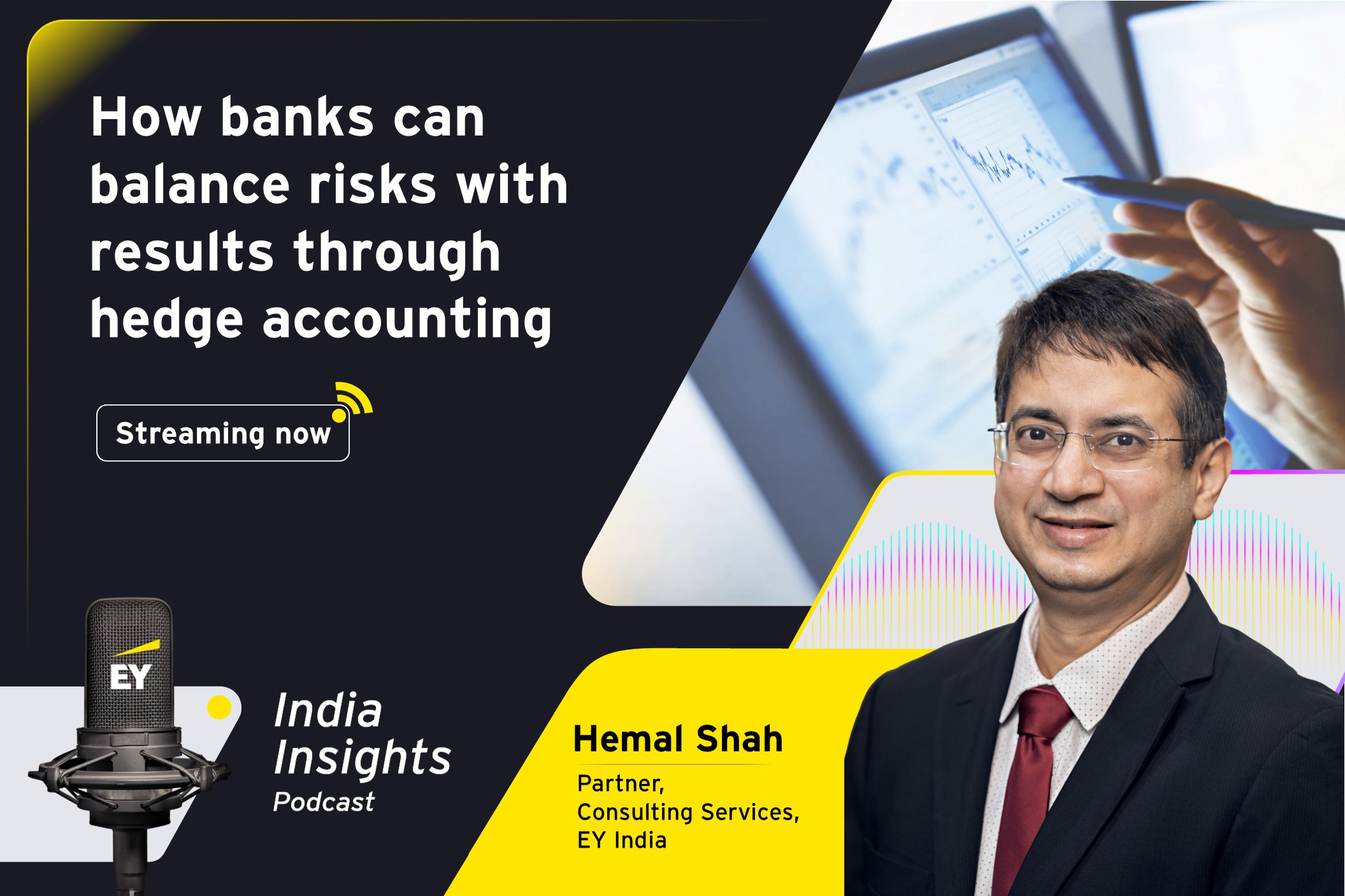
How banks can balance risks with results through hedge accounting
Listen to the EY India Insights podcast on hedge accounting, risk management and financial reporting, and how banks can navigate volatility effectively.
8m 40s
Hedge accounting in banks: Managing risk versus managing outcomes
Explore hedge accounting in Indian banks, covering key risks, gaps and governance frameworks that align with economic reality.
Decoding Ind AS 118 and the future of financial reporting
In this EY India Insights episode, we decode Ind AS 118, its impact on financial reporting, P&L, MPMs and why early preparation matters for businesses.
24m 17s
Ind AS 118: Changing the way the numbers speak
Ind AS 118 enhances financial reporting with clearer presentation, new profit subtotals and disclosures, improving transparency and investor insight.
Discover how banks and GCCs leverage data lineage beyond compliance, transforming it into a strategic enabler for governance, risk management, and decision-making.
How fintech companies can navigate accounting and reporting challenges
Explore key accounting practices for FinTech lending to ensure growth, compliance, and risk mitigation while leveraging automation for financial reporting.
Strategizing year-end closure for FY 2025 and beyond: A guide for financial services
Discover key strategies and regulatory updates for financial services to navigate FY 2025 year-end reporting, compliance, and governance effectively. Find out more.
Year-end considerations FY 2024-25: Navigating the evolving accounting landscape
Navigate key financial reporting changes for FY 2024-25. Explore accounting updates, regulatory shifts, and disclosure trends to enhance compliance and transparency.
How corporate governance in Indian start-ups help secure investor trust
Discover how corporate governance in Indian start-ups enhances transparency, builds investor trust & confidence, underpinning sustainable business growth.
How Alternative Investment Funds can transform its back-office for competitiveness and growth
Discover how AIFs need to leverage automation to leapfrog their growth journey in line with the macro-economic growth. Learn more about AIFs.
Year-end considerations for 2023: what organizations need to know
EY outlines the year-end accounting and financial reporting considerations for FY 23. Read more about the updates in financial reporting standards and accounting pronouncements disclosure 2023
Navigating the latest RBI guidelines on Interest Rate Risk in the Banking Book
EY highlights how important for banks to consider IRRBB, as not just a reporting metric but a strategic measure to manage balance sheets and profitability.
How banks and their GCCs can remediate regulatory reporting shortfalls?
Discover how banks manage regulatory reporting through their Global Capability Centres in India, enhancing compliance with the regulatory reporting framework.
Learn more about Companies Act compliance and corporate governance.
Meet our team
Direct to your inbox
Stay up to date with our Editor's Picks newsletter.