





EY refers to the global organization, and may refer to one or more, of the member firms of Ernst & Young Global Limited, each of which is a separate legal entity. Ernst & Young Global Limited, a UK company limited by guarantee, does not provide services to clients.
Recent Searches

The allocation of goodwill and intangible assets under Ind AS accounts for more than 60% of the total consideration.
In brief
- Ind AS 103: Business combinations influences how companies strategize and execute their acquisition plans.
- Purchase Price Allocation (PPA) affects a company’s future earnings while indicating the deal’s strategic rationale and value drivers to shareholders.
- PPA is significant for income tax purposes; treatment of different intangibles and goodwill varies and requires measurement at fair value.
Ind AS 103 accounting impacts the way companies plan and execute their acquisition strategies. It requires identifying key intangibles and estimating their relative contribution to overall deal value in business combinations in India. While comprehensive valuation guidelines exist and specialists are involved, the subjective nature of assumptions and workings necessitates independent benchmarking with other acquirers’ financial reporting for acquisitions.
The application of Ind AS 103 requires that assets or liabilities (including intangible assets and contingent liabilities that did not exist on the balance sheet of target entities or businesses) acquired in a transaction be measured at fair value, using appropriate intangible asset valuation methods. Any residual value thereafter gets allocated to goodwill or capital reserve. Purchase Price Allocation (PPA) not only affects the future earnings and balance sheet of a company but may also have tax implications. It also serves as an indicator of a deal’s strategic rationale and value drivers to shareholders. In the era of increased auditor and regulatory scrutiny, this matter warrants careful attention. Depending on the transaction structure, PPA in India could also hold significance due to various tax implications of business combinations, as tax treatment for different intangibles and goodwill may differ.
EY has undertaken a study of business combination accounting for transactions that were disclosed in annual reports of the top 500+ listed companies in India by market capitalization and more than 90+ private companies (covering over 750 transactions) since the implementation of Ind AS till 31 March 2025. This study provides sector-wise PPA benchmarks for Indian companies, acting as additional reference points for various stakeholders and serving as a broad guide while evaluating the possible impact of mergers and acquisitions accounting on amortization expenses and the overall impact of PPA on financial statements. It also presents the results of assets (primarily intangible assets) that are typically recognized and reported by a company during an acquisition. However, the results of this study cannot be viewed in isolation, since each deal would have specific nuances.
Key findings of PPA Study
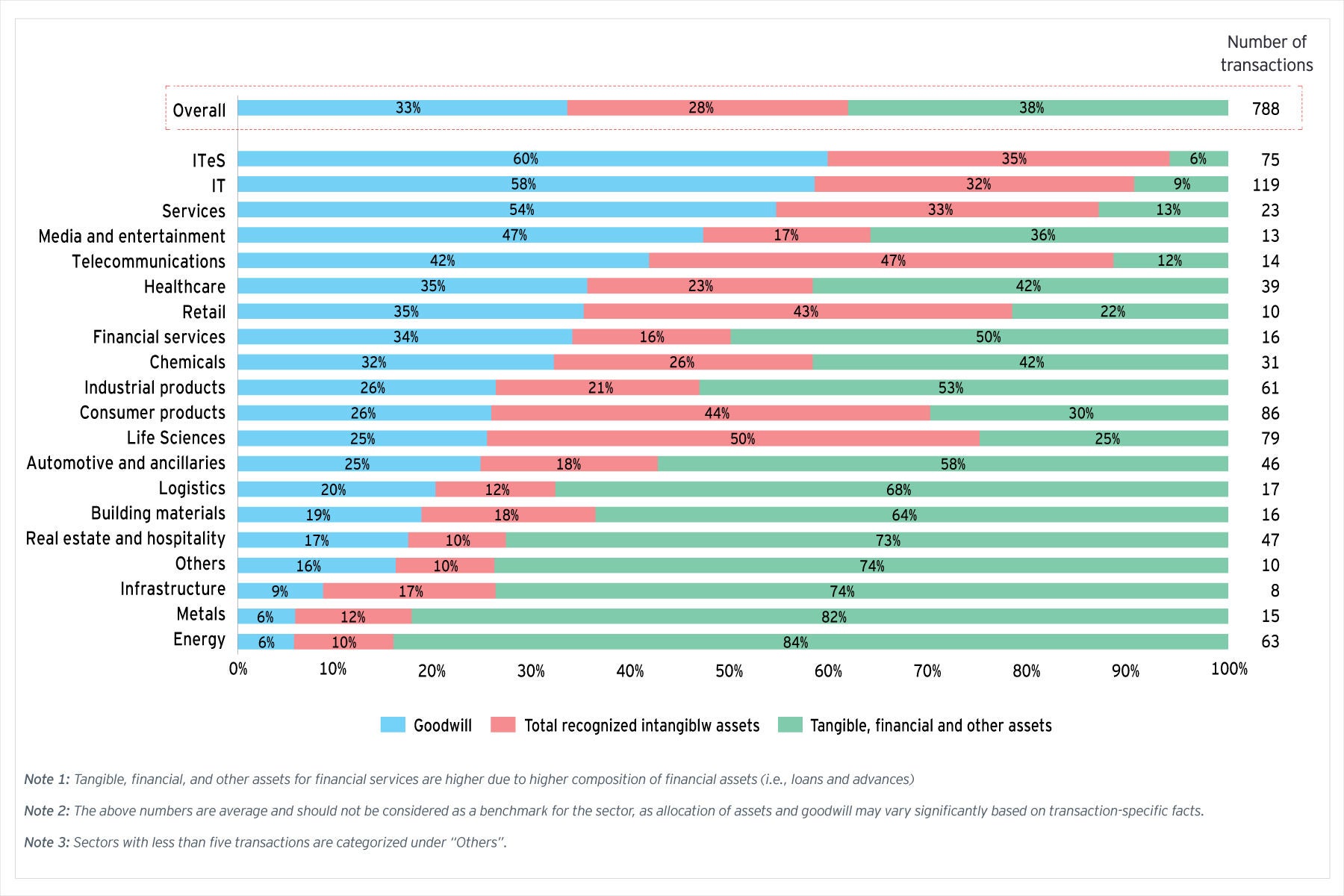
- Based on the study, 28% of the enterprise value of acquired companies was allocated to identified intangible assets and 33% was attributable to goodwill, with the allocation varying considerably from industry to industry. Goodwill allocation in India follows a similar pattern to that observed in global transactions, such as those in the US.
- In sectors such as telecommunications, life sciences, retail, consumer products and technology (IT/ITeS), a relatively higher proportion of deal value is allocated to intangible assets. This is reflected by the underlying products, brands, intellectual property, license and rights and customer relationships, etc.
- Capital-intensive sectors, such as real estate and hospitality, energy, metals, infrastructure and logistics, allocate more than two-thirds of the target’s enterprise value to tangible assets.
- Marketing-related intangibles were the key acquisition driver in the consumer products, life sciences, chemicals and retail sectors. Customer-related intangibles seem to be the acquisition driver in the IT/ITeS, services and telecommunications sectors.
The PPA study also revealed some interesting results as follows:
- Generally, a non-compete agreement is a part of most acquisitions as a safeguard to the buyer. However, the allocation of value to non-compete agreements is on the lower side possibly indicating either a shorter life or that the probability or impact of competition is perceived to be minimal.
- Depending on the transaction structure, PPA in India will also have relevance from an income tax perspective, as tax treatment for different intangibles and goodwill would be different and have to be measured at fair value applying appropriate valuation methods, with residual value allocated to goodwill or capital reserve.
- In the building materials and infrastructure sectors, value is largely driven by licenses and rights, including mining rights and reserves, long-term procurement arrangements, and rights to operate tollways and ports.
The sector-wise allocation trends of purchase consideration among goodwill, intangible assets and tangible assets are as follows:
Download the full pdf
Summary
Understanding the implications of Ind AS 103 is crucial for companies as it impacts balance sheets and taxation. It involves identifying key intangible assets and estimating their contribution to deal value during business combinations. Our study of top Indian companies reveals that 28% of enterprise value is allocated to intangible assets and 33% to goodwill. Allocation varies by industry, with sectors like life sciences, consumer products, services, IT, ITeS and telecom emphasizing intangibles. Real estate and energy sectors prioritize tangible assets. Marketing-related intangibles drive acquisitions in certain sectors. Non-compete agreements, though common, receive lower value allocation. PPA's relevance extends to tax treatment, requiring fair value assessment and allocation to goodwill.
How EY can help
-
Explore merchant banking services by a SEBI Registered Category I firm and IBBI Registered Valuer, supporting strategic planning, transactions, and business valuation.
Read more -
Our Corporate Finance consultants leverage deep financial and capital markets experience to help CFOs drive sustainable value. Learn more.
Read more -
Our EY-Parthenon strategy consultants can help your business achieve optimal long-term value. Learn more.
Read more
Related articles
EPR compliance: The new ESG test for Indian companies
EPR compliance is reshaping ESG in India non-compliance risks fines and lower valuations, while sustainability leaders gain a competitive edge.
Reimagining proxy advisory in India: An investor relations playbook
Explore India’s proxy advisory ecosystem, domestic & global players, and strategies for IR teams to align governance with investor expectations.
RBI gold loan guidelines 2025: Impact assessment and key changes
Read our full report on the significant changes in RBI's Gold Loan Guidelines for 2025 and their potential impact on the financial landscape in India.