




EY refers to the global organization, and may refer to one or more, of the member firms of Ernst & Young Global Limited, each of which is a separate legal entity. Ernst & Young Global Limited, a UK company limited by guarantee, does not provide services to clients.
Recent Searches

India’s strength lies in its domestic demand making it resilient to global uncertainties
In brief
- Due to US tariff related uncertainties, the economic and international trade alignment of major economies may go through a significant change.
- Among the five largest economies, India is favourably positioned with a sustainable government debt-to-GDP ratio, relatively young population, and high saving and investment rates.
- By 2038, with a projected size of constant 2021 PPP$ 34.2 trillion, India has the potential to surpass the US economy if current growth trends continue.
Comparing size of GDP: India’s role in world economy
An appropriate comparison of the relative size of the economies is in terms of constant purchasing power parity (PPP). Table 1 shows that in 2024, the size of US economy in real PPP terms is $25.7 trillion whereas that of India is $14.2 trillion. By 2030, this difference of $11.5 trillion is projected to narrow with the US and Indian economies growing to $28.9 and $20.7 trillion respectively.
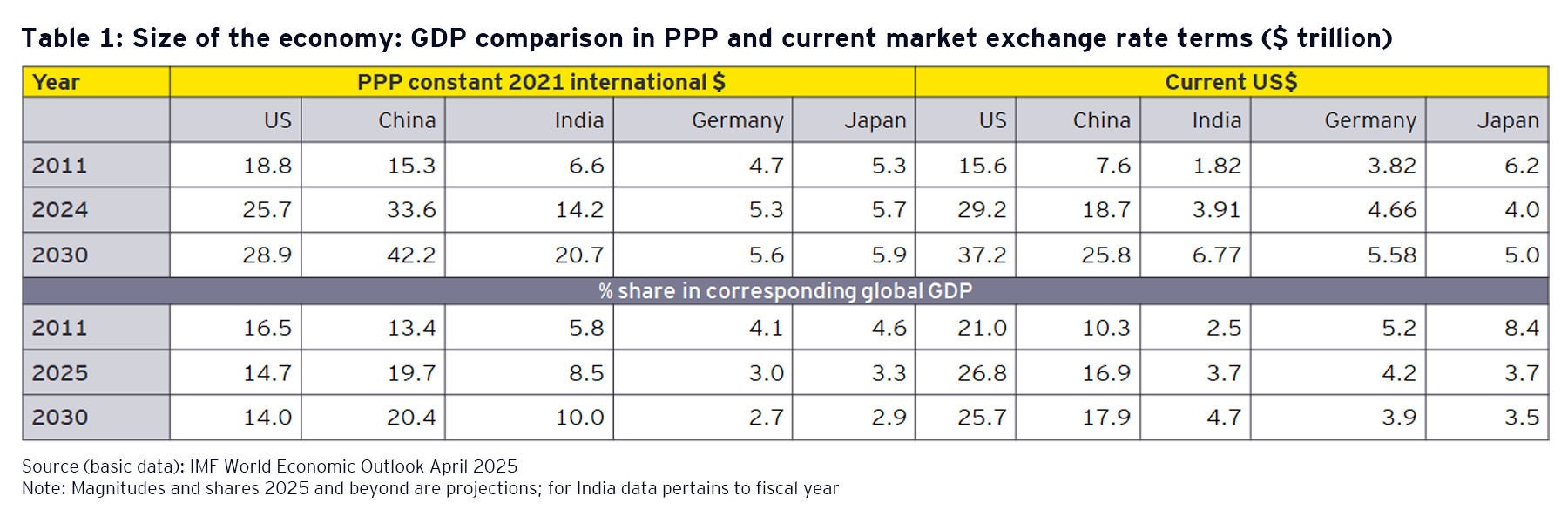
Considering the relative shares in 2025, using market exchange rate rates, the US accounts for nearly one-fourth of the world economy while in PPP terms, its share is 14.7%. As per the International Monetary Fund (IMF), India is projected to account for 10.0% of world output in PPP terms by FY31, only 4% points below that of the US.
In terms of growth, the Indian economy is the most dynamic, leading the world and all other major economies by a significant margin. India’s economic growth multiple with respect to the US, which was 2.3 in 2024, is projected to range between 3.1 and 3.6 in the medium term. Beyond 2030, if India and the US maintain their average forecasted1 growth rates over the period 2028 to 2030 at 6.5% and 2.1%, respectively, India may surpass the US economy in PPP terms in 2038 with a GDP size of $34.2 trillion. In market exchange rate terms, India is projected to become the third largest, overtaking Germany in 2028 (FY29). However, some downside risks arise from the recently announced higher US tariff rates affecting India and various other countries.
Impact of US tariffs on the Indian economy
The US tariff’s impact on India may depend, among other factors, on
- Share of exports in India’s real GDP (22.2% average over FY23 to FY25).
- Share of exports of goods to the US in India’s total exports of goods and services (10.2%).
- Share of India’s exports to US affected by the higher tariffs (approximately 40.1%).2
- The extent to which India is able to diversify these exports to other countries.
- The extent to which additional demand for these goods is created domestically.
We estimate that nearly 0.9% of India’s GDP may be affected by the US tariffs with the actual impact depending on the demand elasticity for Indian goods exported to the US. Assuming that about one-third of the impact results in a fall in demand, the overall impact is estimated at 0.3% of India’s GDP. This may be neutralized by a set of countermeasures, including reduction in India’s overall imports and increase in domestic demand for exported goods. With suitable policies, the US tariff impact could be reduced to about 0.1% of GDP, implying at best, a reduction of 10 basis points in India’s expected economic growth of 6.5% in FY26.
Relative importance of domestic demand
In terms of final expenditure comprising both private and government, all the four countries (excluding China for which data is not available) have a ratio of final consumption to nominal GDP of higher than 70%, with the US at 81.9% in 2022, followed by Japan at 77.2%, Germany at 73.0% and India at 71.7%.
India has the highest nominal investment rate as measured by gross capital formation (GCF) among the five largest economies, remaining above 30% except in FY21, the COVID year. The US has the lowest GCF to GDP ratio. With respect to the share of exports in GDP, the US has the least share followed by Japan. This ratio for India has varied between 18.7% and 23.3% in recent years, while for Germany it has ranged between 43.5% and 50.9%. Thus, Germany appears the most exposed among these five economies to global trade uncertainties while the US is relatively less dependent on exports. India’s position appears balanced in this respect.
Saving/investment rates and medium-term growth prospects
During the period under review, the US has had the lowest saving rate while China has maintained the highest saving rate (Table 2). India’s saving rate is the second highest, despite falling from a peak of 35.4% in FY12 to 32.6% in FY25. For the US and India, investment rates are higher than corresponding saving rates indicating the presence of current account deficit. For China, Germany and Japan, investment rates are lower than corresponding saving rates, indicating presence of current account surplus.
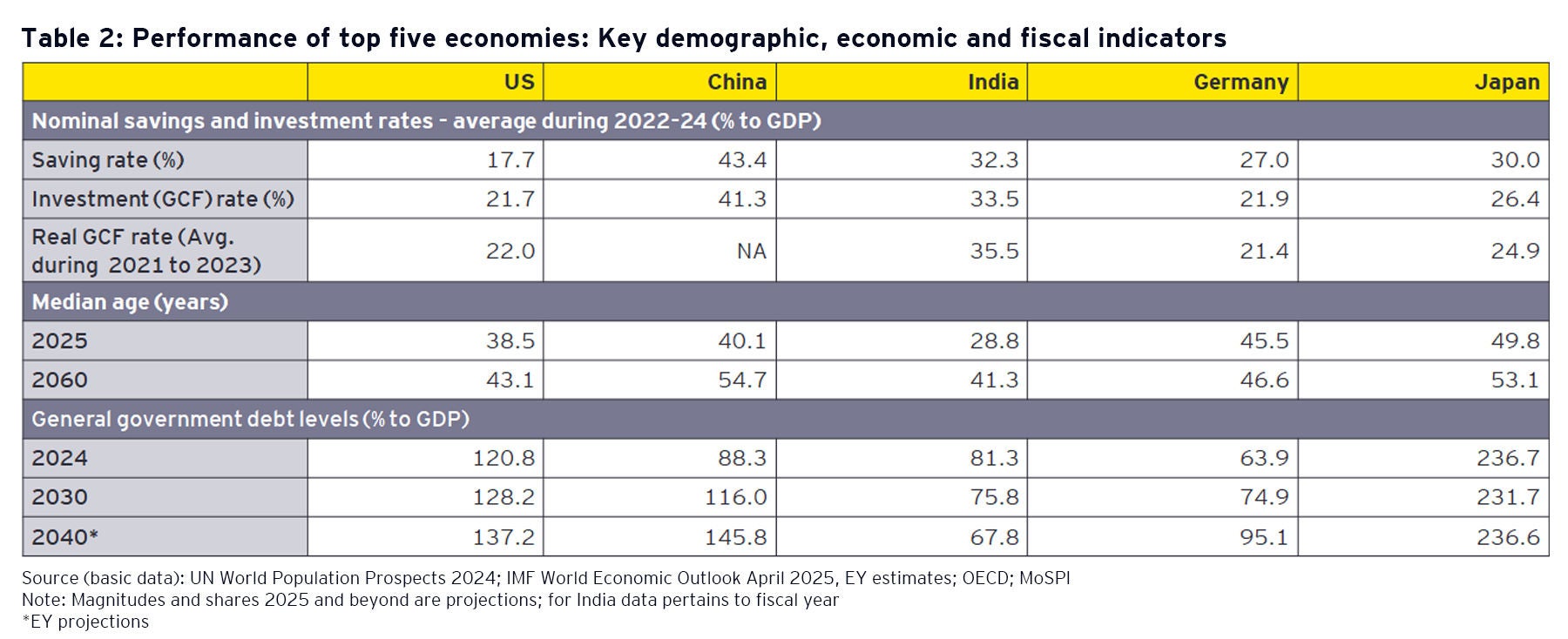
The implicit Incremental Capital Output ratios (ICORs)3, based on real investment rates, are nearly twice as high in the US and China as in India. In Japan and Germany, these are even higher, indicating that all four major economies other than India are highly capital intensive and may require much higher increases in investment rates to achieve a corresponding increase in their real GDP growth rates compared to India.
Dimensions of relative strength and vulnerability
Demographic prospects : Among the five largest economies, India is the youngest with a median age of 28.8 years in 2025 (Table 2). In comparison, the median age of other selected economies is higher with Japan touching nearly 50 years and projected to reach 53.1 years by 2060. India’s median age in 2060 would increase to 41.3 years.
Government indebtedness : India’s general government debt-to-GDP ratio is the lowest after Germany in 2024 (Table 2). In this year, it was 236.7% for Japan, followed by the US at 120.8% and China at 88.3%. Further, India is the only case where the IMF projects this ratio to fall significantly, from 81.3% in 2024 to 75.8% in 2030. In Germany, the US and China, however, it is projected to increase. Our projections show that basis certain assumptions4, by 2040, India’s position may improve further, while the debt outlook for the other four major economies may weaken.
It is notable that nearly 70% of US government debt for which data is available (U.S. Treasury Monthly Statement of the Public Debt July 2025) amounting to nearly US$30 trillion, is due for repayment by 2030. This may need to be refinanced at potentially higher interest rates if current trends persist, which could raise the effective cost of interest payments.
Relative position of reserve currencies
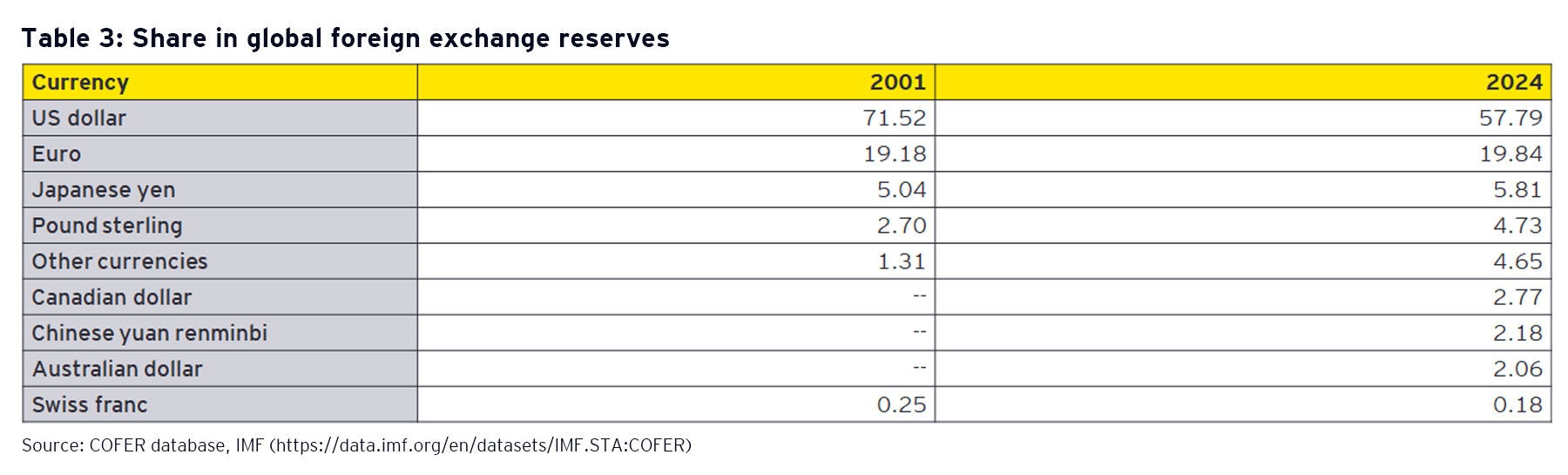
Table 3 shows that the share of US dollars in global foreign exchange reserves has fallen from 71.5% in 2001 to 57.8% in 2024, a fall of 13.7% points. Euro also has a high share of nearly 20%, which has been maintained over the last five years. The ongoing trend shows that the role of US dollars as a reserve currency has steadily fallen over time although it is still significant. The INR is not used as a reserve currency, and this may be influenced by both global trade dynamics and prevailing policy choices. However, this may evolve in the near future with intra-BRICS trade being promoted in local currencies, leading to a potential increase in demand for INR.
Pre-emptive claims on government: Interest payment and defence expenditure
The point at which interest payment on government debt exceeds defence spending, both relative to GDP, is often considered as a warning signal since it implies increased budgetary allocation towards committed interest payments, thereby crowding out strategic expenditures like defence. It is an indicator of fiscal vulnerability.
In the US, this point was reached in 2024. In India, the interest payment-to-GDP ratio on the combined account has remained above the defence spending to GDP ratio partly because of relatively high government borrowing rates and relatively low defence spending. However, most of government debt in India is domestic and the share of external debt low. In China, Germany and Japan, the effective interest rate is relatively low and defence spending higher. Thus, both the US and India may face fiscal pressures in this respect.
Download the full pdf
Summary
India’s comparative strengths lie in its high saving and investment rate trends, young and skilled population, near sustainable government debt and fiscal deficit, and increasing capabilities in modern technologies. Being dependent largely on domestic demand, India may remain resilient to global uncertainties, including tariff pressures, enabling it to become Viksit by 2047.
How EY can help
-
Watch provides an in-depth review of salient developments in India’s macro economy and economic policy in a global context.
Read more -
Tax policy advisory services by EY India offers insights & strategies to navigate complex tax regulations, driving business growth and compliance.
Read more -
EY offers integrated tax advisory and compliance services to optimize tax strategies, meet regulatory demands, and drive long-term business value.
Read more
Related articles
BRICS+ 2025 growth and trade promoting initiatives
BRICS+ drives global shift with rising trade, GDP share, and local currency payments—advancing multilateralism and sustainable growth across 19 nations.
Budgeting for defence expenditure
India's defence needs a 3% GDP benchmark to ensure modernisation, steady funding, and Aatmanirbhar growth amid fiscal constraints and global challenges.
Getting India future-ready: Role of rare earth elements
Rare earth elements are key to India's future. EY explores the role of rare earth metals, minerals & elements technology in mining industry to drive growth.