


EY refers to the global organization, and may refer to one or more, of the member firms of Ernst & Young Global Limited, each of which is a separate legal entity. Ernst & Young Global Limited, a UK company limited by guarantee, does not provide services to clients.
Recent Searches

On 27 October 2025, the Minister for Finance, Hon. Clyde Caruana (the ‘Minister’) delivered the Budget Speech for 2026.
Income Tax
Revision of tax bands
A major revision to the tax bands was announced. Parents with a child who is under the age of 18 years or is under the age of 23 years but who is receiving full time instruction in an educational establishment will benefit from revised tax bands. Two new tax brackets will be introduced - one for parents with one child who satisfy the above condition and another for parents with two or more children who satisfy the above condition. The revision to the tax bands will be introduced over a period of three consecutive years as from basis year 2026.
The new tax bands will be categorized into the following four categories:
1. Tax bands for married couples with one child satisfying the above condition;
2. Tax bands for a parent with one child satisfying the above condition;
3. Tax bands for married couples with two children or more satisfying the above condition; and
4. Tax bands for a parent with two children or more satisfying the above condition
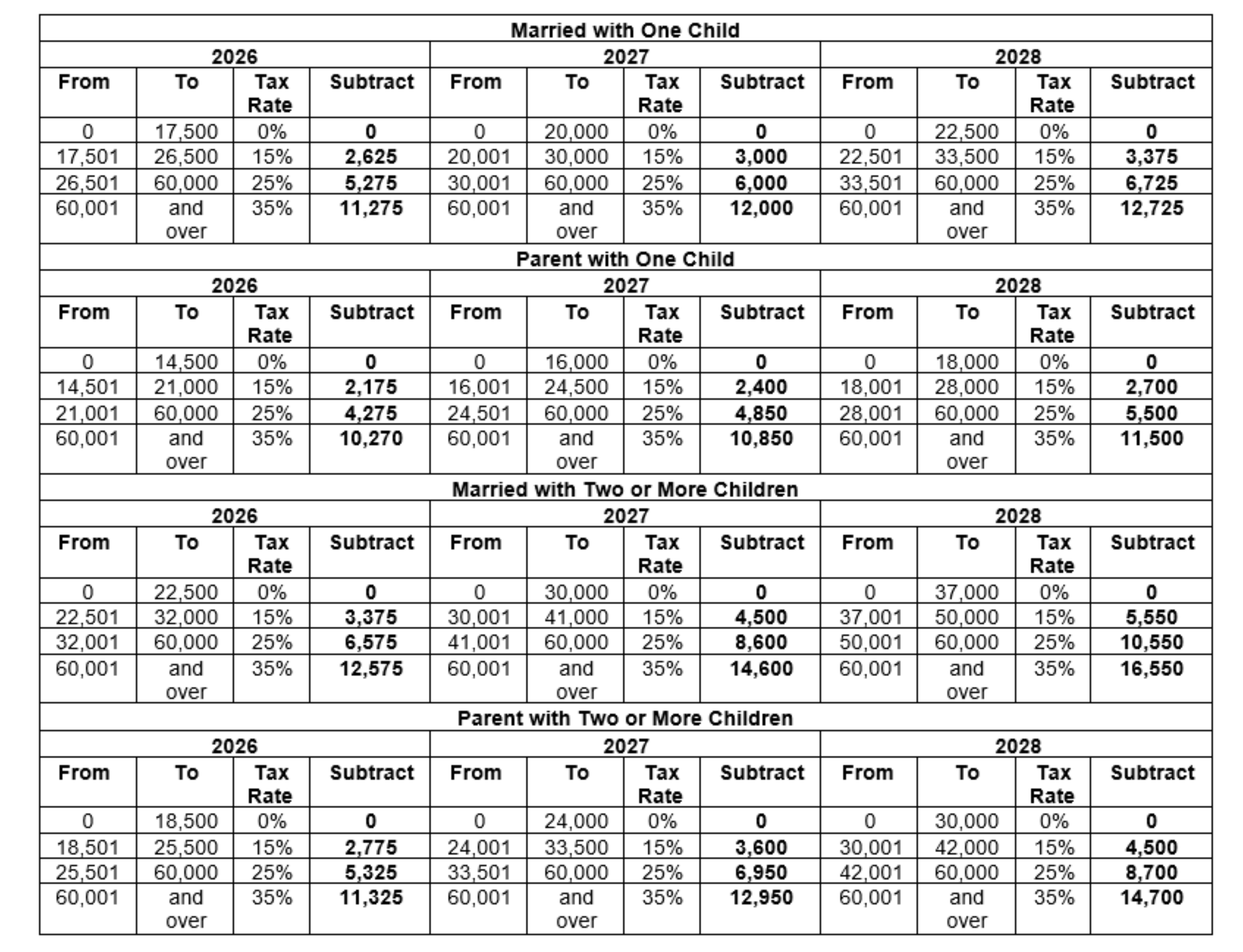
Tax bands for married couples could apply where there is only one of the parents working, or if the income derived by the other parent is minor. On the other hand, the tax bands for parents should apply where both parents work.
The current tax brackets for married couples who do not have any children satisfying the above condition will continue to apply.
Exemption on Pension Income
Recent budgets reduced taxation on pension income by exempting from tax a portion of such income.
In particular, Legal Notice 98 of 2022 (as amended by Legal Notices 220 of 2022, 48 of 2023 and 5 and 356 of 2024), exempted from tax a portion of the pension income derived by an individual who is at least 61 years and who remains active.
In 2025, the exempt portion amounted to 80% of the pension income. The Minister has confirmed that such exemption will apply on the equivalent of the maximum pension. Moreover, those pensioners whose income exceeds the equivalent of the maximum pension income, including working pensioners, will be exempt from income tax as of next year.
Similar to the previous 2 years, widow’s pension will remain exempt from income tax.
Increase in deduction for fees “in respect of residence in a private home for the elderly or the disabled, or at a respite centre for the disabled”
As from 2008, the Income Tax Act began to contemplate a deduction for fees paid in respect of private homes for the elderly and, as from 2013, extended to “private home[s] for the disabled”. The tax deduction is capped to the lower of the amount actually paid and the fixed amount. In 2008 and 2012 the fixed amount was revised. The Minister announced in this budget that the fixed amount will be revised once more from €2,500 to €4,500.
Tax benefit on research and innovation, artificial intelligence and digitalization.
The reduction in tax on investment related to artificial intelligence, digitalization, investment promoting modernization, automation and cybersecurity will be accelerated to 2 years.
In addition, a reduction in tax of 175% on the expenditure on eligible research and innovation will be granted in order to promote companies of every size to invest consistently in technology, know-how and innovation and improve their competitiveness both in the Maltese and global markets.
Scheme for additional capital investment
The “Micro Invest”, will be further strengthened by including within its scope investment in digital solutions while also increasing the tax credit to €65,000 up to a maximum of 65% of the eligible expenditure.
The 20% additional bonus on eligible expenditure for enterprises in Gozo will remain, while the total existing benefit for specific categories of enterprises will increase to a maximum of €85,000.
Tax credit for investments
Enterprises which invest in assets like machinery, tools, equipment, IT software, electronic hardware and cybersecurity systems will benefit from a tax credit equivalent to 60% of the investment value spread over four years.
Duty on Documents and Transfers
Permanent extension of First Time Buyers’ Scheme
The First Time Buyers’ Scheme, contemplated in rule 3 of the Exemption of Duty in Terms of Article 23 Order, (S.L. 364.12) will be extended to apply permanently going forward. This scheme provides for an exemption on duty which would otherwise have been charged on the first €200,000 transfer value upon the inter vivos acquisition of the first residential immovable property. Additionally, this scheme has been extended for individuals who have previously acquired property for non-residential purposes and who will be acquiring their first residential property.
The Minister also declared that the €10,000 grant, payable to First Time Buyers over a period of 10 years, will continue to be granted in 2026.
Extension of the reduced rate of duty on causa mortis property acquisitions
The reduced duty rate of 3.5% on the causa mortis acquisition of a dwelling house, previously occupied by the transferee causa mortis as his ordinary residence, contemplated under sub-Article 35(2)(i) and (ii) of the Duty on Document and Transfers Act, (Cap. 364), will be extended to apply to the first €400,000.
Extension of the beneficial rate on duty on documents and transfers of Family Businesses
The Minister announced that the beneficial rate of duty of 1.5% on donations inter vivos of family businesses to descendants and family members will be extended. This beneficial regime was originally introduced in 2017 via the Duty on Donations of Marketable Securities and Immovable Property used for Business (Exemption) Order, (S.L. 364.15) and has since been extended on a yearly basis.
Other Measures
Increase in Children’s Allowance
Since parents will benefit from a reduction in tax, the increase in children’s allowance will be given to those parents who pay less tax. Indeed, parents whose income amounts to less than €30,000 will be eligible to an increase in children’s allowance of €250 for each child.
Bonus for Birth of a Child
An increase of €500 bonus for the birth of each child (including adopted children) which will result in €1,000 for the first child, €1,500 for the second child and €2,000 for the third and more children.
Adoption Grant
The grant for adoptions has been increased from a maximum of €10,000 to €12,000. For local adoptions reimbursements will increase from €1,000 to €2,000 out of which €500 will be given as a grant.
Fostering Allowance
A weekly increase of €10 in Fostering Allowance has been announced.
Energy Benefit
Eligibility to Energy Benefit will now be amended such that the income limit will be increased by €2,500 per couple.
Payment of arrears of Social Security Contributions
Employed and self-employed individuals will be given the right to settle arrears in social security contributions to improve their entitlement and retirement benefits.
Subject to exceptions, this option will apply to persons aged between 59 and 64 who are still working. Self-employed individuals who defaulted in paying their contributions during the COVID pandemic will be given the option to regularise their position.
Extension of the National Insurance (NI) credits for raising young children
Presently, subject to certain conditions, parents who leave their employment to raise their children are granted a credit for NI contributions until their child reaches the age of 6 years or, in the case of a child with a disability or rare illness, until the child reaches the age of 10 years.
As from next year, the credit will be extended until the child reaches the age of 10 years for the first 3 children per family. In case of families with more than 3 children, the maximum age is increased by 1 year for each child. There shall be no age capping where a family has at least 1 child with a disability or rare illness.
Neonatal care and maternity, paternity and parental leave
The Minister announced he will initiate discussions with social partners so that, subject to mutual agreement, Maternity and Paternity Leave increase and Parental Leave is improved. The government expressed his willingness to reach an agreement on the introduction of additional leave to prospective parents.
In the meantime, Neonatal Care Leave will be introduced for employees who have children who require intensive or additional care immediately after birth. The government will be covering the cost of this leave.
Presently, employees have a right for 8 weeks of paid parental leave in case of birth as well as adoption, fostering or legal custody of a child. Such leave may be claimed until the child reaches the age of 8 years. As of next year, this benefit will be extended to self-employed parents under the same conditions.
As of next year, Bereavement Leave and Miscarriage Leave will also be extended to self-employed individuals.
Other Developments
Besides the measures addressed by the Minister above, other notable developments are the following:
OECD updates Malta’s Country Transfer Pricing (‘TP’) profile
In October, the OECD updated Malta’s Country TP profile. The update is quite comprehensive, covering 47 questions discussing the above and more. Overall, this update is a thorough snapshot of the Malta Transfer Pricing Framework encompassing the Transfer Pricing Rules of Malta and the Guidelines in relation to the said Rules.
OECD country profiles typically focus on the domestic transfer pricing legislation of a country including but not limited to the arm’s length principle, the transfer pricing methods, comparability requirements, local documentation requirements, proactive as well as reactive dispute resolution techniques, jurisdictional safe harbors, the definition of Associated Enterprises etc.
European Commission Work Programme 2026
On 21 October 2025 the European Commission published its work programme entitled “Europe’s Independence Moment”. The Programme announces the European Commission has confirmed that it will present two new initiatives in the area of direct taxation:
1. The “28th company regime”, with the purpose of addressing the absence of non-harmonized tax measures across the EU and which, as a result, prevent innovative firms from setting up, expanding and thriving across the EU. The new initiative shall be presented by the first quarter of 2026; and
The “omnibus on taxation”, which shall be presented by the second quarter of 2026. This initiative also aims to reduce the administrative burden inherent to the non-harmonization and complexity of different tax rules and legislation faced by groups operating or established in the EU.
The European Commission has announced that it will maintain and proceed with the:
1. BEFIT proposal (formally Council Directive on Business in Europe: Framework for Income Taxation (BEFIT));
The BEFIT proposal aims to introduce harmonised rules on the computation of the tax base of groups of companies, with the scope of reducing business’ current tax compliance costs. If the proposal is adopted by the Council, Member States will have to implement the BEFIT into their national laws by 1 January 2028 and the new rules will apply from 1 July 2028.
2. The HOT proposal establishing a Head Office Tax system for micro, small and medium sized enterprises;
Under this proposal, SMEs which operate through permanent establishments across various EU Member States will have the option to file a tax return only in the state of the head office and shall have the option to interact only with one administration – that of the head office. Thereafter, that tax administration shall exchange with the states in which the permanent establishment(s) are situated and transfer any tax revenues attributable to those states in relation to the activity carried out by the permanent establishment(s) therein.
3. The common system of a digital services tax on revenues resulting from the provision of certain digital services, and
4. Rules relating to the corporate taxation of a significant digital presence.
Lastly, the following proposals are set to be withdrawn:
1. The Unshell Directive (formally known as Council Directive laying down rules to prevent the misuse of shell entities for tax purposes and amending Directive 2011/16/EU);
2. The DEBRA Directive (formally Council Directive on laying down rules on a debt-equity bias reduction allowance and on limiting the deductibility of interest for corporate income tax purposes); and
3. The Council Directive on Transfer Pricing.
Introduction of Senior Employees of Family Offices, Back Offices and Treasury Management Operations Tax Rules
On 17 October 2025, through Legal Notice 250 of 2025, a special tax regime for senior employees working in family offices, back offices and treasury management operations was introduced.
These rules are deemed effective as from 1 January 2025 and apply from year of assessment 2026. Qualifying senior employees in eligible offices may benefit from a reduced tax rate of 15% on income from qualifying contracts of employment received in respect of work or duties carried out in Malta. The individual’s annual emoluments must be a minimum of €65,000, adjusted by €10,000 every five years.
Eligibility criteria include:
- The individual’s first employment in Malta must be in an eligible office;
- The individual must not have derived similar income before 1st January 2025;
- The individual is protected as an employee under Maltese law;
- The individual is in possession of the relevant professional qualifications;
- The individual must not be domiciled in Malta, have stable resources, suitable accommodation, valid travel documents and private medical insurance.
Eligible offices include:
- Head of the Back Office, Chief Executive Officer, General Manager, Country Head, Managing Director or equivalent designation;
- Chief and, or Head Risk Officer;
- Chief and, or Head Compliance and Anti-Money Laundering Officer;
- Chief and, or Head Risk Officer, including Fraud and Investigations Officer;
- Portfolio Manager;
- Chief and, or Head Investment Officer;
- Senior Trader;
- Senior Structuring Professional
New Avenues for Taxpayer Protection
On 14 October 2025, Legal Notice 238 of 2025 amended the Court Practice and Procedure and Good Order Rules (S.L. 12.09) to include references to the Charter of Fundamental Rights of the European Union. The L.N. 238 amendments articulate a new procedure for judicial review that may, inter alia, be used by taxpayers who feel aggrieved by tax measures falling within the purview of the Charter (including especially VAT measures and direct tax directives implementing Union law).
For further information kindly contact:
Dr. Robert Attard, Partner
robert.attard@mt.ey.com
Bernard Bonnici, Director
bernard.bonnici@mt.ey.com
James Bonavia, Director
james.bonavia@mt.ey.com
Saviour Bezzina, Senior Manager
saviour.bezzina@mt.ey.com
Mit Gaglani, Senior Manager
mit.gaglani@mt.ey.com
Keith Caruana, Senior Manager
keith.caruana1@mt.ey.com
Martina Gerada, Manager
martina.gerada@mt.ey.com
Rachel Zampa, Senior
rachel.zampa@mt.ey.com
Soham Kulkarni, Senior
soham.kulkarni@mt.ey.com