






AI-powered GCCs

How AI is redefining GCC roles, mandates, workforce and value

AI is redefining enterprise value creation, pushing GCCs toward innovation, intelligence and growth-oriented mandates.


In brief

  • More than four in five GCCs are investing in GenAI, while over half are adopting Agentic AI to scale enterprise-wide transformation.
  • GCCs that successfully redeploy AI-enabled capacity can unlock new growth opportunities, innovation mandates and business value.
  • India's broad GCC talent base positions it to lead the next wave of AI-driven enterprise transformation and GCC 2.0.

India's Global Capability Centers (GCCs) have evolved from offshore cost-savers into global engines of innovation. Today, AI in GCCs is accelerating this shift, transforming how work is delivered, how talent is deployed, and how enterprise value is created across the Indian GCC ecosystem. Once valued primarily for scale and cost efficiency, these centers now support technology, operations, finance, analytics, product, risk and business functions for global enterprises. AI is driving the next phase of GCC evolution, changing how work is executed, teams are structured, and value is created. GenAI and Agentic AI are automating process-driven activities such as testing, documentation, reporting and operational coordination. Work requiring critical thinking, domain expertise and decision-making is becoming more valuable.

The traditional GCC operating model was optimized around managing work efficiently. AI is driving a broader GCC operating model transformation with AI, shifting the focus from work execution to work design. GCCs need to redesign work rather than add AI tools to existing processes. Enterprises must decide which activities agents perform, which decisions people retain and where human oversight remains necessary for quality, risk and context.

The defining shift between contraction and expansion

AI will create contractions by reducing effort in current processes. It will create expansion through new mandates in workflow design, reusable assets, adoption playbooks, data platforms, controls and enterprise change. Managing the transition requires GCCs to redirect the capacity released from existing work into these growing areas.

Expansion means using AI to lower the cost to serve and create new avenues for enterprise growth. GCCs can help companies enter new markets and reach customer segments that were previously too costly to serve. They can also build AI-enabled products and platforms, such as a digital wealth manager that makes wealth services accessible to almost anyone at a viable cost. Next-gen fraud and customer analytics can support this growth by improving customer insights and identifying and preventing risks arising from new markets and segments.

When released capacity moves into these growth opportunities, expansion can outweigh contraction. This positive outlook can be expressed through a simple equation. GCCs that manage this transition well can evolve into global intelligence centers, leading AI-led business transformation.

5x compression × 10x expansion = 2x opportunity

How GCCs are responding to the shift

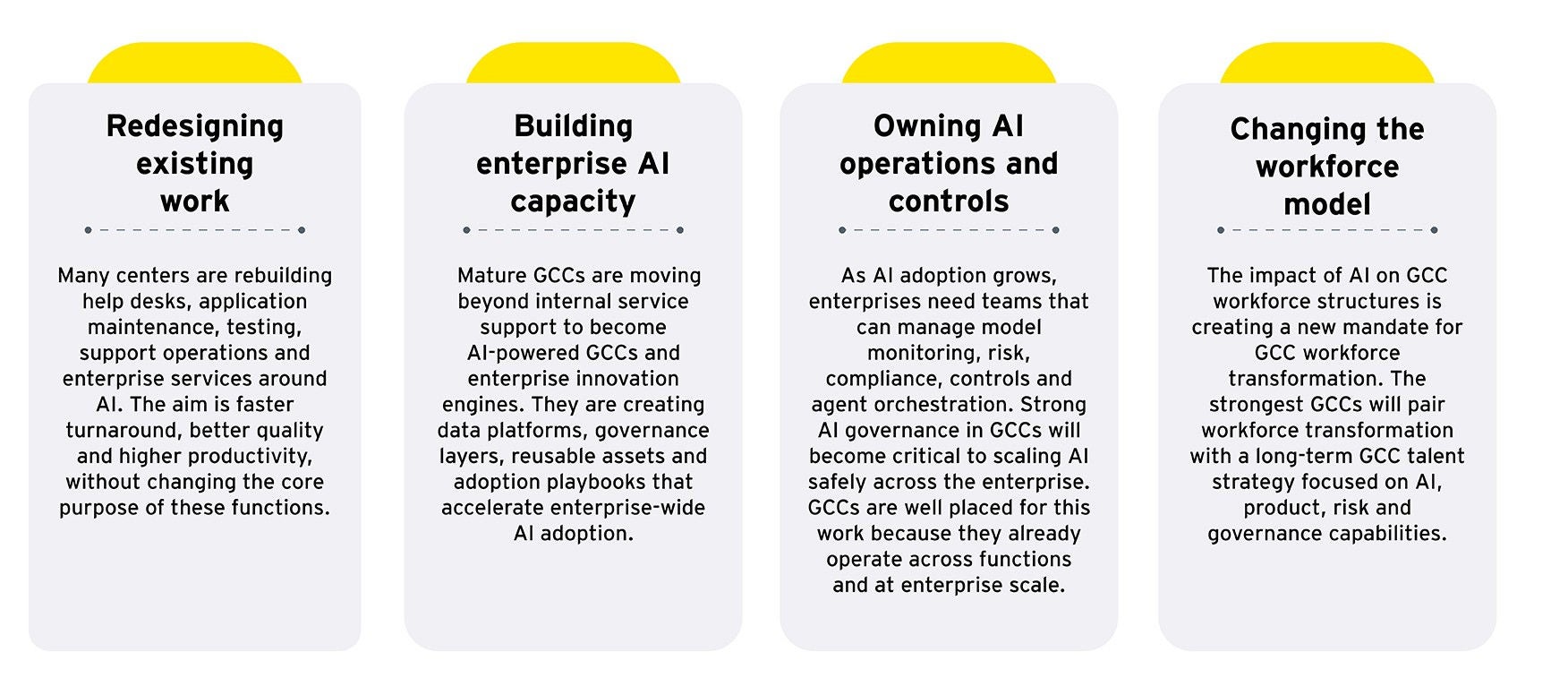
GCCs are moving from AI pilots to enterprise-wide adoption as GenAI and Agentic AI become central to transformation efforts. More than four out of five are investing in GenAI, more than half in Agentic AI and around two-third are creating idea-sharing platforms and dedicated innovation teams1. As adoption matures, GCCs are evolving from AI-enabled delivery centers into AI-native capability hubs. This transition requires four important actions:

How GCCs are responding to the shift

EY GCC Leadership Dialogues

Join Arindam Sen, EY India Partner and GCC Sector Lead, in a video series with top leaders on global capability centres highlighting growth and future trends.

Know more

Why each GCC will follow a different AI path

Not every GCC will experience AI in the same way. The outcome will depend on its mandate, operating-model maturity and ability to redirect released capacity.
 

Technology-led GCCs can use AI to deliver faster, address technical debt and support more products and change programs. Higher productivity may increase demand for engineering, data, platform and product talent. Operations-heavy GCCs may follow a different path. Structured and repeatable processes are easier to automate, which may lead to smaller teams. Their workforce may become more specialized, with a stronger focus on controls, process redesign, risk, service quality and technology-enabled operations. The impact will vary across geographies. Markets such as the Philippines are more heavily weighted towards customer service and transaction processing and may face greater workforce contraction. 
 

Global Capability Centers in India have a distinct advantage through a full-stack Indian GCC ecosystem spanning technology, product engineering, analytics, operations, finance, risk and support functions. Its talent base includes software engineers, data specialists, product teams, cybersecurity professionals and AI practitioners. This breadth allows enterprises to absorb effort reduction in one function and build capacity across AI products, governance, data platforms and enterprise change in another. 
 

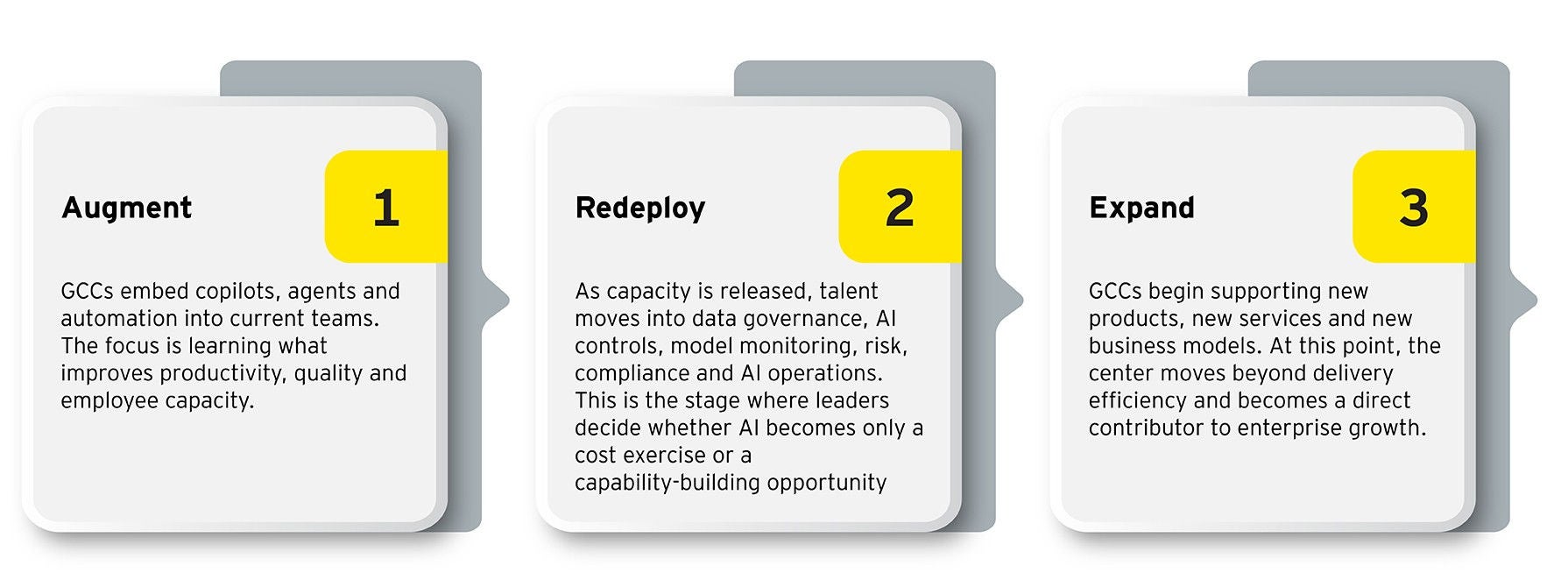
These differences will shape the pace and scale of change, but every GCC will need a clear path for moving from productivity gains to new work. The shift will not happen in one step. Most GCCs will move through three horizons.

AI transformation pathways for Global Capability Centers (GCCs)

What leaders must do next

 For GCC leaders, the next phase requires clear choices on workforce capabilities, ways of working and organizational change.

  • Skillset: Build AI literacy, data-led decision-making, agent orchestration, automation and digital product skills. These capabilities will help GCCs capture productivity gains and redeploy capacity into higher-value work.
  • Mindset: Encourage teams to question existing processes, automate repetitive work and redesign workflows. A shift from work execution to work design will help GCCs own the expansion agenda and create new offerings.
  • Change management: Prepare employees for changing roles through continuous learning, experimentation and clear career paths. Leaders should build AI readiness, governance, risk management and operational controls, then redirect released capacity for data governance, model monitoring, risk and AI operations.

Summary

GCC 2.0 represents the next chapter in GCC transformation. The future of GCCs will be defined not only by the work they execute, but by the intelligence they create, the transformation they lead and the business growth they enable.

Learn more about how AI is transforming GCCs and creating new growth opportunities


Related articles

How Coimbatore can build its path to 200 GCCs by 2032

Discover how Coimbatore can grow from 75 to 200 GCCs by 2032, leveraging engineering talent, innovation and a strategic growth roadmap.

EY named Market Leader in HFS Horizons GCC Services, 2026 report

EY was named a Horizon 3 Market Leader in the HFS GCC Services, 2026 report for delivering AI-enabled GCC transformation at scale.

How GCCs are powering AI-native customer service

Discover how Agentic AI and India’s GCCs are transforming customer service through AI-native CX CoEs, driving efficiency, retention and growth.


About this article